On a cold April evening in 1812, thousands of Britain’s notorious Redcoats crept toward the fortress of Badajoz in silence. Their objective: to scale three breaches hacked into the city’s defenses by enormous siege cannon, and to wrestle one of Napoleon’s key strongholds from French hands. What followed would go down in history as one of the bloodiest episodes of the Peninsular War—a short, ferocious fight where men fell by the hundred, only to be replaced by a new horror as brutal retribution was unleashed.
Within just a few hours, the fight was over. But the storming of Badajoz would be remembered not only for its carnage but for the savagery that followed. Using the words of those who survived that hellish night, we recreate the event that history remembers as the storming of Badajoz.
By April 1812, the Iberian Peninsula had been locked in a brutal conflict for four years. Forces led by Napoleon’s marshals were pitted against an alliance of Spanish, Portuguese, and British troops, at the cost of hundreds of thousands of lives. With Portugal liberated, Arthur Wellesley—the future Duke of Wellington—was finally ready to strike and drive the French from occupied Spain.
To advance into the country, liberate Madrid, and force the French back across the Pyrenees, Wellesley had to hold two key roads—the keys to Spain. The first, running north from the Portuguese border to Salamanca, was barred by the fortress town of Ciudad Rodrigo. The second, some 80 miles to the south, ran directly to Madrid and was guarded by the even more formidable fortified city of Badajoz.
Despite knowing exactly what Wellesley must do, the French were caught off guard when, on January 7th, in bitter winter storms, Anglo-Portuguese troops appeared over the hills to surround Ciudad Rodrigo. Twelve days of siege followed, and on January 19th, a short but extremely bloody assault was launched at two main breaches under cover of darkness. Within hours, the French garrison was defeated, and the town was in Allied hands.
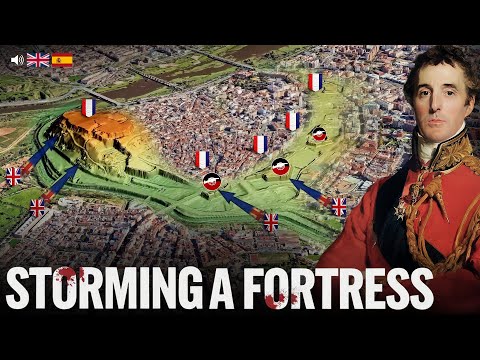
With Ciudad Rodrigo taken, the coalition’s attention turned south to the fastness at Badajoz. A look at the battlefield today gives us some idea of the task facing Wellesley and his men. Badajoz was extremely well defended: the broad Guadiana River protected the northern approaches, the smaller Rivillas tributary guarded the east, and the fortress itself had robust walls studded with eight bastions covering all sides.
Using modern LIDAR technology, we can peel back the layers of history to better understand the ground these men fought over. Starting in the northeast corner, we find the city’s castle, the oldest part of the defenses, perched upon a natural rocky outcrop. At the foot of those slopes, the Rivillas stream flows northwards to the Guadiana. The French defenders had dammed the Rivillas, flooding the area beyond the city’s southeastern walls and making an assault there extremely difficult.
On the northern bank lies Fort San Cristóbal, a substantial work guarding the single ancient bridge crossing the river. Continuing around the fortress, the San Vicente Bastion comes into view in the northwest corner. Returning towards our starting point, the southern bastions of Santa María and Trinidad appear—it was in these locations that the most bitter fighting would take place.
Outside the main defenses, the outworks—Fort Pardaleras, the Picurina, and the San Roque lunette—served to deny prominent high ground from which breaching batteries could assault the main town walls. In short, for Badajoz to fall, the outworks must first be carried.
If all went to plan and the coalition could overcome those defenses, the task was still not over. The old town was a tightly knit maze of streets and alleys, and the assailants would need to battle through these if they were to take the city. This was the nut the coalition would have to crack to succeed in Spain.
In command of the French garrison was Major General Armand Philippon, a seasoned soldier regarded as one of the most formidable fortress commanders in Europe. At his side was Colonel Lamare, his engineering chief, responsible for shoring up the defenses. Nearby, Marshal Soult and Marshal Marmont each had an army in the field, though their inability to reach Badajoz in time to break the siege would be a decisive feature of the battle.
Wellesley, then Earl of Wellington, headed the British and Portuguese troops. The Battle of Waterloo was still three years away, but he was already a famed commander and one of the British Army’s key assets in the Peninsula. Wellesley had seven divisions with him at Badajoz, three of which would make the broad ring facing outwards to protect against Marmont or Soult’s attempts to raise the siege. That left four divisions—approximately 12,000 men—to conduct the siege proper.
The main assault would come from the Fourth and Light Divisions, led by Sir Charles Colville and Lieutenant General Charles Alten respectively. Subsidiary attacks—diversionary and not designed to breach the walls—would come from General Picton’s Third and Leith’s Fifth Divisions.
But what about the men doing the fighting? Let’s meet a few. Private William Brown of the 45th (1st Nottinghamshire) Regiment of Foot served in Picton’s fighting Third Division and would be in the thick of the action around the castle. Close by was Sergeant Joseph Donaldson, a Glaswegian who ran away to sea in search of adventure and fortune but eventually found himself serving with the 94th Foot in the Peninsula. And then there was Bugler Bill Green from Lutterworth in Leicestershire. Green had been in the army since 1805 and had served throughout the Peninsular Campaign. He was with Alten’s Light Division at Badajoz and would be amongst the troops assaulting the main breaches.
All three men came from very different backgrounds, but each leaves us with a fascinating primary source in the form of their own accounts of the battle. We’ll be hearing from all three as the action unfolds.
Siege warfare was no new development at Badajoz. This would be the third time the city had been put under siege in a little over a year. Marshal Soult successfully took the town from the Spanish in March 1811, and Philippon held it in the face of British and Portuguese forces between April and June. This time, Wellesley hoped things would be different. He would take personal charge of the attack.
By March 16th, his force—and crucially his heavy artillery—had arrived, crossing the Guadiana to begin the siege. Turning once again to a historic map overlaid on the modern satellite image, we can understand the progression of events. The first parallels, or trenches, were installed to the southeast following the line of the old French works. Along these parallels, the first breaching batteries were installed—heavy guns used to smash great gaps in the walls of the Picurina fort. But the main assault force would attack from the south, just as Soult had done successfully the year before.
As they made their preparations, the weather, which had been largely fine, took a turn for the worst, deluging troops with rain. But the weather wasn’t the only issue facing the attackers. On March 19th, showing considerable spirit, French forces sallied out with 1,500 infantry and 40 cavalry, charging the troops constructing the siege works beyond the Badajoz walls. The coalition lost 150 men and a large quantity of crucial siege stores such as spades and picks before the attack was forced back.
If this was a setback for Wellesley, it was only a temporary one, as just six days later Picton’s troops were to assault the Picurina. In a short but bloody affair, the fort was carried by an assault across this very ground. Today, only a small remnant of the imposing fort can be seen nestled in a peaceful park in the suburbs of Badajoz.
So with the Picurina taken, the coalition could finally bring the full force of their artillery down on the city walls. Again, the historic map overlay provides unique insight. We see that once the Picurina fell, batteries Mark J and Y could be installed and, from March 31st, used to methodically chip away at the defenses. Eventually, it would be these artillery pieces that punched the main breaches into the Trinidad and Santa María bastions.
It should be noted that these breaches were not simple holes in the city walls. They were effectively steep rubble slopes—in this case some 30 feet in height—which attacking infantry would need to traverse to gain access to the town. A little further along the same parallel, four smaller batteries laid down harassing fire on the eastern face of the Trinidad, the San Roque Bastion, and right here at the castle, smashing French defenses, dismounting guns, and causing widespread casualties.
By April 6th, three significant breaches had been blasted into the walls: here at the Santa María, in this space facing the Trinidad, and a third last-minute breach between the two bastions. These would be the targets for the Fourth and Light Divisions.
Colonel Lamare described the chaos among the French positions at Badajoz and the desperate attempts to plug those gaps: “Death was dealt every direction amongst us; the ramparts were crumbling to pieces, the breaches becoming practicable, and the efforts which our workmen made nightly to clear them were ineffectual. In this state of things a council of defense was assembled to make the last arrangements.”
But what sorts of preparations were being made by the defenders? Firstly, a series of ditches and earth ramparts were dug along the base of the main wall, which the assault parties would use to navigate their way to the breaches. One of those ditches was flooded with water from the Rivillas to increase the difficulty of an advance, while another had been mined with barrels of gunpowder and flammable material.
Perhaps even more horrifying was what waited in the breaches themselves. Lamare and his men had largely cleared the rubble from the bombardment, giving them a clear line of sight on their assailants. Within those cleared avenues lay planks of wood studded with metal spikes, ready to tear the flesh of the assailants. When the attack commenced, the defenders would block the breaches with chevaux-de-frise—hundreds of sword blades studded into a central wooden beam, completely blocking each breach at its summit. These were traditionally anti-cavalry devices, but they would be grimly effective against Wellesley’s infantry too.
To top off the defenses, the largest of the breaches was also covered by a battery of French artillery pieces dug in here in an enfilade position and loaded with canister shot. This battery would open up at point-blank range when the assault began, showering the attackers with barrel after barrel of musket balls. Around one quarter of the French manpower at Badajoz—more than a thousand men—was also stationed at the southwest corner of the city, each with multiple preloaded muskets ready to add their own fire to the storm of shot and shell.
Wellesley might have felt he had the upper hand, but Philippon, Lamare, and their men were certainly not going down without a fight. At 7:30 p.m. on April 6th, the siege guns fell silent, their work complete. Now the defenders would see just how effective their preparations had been. The attack was coming.
Bugler Green fell wounded early, yet lived to describe the ditch where “ten or twelve men were blown in every direction” as shells rolled down from the walls. Time and again the Fourth and Light Divisions surged forward, only to be drowned in blood or skewered on blades. Wellington watched his finest soldiers cut down in scores, and still the breaches held.
Then came the turning point: Leith’s Fifth Division, never meant to enter the town, scaled the San Vicente Bastion around midnight. With bugle calls sounding in their rear, the French defenders of the breaches broke. The shattered survivors of the main assault finally summited the deserted slopes—and the killing was done.
What followed was horror of another kind. Drunken Redcoats ran through the streets in an orgy of plunder and cruelty that lasted two full days. Wellington wept at the sight of the breaches, where more than 3,700 of his men had fallen in the storming alone. Today a peaceful park marks the resting place of over a thousand Redcoats buried where they fell.
Was the storming of Badajoz a necessary sacrifice—or a victory that cost far too much?
Report this article
Select a reason for reporting:






