In 1817, DeWitt Clinton stood at the edge of a swamp in Rome, New York, and drove a shovel into the dirt. The crowd that gathered to watch probably didn’t cheer. They had come to witness a fool’s errand—a ditch 363 miles long, 40 feet wide, and 4 feet deep, stretching from Albany to Buffalo through virgin forest, malarial marsh, and solid rock. Critics called it Clinton’s Ditch. They said it would bankrupt the state, that it was physically impossible, that no engineer in America had ever built a canal longer than 27 miles. They were right about one thing: there was no engineer. There were no machines. There was only a judge, a farmer, and 9,000 men with shovels, wheelbarrows, and black powder.
Eight years later, that ditch cut the cost of shipping goods from the frontier to New York City by 95 percent. It made New York the richest city in America and opened the continent. But the men who dug it—Irish immigrants, farm boys, freed black laborers—died in the swamps for 80 cents a day and a ration of whiskey. Their names were never carved on any monument. This is the story of the Erie Canal, and of the men who built it with their hands.
To understand why anyone would attempt such a thing, you have to picture America in 1817. The country was 41 years old, and it effectively ended at the Appalachian Mountains. West of those mountains lay the frontier—Ohio, Indiana, Illinois—where farmers were growing enough wheat and corn to feed half of Europe. But they couldn’t get it to market. A barrel of flour worth $3 in Buffalo was worth $10 in New York City. The difference was the cost of moving it: $100 a ton over roads that were frozen mud in winter, soupy mud in spring, and rutted bone-dry mud the rest of the year. Oxen pulled wagons at two miles an hour. By the time the flour reached the city, its value had been eaten alive by the journey.
George Washington had dreamed of a canal. Thomas Jefferson, who built Monticello and bought Louisiana, called the Erie Canal idea “little short of madness.” That was in 1809—the president of the United States saying it couldn’t be done. But DeWitt Clinton was not a man easily discouraged. Born in 1769, he was 6-foot-3 in a country where most men were 5-foot-6. He graduated at the top of his class at Columbia at 17, served as mayor of New York City, and was a naturalist who cataloged fish in the Hudson. By 1817, when he was elected governor, he had been beating the drum for the canal for eight solid years. The legislature passed his bill by a single vote. The federal government refused to help, so New York borrowed $7 million against itself—at a time when the entire federal budget was $25 million.
On July 4th, 1817, Clinton drove the first shovel into the dirt. There was no engineer on the continent who had ever built a canal longer than 27 miles. The longest in America was the Middlesex in Massachusetts—27 miles. Clinton’s ditch would be 363, more than ten times longer than anything ever attempted on American soil. And the two men who had to figure out how to build it were a country judge and a farmer.
Benjamin Wright was a judge from Rome, New York, who had surveyed land and laid out a few short canals for mill owners. James Geddes was a farmer and sometimes salt boiler from Onondaga County who had surveyed a possible route in 1808 with borrowed instruments he didn’t fully understand. Neither was a trained civil engineer—nobody in America was. They taught themselves trigonometry out of English textbooks by lamplight. They invented a wheelbarrow that one man could push up a ramp of loose dirt. They designed a stump puller made of a beam, a chain, and an iron screw that could tear a 40-year oak stump out of the ground in half an hour. The whole design was sketched on the back of an envelope.
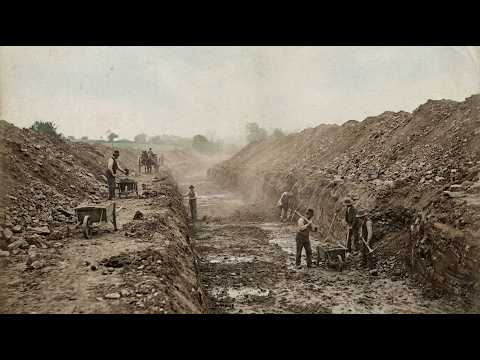
The first summer, they faced a problem that would have stopped lesser men. Most of the 363-mile line went through virgin hardwood forest—oaks six feet across, elms and hickories, roots a foot thick running 20 feet out from the trunk. Before you could dig a canal, you had to clear a path 60 feet wide, then pull the stumps, then dig the ditch, then line it with clay to keep the water from soaking away, then build the towpath for the mules. And then do it all again the next mile. And the next.
Wright and Geddes broke the route into three-quarter-mile sections and put them out to bid. Local farmers signed up to dig with their sons and hired hands, paid by the cubic yard of dirt moved. That was the ladder. That was how the canal got built—not one big army, but hundreds of small crews working side by side across New York state. At peak in 1819, there were 9,000 men on the line. Most were Irish. Some were local farm boys earning winter money. Some were freed black laborers from the Hudson Valley. Some were German immigrants from the old Palatine settlements. The wage was 80 cents a day and a ration of whiskey—four times a day, about 12 ounces of hard liquor per man per shift. They drank it because the water was often bad, because the work was brutal, and because the foreman believed it kept the men moving.
But 9,000 is just a number. The numbers never tell you what it cost. In a burial register in Herkimer County, cross-referenced against a contractor’s payroll book that survived in a basement in Syracuse, there are names. Patrick Donnelly, age 22, born in County Mayo, Ireland, came over in 1818 in steerage, paid for his passage with a note against his first year’s wages. He couldn’t read. He signed his contract with a mark. He was put to work at the deep cut through the Montezuma marshes—eight miles of black water swamp between Syracuse and the Seneca River. Cedar and tamarack stood in two feet of tea-colored water. Mosquitoes rose in clouds thick enough to choke a man. The mud was so soft it wouldn’t hold a ditch; every foot they dug in the day filled back in by morning. The men stood in that water from dawn to dark, digging with short-handled spades because a long handle wouldn’t clear the cedar knees.
By September 1819, the fever came. They called it the ague—shaking chills in the morning, high fever by noon, soaking sweat by night. We know now it was malaria, carried by the swamp mosquitoes. They didn’t know. The contractor’s doctor dosed men with calomel and Peruvian bark, and sometimes with nothing at all because he had run out. More than a thousand men died in the Montezuma stretch between 1819 and 1821. A thousand in eight miles of ditch. Patrick Donnelly caught the ague on September 14th, 1819. The ledger notes him missing a day of work, then two, then a week. On September 28th, the entry beside his name reads: “Buried near the line.” He was 22. He had been in America for 14 months. He never mailed a letter home because he couldn’t write one. His mother in County Mayo almost certainly never learned what became of him.
That was one man. There were a thousand in that swamp alone. But the men who survived Montezuma, the men who dug out of the marshes and kept going west, were part of something that had never been done on this continent before. The engineering they improvised was as clever as anything in Europe at the time. The stump puller, designed by a blacksmith named Jeremiah Brainard, could pull 40 big stumps in a day—before the machine, the same team could pull five. Hydraulic cement, the secret of the old Roman aqueducts, was reinvented by a 27-year-old miller named Canvass White, who walked the English canal country for a year and came back to find the right limestone near Fayetteville, New York. The canal used 400,000 bushels of it. White patented his process; the government largely ignored the patent, and he died poor at 45.
And there were the locks—83 of them, end to end. Each lock was a rectangular stone box with heavy wooden gates. A boat floats in, the gate closes behind it, sluices open in the upstream gate, water pours in, the boat rises, the gate opens, and the boat floats out at a higher level. Every lock lifted a boat between 6 and 12 feet. String 83 of them together from Albany at sea level to Lake Erie, and you raise a freight boat 675 feet straight up in the air—using no power source except falling water. The stone was quarried locally, dressed by stonecutters—some Scottish, some Welsh, some Yankee boys who had never touched a chisel before. They worked in lock pits 12 feet deep, in the rain, cutting stone to within an eighth of an inch of specification. A lock out of square by even a little would leak. A leaking lock would drain the canal dry in a week.
But the whole thing almost fell apart at Lockport. About 20 miles east of Buffalo, the canal had to climb the Niagara Escarpment—a limestone cliff 60 feet high running from Niagara Falls to Rochester. No going around it. The line had to go over it. Nathan Roberts, the same farmer who had started with a three-quarter-mile contract near Rome eight years before, was now chief engineer. He designed a flight of five stone locks paired side by side so boats could go up and down at the same time—ten locks in all, 60 feet of lift in the length of a city block. And before the locks could be built, a cut had to be blasted through the escarpment itself: three miles of trench, 30 feet deep, straight through solid rock. They had black powder—the only blasting agent on Earth in 1822. Nitroglycerin had not been invented. Dynamite would not come for another 45 years.
Lockport was the first place in American history where drilling and blasting were done at the scale of modern quarrying. The workers had no helmets, no safety glasses, no shoring against loose rock. Men were killed by flying stone. Men were killed by premature detonations when a piece of flint struck a spark against the drill bit. Men lost eyes. Men were buried when the walls of the cut collapsed. The exact death toll at Lockport is not known because the records burned in a Buffalo warehouse fire in 1844, but eyewitness accounts put it above 500 for that three-mile section alone.
One of those men was Michael Kearney, age 34, born in County Cork, came to America in 1816 with a wife named Mary and two small children. He had been a stonemason in Ireland. He hired on at Lockport in the spring of 1823 as the powder man. He set charges. He was good at it—the foreman noted in the payroll that Kearney was trusted to calculate his own powder loads. On July 11th, 1823, a charge he had set failed to detonate. Under the rules of the work, a man was supposed to wait a full 20 minutes before approaching a dud. Kearney waited. He walked up to the hole to pull the fuse. The charge went off while he was standing over it. He was killed instantly, along with a laborer named Shawn Flaherty, who was clearing rubble 10 feet away. The contractor paid Mary Kearney $25 and the last week of her husband’s wages. She moved to Rochester, took in laundry, and raised the two children alone. One of the boys later worked the canal as a boat captain. He lived to be 74.
Every few miles along the finished canal, if you know where to look, there is a stone with a cross on it and a name almost worn away. Most of the Irish workers who died were buried near where they fell. The contractor did not have a budget for hauling bodies. The men who survived marked the spots as best they could, often with a small cairn of quarry stone.
And on October 26th, 1825, the canal was finished. Eight years, three months, and 22 days after DeWitt Clinton had driven that first shovel into the dirt at Rome. Clinton himself, now in his second term as governor, boarded a packet boat called the Seneca Chief at Buffalo. They fired a cannon. A mile down the line, the next battery fired when they heard the first shot. Then the next, then the next. A chain of cannon shots relayed the news from Buffalo to New York City in about 81 minutes—the fastest any piece of information had ever traveled on the North American continent. Clinton rode the Seneca Chief the entire 363 miles, nine days on the boat. When he reached New York Harbor on November 4th, he carried two wooden casks of Lake Erie water. He poured them into the Atlantic Ocean in a ceremony they called the wedding of the waters. Crowds lined the battery. Cannons fired from the forts. Newspapers in Paris and London picked up the story within a month.
Here is what the canal did. Before the canal, moving a ton of freight from Buffalo to New York cost about $100. After the canal, it cost five. A 95 percent reduction in shipping cost, overnight. A farmer in Ohio could now send wheat to New York for less than it cost him to send it to New Orleans down the Mississippi. The geography of American commerce flipped on its head. New York City, which had been the third largest port in America behind Philadelphia and Boston, became the first. It passed them both in ten years and never gave back the lead. The population of New York doubled between 1825 and 1835. Buffalo, a burned-out frontier village after the War of 1812, became one of the fastest-growing cities in the country. Rochester went from a cluster of cabins to a flour-milling capital with 20,000 people. Syracuse rose up around the salt works at the canal’s middle point. Utica, Schenectady, Troy—every one of them fed by the ditch. And beyond New York itself, the canal opened the Midwest. Ohio and Indiana and Illinois and Michigan filled up with settlers who could not have afforded to go west without a way to get their produce back east. Chicago did not exist in 1820. By 1850, because of the canal and the grain trade it unlocked, Chicago was on its way to becoming the second city in America. The entire interior of the continent was stitched to the Atlantic economy by 363 miles of water four feet deep, dug by Irishmen with short-handled spades.
The canal is still there, most of it. The original ditch was widened and deepened twice in the 19th century, then enlarged again in 1918 into what is now the New York State Barge Canal, and then mostly abandoned as a commercial route when the railroads and trucks took over in the 1950s. But the water is still there. The locks are still there—some of them the original cut stone from 1823. The towpath is now a bike trail in most sections. You can walk from Albany to Buffalo on it. It takes about three weeks. Along the way you pass the old lock chambers—some in active use, some stranded in the trees. Stone walls 20 feet high rising out of second-growth forest with nothing connected to them anymore because the line was rerouted in 1918. You can stand at the bottom of one of those abandoned locks and look up and see the chisel marks from 1823. Still there. Straight and true. A man named William or Duncan or Michael cut that stone by hand in the rain, and nobody wrote his name down, and the stone is still holding.
DeWitt Clinton died in 1828, three years after the canal opened. He was 58. He collapsed at his desk in Albany, working on another project, and was gone before the doctor reached the room. His estate was bankrupt. He had spent his own money on the canal fights over the years, and he had never been a rich man. His widow could not afford a funeral, and friends paid for it. They buried him with a simple stone in New York City. The state of New York did not put up a proper monument to him for many years after. Benjamin Wright went on to be called the father of American civil engineering. James Geddes kept surveying into his 70s. Canvass White, who gave the country its hydraulic cement, died in his mid-40s of the same swamp fever that killed so many of the diggers he had worked beside.
363 miles. 83 locks. 9,000 men. 1,000 buried in the Montezuma swamps, and no one knows exactly how many at Lockport. A 95 percent reduction in shipping cost. The making of New York City. The opening of the American interior. Eight years and three months of work. 80 cents a day and a ration of whiskey. I put my hand on the stone at the old Lockport flight. I’ve walked the towpath near the Montezuma refuge, where the water still runs black and the mosquitoes still rise at dusk. There’s no plaque there for Patrick Donnelly. No marker for Michael Kearney. Just the ditch they dug and the water that runs in it. And the country that was built because they cut it through the forest with their hands.
That was the Erie Canal. 1817 to 1825. Dug with shovels and wheelbarrows by men whose names are mostly gone, for a country that had no idea what it was about to become.
So here is what I keep coming back to, standing on that towpath with the black water moving slow beside me. DeWitt Clinton got the glory, and Benjamin Wright got the title, and both of them earned it. But the canal was not built by the men whose names we remember. It was built by Patrick Donnelly, who signed with a mark and died at 22 in a swamp, and by Michael Kearney, who waited his twenty minutes and still got killed by the rock.
Their names are not on any plaque. But every mile of that ditch is their signature. The water still runs because they cut it through. The stone still holds because they dressed it true.
If you ever drive Route 31 across Upstate New York, pull over where the old locks stand in the trees. Put your hand on the chisel marks. That is the only monument they ever got.
Now I want to hear from you: does anyone in your family carry a story like this—a laborer, a digger, a stonecutter whose name never made a book? Tell me in the comments. I read every one.
Report this article
Select a reason for reporting:






