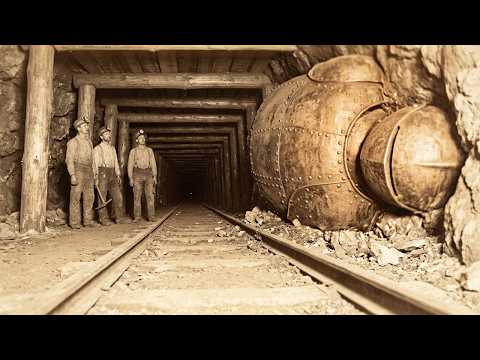
On April 16, 1918, deep beneath the main street of Hibbing, Minnesota, a timberman’s steel bar struck something warm. The air in the tunnel shifted, every lamp flame bent toward the rock, and for half a minute the mine seemed to hold its breath. When the crew cleared the rubble, their lamps revealed a man—a forty-foot figure of overlapping copper plates, riveted like a ship’s hull, lying curled on its side as if asleep. Its chest rose once every hour, and the miners called it the Sleeper.
Within weeks, three facts became undeniable: blasting near the figure made it stir, the ore around it grew richer each time it moved, and the streets of Hibbing, three hundred feet above, sank a little lower with every breath. A young engineer named Martin Aro would spend thirty-eight years measuring that sinking, documenting a town’s slow descent in thousandths of a foot. But the Ojibwe had a name for this ground long before the miners came: Misabi Waju—the big man lying down.
The village of Hibbing in 1918 was home to fifteen thousand people—Finns, Slovenians, Croatians, Italians, Swedes, Cornishmen, and Greeks—who called it the richest village in the world. Every school and street lamp was paid for by taxes on the mines that surrounded it. The map of the village showed a neat grid of forty blocks, but it did not show who was there first. The Ojibwe had lived in the lake country for generations, and many of their men worked in the lumber camps and mines. The long ridge that crossed the range had a name printed on every map, but few who worked under it knew what it meant.
Most of the ore around Hibbing came from open pits by then, but some still came from the old underground mines, and the oldest of those was the Bert. It had shipped its first ore in 1895, and by 1918 it belonged to the Oliver Iron Mining Company, the arm of United States Steel that ran most of the range. Its shaft stood at the north edge of the village. The Misabi ore is soft, lying in great flat beds of red and blue earth, and an underground mine did not so much cut through it as eat it from below—taking a slice, letting the ground above settle onto the timbers, then taking another slice beneath. The engineers called the method caving. Everyone knew what it did to the surface: fields over the old mines sagged into long shallow bowls, and now and then a hole opened in a pasture overnight.
In the spring of 1918, the 300 level of the Bert was pushing a new tunnel south—a drift—following a tongue of rich ore that ran under the village, under Pine Street itself. The mine captain had promised Duth he would find its edge by summer. At the end of each night shift, the crew charged the face with dynamite and fired it, and at seven the day shift came down to see what the round had broken. The south drift gained about seven feet a day.
The first man into the drift each morning was Simon Martino. He was fifty-eight, a timberman, the oldest man on the level. He was Ojibwe from the Fond du Lac reservation near Cloquet. A timberman sets the heavy posts and caps that keep a tunnel open, and the good ones can hear in a timber how much weight it is carrying. Simon tested everything with a long steel bar. His grandmother had raised him on the St. Louis River, and he still went home to Fond du Lac twice a year.
On the morning of April 16, the round had been fired at a quarter to six. The day shift rode the cage down at seven and walked south through air that stayed near fifty degrees in every season, past rock that sweated red water. When the smoke thinned, Simon went in with his bar and struck the new roof. Sound rock gives back a sharp, clean note. Loose rock answers with a dead thud. This was neither. The bar sank a little into something that yielded and was warm like the flank of a horse in a cold barn. Then it was pressed back into his hands slowly, about the width of three fingers.
In the same moment the air of the drift began to move. It came from behind the men and flowed past them toward the face, and every lamp flame on the level bent the same way and stayed bent for half a minute. Then the pressure let go of the bar. The current turned and came back over them, warm and without any smell, and the drift went still.
For a while, nobody moved. Then the machine man, a Finn named Aino Salo, who had drilled the round the night before, scrambled up the muck pile to the ragged hole where the blast had punched through into open dark. He pushed his arm into the shoulder. His hand met something smooth, and he kept it there, as if he were feeling for a heartbeat. The others crowded up behind him with their lamps. Beyond the hole was a cavity in the ore body as big as a church nave, and most of it was taken up by one rounded mass of copper, red-gold sheets of plate lapped edge over edge and studded with rivets. It was the round of a shoulder, and it stood as big as a freight wagon.
A nipper was sent running for the cage. A nipper is the boy who carries tools and messages through a mine, and the nipper on the 300 level was Simon’s nephew, Thomas Martino—called Tommy—sixteen years old. By noon the captain of the Bert had come down. Gideon Thea was fifty-four. He had started at thirteen pushing ore cars in Ishpeming. He wrote his orders in pencil on yellow forms and signed them with his initials. He had eleven hundred men under him and a tonnage figure from Duth that came in the end from Washington. His daughter Ruth, twenty-three, was an army nurse with a base hospital in France.
Thea wrote an order that no powder of any kind was to be fired in the hollow and sent a telegram to Duth for the company geologist. By evening there was an engineer underground with a steel tape, and nearly everything that is known about the next thirty-eight years comes from his field books. Martin Aro was twenty-five, a junior engineer in the Hibbing office of the Oliver Company. He was born in Calumet, Michigan, the son of a Finnish copper miner, and had grown up in a town where copper was as ordinary as snow. He finished the school of mines at the University of Minnesota in 1916. He never erased anything. A wrong figure got one straight line through it and his initials beside it, and every day’s page ended with a double rule and the hour. His rodman, a fifteen-year-old named Arvid Lind, initialed every page, too. Martin meant to be chief engineer of a district before thirty and to send money home every month to his widowed mother.
For six days, with picks and bars and no powder, the crew cleared the broken ore out of the hollow. Then Martin measured what was in it three times over in sections. It was the figure of a man lying on its right side, knees drawn up, head bowed onto its chest. Straightened out, it would have been about forty feet long. The top of the shoulder stood more than eight feet above the floor. It was sheathed in copper plates as big as doors. They overlapped from the crown of the head down toward the feet, the way slates are hung on a church roof, so that water would run off it. Their rivets marched in lines a draftsman could not have drawn straighter. Each head a dome as big as a clenched fist. Martin started counting the rivets on one plate, reached sixty-four, and wrote that number down and no other.
The color troubled the older men first. It was the color of a new penny. In the Bert, every piece of metal rusted; a shovel left there over a Sunday came back orange, and copper wire went green. The figure carried no stain of any kind. It looked new. Martin, who had grown up with copper, wrote one short line and underlined it: has not been exposed to air. There was something else in that line, and he did not write it down until years later. If the ore had formed around the figure, and the hollow fitted it so closely that it seemed to have, then the figure was older than the ore. And Misabi ore is ancient. The geologists of the day measured its age in ages.
There was no nose and no mouth. Where eyes would be, two long lids lay shut, each beaten from one curved plate. The hands ended in broad flat paddles crossed by a single seam like a child’s mittens. Martin looked for any seam that opened, any fastening, any letter or numeral or maker’s mark, and found none. The right arm lay along the flank; the left was bent at the elbow and reached out and down over a bed of dark blue ore. The way a man asleep lets one arm hang off the side of the bed.
Martin wrapped the bulb of a mercury thermometer in his handkerchief and held it to a plate. The hollow itself was fifty-four degrees. The copper was ninety-eight, close to the warmth of a living man. He checked it at the end of the shift, and again the next day, and it had not changed. And it breathed once in each hour. The great chest swelled, perhaps six inches, for about thirty seconds, and the air of the entire 300 level streamed into the hollow to fill it. Then the chest sank, and the air streamed back out. Martin’s watch put the gap between breaths at no less than fifty-nine minutes and no more than sixty-one.
Tommy Martino did not need a watch. He had always known to the minute how long ago the last round had gone off. Now he could say when the next breath was coming, and he was not wrong by more than a minute.
They tested it the way miners test anything. Simon’s bar swung with his whole weight, landed as dead as if it had hit a grain sack. A pick skated off a plate edge and left it bright and unmarked. A cold chisel under a four-pound hammer mushroomed and turned its edge. A hacksaw blade was stripped of its teeth before it had scored the surface. Simon watched and said nothing. Then he walked once around the figure, tapping the rock of the hollow as he went, and stopped where the outstretched arm lay over the ore. A trammer saw him take a pinch of tobacco from his shirt pocket and set it on the rock beside the copper hand. For many Ojibwe people, tobacco is how something that matters is begun. It is set down as an offering before a prayer, a request, a journey, or the taking of anything from the land. The trammer thought the old man had dropped it.
Riding the cage up that evening, Martin asked Simon what he made of it. Simon said the name of the range, Misabi. Martin wrote the word in the margin three ways, with a question mark after each. Then Simon said one more thing, and Martin wrote that down as well. He is not sleeping, he is carrying.
Under the outstretched arm, at the very back, where the copper hand met the rock, there were the butts of old timbers—gray, hewn, and not sawn—flattened and split along the grain. Simon crouched and drew his thumb along one. “Tamarack,” he said, and went back to work. No one examined those timbers that spring. No one would for eight years.
That week the ore from under the arm went to the assay office. Ordinary Bert ore ran about fifty-two percent iron. This ran fifty-eight. Thea read the slip and wrote a second order on a yellow form. No man would strike the obstruction with steel again, but two new drifts would be driven, one along each side of the hollow at sixty feet, to get past it into the ore beyond. Nobody on the level thought it unreasonable. Ore was ore, and the war wanted all of it.
The East Side Drift fired its first round on the twenty-fifth of April as the day shift came off. Martin and Tommy had stayed in the hollow to close a survey on the shift boss’s word that sixty feet of rock would swallow the shock. It did not. The floor kicked under them, and a sheet of red dust slid off the roof. The figure had breathed only forty minutes before. Now it breathed again, a hard short pull that sucked the flame off Tommy’s lamp. Then it shifted. The copper shoulder heaved and rolled away from them by the breadth of a hand, the way a sleeper turns his back on a light, and the plates rasped over one another with a long dry sound like a sled runner on crusted snow. Its next breath came early, nineteen minutes later. After that, it went back to its hour.
In the morning, the assay office sent down the figures for the ore beside the arm: sixty-three percent iron. And when the miners opened that ground with picks, they found something nobody had ever seen on the Misabi. Fine threads of pure red copper branching through the blue ore like frost ferns on a window. Misabi ore does not carry copper. The men who had come from the Michigan copper country turned the pieces in their lamplight and all said the same thing. This does not belong here.
Martin caught one more thing that week, and only because of a job nobody else had wanted. The summer before, the village had borrowed an engineer from the company to fix the exact height of its streets for new sewer lines, and Martin had set eighteen brass benchmarks. They were small brass plugs, each one sunk level into stone or concrete, each one stamped with a number, and recorded in his book to the thousandth of a foot above the sea. Number four was in the bottom step of the Arcade Hotel on Pine Street. Number eleven was in a bare ledge of dark greenstone at the far south end of the village where nothing had been built.
That Saturday, running his weekly line of levels for the sewer work, he found benchmarks three, four, and five lower than the Saturday before. Eleven-thousandths of a foot, the thickness of a fingernail. He read each one three times, and Arvid Lind initialed the page. In the ten months since the discs were set, Pine Street had not moved a thousandth. From then on, he read the line every morning before work.
The geologist the telegram had summoned was Raymond Fairburn, forty-four, from the Oliver offices in Duluth. He held a theory that the rich Misabi ores had been made by water carrying the rock away and leaving the iron behind. He wanted—and would say so after a whiskey—one discovery with his name on it. In the middle of May, he asked for a sample. The company ought to know, he argued, whether this was native copper grown in place or copper shaped by hands. Thea allowed one hole in the forearm with an air drill and a fresh bit.
The drill was given to Aino Salo. He was thirty-four, from Ostrobothnia in Finland. In 1916, he had walked out with the strikers when the whole range stopped work for three months. Afterward, the companies kept lists, and his name was on one. In 1917, he had come back to the Bert under his mother’s maiden name, Kangas, and the timekeeper wrote it down without looking up. He had a wife, Hillya, and a small son, and he wanted forty acres of cutover land near Toivola, and a cow, and never to go down a shaft again. He told the shift boss plainly he would rather not touch the arm. Then Fairburn asked a second time, and the shift boss stopped asking, and Aino set up the machine.
The bit for the first time the copper gave. A quarter of an inch of steel went into the forearm, and a bright ribbon of copper wound up out of the hole. Then the bit broke with a report like a rifle, and the snapped end whipped past Aino’s ear and rang off the wall behind him. Over the ore, the copper arm drew in, only slightly, the way fingers close on a banister. The shift boss logged the broken bit at eight minutes before eleven in the morning.
Martin Aro was on Pine Street at that minute, setting up his level in front of the First National Bank. At eight minutes before eleven, the plate glass of Pine Street split—every window at once with one dry crack that Martin compared to lake ice under a skater. Nothing fell. What Martin saw, and nobody else on the street did, was the line. Each crack ran level across its pane from frame to frame, and when he walked the block with his rod, every one of them stood within an inch of the same height above the street. It was as if a single ruled line had been drawn through all of Pine Street. Only that evening did he learn what had happened underground at the same minute.
Fairburn had picked up the broken bit, with the ribbon of copper still wrapped around its edge, pronounced the sample spoiled by the steel, and tossed it aside. Martin went down, found it in the muck, and sealed the copper in a small cedar medicine bottle. He kept that bottle thirty-eight years. The next day, there was nothing to see where the bit had gone in. A rivet sat there instead—the same fist-sized dome as its neighbors, only newer and a little brighter.
By June, Martin had ruled a new table into the back of his ledger: four columns—the time and size of each round, the time of the next breath, the assay of the ore beside the arm the following morning, the height of the Pine Street benchmarks the following morning. Read across, the rows said one thing. On days with no round within about 250 feet, the figure kept its hour, and Pine Street did not move. On days with a round, the breath came early, the shoulder shifted, the ore came up richer, and Pine Street came down. The heavier the round, the larger every number. Beneath the table, he added a single line about the window glass: Damage to the body appears at the surface in the same minute.
He kept the table to himself for a week. The assay column got out on its own. By the middle of June, ore from the side drifts was running sixty-five percent. The table went to the district chief engineer, Lyall Brandt, and from Brandt to the captain. Thea ran his finger down the assay column and then down it again. In July, Duth asked for more ore again, and Thea answered it with a decision that shaped every year that followed. The firing near the figure would not stop. It would increase. He had a ring drift cut all the way around the hollow sixty feet out, with stopes opening off the ring into the richer ground, and he had rounds fired on both sides of the hollow every shift. Nobody put it into words on paper, but every man on the level understood. Before, they had fired around the sleeper and accepted what it did. Now they were firing around it for what it did.
The pace that summer broke men. Aino Salo was drilling two rounds a shift. The crews came to know the sleeper’s rhythm as well as their own pulse, and they fired the moment a breath had passed, which left them close to an hour to clear the broken ore and be gone before the next. That summer a card of rules hung on a nail at the mouth of the hollow, and Martin copied it into his fieldbook. No tool to be laid against the obstruction. Ring drift rounds to be fired only in the minute after the breathing. And a last rule added later in pencil: No figures concerning the obstruction to be sent to Duth.
There was also the tobacco. Every morning before the first round, Simon walked into the hollow, stood by the outstretched hand for a moment, and set a pinch of tobacco on the rock. A Slovenian shift boss began to keep track on the back of his time sheet. On the mornings when Simon had been in the hollow before the round, the sleeper stirred less. On the two mornings that summer when Simon was home at Fond du Lac, the stirs were the worst of the season. None of it could be proved, and Martin never put it in a report. But from August on, the Bert kept a can of plug tobacco on a shelf by the ring drift, and before every round one man went into the hollow and set a little of it down by the hand. Finns did it, and Italians and Cornishmen, who had never prayed to anything. Simon showed a young Croatian how to hold the tobacco in his left hand, nearest the heart, and to say what he was asking for before he set it down. What Simon himself said, he never told.
Three hundred feet under the richest village in the world, men from a dozen countries were laying tobacco by a copper hand, asking it to let them rob it in peace.
Tommy found the passage by lying flat on the cool floor of the hollow. Beyond a gap between the copper arm and the rock ran a crawlway, its floor worn into two shallow troughs set exactly a knee’s width apart—polished the way a threshold is polished by generations of feet. Thirty feet in, it stopped at a wall of crossed gray timbers, crushed flat.
Fairburn had planks nailed across the gap, and a NO ENTRY sign hung on them. The question of whose knees had made the troughs was not raised.
The village moved south. The houses went on wheels, hotels cut in half to fit the road, and the pit ate the rest. By 1956, the water took the levels, and Tommy sat alone by the planks for the final breath. “The air went out of it for longer than a minute, one long, warm draft running away down the drift, and then nothing.” He laid tobacco by the hand and signed out.
In Coleraine that week, Martin uncorked the bottle. For thirty-eight years the ribbon had stayed the color of a new penny. Now it was green through and through.
The Ojibwe named the ridge long before anyone dug into it. Misabi Waju—the big man lying down. Almost nobody who says it knows what it means.
If an old map of your own town holds a name nobody can explain—what is it, and where?
Report this article
Select a reason for reporting:






