In the early morning fog of November 20, 1917, the thunder of engines shattered the silence of the French countryside. German soldiers, entrenched along the formidable Hindenburg Line, stared in disbelief as hundreds of iron behemoths emerged from the mist. This was the dawn of the first mass tank assault in history—a gamble that would change warfare forever. Among those steel monsters was a single tank named Deborah, crewed by eight men whose courage would be tested in ways they never imagined.
As the first wave of tanks rolled forward, the ground trembled under their weight. The air filled with the deafening roar of engines and the crack of artillery. For the crew of Deborah, a Mark V tank, the battle was not just about breaking through enemy lines—it was about survival in a machine that was as dangerous as the enemy’s guns.
Inside the tank, temperatures soared to 50 degrees Celsius, and carbon monoxide fumes threatened to poison the crew. The men wore chain-mail masks to protect their faces from flying metal splinters, known as ‘splash,’ caused by bullets hitting the armor. Every moment inside was a struggle against heat, noise, and the constant fear of a direct hit.
Deborah was commanded by Second Lieutenant Frank Heap, a 24-year-old from Blackpool who had traded a life of privilege for the trenches. His crew included Gunner Joseph Chevon, a young man from Cambridge who would celebrate his 20th birthday on the day of the battle. “We’ll have a proper celebration when this is over,” his comrades promised. It was a promise that would never be kept.
The plan was audacious: use the surprise of massed tanks to break through the Hindenburg Line, capture the village of Flesquières, and push on to Bourlon Wood. The tanks were to crush the barbed wire, silence the machine guns, and pave the way for the infantry. But the Germans had prepared well. Hidden artillery batteries and fortified villages turned the battlefield into a killing ground.
As Deborah advanced, she and her crew witnessed the chaos of war. Tanks broke down, ditched in craters, or were knocked out by direct hits. The first wave had reached the Blue Line, but the second wave, including Deborah, faced a renewed and determined enemy. The pause to reorganize had given the Germans time to bring up reinforcements and aim their guns.
When Deborah crested the high ground near Flesquières, she came under fire from multiple batteries. Shells slammed into her hull, and within minutes, seven of the eight tanks in her sector were destroyed. But Deborah pushed on, alone and surrounded. Heap and his men fought with everything they had, their six Lewis guns blazing from every port. They advanced to the village crossroads, scattering German defenders in panic.
For a brief moment, it seemed they might achieve the impossible. But as Deborah emerged from the cover of the buildings, two artillery batteries opened fire. Several shells struck her left side, ripping through the armor and showering the crew with red-hot fragments. Fuel and ammunition ignited, and the tank became a blazing inferno. Lance Corporal Foot and Gunner Chevon were killed instantly. Deborah’s advance was over.
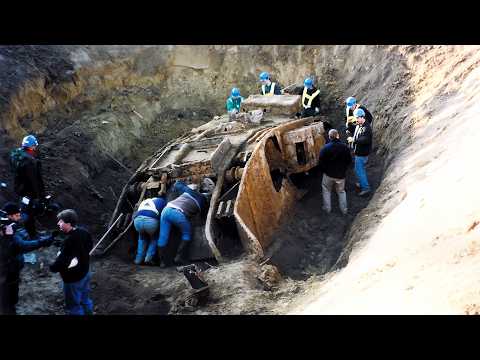
The Battle of Cambrai would continue for days, with gains and losses on both sides. But for the crew of Deborah, the war was over. Three men survived, including Frank Heap, who would receive the Military Cross for his gallantry. The tank itself lay forgotten in a field for 80 years, until a local historian’s rumor led to its excavation in 1998. Today, Deborah stands as a museum piece, a silent witness to the courage and sacrifice of those who fought in the first tank battle.
But the story of Deborah did not end when the flames died down. For the men who survived, the memories of that November morning would never fade. Frank Heap, though decorated and eventually settled into a quiet civilian life running a hotel in Blackpool, rarely spoke of the horrors he had witnessed. Yet those who knew him said his eyes would grow distant whenever the subject of tanks arose.
Lance Corporal David Marsden, Deborah’s likely driver, carried shrapnel wounds for the rest of his life—a second injury sustained when the tank was hit. He returned to England, married, and lived quietly until his death in October 1969 at the age of 82. The third survivor, whose name has been lost to history, remains an anonymous footnote in the story.
For decades, the fields around Flesquières returned to farmland. The villagers rebuilt their homes, and the war became a distant memory. But rumors persisted—whispers among the locals that one of the lost tanks still lay buried beneath the soil. It was not until the 1990s that historian Philippe Gorczynski began to investigate these stories, speaking with elderly residents who remembered the battle.
“There is a tank in the field,” one old farmer told him. “My father saw it buried.” Gorczynski spent years cross-referencing records, studying aerial photographs, and interviewing witnesses. His persistence paid off when, in November 1998, a team excavated the site and unearthed a rusted hulk that had lain hidden for eight decades.
The tank was identified as Deborah. Battle scars still visible on her armor, she was carefully lifted from her grave. For the next twenty years, she was kept in a barn, where pilgrims and historians came to pay their respects. Then, in 2018, a museum was built just yards from where she had been knocked out.
Today, Deborah stands in the center hall, her damaged hull a testament to the men who fought and died inside her. Visitors can trace the dents left by German shells, peer into the cramped interior where eight men once sweated and bled, and read the names of those who never returned.
In Flesquières Hill British Cemetery, just a stone’s throw away, four men still rest side by side: Lance Corporal George Foot, Gunner Joseph Chevon, William Gway, and Fred Tipping. Chevon, who never saw the end of his twentieth birthday, lies beside the comrades who fell with him.
The Battle of Cambrai ultimately achieved little in strategic terms—the lines would shift back and forth for years, and the war would grind on for another twelve months. But the lessons learned that day changed military thinking forever. The massed tank assault proved that armored vehicles could break even the strongest defenses. It was a preview of the wars to come, where steel and fire would dominate the battlefield.
For the men of Deborah, however, the legacy was more personal. Frank Heap’s Military Cross was not just a medal—it was a reminder of the day he led two survivors through enemy territory to safety, refusing to leave anyone behind. David Marsden’s quiet life in post-war England was a world away from the hell of the tank’s interior, but he carried the scars with him always.
And for the villagers of Flesquières, Deborah became a symbol of resilience. The tank that once brought destruction now brings visitors from around the world, eager to learn about the ordinary men who did extraordinary things. Schoolchildren gaze at the rusted armor and try to imagine what it was like to be inside, surrounded by noise and heat and fear, fighting for a cause they believed in.
But the story of Deborah and her crew is not merely one of steel and fire. It is also a story of the men who built and maintained these machines—the unsung heroes of the Tank Corps. Among them was a young mechanic named Albert Baker, whose meticulous care of Deborah’s engine ensured she ran smoothly on the morning of the assault.
Albert was just nineteen when he enlisted, lying about his age to join the war effort. Assigned to the 12th Company, D Battalion, he quickly proved adept at coaxing the temperamental Daimler engine into life. “She’s got a soul, this one,” he would often say, patting Deborah’s hull. On the eve of battle, he worked through the night, checking every bolt and hose, knowing that his comrades’ lives depended on his diligence.
When Deborah rolled out of Aveluy Wood, Albert watched from the sidelines, his heart pounding. He had done all he could; now it was up to Heap and the crew. As the tank disappeared into the mist, he whispered a silent prayer.
Meanwhile, the battle raged on. The success of the first wave had emboldened the British command, but the German defense was stiffening. By midday, the attack had stalled in many sectors, and the dreaded sound of German artillery grew louder. For the infantry following the tanks, the absence of their armored protectors was keenly felt. “Where are the tanks?” became a desperate cry across the field.
In the chaos, a group of Highlanders found themselves pinned down by machine-gun fire from a fortified farmhouse near Flesquières. With no tank support, they were sitting ducks. Lieutenant Colonel Jameson, commanding the 51st Highland Division unit, called for volunteers to flank the position. “We’ll take it or die trying,” he growled, leading a small squad through a hail of bullets.
They succeeded, but at a terrible cost. Jameson himself was wounded in the leg, and half his men fell. The farmhouse was taken, but the delay allowed German reserves to pour into the village, further tightening their grip on the Brown Line.
Back at the British lines, news of Deborah’s fate filtered through. The loss of so many tanks in E Company was a bitter blow, but the survivors pressed on. The village of Flesquières would eventually fall, but Bourlon Wood remained elusive. The cavalry, waiting for the breakthrough that never came, were ordered to dismount and fight as infantry—a humiliating end to a bold plan.
As dusk fell on November 20th, the battlefield was a scene of carnage. Wrecked tanks smoldered in the fields, and the cries of wounded men echoed through the mist. The first day of Cambrai had ended in a tactical draw, but the strategic implications were clear: the tank had arrived, and warfare would never be the same.
For the crew of Deborah, the aftermath was a blur. Frank Heap, wounded but alive, led his two surviving comrades through the German lines under cover of darkness. They dodged patrols and crawled through ditches, finally reaching British lines near dawn. Heap’s Military Cross was well deserved, but he would later say, “I only did what any man would have done for his crew.”
The bodies of Foot, Chevon, Gway, and Tipping were recovered days later and buried in Flesquières Hill Cemetery. Their graves, marked by simple white crosses, became a place of pilgrimage for their families. Chevon’s mother, who had received his birthday letter just days after his death, never fully recovered from the loss.
In the years that followed, the legend of Deborah grew. The tank that fought alone against impossible odds became a symbol of British grit and determination. But for the men who knew her, she was simply a machine—a machine that had carried them into hell and, for some, back again.
Albert Baker, the young mechanic who had tended Deborah’s engine, survived the war and returned to his native Leeds. He rarely spoke of Cambrai, but in his later years, he made a pilgrimage to Flesquières. Standing before the rusted hull, he placed a hand on her armor and whispered, “You did well, old girl.” He passed away in 1974, his story known only to his family.
Today, Deborah’s museum draws thousands each year. Visitors trace the shell dents, peer into the cramped interior, and read the names of the fallen. In Flesquières Hill Cemetery, four headstones stand side by side—Foot, Chevon, Gway, and Tipping—forever linked to the tank that carried them into history.
The Battle of Cambrai ultimately changed little on the map, but it changed everything in military thinking. The massed tank assault proved that armor could break the strongest defenses. For the men of Deborah, the legacy was simpler: courage, sacrifice, and a promise of celebration that was never kept.
What would you have done, trapped inside that blazing steel box, with only seconds to escape?
Report this article
Select a reason for reporting:






