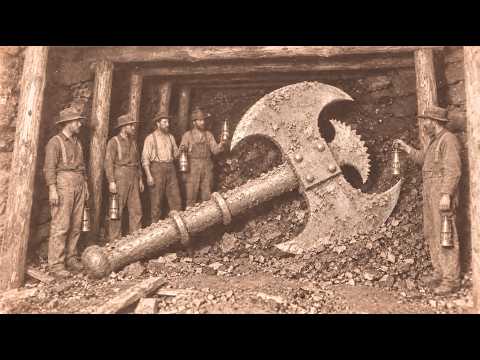
On a crisp October afternoon in 1893, deep inside a Colorado mountain, a miner’s pick struck something that rang wrong—not the sharp crack of coal, but a dull, metallic clang that traveled up the handle and into his bones. Tomaž Kastelic had just hit iron. Not a stray rail, not a forgotten tool, but a massive, ringed shaft embedded in a coal seam that had formed 70 million years before humans existed. What he and his crew would eventually uncover was a tool so large it defied belief: a double-crescent blade, one smooth and sharpened, the other lined with 13 perfect teeth, mounted on a handle no man could wrap his arms around. It weighed an estimated 10 tons. And the coal had grown around it, its bands bending like tree rings around a nail, as if the object had been there since the beginning.
This is the story of five records, scattered across four cities and two states, none of which knew the others existed. A mining engineer’s field book. An anthropologist’s unpublished notebook. A state geologist’s buried report. A Ute elder’s ancient memory. And a 1986 inspection form that mentions a “large iron object” left in place. Together, they describe the same impossible thing—a tool buried in coal that should not have been there, known to a people who had never seen it, and left sleeping inside a mountain until a miner’s pick woke it.
The mine itself was real. The coal was real. The maps, the ledgers, the laws—all real. What happened after the pick struck iron is where the questions begin. The Anthracite mine sat high on a mountainside north of Crested Butte, Colorado, a town of a thousand people in 1893, ringed by peaks that rose past 14,000 feet. The coal seam was thin—three or four feet thick—and the men worked bent double, sometimes on their knees, in the dim glow of their lamps. Above them lay 600 feet of rock. They knew the risks: methane, roof falls, the silent black damp that stole the air from a heading. Just nine years earlier, 59 men had died in the Jokerville explosion nearby. Every working was mapped, every advance recorded, every accident logged. So when Kastelic’s pick opened a crack and revealed a dark, rust-crusted surface, the pit boss, Michael Tully, wrote it down. “North heading, iron in the coal, not ours.”
For three days, three men cleared the coal away by hand, careful as if something might break. First the shaft appeared, then a ring, then a square bolted plate. On either side of the plate, two broad curved iron wings bent away into the coal. On October 20th, Tully sent word up to the office. The next day, an engineer came down—Walter H. Ashby, 31 years old, born in Pottsville, Pennsylvania, in the heart of anthracite country. He knew coal better than almost anyone in Colorado. For three days, he measured. His field book, 11 pages and four pencil drawings, still exists. He recorded the tool’s position to within a foot, tied to the mine’s survey map. He described the coal around it: same luster, same hardness, no crack, no void, no path by which anything could have entered from above. At the bottom of the third page, he underlined a single sentence: “The coal formed around it.”
What he measured next reads like an inventory of the impossible. Overall length: 17 feet 8 inches. The shaft, 13 feet from pommel to head, was 5 feet 4 inches around. Price, the biggest man on the crew at 6-foot-3, wrapped both arms around it—his fingertips did not meet on the other side. Tully wrote, “Price can’t reach round it.” Two raised collars sat on the shaft, their faces lined with fine parallel grooves—forged, not cast. At the butt, a round pommel 26 inches across, with a clean 3-inch hole bored straight through its center. No coal inside the hole. Only rust. The head held a square iron plate, 30 inches on a side, with four domed bolt heads the size of fists, hammered over hot like rivets—never meant to come off. From the front swept a great crescent, 7 feet 9 inches from horn tip to horn tip, its edge smooth and marked with the fine, regular lines of a whetstone, all at the same 30-degree angle. From the back rose a second crescent, two-thirds the size, its edge lined with 13 triangular teeth, each about 5 inches long, not one broken. Ashby estimated the weight at 20,000 pounds—10 tons. In the corner of his drawing, he sketched a small human figure for scale, 5 feet 8 inches, his own height. The figure did not reach halfway from pommel to head.
On October 25th, Tully tried to move it with 12 men, a mule, and two jacks. The jack handles bent. The mule pulled. The tool slid three feet. And when the pommel came free of the coal, it left a hollow behind—a perfect negative mold. Even the fine grooves on the collar showed in the face of the coal. An engineer knows what that means: the coal had formed around the tool while it was still soft. Ashby drew the mold. It was his fourth and last drawing. But the heading was only six feet high. The tool’s head was 7 feet 9 inches wide. It could not come out without widening the heading, cutting the roof, rebuilding the tramway—weeks of work. That evening, the superintendent, H.C. Wheeler, stopped the work. In Colorado in 1893, with silver collapsed and banks failing, no manager wanted to spend weeks on a heading that produced no coal. “No superintendent in that valley wanted visitors in his headings,” the record suggests. The decision was practical. It did not answer the question. It only put it off.
Six days later, Ashby wrote a letter to Denver. But before we follow that letter, we must hear from the mountain’s other witnesses—the ones who never saw the tool at all. Because 43 years later and 300 miles west, an old Ute man would describe this tool to an anthropologist. A tool he had never seen. Counting its teeth.
The letter was addressed to Samuel Franklin Emmons, head of the Rocky Mountain division of the US Geological Survey and one of the three authors of the Geological Atlas of the Anthracite and Crested Butte district. Ashby wrote it on October 31, 1893, six days after Wheeler sealed the heading. The letter has never been found. But in the minutes of the Colorado Scientific Society’s meeting of December 1893, there is a single line in the list of communications presented that evening: “An iron object in the Anthracite coal, Gunnison County, W. H. Ashby, read by title.” Only the title was read. No discussion is recorded. No paper followed in the next volume. At the bottom of the eleventh page of Ashby’s field book, in a different ink, two words were added later: March 3rd, 1894, no reply.
Ashby left CF&I in 1897, opened his own engineering office in Denver, and died in 1931. His obituary lists his career, his mines, his bridges. It does not mention Anthracite. The letter itself has never been found among Emmons’s papers. Emmons died in 1911. The Survey’s Denver files were shipped to Washington. Somewhere along the way, the letter was lost. Ashby’s field book, on the other hand, was never lost. It was only filed in the wrong place.
CF&I’s archive is kept today in Pueblo at the Steel Works Center of the West—6,000 cubic feet of records, the papers of more than 60 mines, over 30,000 maps and drawings, thousands of ledgers. Even now, much of the collection has only been processed at the level of the box. In 2009, a man retired from the Pueblo steel mill, volunteering at the archive, began opening the boxes from the Anthracite mine one at a time and listing what was inside. The list he left survives today as one line in the archive’s finding aid: “Field notes, W. H. Ashby, October 1, 1893, includes sketches of unidentified iron object.” Ashby’s 11 pages and four drawings were in one of those boxes, in a folder labeled “Anthracite, ventilation, 1893.” Ventilation—among exactly the kind of notes an engineer kept most that year at that mine.
But the story of this mountain does not end with the engineer’s measurements. Because 26 years later, someone else went down into the heading Wheeler had sealed. And that day, beside the tool, he found something no one had seen in 1893.
The fourth record belongs to the summer of 1919. By then, the Anthracite mine had been closed for 11 years. CF&I took out its last coal in 1907 and abandoned the mine in 1908. The tram rails were pulled up, the breaker was torn down, the company store was emptied. On the mountainside, there was nothing left but the portal, rotting timbers, and a scar running down the slope at 45 degrees. In 1912, for the US Geological Survey, Willis T. Lee had published a bulletin of 237 pages on the coal fields of the Grand Mesa and the West Elk Mountains. Bulletin 510. The Anthracite Mine appears in it briefly as an abandoned anthracite working. The North Heading is not mentioned. But a story can outlast paper.
In 1919, Everett J. Sayer was 26 years old. He was born in Boulder and had studied geology at the University of Colorado. That summer, he was working for the Colorado Geological Survey under the state geologist R. D. George, on a small field party re-measuring the coal seams of Gunnison County. In Crested Butte, in the hall of the Slovenian Benefit Society, someone told him about the Iron Crescent at Anthracite. It seemed that everyone in town knew the story, but for 26 years, no one had gone down into that heading. One of the men who told it was Tomaž Kastelic. He was now 55.
Tuesday, August 12, 1919. Sayer, Kastelic, and two young miners from Crested Butte went in at the Anthracite portal with carbide lamps. In places, the roof had come down. The way to the second level was half caved. It took them four hours to reach the North Heading. On the last stretch, there was black damp in the air—carbon dioxide, no smell. It takes the oxygen out of a working. The flames of the carbide lamps shrank and turned yellow. One of the young miners turned back. Kastelic, walking ahead of Sayer, kept going, his eyes on the flame.
At the mouth of the heading, the timber and stone stopping that Wheeler had ordered built on November 4th, 1893, was still standing. For an hour, the four men worked the top of it loose. The first sentence in Sayer’s field book reads, “It is here.” The tool lay where it had been left in 1893. The pommel three feet from the hollow it had been pulled out of, the head still inside the seam. The crust of rust was thicker. The coal still held the mold the pommel had left behind. Sayer took the measurements again. He took them without ever having seen Ashby’s figures. At that time, Ashby’s field book was somewhere in CF&I’s papers, and Sayer did not know it existed.
Overall length, 17 feet 9 inches. Circumference of the shaft, 5 feet 4 and a half inches. Teeth on the rear crescent, 13. Differences of half an inch—exactly the difference to be expected between two men with two different tapes, 26 years apart, measuring over the same crust of rust. Sayer looked into the hole through the pommel. Three inches, clean-edged. After 26 years in the dust of a sealed heading, with every surface around it coated in coal dust, the inside of the hole was still clean. Sayer noted it. He did not try to explain it.
Kastelic, meanwhile, stood by the shaft. According to Sayer’s notes, he pulled off his glove, laid his bare hand on the rust, and said something short in Slovene. Sayer did not ask what. In his book, he wrote only, “TK spoke to it.”
But Sayer’s day did not end there. Behind the head, in the part of the seam that had never been mined in 1893, the coal face was still standing. Sayer held his lamp to it. And in the coal he saw parallel grooves running away from the back of the head. The grooves came in groups, 13 grooves to a group, evenly spaced. Sayer measured the spacing: 5 and one-eighth inches. He measured the spacing between the teeth of the rear crescent: 5 and one-eighth inches. The grooves were inside the bands of the coal. The coal had formed over them. Which means that toothed edge had passed through the material of this seam while it was still soft. Not once. Sayer counted four separate sets, each one a little farther on than the last. Someone had already been there. Someone had worked this seam long before anyone had a word for coal.
Sayer cut out a block of coal carrying part of the grooves, labeled it, and took it back to Boulder. Specimen number 191947. And that day, in his field book, he added just one opinion. It was used here.
Sayer’s report was filed and forgotten, but the grooves stayed. In 1936, Anne Smith’s notebook captured the same tool from a Ute elder’s memory—two moons back to back, 13 teeth, a hole for a rope. Neither record knew the other existed. Both said the same thing: the tool was not lost. It was put to sleep.
In 1986, a reclamation crew sealed the portal. Their form noted a “large iron object, approximately 18 ft, left in place.” No photographs remain. The tool is still there, under rubble and concrete, waiting.
Ashby, Sayer, Smith, the elder, the crew—none of them did anything wrong. They simply had other work. And that is the story: not a cover-up, but a silence made of ordinary men with ordinary jobs.
But the question remains. Who would want to wake something that was put to sleep—and why?
Tell us in the comments: if you had Ashby’s field book in your hands, would you go looking for the moon with teeth?
Report this article
Select a reason for reporting:






