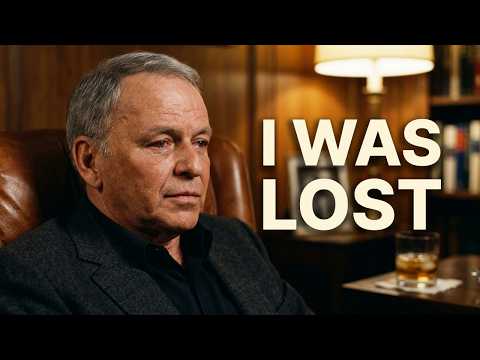
Frank Sinatra stood at the edge of the stage, the roar of the crowd still ringing in his ears, but inside, a silence louder than any applause. He had spent decades building a fortress of confidence, a persona so bulletproof that even those closest to him rarely glimpsed the cracks. But on this night, the cracks were widening, and the man the world thought it knew was about to unravel.
For the first time, the Chairman of the Board was forced to confront the one thing he had spent a lifetime avoiding: himself.
The world saw the swagger, the sold-out shows, the endless string of victories. They saw a man who never flinched. But behind the curtain, Frank Sinatra was fighting a war no one knew existed. He was a man who gave anonymously to strangers, who paid hospital bills for children he would never meet, and who insisted his name never be attached to a single act of kindness. “No credit, no acknowledgement, no story,” he would tell his intermediaries. The generosity was real, but so was the fear that if people saw the softness, the toughness would crumble.
And then there was the song. My Way—the anthem that defined him, that played at his funeral, that millions believed was his personal manifesto. He hated it. Not the song itself, but what it demanded of him. He had recorded it reluctantly, and for the rest of his life, he carried its weight like a burden he never chose. Night after night, he sang the words that felt less like a declaration and more like a sentence.
But the deepest secret, the one he kept locked away for decades, was not about generosity or a song. It was about a night in 1951 when the world nearly lost him. His career had collapsed, his voice had failed, and his relationship with Ava Gardner had become the only thing tethering him to life. When that tether frayed, he plunged into a darkness so complete that he saw no way out. He acted on that darkness. He survived, but the silence that followed was deliberate, a pact between him and the few who knew.
Only in his final years did he speak of it—quietly, without drama, with a clarity that stunned those who heard. “I was there,” he admitted. “I came back because something in me refused to let that be the end.” The same man who filled every room with laughter and music had once been a man who needed saving. And that, perhaps, was the most human thing about him.
The silence in the room after he said it was not uncomfortable. It was the silence of people who had just been handed something fragile and were afraid to move. Sinatra did not elaborate. He did not turn the admission into a story with a beginning and an end. He simply let it sit there, exposed, and then he changed the subject with the ease of a man who had spent a lifetime learning how to close doors.
But the door had been opened. And once opened, it could not be fully shut again.
Those who were present that night would later describe a shift in him that was almost imperceptible at first. He was still Frank. Still the man who commanded a room, who told stories that made people laugh until their sides ached, who could silence a crowded restaurant with a single raised eyebrow. But there was something different in the way he carried himself afterward. A softness that had not been there before, or perhaps had always been there but had never been allowed to breathe.
He began, in small ways, to let people closer. Not everyone. Not even most. But a select few—his daughter Nancy, a handful of lifelong friends, a priest he had known for years but had never fully trusted with the truth—were given glimpses of the man beneath the image. He talked about the night in 1951 more than once, though never in detail. “I don’t know why I’m still here,” he told one of them. “But I am. And I figure that means something.”
That admission, simple as it was, carried more weight than any award he had ever received. Because for Frank Sinatra, acknowledging that his survival might have meaning was a kind of surrender. He had spent his entire life insisting that he was the author of his own story, that every triumph was earned and every comeback was willed into existence. To admit that something else—fate, grace, luck, call it what you would—had played a role was to admit that he was not entirely in control.
And control, for Sinatra, had always been the whole game.
The years that followed were not a transformation. He did not become a different man. He still had a temper that could scorch the paint off a wall. He still demanded perfection from everyone around him and gave nothing less in return. He still filled the silence after every show with voices and laughter and the clink of glasses, because the silence was still the hardest part. But there was a new honesty in the way he moved through the world. He stopped pretending that the toughness was the whole story.
When asked, in one of his last interviews, what he wanted people to remember about him, he did not say My Way. He did not say the comeback, the Oscar, the decades of sold-out houses. He paused for a long moment, and then he said something that surprised everyone in the room.
“That I showed up,” he said. “That I was scared plenty of times and I showed up anyway.”
It was not the answer anyone expected from the Chairman of the Board. It was not the answer the legend demanded. But it was the truth, and by then, Frank Sinatra had decided that the truth was worth more than the legend.
He had spent a lifetime building a wall between who he was and who the world believed him to be. And in the end, the wall came down not with a crash, but with a quiet admission, spoken in a small room to a handful of people who had earned the right to hear it.
He had been there. He had come back. And he had spent the rest of his life proving that coming back was worth it.
There is a recording of Sinatra from those final years, one of the last sessions he ever did. The voice is not what it was. The power is diminished, the range is narrower, the breath is shorter. But there is something in it that was never there before—a vulnerability, a willingness to let the cracks show. He is singing a ballad, something slow and aching, and you can hear the weight of every year in every phrase.
And then, in the middle of the song, he does something he almost never did. He lets a note fade instead of holding it. He lets the silence come. And for a moment, the man who had spent his entire life filling every empty space with sound simply let the emptiness be.
It was, for those who knew what to listen for, the most honest thing he ever recorded.
The men who worked with him in those final sessions noticed it too. “He used to attack a song like it owed him money,” one engineer recalled. “Toward the end, he just let it breathe. Like he was having a conversation instead of giving a command.” The change was subtle enough that most listeners never caught it. But the ones who had been in the studio with him for thirty years heard it instantly, and more than a few of them had to look away.
Sinatra never explained the shift. He did not have to. The men around him had watched him bury friends, outlive enemies, and survive things that would have flattened a lesser man. They understood that a voice can only carry so much weight before it either breaks or learns to soften.
He chose to soften.
There was one more thing, though, that almost nobody knew. Something that had been sitting in a drawer for years, waiting for the right moment, or perhaps waiting for the courage to let it out.
It was a letter. Handwritten, never sent, addressed to the child he had lost—the son who had been born too early, in 1940, and who had lived only a few hours. Frank Sinatra had never spoken of it publicly. Not once. The world knew about his three children with Nancy Barbato, knew about the tabloid drama and the marriages and the headlines. But the child who never came home—that was a grief he had folded so tightly and stored so deep that even his closest friends were not certain he had ever fully processed it.
He had written the letter on the night of the 1951 collapse. Not to send. Not to share. Just to say the things he could not say out loud to anyone living. He wrote about being sorry. He wrote about being scared. He wrote about not knowing whether he was a good man or a bad one, and whether it even mattered anymore.
And then he folded it, placed it in an envelope, and put it away.
Decades later, in the last year of his life, he pulled it out. He did not read it aloud. He did not show it to anyone. But he told his daughter Nancy that it existed. “There’s a letter in my desk,” he said. “When I’m gone, you can read it. But not before.”
She never asked what was in it. She did not need to. The fact that he had told her at all was the message. The man who had spent a lifetime refusing to be seen had finally allowed one person to know that there was something to see.
Frank Sinatra died in 1998, and the world mourned a legend. The obituaries spoke of the voice, the swagger, the comeback, the Oscar, the endless encores. They spoke of My Way and New York and the bobby soxers and the Rat Pack. They spoke of a man who had lived several lifetimes in one.
What they did not speak of—what they could not know—was the letter in the desk. And the boy who never came home. And the night in 1951 when the Chairman of the Board sat alone in a dark room and decided, against every instinct and every expectation, to keep going.
That was the real Frank Sinatra. Not the one who filled the room, but the one who filled the silence. Not the one who never flinched, but the one who flinched and stood up anyway.
He had shown up. Scared, cracked, and carrying more than anyone knew. And he had shown up anyway.
Nancy waited a full year before she opened the drawer. When she finally did, she found the envelope exactly where he had said it would be, the paper gone soft at the creases from decades of sitting untouched. She read it alone, in a quiet room, and she never shared a word of what it said.
But she did say this much, years later, in an interview she almost cancelled: “My father was not a simple man. But he was a real one. And the real one was better than the legend.”
That is the thing about the strongest people we know. We build monuments to the version of them that never wavered, and we forget that the monument was carved by hands that shook. Frank Sinatra shook. He shook in 1951, in a dark room, alone. He shook in a thousand hotel suites after a thousand standing ovations. He shook when he wrote a letter to a son who never drew breath.
And then he walked out and sang anyway.
Maybe that is the whole story. Not the voice. Not the swagger. Not My Way. Just a frightened man who kept showing up.
So here is the question, and it is not a small one: when you look at the people you admire most, are you admiring who they really are—or the wall they built so you would never have to see the cracks? And more importantly, which one are you building right now?
Report this article
Select a reason for reporting:






