At 12:40 a.m. on an October night in 1945, Harlem didn’t wake to gunfire—it woke to paper. Fifty thousand copies of a newspaper flooded every corner, every doorstep, every sidewalk, each page carrying a single, damning message: Bumpy Johnson must be erased. The ink was still warm from the press, smelling of chemicals and something darker—the particular stink of anger laid down in type. By dawn, the sidewalks were buried. By 6 a.m., Harlem was reading, and what it read was designed to destroy one man.
The headline filled the entire top third of the front page: “Bumpy Johnson Betrays Harlem.” Beneath it, three columns of accusations—names, dates, dollar amounts, quotes from sources nobody could identify. The story was built the way all good lies are built: 90% truth, 10% poison, mixed so thoroughly you couldn’t separate them without bleeding.
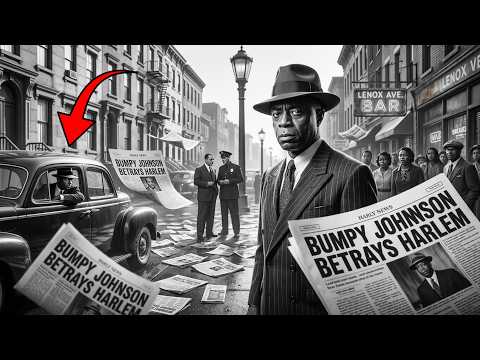
In the barbershop on 125th Street, men read the paper the way people read a death notice—carefully, quietly, hoping they misunderstood something. A numbers runner named Clarence, who had worked Bumpy’s corners for eleven years, stood outside the Lennox Diner with the front page in both hands. He read it once, twice, three times. Then he folded it, tucked it under his arm, and went home. He didn’t run his numbers that day. Nobody asked why. They already knew.
That was the first casualty—not a person, but a decision. By the second day, hesitation had spread like a fever. Small business owners on 7th Avenue locked up an hour before dark. A woman named Mrs. Estelle Carter, who ran a laundry on 118th Street, pulled her youngest daughter aside and said, “When papers start printing a man’s name like that, the decision’s already been made somewhere. We’re just the last ones to find out.” She said it the way women in Harlem said hard things—low, flat, without drama, because the drama was already in the facts.
Bumpy Johnson heard about the papers at 5:45 a.m. He was at the kitchen table of a brownstone on 131st Street, coffee going cold beside him, when his lieutenant Deacon walked in and set a copy down without a word. Bumpy didn’t flinch. He read it the way a surgeon reads a scan—looking for information, not feeling. He noted each accusation, the specific dates they cited, what they left out. Then he folded the paper, set it on top of his coffee cup so it wouldn’t blow off the table, and sat in silence for a long time.
Deacon waited. Finally, Bumpy said, “Don’t touch it. Don’t answer it. Don’t even look angry about it.”
Deacon’s jaw tightened. “They’re calling you a traitor to your own people.”
“I heard what they called me.”
“The corners are already spooked. Two captains called this morning. They want to know what we’re doing.”
Bumpy looked at him. “Tell them we’re doing nothing. That’s exactly what we’re doing.”
He meant it. He ordered silence down the entire chain—no statements, no threats, no visible reaction of any kind. Numbers runners kept their routes. The women running the community kitchens and clothing funds Bumpy had quietly financed for years kept working, kept showing up, kept saying nothing. He withdrew every visible signal of power and let the street go cold.
It was a brutal calculation, because silence in this game is a double-edged knife. Every hour he stayed quiet, the newspaper filled the vacuum. New editions dropped Wednesday, Thursday, Friday—each one louder than the last, each one adding names, adding quotes, adding the weight of institutional credibility. A city councilman gave a statement. A precinct captain gave a statement. The machine was running, and it had been running for a while before Bumpy ever saw the first page.
By Friday afternoon, three of his corner captains had pulled operations back without being told to. Not deserting—just shrinking. Just in case. Bumpy sat with that overnight and understood now what this was. This was not a hit on his reputation. Reputation can be rebuilt. This was psychological demolition—breaking the ground before they brought in the foundation for someone else. Make Harlem believe Bumpy was already gone. Then when the next move came, it wouldn’t feel like a takeover. It would feel like a rescue.
He called Deacon back in before dawn. “Follow the money behind that paper,” he said, not loudly, quietly. “Find every invoice, every advertiser, every printing contract. Find who’s been paying for 50,000 copies of something nobody ordered. Find the hands before they finish building whatever they’re building.”
Deacon nodded and left without another word. In this game, the man who holds his silence the longest is almost always the man who has already chosen the burial ground.
The old men on Lennox still say those first headlines hit harder than any gunshot they’d ever heard on those streets. A bullet at least shows you the wound. Ink just makes you bleed from the inside.
By the start of the second week, Harlem had learned to hate its morning routine. Wake up, smell the coffee, hear the paper hit the stoop, feel your stomach drop before you even picked it up—because every morning brought a new installment in the ongoing public execution of Bumpy Johnson’s name, and every installment was more specific, more damning, more carefully sourced than the one before.
The downtown crew running this operation understood something most criminals never figure out. A knife makes noise. A story is silent. And a story told right kills slower and deeper than anything with a blade.
Monday accused Bumpy of stealing from the community relief funds he’d personally built during the war years—the same funds that kept families in this neighborhood from going hungry when everything else failed. Tuesday produced an unnamed former associate who swore Bumpy had sold out a rival operation to the NYPD in 1942 in exchange for protection.
Wednesday ran a photograph. Grainy, poorly lit. A heavy-set man in a dark hat standing outside a Bronx police precinct. The caption beneath it read, “A familiar face in unfamiliar company.” It wasn’t Bumpy. Anyone who knew the man could see that in three seconds. But three seconds is not how people read things they already half believe. They read slowly. They look twice. They think, Well, it could be. And that half-second of doubt is all the weapon needs to work.
This was character assassination running at industrial scale. Every accusation engineered to demand a denial—because in the court of street opinion, the man who defends himself has already confirmed the charge exists. The crew downtown had built a machine that fed on response. The only way to starve it was to give it nothing.
Bumpy gave it nothing. Instead, he deployed three men—quiet men, careful men, men who had spent their careers moving money and would know how to follow it. No names written anywhere. No meetings in visible places. Their assignment was clean and precise: Start at the newsstands and work backward until you find the hand that’s feeding this thing.
They started with the economics. Fifty thousand copies daily at three cents each generated $1,500 in street sales. That sounds like money until you price out the full operation—printing costs, paper stock, distribution across every corner of Harlem, the staff to write and edit and lay out a daily paper, and the advertising campaign running simultaneously in parallel publications to legitimize the whole thing. The numbers bled red from day one.
Someone was covering the difference, and covering it without hesitation—which meant the budget behind this was not a street investment. This was corporate money. This was patience money.
The printing house was on West 43rd Street. Mid-sized operation. Three other clients, none of them political. The manager, a man named Farucci, had the eyes of someone who hadn’t slept properly in two weeks. He provided invoices when pressed. Some of them. The others had been misfiled, he said. He’d have to look. He looked for the rest of his employment there and never found a single one.
But what he did hand over was enough. The invoices pointed to a holding company in Lower Manhattan. The holding company dissolved into a law firm in Midtown that existed primarily to insulate its clients from exactly this kind of backward tracking. The law firm, pushed through channels that cost Bumpy three favors and one very uncomfortable conversation, pointed to a family name. Not a street crew. Not a local capo with ambitions above his station. One of the five families that owned the architecture of organized crime in New York City.
Bumpy received that information on a Thursday evening, alone, and sat with it for six hours without speaking to anyone—because the information changed the geometry of everything. This was not a territorial dispute. This was a corporate acquisition. The newspaper wasn’t the weapon; it was the marketing campaign. Soften the community, erode the trust, make the transition of power feel inevitable. Then walk in and take what was never theirs to take.
He called Deacon in at midnight. “It’s a family operation.”
Deacon sat down like a man who’d just been told the building he was standing in had no foundation. “Which one?”
Bumpy told him. The name sat in the room like something physical. After almost a full minute, Deacon said, “That changes everything.”
“It changes the size,” Bumpy said. “Nothing else.”
His accountants cross-referenced every advertising purchase against known business fronts with documented ties to the family. They found three direct lines. They wrote everything by hand, on paper stored in a location that existed in no record anywhere—a map built not from streets, but from transactions. And on that map, the origin of the newspaper was visible as a scar.
Whoever funds the story controls what history remembers. The crew downtown believed that completely, and they weren’t wrong to believe it. Money had been purchasing truth in this city since before any of them were born. But money is not invisible. It moves. It leaves marks. It passes through human hands. And human hands make mistakes. And mistakes leave paper. And paper—the right paper, found by the right people—is the most dangerous weapon in any room.
Bumpy didn’t strike back with soldiers. He struck with supply lines. For three consecutive Tuesdays, the New Jersey paper company’s deliveries to the West 43rd Street printing house failed—a routing error, a counting mistake, a breakdown on the Holland Tunnel approach. Each disruption looked like an accident; stacked together, they screamed.
Sal Neri felt the squeeze. He pumped in family money, then personal capital, and in doing so made the critical error Bumpy had engineered: he called in political insurance. A councilman, a precinct captain—both said yes. Both left paper.
Then the funeral changed everything. When Marcus Webb was gunned down, Bumpy refused to retaliate. Instead he filled First Corinthian Baptist with five hundred silent Harlem residents. “Sal needed to see what he’s actually up against,” Bumpy told Deacon. The photograph ran without a caption. It didn’t need one.
By Thursday, the bank called the loan. The printing house demanded cash in full. Advertisers canceled in a single 48-hour window. The final edition was four sentences long—a notice of indefinite suspension. Sal met Bumpy once, alone, in the back room on 7th Avenue. No handshake. Just terms: the family withdraws from Harlem for five years, and the documents vanish.
Arthur Wells relocated to Philadelphia. The ledger was never produced. Harlem didn’t celebrate—it exhaled. The floor didn’t flex the same way anymore.
Bumpy held his neighborhood not because he was innocent, but because he was patient—willing to spend parts of himself that never grew back. Some debts from that October were never settled in any room anyone could name.
So tell us: can a man protect his community using the same methods that harm it—and if Bumpy had done nothing, would Harlem have survived without him?
Report this article
Select a reason for reporting:






