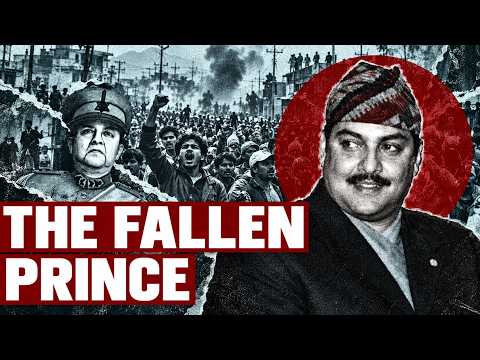
Imagine being born into the only Hindu kingdom on earth, where your family is worshipped as living gods. Imagine knowing that one day, an entire nation will bow to you. Now imagine all of it being ripped away—not by an invading army, but by a single night of gunfire inside your own home. That is the story of Paras Shah, the last crown prince of Nepal, a man who went from heir to a 240-year-old throne to a disgraced exile making headlines for all the wrong reasons.
To understand what happened to Paras, you have to understand the world he was born into. The Shah dynasty was not just any royal family; they literally built the nation of Nepal. Their story begins in the mid-18th century, when a young king named Prithvi Narayan Shah ascended the throne of Gorkha, a small hill kingdom. From the very beginning, he had a vision that went far beyond his tiny domain. He looked at the fractured kingdoms of the Kathmandu Valley and saw not chaos, but opportunity.
Prithvi Narayan Shah launched a campaign of conquest that would take him over two decades to complete. He captured strategic fortresses, imposed blockades, and one by one, the valley kingdoms fell. In 1768, he captured Kathmandu itself, timing his assault to coincide with a festival when the city’s defenders were distracted by celebration. He moved his capital to Kathmandu and declared the unified kingdom of Nepal. The Shah dynasty was born, and it would rule this Himalayan nation for the next 240 years.
For most of that history, the Shahs were not actually governing. From 1846 to 1951, real power was held by the Rana family, a line of hereditary prime ministers who reduced the Shah kings to figureheads locked away in their palaces. It was not until 1951 that King Tribhuvan, with the backing of India, overthrew the Rana regime and restored the monarchy to actual power. His grandson, King Mahendra, then went further. He dissolved parliament in 1960, banned political parties, and established what he called the Panchayat system, an autocratic framework that gave the king absolute authority.
And so for decades, the Shah kings ruled Nepal as near absolute monarchs. Their legitimacy rooted not just in political power but in religious authority. The king of Nepal was considered a living incarnation of the Hindu god Vishnu, a divine figure whose word carried the weight of cosmic law. To question the king was to question the gods themselves.
It is into this world—this extraordinary bubble of power and divinity—that Paras Bir Bikram Shah was born on December 30, 1971. Paras was the only son of Prince Gyanendra and Princess Komal. His grandfather was King Mahendra, the architect of the Panchayat system. His uncle was King Birendra, who had taken the throne in 1972 and under massive public pressure during the people’s movement of 1990 had agreed to transition Nepal into a constitutional monarchy with a multi-party parliament.
Paras grew up inside the Narayanhiti Royal Palace in Kathmandu, a sprawling compound that was less a home and more a self-contained universe. He received his early education at some of the finest schools available to Nepali elites, and by all accounts he lived a life of extraordinary privilege. But privilege, as history has shown us again and again, does not guarantee character. From a young age, Paras developed a reputation that would haunt him for the rest of his life. He was known as a wild child, a young man who seemed to believe that the rules governing ordinary people simply did not apply to him.
There were stories of reckless behavior, of late nights at Kathmandu’s nightclubs, of drinking and partying that seemed completely at odds with the solemn dignity expected of a member of the royal family. In a country where the king was worshipped as a god, the crown prince’s son was behaving like a playboy. And then in August of 2000, something happened that turned public annoyance into genuine rage.
A popular Nepali singer named Praveen Gurung was riding his motorbike near the eastern gate of the royal palace in Kathmandu when a blue Mitsubishi Pajero allegedly struck and killed him. Police officers who witnessed the vehicle speeding through the streets reported that when they caught up to it, they found Prince Paras behind the wheel. According to reports at the time, when Paras arrived at the police station, he allegedly pointed a gun at the officer on duty and threatened him to keep quiet about what had happened.
The initial police reports recorded that Gurung had been hit by an unidentified vehicle, despite multiple officers having reported the Pajero’s registration number to the control room. Eventually, an army officer came forward and claimed responsibility for the accident, effectively shielding Paras from prosecution. The case was closed without charges. But the Nepali public was not fooled. Over 600,000 people took to the streets in protest, demanding accountability. It was one of the largest demonstrations Nepal had ever seen, and it planted a seed of resentment against the royal family that would grow into something much larger in the years to come.
For many Nepalis, the Praveen Gurung incident was proof that the monarchy was above the law, that the divine right of kings had become nothing more than a license for the powerful to destroy lives without consequence. And yet, despite all of this, what happened next was something that nobody could have predicted—something so shocking that it would fundamentally alter the course of Nepali history and set in motion a chain of events that would ultimately destroy the monarchy itself.
On the evening of June 1, 2001, the royal family gathered for their regular Friday night dinner at the Tribhuvan Sadan, a building within the Narayanhiti Palace complex. It was supposed to be a routine family gathering. King Birendra was there. Queen Aishwarya was there. Prince Nirajan, Princess Shruti, and several other members of the extended royal family were all present. The only senior member who was notably absent was Prince Gyanendra, Paras’s father, who was away in the southern district of Chitwan.
Crown Prince Dipendra, Birendra’s eldest son and the heir apparent to the throne, arrived at the dinner and, according to multiple accounts, had been drinking heavily. Some witnesses said he had also smoked hashish mixed with another substance. He became unruly. He misbehaved with a guest. His father, King Birendra, told him to leave the party. His brother, Nirajan, and his cousin, Paras, helped escort the stumbling crown prince to his room.
What happened in those next minutes would become one of the most debated events in modern Asian history. Dipendra returned to the gathering, but he was no longer the stumbling drunk who had been led away. He was dressed in army fatigues and armed with an arsenal of military-grade weapons, including an assault carbine, a submachine gun, and a shotgun. And then he opened fire.
He shot his father, King Birendra, first. Then he shot his mother, Queen Aishwarya. Then he turned his weapons on his brother Nirajan, his sister Shruti, his aunts, his uncles, anyone who was in that room. In the space of just a few horrifying minutes, nine members of the royal family were dead or fatally wounded. Then Dipendra turned one of the weapons on himself.
Paras was there. He was in that room. And here, in the midst of this unimaginable horror, he did something that even his harshest critics would have to acknowledge as genuinely heroic. According to eyewitness accounts, as the gunfire erupted, Paras grabbed a sofa and pulled it over at least three members of the family, including two children, shielding them from the bullets. He himself sustained injuries during the massacre, but he survived.
Now, the aftermath of the massacre was absolute chaos. King Birendra was dead. Queen Aishwarya was dead. But Dipendra, despite having shot himself in the head, was still alive, lying in a coma in the military hospital. Under Nepali constitutional law, the crown passed to the next in line upon the king’s death. And that was Dipendra. So for three surreal days, Nepal had a comatose king—a man who had just murdered most of his own family, lying on a hospital bed with a bullet in his brain, wearing the crown.
On June 4, Dipendra died without ever regaining consciousness. And the crown passed to the next in line: Prince Gyanendra, Paras’s father—the man who had been conveniently absent from the palace on the night of the massacre. And Paras, the playboy prince with a scandal-plagued reputation, was suddenly the crown prince of Nepal, heir apparent to the throne.
The public reaction was not what you might expect for a grieving nation rallying around its new king. Instead, there was fury. Suspicion. Conspiracy theories spread like wildfire through Kathmandu. Many Nepalis simply could not believe that Dipendra, who had been beloved by the public, would have committed such an act on his own. They looked at the fact that Gyanendra and his immediate family—the very people who stood to gain the most from the massacre—were the ones who survived.
The conspiracy theories were never proven, and the official government investigation named Dipendra as the sole perpetrator. But the damage to the monarchy’s legitimacy was catastrophic and permanent. And so, Gyanendra took the throne under a cloud of suspicion that would never fully lift.
He was a very different kind of king from his brother. Where Birendra had been seen as gentle, approachable, and supportive of democratic reforms, Gyanendra was perceived as aloof, authoritarian, and deeply contemptuous of the democratic process. He was a chain-smoking royal with expensive tastes and a penchant for astrology, and he made no secret of his belief that the parliament was an obstacle rather than a partner.
Meanwhile, Nepal was already in the grip of a crisis that had been building for years. In 1996, the Communist Party of Nepal—known as the Maoists—had launched what they called a People’s War, a full-scale armed insurgency aimed at overthrowing the monarchy and establishing a communist republic. The insurgency was rooted in genuine grievances. Nepal was one of the poorest countries in Asia, with staggering inequality, a rigid caste system that kept millions in permanent poverty, and a political establishment that seemed incapable of addressing any of it.
The Maoists drew their support from the rural poor, from landless farmers and oppressed communities who had been failed by every government in living memory. By the time Gyanendra took the throne in 2001, the Maoist insurgency had already claimed thousands of lives and was spreading rapidly across the countryside. Successive elected governments had failed to contain it. Ceasefires were declared and collapsed. Peace talks stalled and restarted and stalled again. The country was caught in a spiral of violence that showed no signs of ending.
And this is where Gyanendra made the decision that would ultimately destroy the monarchy. On February 1, 2005, King Gyanendra dismissed the elected government, suspended the constitution, and assumed direct control of the state. He declared a state of emergency, curtailed civil liberties, arrested journalists and political leaders, and shut down telecommunications. He told the nation that this was a temporary measure—that only a strong hand could crush the Maoist insurgency after elected governments had failed. But in truth, it looked an awful lot like a power grab, an attempt to restore the kind of absolute monarchy that his father, Mahendra, had enjoyed decades earlier.
The gamble backfired spectacularly. Instead of weakening the Maoists, Gyanendra’s seizure of power achieved something that years of conflict had never managed. It united the Maoists and the mainstream political parties against a common enemy: the king himself. In November of 2005, the Maoists and seven major political parties signed a twelve-point understanding, an agreement to jointly oppose royal rule and work together to restore democracy.
Then came what Nepalis call Jana Andolan, the second people’s movement, and it was one of the most remarkable uprisings in modern South Asian history. In April of 2006, millions of Nepalis took to the streets. For nineteen straight days, they defied curfews, police crackdowns, and threats of violence. They marched in Kathmandu and in towns and villages across the country. They shut down roads and businesses. They demanded the restoration of democracy and the end of monarchical rule. The scale of the protest was staggering. The entire nation seemed to rise up at once.
Faced with this overwhelming tide of public anger, Gyanendra capitulated. He reinstated the dissolved parliament, gave up his emergency powers, and the parliament in its very first session back voted unanimously to strip the king of virtually all his remaining authority. His control over the army was removed. His veto power was eliminated. His tax exemptions were revoked. He was, in effect, reduced to a ceremonial figurehead overnight.
But the political parties and the Maoists were not finished. They wanted the monarchy gone entirely. In December of 2007, parliament voted 270 to 3 in favor of abolishing the monarchy. And on May 28, 2008, the newly elected constituent assembly—in which the Maoists had emerged as the largest party—formally declared Nepal a federal democratic republic. The 240-year reign of the Shah dynasty was over.
For the Shah family, the transition from royalty to civilian life was swift and unceremonious. The Narayanhiti Royal Palace was converted into a museum. The family was stripped of all titles, privileges, and legal immunities. They were, in the eyes of the law, ordinary citizens.
Paras seemed to spiral. Within weeks of the monarchy’s abolition, he left for Singapore. Then came the headlines: a drunken altercation at a forest resort where he allegedly fired a pistol into the air, drug arrests in Thailand, and a public confrontation with a traffic officer. He was a man who had never learned to function outside the golden cage.
His health, too, collapsed. Five heart attacks by the age of 53. A hereditary vulnerability, doctors said, compounded by a lifestyle that had not been kind to his body.
Today, the palace is a museum. The throne exists only in memory. Paras Shah still bears the name, but the kingdom is gone. Was Nepal better off without its divine kings—or did it trade one cage for another?
Report this article
Select a reason for reporting:






