Deep in the anthracite-dark heart of a Colorado mountain, a miner’s pick struck iron that should not have existed. It was October 17, 1893, and Tomaž Kastelic was 1,140 feet inside the Elk Mountains, working a coal seam that had lain undisturbed for seventy million years. The pick did not ring against rock. It rang against something else—something with a handle too thick for a man’s arms to encircle and a blade taller than a grown man. What Kastelic and his crew would uncover over the next three days would defy every law of geology, metallurgy, and common sense. And it would set in motion a mystery that would stretch across three states, two centuries, and the memories of a people who had been driven from that land just twelve years before.
This is the story of a tool that was never meant to be found. A tool that the Ute people already had a name for, though they had never seen it. A tool that two separate records—one written in lamplight by a mining engineer, the other spoken in a Utah reservation forty-three years later—would describe with uncanny, impossible precision. The same length. The same number of teeth. The same hole through the pommel. Neither witness knew the other existed.
The mine itself was real. The coal seam was real. The laws, the maps, the ledgers—all real. The unanswered questions begin only after that point. In 1893, the Anthracite mine was owned by Colorado Fuel and Iron, carved into a mountainside north of Crested Butte. The seam was thin—three or four feet thick—and the men worked bent double, sometimes on their knees, in the flickering light of oil lamps. Above them lay six hundred feet of rock. Below them, a company town of the same name clung to the slope, its boarding house and store serving miners who had come from Slovenia, Wales, Cornwall, and Ireland to dig black stone from the earth.
Kastelic was twenty-nine, a quiet Slovene from Ribnica who had been in Crested Butte since 1886. He knew the mountain’s moods—when the roof was about to talk, when the gas was about to smell. But nothing had prepared him for this. For several days, the seam had been behaving strangely. Miners called it a roll—the coal thickening and bending. Four feet had become seven, then eight, then eleven within a few paces. That happened. Coal remembered the hollows and twists of the ancient swamp it came from. But this swelling was round. The bands of the coal were bending as if they were turning around something.
That afternoon, Kastelic’s pick came down at the center of those bands. The sound was wrong. Not the dry, glassy crack of anthracite splitting. A short, dull ring. Metal on metal. The shock ran up the handle into his arms and shoulders. He brought his lamp closer. In the crack his pick had opened, there was a dark, dull surface. Rough. Crusted with rust. Curved.
He called the man working beside him—Llewellyn Price, Welsh, the biggest man on the crew at six foot three. Together they widened the crack. Then the pit boss came. Michael Tully, from County Mayo, forty-two years old with twenty of them underground. Tully had a habit. At the end of every shift, he wrote a few short lines in a small, thick, black-covered book he kept in his pocket. How many cars of coal came out. Which roof was sagging. Who got hurt.
On the evening of October 17, 1893, he wrote this: North heading, iron in the coal, not ours.
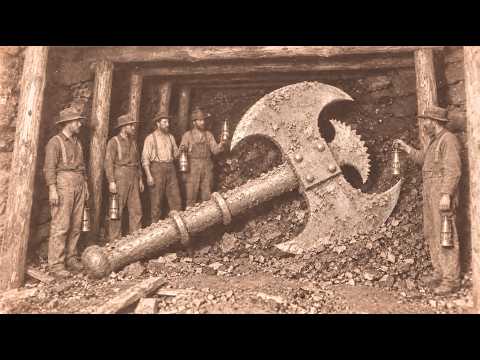
For three days, three men cleared the coal away from it. First with picks, then with hand tools, then almost with their fingers. Tully told them to go carefully, as if something might break. Each day, more of it showed. First part of the shaft. Then a ring. Then a square bolted plate. Then, on either side of the plate, two broad curved iron wings bending away into the coal.
On Friday, October 20, Tully sent word up to the office. The next day, an engineer came down. His name was Walter H. Ashby, and the first record of this story is his field book. Ashby was thirty-one, born in Pottsville, Pennsylvania—the heart of the anthracite country. He had grown up in the very valleys that coal came from. He graduated from Lehigh University as a mining engineer in 1884 and came to Colorado in 1888. At CF&I’s Anthracite mine, the surveys, the maps, and the ventilation figures were his. There were very few men in Colorado who knew better than he did what could and could not be inside that seam.
For three days, from October 22 to October 24, Ashby worked beside it. He brought his transit, a measuring tape, two lamps, and his field book. Eleven pages of that book and four pencil drawings still exist. On the first page, he wrote down where it lay: Level two, north heading, 1,140 feet from the portal, where the seam swells. He tied the spot to the nearest survey station on the mine map and carried a line back to the portal—bearing and distance—so that anyone who came after him could find it again to within a foot. It was a routine thing for a mine surveyor to do. It would matter twenty-six years later.
On the second page, he described the coal. The coal around the object was the same as the coal in the rest of the mine—same luster, same hardness—and the bands, Ashby wrote, turned around it like the growth rings of a tree around a nail. There was no crack. There was no void. There was no path by which anything could have fallen or worked its way in from above. At the very bottom of the third page, he wrote a single sentence and underlined it: The coal formed around it.
Ashby knew what that sentence meant. He knew the age of the coal—more than seventy million years. And so, from the fourth page on, he wrote no more opinions. He only measured. But what he measured says everything he did not write.
Pages four through eleven of Ashby’s field book read like an inventory—unemotional, numbered, the language of an engineer trying to describe what is in front of him to someone who will never see it. Overall length: 17 feet 8 inches. The tool lay across the seam at an angle. The butt end of the shaft had come free of the coal and sloped down toward the floor of the heading. The head was still buried in the thickest part of the seam, at the very center of the swelling.
The shaft: 13 feet from pommel to head, round, straight, like a tree trunk. Ashby put his tape around it: 5 feet 4 inches. That number deserves a moment. A grown man’s hand closes comfortably around a handle 4 to 4½ inches around—a pick handle, an axe handle, a hammer. Every tool the human hand has held from the Stone Age until now has been shaped to the size of that hand. This handle was not 4 inches around. It was 64. Price, the biggest man on the crew, wrapped both arms around the shaft. His fingertips did not meet on the other side. Tully wrote in his book: Price can’t reach round it.
On the shaft, evenly spaced, sat two raised collars—thick, rounded rings, their faces lined with fine parallel grooves. Not cast. Forged. At the butt of the shaft, a heavy round pommel, 26 inches across. In his sketch, Ashby compared it to a cannonball.
Then the head. At the end of the shaft sat a square iron plate, 30 inches on a side. At its four corners, four domed bolt heads, each the size of a man’s fist. The plate joined the head to the shaft crosswise, the way an axe head sits on its handle. But this was not an axe. From the front of the plate swept a broad, deep, full crescent. Its two horns curved back and ended in sharp points. Horn tip to horn tip: 7 feet 9 inches. The edge was smooth, and along that edge, where Ashby went over it with a hand lens, ran fine, regular, parallel lines. The kind of lines a whetstone leaves. Ashby measured their angle. Along the whole length of the edge, they ran at the same slant—about 30 degrees. The angle at which a hand holds a stone against a blade. The blade had been sharpened.
From the back of the plate rose a second crescent, two-thirds the size of the first—5 feet 2 inches—the same deep curve, the same horns sweeping back. But the edge of this crescent was not smooth. It had teeth. Ashby counted them one by one: 13. Each about 5 inches long, triangular, evenly spaced. Not one of them broken. A cutting edge in front. Behind it, an edge made to rake, to scrape, perhaps to tear. Two faces for two different kinds of work on a single shaft.
The surface, Ashby wrote, was covered in coal dust and a thick crust of rust. Where the crust had fallen away, there was dark, dull metal beneath. Ashby tried a magnet. It held. Iron, or something very close to it. He made an estimate of the weight. He worked out the volume of the shaft and the head, and multiplied by the density of iron. The answer: roughly 20,000 pounds. Ten tons.
He paid particular attention to the bolts. None of the four domed heads had a wrench flat, a corner, or a thread. The heads looked as though they had been hammered over while they were hot, like rivets. This head was never meant to come off. It had been fitted once and left that way.
There was something in the pommel, too. Straight through its center, from one side to the other, ran a clean round hole 3 inches across—for a rope, a chain, perhaps a strap. Ashby held his lamp to the hole. It was clean. There was no coal inside it. There was rust, but no coal.
And in the corner of his first drawing, beside the tool, Ashby drew a small human figure for scale—5 feet 8, his own height. The figure did not reach even halfway from the pommel to the head.
The men below could see that difference, too. Tully’s entry for October 23 is short: Two men won’t go up the north heading. The old Cornish miners talked about the Tommyknockers—the unseen things that worked inside the mountain and left their tools behind. The Slovenes crossed themselves. Kastelic kept going. Every morning, during the measurements, he held the lamp.
And then came what may be the quietest and most important detail in this story. On October 25, Tully tried to move it with twelve men, a mule, and two jacks. They wanted to free the butt end—the pommel—from the coal completely. The jack handles bent. The mule pulled. The tool slid three feet. And when the pommel came out of the coal, it left a hollow behind. The coal held the shape of the pommel and the first collar as a perfect negative—a mold. Even the fine grooves on the collar showed in the face of the coal.
An engineer knows what that means. If an object had entered the coal later, through a crack, through a hole, the coal would not have taken its shape. The coal would already have been hard. A mold like that forms only when the object is already there while the material that will become coal is still soft and is pressed around it. Ashby drew the mold. It was his fourth and last drawing.
The same day, another problem appeared. The heading was six feet high. The head of the tool, from horn tip to horn tip, was 7 feet 9. It could not come out of the mountain—not without widening the heading, cutting the roof, and rebuilding the tramway. Weeks of work. And in the autumn of 1893, no manager at CF&I wanted to spend weeks of money on a heading that produced no coal.
On the evening of October 25, the superintendent, H. C. Wheeler, stopped the work. Here, we have to be fair. There is no need to look for a mystery behind that decision. In Colorado in 1893, a mine superintendent’s job was coal. The state’s economy was falling apart. Miners were waiting for work. The anthracite mine was already working a thin seam in hard conditions on a narrow margin. And throughout history, most of the strange things found in mines have turned out, in the end, to have ordinary explanations—tools abandoned from older workings, machine parts buried under an old roof fall, mineral nodules, iron sulfide and the like, that really did form inside the coal and happen to look as if hands had shaped them. Stories that grew among miners and leaked into the papers.
The anthracite mine had been working for eleven years. In that time, a great many things could have been lost underground. A great many things could have been buried. That explanation may be right, but it does not explain this. Since 1882, everyone who opened and worked the anthracite mine had mapped every entry and every heading inside that mountain. In October of 1893, the north heading was advancing into fresh coal that no one had ever entered. There were no old workings there. There was no roof fall. There was no abandoned machinery. Nobody leaves a ten-ton, seventeen-foot double crescent iron tool, sharpened and toothed, lying forgotten in a heading. And no mineral nodule carries thirteen even teeth, four domed bolts, and the marks of a whetstone.
There was one more reason, and it was not a sinister one. Word of a huge iron relic in the anthracite mine would have brought the curious up the mountain. Reporters, collectors, men who had never been underground wanting to walk 1,100 feet into a working with open lamps. Crested Butte had buried fifty-nine men from Jokerville only nine years before. No superintendent in that valley wanted visitors in his headings. For a coal company, Wheeler’s decision was the right one. But it did not answer the question. It only put it off.
Ashby did not want to put it off. Six days later, on Tuesday, October 31, 1893, he sat down at his desk and wrote a letter to Denver. We will come back to who that letter went to and what happened to it when it arrived. Because first, we need to hear from this mountain’s other witnesses—the ones who never saw the tool at all.
The letter went to Samuel Franklin Emmons, head of the Rocky Mountain division of the USGS. Ashby’s words vanished into a filing system, but the tool did not. It stayed in the dark, waiting.
In 1919, geologist Everett J. Sear re-entered the sealed heading. His measurements matched Ashby’s to within half an inch. Then he found something new: four sets of thirteen parallel grooves in the coal face, spaced 5 and 1/8 inches apart—the exact spacing of the rear crescent’s teeth. The tool had been used. Not once. Four times.
In 1936, anthropologist Anne Smith recorded an Uncompahgre elder describing a tool he had never seen: two moons back to back, one that cuts, one that bites with thirteen teeth. He called it the moon with teeth. He said it was not lost. It was put to sleep.
In 1986, a reclamation crew sealed the portal with concrete. Their form noted a large iron object, condition stable, left in place. The box for photographs was checked. The photographs are missing.
Five records. Four cities. Two states. Not one refers to another. Yet all describe the same impossible thing. The tool is still there, beneath Anthracite Mesa, in the dark.
So here is the question that remains: if something was deliberately put to sleep beneath that mountain—and if the miners woke it—what happens now that we have stopped watching? Tell us what you think in the comments.
Report this article
Select a reason for reporting:






