The war ministry building in Tokyo smelled of charred wood and sweat. At 2:30 a.m. on August 10, 1945, Colonel Masahiko Teeshida hunched over intelligence reports, his abacus clicking a rhythm of doom. Four days earlier, a single American bomb had erased Hiroshima. Seventy thousand people vanished in a flash hotter than the sun. Now, the numbers told a story no amount of spiritual conviction could alter.
Teeshida had been raised to believe the spirit of Yamato was invincible. Bushido—the way of the warrior—had sustained Japan through four years of brutal war. But the atomic bomb had done more than kill. It had killed the very framework within which Japanese resistance made sense.
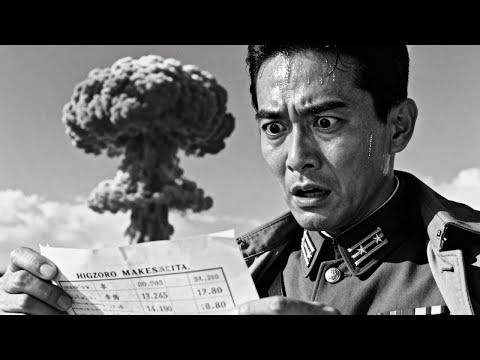
How could courage face a weapon that erased cities in seconds? What use was the willingness to die when the enemy could make death instantaneous for hundreds of thousands? The military elite had expected Americans to be soft, decadent, unwilling to sacrifice. They had been wrong.
On August 6, at 8:15 a.m., the Enola Gay released its payload. Temperatures at ground zero exceeded 3,000°C. Steel melted. Concrete vaporized. Human beings became shadows burned into sidewalks. In less than a second, five square miles ceased to exist.
Lieutenant Colonel Saburo Hayashi, stationed near Hiroshima, reported to Tokyo with words no military training had prepared him to speak: “There are no tactics for this. There is no defense against this. This is the power of gods, and our enemies wield it as casually as we might fire a rifle.”
The Supreme War Council remained deadlocked. The Big Six—Prime Minister Suzuki, Foreign Minister Togo, Army Minister Anami, Navy Minister Yonai, and the two chiefs of staff—split exactly down the middle. Three favored surrender. Three demanded death before dishonor.
General Anami argued the bomb was a bluff. “They seek to terrify us with a single demonstration,” he declared. “But they cannot have many such weapons. This is psychological warfare, nothing more. The spirit of Japan cannot be broken.”
His reasoning reflected a fatal miscalculation. The Manhattan Project had employed 130,000 workers. Its Oak Ridge facility alone consumed more electricity than New York City. This was not a desperate gambit—it was the methodical application of industrial might Japan had never possessed.
On August 9, another bomb fell on Nagasaki. Forty thousand died instantly. But for Japan’s leaders meeting beneath the Imperial Palace, the news was not the day’s most devastating development. At one minute past midnight, 1.5 million Soviet troops had crossed into Manchuria. Operation August Storm had begun.
Within 24 hours, the Kwantung Army—Japan’s elite force of 700,000 men—was shattered. Soviet tanks swept across the plains like a steel hurricane. General Umezu received the reports with visible shock. “The Kwantung Army is being destroyed piecemeal,” he told Emperor Hirohito. “What we are witnessing is not a battle, but the complete annihilation of our forces in continental Asia.”
Manchuria had been the cornerstone of Japan’s empire—its industrial base, its source of coal and iron. Its loss meant economic collapse within months, even without invasion. Worse, Soviet forces were moving toward Korea, toward Hokkaido. Japan now faced invasion from two directions, from enemies whose combined resources exceeded its own by thirty to one.
In his sweltering office, Colonel Teeshida understood what his colleagues refused to acknowledge. Japan was not fighting American military forces. It was fighting American industrial civilization itself. The atomic bombs were merely the most dramatic manifestation of a productive capacity that had already overwhelmed Japan’s ability to resist.
On August 10, Japan sent a conditional surrender offer. But the American response, delivered through Secretary of State Byrnes, was uncompromising: “From the moment of surrender, the authority of the emperor and the Japanese government to rule the state shall be subject to the Supreme Commander of the Allied Powers.” No negotiation. No preservation of the old order.
General Anami read the message and reportedly said: “They demand that we place our emperor, the direct descendant of the sun goddess Amaterasu, under the authority of an American general. This is not surrender. This is the destruction of Japan itself.”
The deadlock continued for four more agonizing days. While American and Soviet forces prepared final assaults, six men in a basement debated whether national suicide was preferable to national humiliation. The arguments revealed how completely the atomic bombs had shattered traditional concepts of honor.
Foreign Minister Togo argued for acceptance: “To continue this war is not courage. It is the murder of our people for the sake of abstract principles that will die with them.” General Anami countered: “Better that we should die as Japanese than live as American slaves. Our ancestors conquered death itself through the purity of their devotion to honor.”
Outside, American aircraft dropped leaflets warning civilians to evacuate. The leaflets carried a message both compassionate and terrifying: “Your government has been given an opportunity to surrender. If they do not accept our terms, we will be forced to destroy your cities one by one. Evacuate these areas immediately. Save yourselves while there is still time.”
The psychological impact was profound. Japanese civilians had been told that American barbarism knew no limits. Now they were being warned to flee—by an enemy who possessed not only overwhelming power but also moral restraint. It undermined everything propaganda had claimed.
On the night of August 14, as Emperor Hirohito prepared to break the tie through direct imperial intervention, a group of officers made a final desperate attempt to prevent surrender. Major Kenji Hatanaka and his conspirators planned to occupy the Imperial Palace, place the emperor under protective custody, and prevent the broadcast of any surrender announcement.
The coup began at midnight on August 15. Hatanaka’s men killed Lieutenant General Takeshi, commander of the Imperial Guards, when he refused to join. They searched frantically for the recordings of the emperor’s surrender speech. For several hours, as dawn approached, the fate of Japan hung in the balance.
But the conspiracy collapsed. Palace guards loyal to the emperor surrounded Hatanaka’s forces. At dawn, Major Hatanaka and several followers committed suicide on the palace grounds, choosing death over witnessing their emperor’s surrender. Their final act embodied everything that had made Japanese resistance so fanatical—and ultimately so futile.
At noon on August 15, Emperor Hirohito’s thin, high-pitched voice crackled across Japan’s radio networks. The Gyokuon-hoso—the Jewel Voice Broadcast—was the first time an emperor had directly addressed his people. The speech was in classical court Japanese that many listeners could barely understand.
“To our good and loyal subjects,” the emperor began. “After pondering deeply the general trends of the world and the actual conditions obtaining in our empire today, we have decided to effect a settlement of the present situation by resorting to an extraordinary measure.”
He never used the word surrender. “The war situation has developed not necessarily to Japan’s advantage, while the general trends of the world have all turned against her interest. Moreover, the enemy has begun to employ a new and most cruel bomb, the power of which to damage is indeed incalculable, taking the toll of many innocent lives.”
These carefully chosen words carried the weight of an empire’s end. The new and most cruel bomb had done more than kill civilians. It had killed the belief system that had sustained Japanese resistance. The general trends of the world acknowledged that Japan was not merely losing a war, but witnessing the emergence of a new global order in which its traditional values had no place.
Across Japan, people gathered around radios in stunned silence. Many wept openly as they heard their god emperor acknowledge defeat. Some committed suicide rather than live with the shame of occupation. Others felt only overwhelming relief that the nightmare was ending. But all understood that they were witnessing the death of one Japan and the birth of another.
In military bases across the home islands, soldiers who had prepared for months to die in glorious final battles stood at attention and listened to their emperor order them to lay down their arms. Some units disbanded immediately. Others maintained discipline until American occupation forces arrived, surrendering their weapons with military precision even as tears streamed down their faces.
The transformation was not just political or military, but spiritual. Lieutenant Hiroshi Yanagida, a kamikaze pilot scheduled to make his final flight on August 16, wrote in his diary: “I had prepared my soul for death. I had written my final letters, performed my purification rituals, and accepted that my body would become a weapon for the emperor. But now the emperor himself tells us that we must live rather than die. What am I to do with a life that was already dedicated to ending?”
The atomic bombs had rendered meaningless not just Japanese military strategy but Japanese spiritual beliefs. For centuries, the warrior culture had taught that death before dishonor was the highest virtue. But what meaning did individual death have when entire cities could be obliterated in seconds? What significance could personal courage possess when the enemy wielded weapons that made courage irrelevant?
General Anami, who had promised that 20 million Japanese would die as shattered jewels rather than surrender, spent the evening of August 14 composing his death poem. “Believing in the eternity of our divine land, with my death, I apologize to the emperor for the great crime.” He committed seppuku using his father’s sword, while his aide delivered the final blow. His suicide note expressed the agony of a man whose entire worldview had been destroyed.
But Anami’s death represented the end of an era rather than the preservation of its values. The Japan that emerged from defeat would be built on different foundations. Not the warrior’s willingness to die, but the civilian’s determination to rebuild. Not the pursuit of military glory, but the achievement of economic prosperity. Not the conquest of others, but cooperation with former enemies.
The formal surrender ceremony took place on September 2, 1945, aboard the USS Missouri in Tokyo Bay. Foreign Minister Mamoru Shigemitsu, walking with a cane from an assassination attempt years earlier, signed the documents with hands that visibly trembled. General Umezu maintained rigid bearing as he affixed his signature to papers that ended his nation’s existence as an independent power.
Above them, nearly 500 American aircraft flew in formation—a demonstration of overwhelming force that made Japan’s decision to surrender appear not just inevitable but embarrassingly overdue. The aircraft embodied the industrial capacity to produce, maintain, and deploy technology on scales Japan had never imagined.
General MacArthur spoke of the future rather than the past: “It is my earnest hope and indeed the hope of all mankind that from this solemn occasion a better world shall emerge out of the blood and carnage of the past. A world founded upon faith and understanding, a world dedicated to the dignity of man and the fulfillment of his most cherished wish for freedom, tolerance, and justice.”
These words represented a revolution in thinking about warfare and its aftermath. Traditional conquest had been followed by subjugation and revenge. The American approach offered something unprecedented: the transformation of total defeat into democratic renewal, of occupation into partnership, of former enemies into future allies.
Emperor Hirohito, listening to radio reports from within the palace, issued a private statement that revealed how completely the atomic age had transformed his understanding: “We have learned that military strength without moral purpose leads to destruction. We have learned that spiritual conviction without material foundation leads to defeat. But most importantly, we have learned that true strength lies not in the willingness to die for abstract principles, but in the wisdom to live for concrete human values.”
The mushroom clouds over Hiroshima and Nagasaki cast shadows that extended far beyond physical destruction. They marked the end of an age when nations could believe that spiritual strength alone could overcome material disadvantage. Japan’s resistance had collapsed not because its soldiers lacked courage, but because the atomic bomb had rendered traditional concepts of military virtue obsolete.
The rice ball passed from American hands to Japanese mouths in the aftermath of surrender carried a promise that the new world would be built on different foundations. Not the warrior’s code of death before dishonor, but the citizen’s commitment to life, prosperity, and peaceful cooperation with former enemies.
The transformation was complete, but not without cost. Japan had lost not just a war, but an entire way of understanding itself. The price of learning that spiritual strength without material foundation leads to defeat was paid in the lives of millions. The price of discovering that courage without wisdom leads to catastrophe was measured in the destruction of cities and the shattering of families.
But from that suffering emerged a different kind of strength. Not the brittle hardness of the warrior’s sword, but the flexible resilience of the bamboo that bends without breaking. The Japan that rose from defeat would become not a military power but an economic miracle. Not a conqueror of territories but a creator of prosperity. Not an enemy of democracy but one of its most successful practitioners.
The symbol that best captured this transformation was not the mushroom cloud or the surrender ceremony, but something far simpler: American chocolate distributed to Japanese children in the months following occupation. That chocolate—manufactured in American factories, packaged with machinery Japan could not reproduce, distributed with a casualness that revealed vast abundance—represented the true power that had defeated Japan. Not merely the ability to destroy, but the capacity to create, to produce, to provide abundance so complete that warfare itself became unnecessary.
The children who received that chocolate would grow up in a Japan transformed by the recognition of American abundance. They would attend schools built with American aid, study sciences developed in American universities, work in industries created with American technology. They would live in a democracy inspired by American ideals, protected by a constitution written under American guidance, sustained by an economy integrated into an American-led global system.
The Bushido code that had proclaimed death before dishonor would give way to values that celebrated life, prosperity, and peaceful cooperation. The echoes of that August afternoon in 1945 continue to resonate today. They remind us that the most decisive battles are not always fought with traditional weapons. That the most complete victories arise not from superior violence, but from demonstrated abundance. That the most lasting peace comes not from conquest, but from the recognition that cooperation creates more prosperity than conflict ever could.
The Japanese resistance collapsed not because it lacked courage or dedication, but because it faced an opponent whose vision of human possibility transcended the ancient assumptions that had driven nations to war since civilization began—replacing them with something unprecedented: abundance so complete that it eliminated the fundamental scarcities that had made warfare seem inevitable.
In the end, the atomic bombs that ended World War II did more than demonstrate American military superiority. They revealed American abundance so overwhelming that they transformed the very concept of national power, replacing the ancient cycle of conquest and resistance with a new paradigm where prosperity and peace became not just possible but inevitable for those wise enough to choose cooperation over conflict.
Colonel Teeshida closed his abacus one last time. The numbers had spoken, and they demanded silence. Outside his window, dawn touched the ruins—and he understood that the empire he had served was already a ghost.
He tore the intelligence reports in half, then burned them in a tin ashtray. “We did not lose to a bomb,” he whispered to the empty room. “We lost to a world that no longer needed our swords.”
When the first American supply ships entered Tokyo Bay weeks later, Teeshida stood among the starving crowds. A young soldier handed him a rice ball, warm and white. He ate it slowly, tasting not humiliation—but survival.
What do you think—can a nation truly be reborn from the ashes of its most sacred beliefs?
Report this article
Select a reason for reporting:






