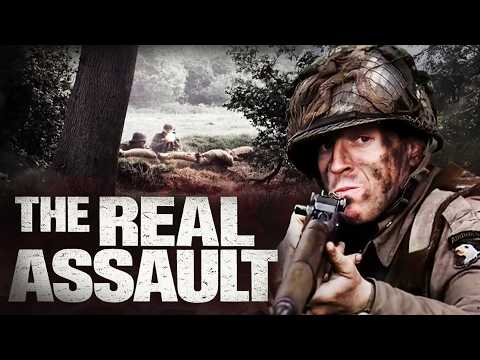
Normandy, June 6, 1944. As the first waves of Allied troops hit the beaches, a small group of paratroopers was already fighting for their lives inland. Their mission: to silence a battery of German artillery that was raining hell on Utah Beach. This is the story of Easy Company’s legendary assault on Brecourt Manor.
The men of Easy Company, 506th Parachute Infantry Regiment, 101st Airborne Division, had dropped into the darkness hours earlier. Scattered and disoriented, only a dozen men, including First Lieutenant Richard Winters, had reached the rallying point near Sainte-Marie-du-Mont. Among them were Lieutenant Buck Compton and Sergeant Bill Guarnere, each a leader in his own right.
As dawn broke, the sound of artillery fire grew louder. The guns were firing directly at causeway number two, the main exit from Utah Beach. Every shell that landed threatened the lives of the men coming ashore. Winters knew they had to act fast.
He led his small group toward the sound of the guns. Crawling along a hedgerow, Winters spotted the enemy position: four 105mm howitzers, dug into the hedgerows and camouflaged, with machine gun nests protecting them. The guns were firing relentlessly, and the situation was desperate.
Winters quickly devised a plan. He would split his men into two assault teams, with machine gun support, and attack the guns from the flank. “Take care of it,” Captain Clarence Hester had said, pointing toward the hedgerow. Now Winters knew exactly what needed to be done.
With only 11 men, Winters positioned his machine guns to provide covering fire. He sent Sergeant Lipton and Private Rani to lay down flanking fire while he and Compton led the assault teams along the hedgerows. The men moved into position, hearts pounding, knowing that surprise was their only advantage.
The attack began with a burst of machine gun fire. Winters and his team crawled toward the first gun, grenades ready. “Just as Compton was ready to hurl his grenades, I started across the field with the rest of the assault team so that we jumped into the position together as the grenades exploded,” Winters later recalled.
The first gun was silenced, but the enemy responded with fierce resistance. A German grenade landed among the Americans, wounding Corporal Joe Toye. “Move! For Christ’s sake, move!” Winters yelled, but Toye, stunned, could only bounce up and down from the concussion. Despite the chaos, the men pressed on.
Winters spotted two Germans setting up a machine gun and shot them both. The route to the second gun was open. “Leaving three men at the first gun to maintain supporting fire, we then charged the next position with grenades and lots of yelling and firing,” Winters said. Within seconds, the second gun was captured.
But ammunition was running low. Just in time, PFC John Halls arrived with more ammo, and reinforcements from battalion headquarters bolstered their position. Winters led the charge on the third gun, and after a savage fight, it too was taken. However, the victory came at a cost: John Halls was killed.
With three guns down, only one remained. Captain Hester arrived with TNT and incendiary grenades, which were stuffed down the barrels of the captured howitzers and ignited, destroying them completely. The final gun was still firing, but help was on the way.
Lieutenant Ronald Spears of Dog Company arrived with five men to reinforce Easy Company. Among them was Sergeant Bill Guarnere, who, having just learned of his brother’s death in Italy, fought with ferocity. “In a savage attack, Spears captured the gun and promptly disabled it,” Winters recalled. But the cost was high: Rusty Houch was killed, and Leonard Hicks was wounded.
With the battery destroyed, the men withdrew under intense machine gun fire. The assault on Brecourt Manor was over. In just a few hours, a dozen men had neutralized a battery that had been wreaking havoc on Utah Beach, saving countless lives.
For his leadership, Winters was recommended for the Medal of Honor but received the Distinguished Service Cross. Compton, Guarnere, and Lorraine were awarded the Silver Star, while others earned Bronze Stars. It was one of the most decorated actions of World War II.
But for the men of Easy Company, the war was far from over. There would be more battles, more sacrifices, and more acts of heroism. This was just the beginning.
The silence that followed the destruction of the last gun was broken only by the distant crackle of small arms fire and the low hum of aircraft overhead. Winters gathered his men, their faces smeared with dirt and sweat, and counted them. Miraculously, most were still standing. But there was no time to dwell on the losses.
As they withdrew from the battery position, the machine gun fire from the Manoir and surrounding hedgerows intensified. “We withdrew because the machine gun fire that we were receiving from the Manoir and other positions remained intense,” Winters later wrote. The men moved in short bursts, using the hedgerows for cover, each step a gamble against the bullets that snapped through the air.
Back at the battalion command post, the mood was a mix of relief and urgency. Colonel Strayer, his face grim, listened as Winters delivered his report. The guns were destroyed, but the causeway was still not fully secure. German resistance continued to threaten the beachhead.
Winters barely had time to catch his breath before new orders came. Easy Company was to move out again, this time to reinforce the positions along the causeway and prepare for a possible counterattack. The men, exhausted and low on ammunition, nevertheless readied themselves.
As they marched toward the causeway, the reality of D-Day unfolded around them. Wounded men were being carried back, and the distant boom of naval guns provided a constant backdrop. “You could see the beach below, the ships, the smoke, the chaos,” recalled Sergeant Carwood Lipton. “And you knew that this was just the beginning.”
By midday, Easy Company had established a defensive line along the causeway, digging in as best they could in the soft Norman soil. The expected German counterattack did not materialize, but the threat remained. Every shadow, every rustle in the hedgerows, was a potential enemy.
It was during this lull that the men had a chance to reflect on the morning’s action. Buck Compton, usually quick with a joke, was quiet. “We did what we had to do,” he said simply. “But it doesn’t feel like victory. Not yet.”
Bill Guarnere, still grieving his brother’s death, was a study in controlled fury. He had fought like a demon at the final gun, and now he sat apart, cleaning his weapon with methodical precision. “I’ll get my chance,” he muttered, more to himself than to anyone else.
For Winters, the assault on Brecourt Manor was a defining moment. It had tested his leadership, his tactics, and his courage. But it had also revealed the caliber of the men he commanded. “They were the best,” he later said. “I would have followed any of them into hell.”
As the afternoon wore on, more paratroopers from the 101st and 82nd Airborne filtered in, strengthening the American presence. The beachhead was expanding, but the fighting was far from over. The Germans were regrouping, and the hedgerow country ahead promised to be a nightmare of close-quarters combat.
Winters received word that the battalion would soon push inland, toward the town of Sainte-Marie-du-Mont. The objective was to link up with other units and secure the area for the advancing infantry. It was a mission that would take them deeper into enemy territory, where every field and every farmhouse could hide a deadly surprise.
Before they moved out, Winters gathered his men one last time. “You did good today,” he told them. “But we’re not done. Stay sharp, stay together, and we’ll get through this.” The men nodded, their faces set with determination.
As Easy Company prepared to advance, the sounds of battle echoed across the Norman countryside. The assault on Brecourt Manor had been a triumph, but it was only the first chapter in a long and bloody campaign. The men of Easy Company would go on to fight in Holland, Belgium, and Germany, earning a reputation as one of the finest units in the American army.
But for now, their focus was on the immediate task: moving forward, into the unknown, with the same courage and determination that had carried them through the morning’s hell. The war was far from over, and the men of Easy Company knew that their greatest challenges were still ahead.
As Easy Company moved inland, the fields of Normandy stretched before them like a patchwork quilt of danger. Every hedgerow could hide an enemy machine gun, every farmhouse a sniper. The men advanced cautiously, their senses heightened by the morning’s brutal lesson.
Winters walked at the front, his mind already racing ahead to the next objective. He had learned something vital at Brecourt Manor: that audacity, when paired with careful planning, could overcome overwhelming odds. It was a lesson he would carry with him through every battle to come.
By late afternoon, the company reached the outskirts of Sainte-Marie-du-Mont. The town was eerily quiet, its streets empty save for the occasional stray dog and the distant rumble of artillery. “Where is everyone?” whispered Private Webster, his rifle held tight against his shoulder.
The answer came soon enough. A French farmer, his face weathered and eyes wide with a mixture of fear and hope, emerged from a cellar. He spoke rapidly in French, gesturing toward the church. Through a translator, the men learned that German soldiers had been there that morning but had fled as the American advance grew closer.
Inside the church, they found evidence of the enemy’s hasty departure: abandoned equipment, half-eaten rations, and a map marking defensive positions along the hedgerows. Winters studied the map carefully, committing its details to memory. “This could save lives,” he said quietly.
As dusk settled over the Norman countryside, Easy Company dug in on the outskirts of town. The men were exhausted, their bodies aching from the day’s exertions, but there was no rest for the weary. Sentries were posted, weapons cleaned, and ammunition redistributed.
Winters sat alone for a moment, writing in his journal by the dim light of a candle. He thought of the men he had lost—John Halls, Rusty Houch—and the ones who had fought beside him with such courage. “They were the best,” he wrote. “I would have followed any of them into hell.”
The night passed without a major attack, but the sounds of battle continued in the distance. The invasion was far from over, and the men of Easy Company knew that their greatest challenges were still ahead. Yet in that moment, they had done something remarkable: they had silenced the guns of Brecourt Manor and saved countless lives on Utah Beach.
As the first light of dawn crept over the horizon, Winters looked at his men—dirty, tired, but unbroken—and felt a surge of pride. They had proven themselves in the crucible of combat, and they would continue to fight, not for glory, but for each other.
The war would go on, with more battles to fight and more sacrifices to make. But the assault on Brecourt Manor would never be forgotten. It was a testament to what a small group of determined men could achieve against impossible odds—a story of courage, sacrifice, and the unbreakable bond of brotherhood.
What do you think was the most important lesson the men of Easy Company learned that day—and how would it shape them in the battles to come? Share your thoughts in the comments below.
Report this article
Select a reason for reporting:






