Emma Harris wiped dust from the leather-bound album, her fingers leaving trails on its cracked surface. Rain tapped against the windows of the Massachusetts Historical Society’s archive room, casting a gray pall over the stacks of boxes. Three weeks into her sabbatical research on Depression-era family structures, and she’d found little of note—until now.
“Where did this come from?” she asked the archivist, lifting the heavy album.
“Donation last month. Family cleaning out an attic in Salem. Nobody’s cataloged it yet.” The elderly man replied, adjusting his glasses. “Figured it might interest you.”
The album’s first page showed a handsome couple standing before a white Victorian house with intricate gingerbread trim. A brass plate read, “The Wilson Family, 1932.” The man wore a banker suit, the woman a modest dress, both smiling stiffly at the camera. Three children arranged by height stood before them, wearing their Sunday best.
Emma turned the page and frowned. The same family appeared in the next photograph, but something seemed different. She pulled her magnifying glass from her bag, studying the image. The children’s expressions were tense, unnatural. The mother’s hand gripped the smallest child’s shoulder with visible pressure, fingertips white against the fabric. Behind them stood the house again, but Emma noticed a window on the third floor that appeared to be boarded up from the inside.
She flipped through more pages—family picnics, holiday gatherings, beach outings—all perfectly ordinary except for the unchanging, rigid smiles and eyes that never seemed to crinkle with genuine joy.
On the last page, she found something odd: a newspaper clipping dated October 1934. “Local. Banker relocates family west after tragic accident.” The article mentioned only four family members.
Emma counted the people in the first photograph again. Five. She checked the final family portrait from 1934. Four. The youngest child had disappeared from both the photographs and the public record with no explanation.
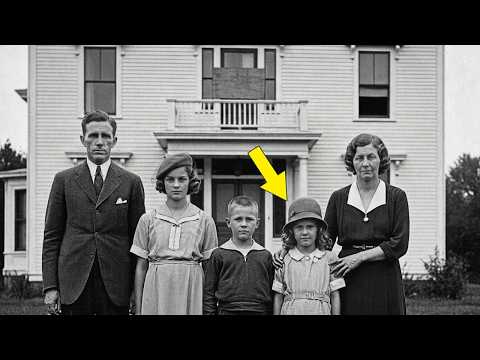
Emma felt a chill that had nothing to do with the archives’ air conditioning. She pulled out her notebook and wrote, “What happened to the Wilson child?” Below it, she added, “Elizabeth, missing from records after spring 1934.”
As she closed the album, a small envelope slipped from between the final pages. Inside was a single lock of dark hair tied with a faded blue ribbon.
Emma’s request for additional Wilson family records yielded a small trove: property deeds, tax documents, school registrations, and church membership rolls. She spread them across her hotel room desk, organizing them chronologically while rain continued to drum against the windows of her small Salem hotel.
Thomas Wilson had arrived in the coastal town of Harborview in 1929, just before the market crash. Curiously, he maintained his position at First Regional Bank while others lost everything. The 1930 census listed him as bank manager, but by 1932, documents referred to him as proprietor. His wife, Marion, was active in church affairs and ladies auxiliaries. Their children—James, Katherine, and Elizabeth—were enrolled in local schools.
Elizabeth, the youngest. Emma circled the name, noting how it disappeared from school records after spring 1934. No transfer papers. No death certificate. Nothing. Records showed James and Katherine continuing through school years, then James joining the military in 1941. Katherine married in 1943 and moved to Connecticut. The parents eventually relocated to California in 1946. The house in Harborview sold to a Dr. Preston.
Emma picked up her phone and called her department colleague, Michael. “I need a favor,” she said when he answered. “Can you check if Harborview still has local newspapers from the 1930s? I’m looking for anything on the Wilson family, especially around April to October 1934.”
“Missing child case?” Michael asked. They’d worked together on historical genealogies before.
“Maybe. Something’s not adding up. I’ll see what I can find. Harborview has a small historical society. Probably closed for the season, but I know someone there.”
Emma thanked him, then opened her laptop to search death records for Massachusetts in 1934. No Elizabeth Wilson listed. She expanded her search to neighboring states. Nothing.
As night fell, Emma pulled out the town directory for Harborview, 1934. She found the Wilson entry, but something caught her eye. The address of Dr. William Preston, the town physician, was just two doors down from the Wilson home. Coincidence or something more? She made another note: Follow up on Preston connection.
On her nightstand, the envelope with the lock of hair sat like an accusation.
The white Victorian stood exactly as it had appeared in the photographs, though nearly a century of salt air had weathered its gingerbread trim and faded its once pristine paint to a dull cream. Emma parked across the street, studying the three-story structure. The current owner had agreed to a brief tour after Emma explained her historical research.
“It’s just such a fascinating example of preserved Victorian architecture,” she’d said on the phone, concealing her true interest.
A middle-aged woman named Diane greeted Emma at the door. “My husband and I bought it five years ago. Been renovating ever since,” she said, leading Emma inside. “These old places are money pits, but we couldn’t resist the character.”
Emma nodded, eyes scanning the entryway with its original hardwood floors and sweeping staircase. The layout matched what she’d seen in the album photographs.
“Has anything unusual turned up during renovations?” Emma asked casually. “Hidden spaces or objects from previous owners?”
Diane laughed. “Funny you should ask. The third floor was a complete mystery when we bought the place. The previous owners had it sealed off completely. Said it had water damage, but when we finally opened it up, it was perfectly preserved—just dusty. Almost like a time capsule.”
Emma’s pulse quickened. “The third floor? Would that be where the window was?” She caught herself. “Where there’s a dormer window facing the street?”
“Yes, that’s the nursery. Strangest thing about it: all the furniture was still there, covered in sheets. Children’s toys from the 1930s, even clothes in the dresser.” Diane led the way upstairs. “My husband wanted to clear it out immediately, but I found it too interesting. Some historian you are—you’ll probably appreciate that I cataloged everything before we renovated.”
They reached the third floor and Diane pushed open a door to a bright, modernized home office. “This was the nursery. When we pulled up the old wallpaper, we found drawings underneath. Children’s drawings, right on the plaster. Some were disturbing. My husband plastered over them immediately.”
Emma tried to keep her voice steady. “Do you have photographs of the drawings?”
Diane hesitated. “Yes, but they’re not something I show people. The child who drew them was clearly troubled.”
“Please,” Emma said. “It could be important for my research.”
Diane returned with a laptop, opening a folder labeled “House Renovation, Third Floor.” She clicked through images of the room being stripped down, revealing layers of history beneath modern additions.
“Here,” she said, stopping at an image that made Emma catch her breath.
Beneath peeling floral wallpaper were childish drawings in what appeared to be crayon or colored pencil. Stick figures of a family. Four tall figures surrounded one small one. In subsequent drawings, the small figure was shown separated from the others, then behind what looked like bars or in a box. The final image showed four figures standing above what appeared to be a hole in the ground.
“There were dates,” Diane said quietly, “written in the corner of each drawing. They spanned from January to April 1934.”
Emma’s hand trembled as she made notes. “Did you find anything else unusual in this room?”
Diane hesitated. “Under the floorboards by the window, there was a tin box. Inside were some children’s belongings—a small diary, hair ribbons, a broken doll. I kept them thinking they might be historically valuable.” She walked to a cabinet and retrieved a shoebox. “It felt wrong to throw them away.”
Emma carefully examined the items, her historian’s training warring with growing dread. The diary was small, its pages filled with a child’s uneven handwriting. Most entries were mundane, but several from March 1934 caught her attention.
Daddy says I’m not to go outside anymore. I’ve been bad.
Mother says the doctor will make me better if I take the medicine.
They locked my door again. I’m scared of the dark.
The final entry, dated April 15th, 1934: Dr. Preston came again. I heard them talking about the basement.
Emma closed the diary, her mind racing. The newspaper had mentioned a tragic accident in October, but Elizabeth had stopped writing in April.
“Is there access to the original basement?” she asked.
Diane nodded. “It’s mostly storage now, but the original foundation is intact. There’s an unusual feature—a secondary room behind a false wall. The previous owners used it as a wine cellar, but it seemed purpose-built for something else.”
“Would you mind if I see it?” Emma asked, her academic curiosity now transformed into something more urgent.
“Of course,” Diane replied, leading the way downstairs. “Though I should warn you, it’s the one place in the house that always feels uncomfortable.”
Emma’s meeting with Harriet Johnson, the 93-year-old former town librarian, took place in the sunroom of the Harborview Retirement Home. Harriet’s mind remained sharp despite her frail body, her eyes lighting up at the mention of local history.
“The Wilson family?” Harriet repeated, setting aside her teacup. “By goodness, that’s a name I haven’t heard in decades. They were prominent in town before they left. Thomas Wilson practically saved the bank during the Depression, though rumors circulated about his methods.”
“What about the children?” Emma prompted gently, watching Harriet’s expression closely.
A shadow passed over the elderly woman’s face. “James was a few years ahead of me in school. Katherine was in my class. Quiet girl, never invited anyone to their home. Elizabeth was younger—such a sweet child. Sickly, though. That’s what they told everyone.”
Emma leaned forward. “What happened to Elizabeth?”
Harriet’s hands trembled slightly. “The official story was tuberculosis. She was quarantined at home, then sent to a sanitarium. Never returned.” She lowered her voice. “But my father was the postmaster. Mail came through him. He told me Dr. Preston never sent any medical samples for testing, never requested records from any sanitarium.”
“Do you think something else happened to her?”
Harriet glanced toward the door as if checking for eavesdroppers, an old habit from a lifetime in a small town. “There were whispers. Marion Wilson had episodes. Thomas would call Dr. Preston whenever she became difficult. Elizabeth started showing similar behaviors—outbursts, talking back. In those days, defiant children were considered problematic, especially girls.”
“What kind of doctor was Preston?”
“Officially, the town physician. Unofficially, he had interests in new psychiatric treatments. He traveled to conferences in Europe, brought back ideas about controlling difficult behaviors.” Harriet’s voice dropped further. “Some said he experimented. Nothing could be proven, of course. And the Wilsons left town shortly after Elizabeth disappeared.”
Harriet nodded. “Six months later, Marion seemed different—subdued. They sold to Preston, who kept the house until he died in 1963. His family sold it, and all his papers were destroyed in a fire at his office. Very convenient.”
As Emma thanked Harriet and prepared to leave, the old woman caught her wrist with surprising strength. “There’s a section of the old cemetery behind the pine grove. Unmarked graves from that period. Town records show one from April 1934. No name—just a number.”
Emma felt a chill. “Thank you, Harriet. One last question: do you know if there are any Wilson descendants still living?”
“Katherine’s daughter, Helen, moved back to the area about ten years ago. Lives in the next town over. Never married, no children. Keeps to herself.”
Emma nodded, making a note of the name. The pieces were beginning to align into a disturbing picture.
Emma and Helen stood together as the last snowflakes settled on the new headstone. “She has a name now,” Helen whispered, her voice breaking. “That’s all Mother ever wanted.”
Back at her hotel, Emma opened her laptop and began the final draft of her paper. The lock of dark hair lay beside her keyboard—no longer an accusation, but a quiet witness.
Weeks later, the university press published her findings. Within days, other historians wrote to her with similar cases: children erased from family albums, basements with iron rings, doctors who promised cures.
Emma saved every letter in a new folder labeled “Elizabeth’s Children.”
Some stories end with a grave. Others begin there. Which forgotten name will you restore?
Report this article
Select a reason for reporting:






