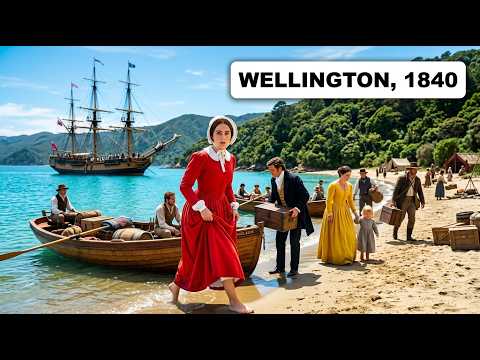
The wind off Cook Strait cut through the canvas of the Aurora like a blade. On January 22, 1840, after four brutal months at sea, nearly 150 exhausted English settlers finally dropped anchor in Port Nicholson. They had crossed the entire planet, driven by desperation and a dream. But the land they stepped onto was not empty—and the document that would define a nation was still weeks away from being signed.
They thought they had bought the land fair and square. They were wrong. Within nine days, a treaty would be signed far to the north that would change everything. Within six weeks, a river would flood their fragile new homes. And within nine months, they would abandon the settlement entirely, moving across the harbor to a place that would one day be called Wellington.
To understand that January morning, we must first go back to the England they left behind. In the 1830s, Britain was the richest country on Earth—and one of the hungriest. Cities swelled faster than anyone could house the newcomers. London held nearly two million souls. In the industrial north, families crammed into cellars and row houses without clean water. Cholera swept the nation in 1832, killing tens of thousands.
The countryside offered no escape. For decades, agricultural workers in southern England watched their wages shrink. Public lands where they grazed cows or gathered fuel were seized. Annual work contracts were cut to weekly ones. Then came the threshing machine, threatening the winter work that kept many families alive.
In the summer of 1830, anger exploded. It began in east Kent and spread across the southern counties and East Anglia. Workers smashed threshing machines, burned hayricks, and attacked workhouses. Threatening letters were signed by a fictional leader called Captain Swing. It was the largest wave of rural unrest in nineteenth-century England.
The punishment was savage. Nearly 2,000 people were brought to trial. 252 were sentenced to death, and 19 were actually hanged. 644 were sent to prison. About 480 were transported in chains to the penal colonies of Australia.
For a young farm laborer with children, England offered only hard work, low pay, and instability. Across the seas lay the colonies—but Australia was still notorious for convict transportation, and New Zealand was not a British colony at all. About 2,000 Europeans lived there, mostly whalers, traders, and missionaries. The land belonged to the Māori, who had lived there for centuries.
Into this world stepped a man with a plan and a past he could not fully escape. His name was Edward Gibbon Wakefield.
Born in London in 1796, Wakefield was brilliant, charming, and utterly ruthless. In 1826, he abducted a fifteen-year-old heiress named Ellen Turner and duped her into marriage, scheming to seize her family’s fortune. The marriage was annulled. Wakefield was sentenced to three years in Newgate Prison—and there, behind bars, he began to think about colonies.
In 1829, while still locked away, he published a work titled A Letter from Sydney. It was written as though by a settler in Australia, though Wakefield had never set foot there. His idea became known as systematic colonization.
The theory was simple and bold. Colonial land should never be given away cheaply. It should be sold at what he called a “sufficient price.” The money raised would pay the passage of young laborers—men and women—from Britain. These workers would labor for landowners until they saved enough to buy land of their own.
In this way, Wakefield believed, a colony could reproduce a balanced English society, with gentry, farmers, and laborers all in their proper places. His ideas influenced the founding of South Australia. But Wakefield wanted something bigger. He turned his eyes toward New Zealand.
In 1837, he helped form the New Zealand Association. Its committee included powerful names: Lord Durham, Lord Petre, Sir William Molesworth. The British government was wary. Missionaries opposed the plan. The Colonial Office had no wish for a private company to establish a colony on land it did not control.
Wakefield and his supporters decided not to wait. In May 1839, the organization was reconstituted as the New Zealand Land Company—later known simply as the New Zealand Company. It began selling land in New Zealand to investors in London—land it did not yet own.
The Company had to move fast. The British government was preparing to send its own representative. Private land deals were about to come under scrutiny. So in May 1839, the Company dispatched a ship to beat the settlers there. That ship was the Tory.
She sailed from Plymouth on May 12, 1839. Commanding the expedition was Colonel William Wakefield, Edward’s younger brother. Also aboard was Edward’s son, Edward Jerningham Wakefield, still a teenager. There was a German naturalist named Ernst Dieffenbach. There was a young artist named Charles Heaphy, who would later win the Victoria Cross. And there was a Māori interpreter named Naiti.
The Tory reached Queen Charlotte Sound at the top of the South Island on August 17, 1839, after ninety-six days at sea. The men took on fresh water, food, and timber. They spent about five weeks in the sounds. Then they crossed Cook Strait.
On September 20, 1839, the Tory sailed into Port Nicholson—the great harbor known to Māori as Te Whanganui-a-Tara. The harbor was home to the Te Āti Awa people, who had come south from Taranaki in earlier years. At Pito-one, the place the settlers would call Petone, lived the chief Te Puni. Nearby was another prominent chief, Te Wharepōuri.
Their people had seen European ships before. They had traded with whalers. Many were interested in trade—in muskets and tools and European goods—and in the protection and prosperity that alliances might bring.
William Wakefield wasted no time. The negotiations took only days. The interpreter was a trader and whaler named Dicky Barrett, who had lived among the Te Āti Awa for years. On September 27, 1839, sixteen chiefs placed their marks on a deed of purchase.
In return, the Company handed over goods—including muskets, blankets, and other materials—divided into portions distributed by Te Puni. The Company believed it now owned all the land around the harbor, from the southern coast to the Tararua ranges, including the islands in the harbor.
It was a vast area. But the deed was written in English. Barrett spoke only a rough whaler’s Māori. Many years later, in 2003, the Waitangi Tribunal ruled that he had been utterly incapable of conveying the meaning of the deed. The Tribunal found that the boundaries were unclear, that not all those holding customary rights had signed, and that those who did sign had not understood what they were signing. The deed was declared invalid.
Wakefield did not stop at Port Nicholson. In October, on Kapiti Island, he reached an agreement with the powerful Ngāti Toa chief Te Rauparaha. More deals followed. By early 1840, the Company claimed to own some twenty million acres of New Zealand—acquired for goods valued at a halfpenny an acre.
Meanwhile, back in England, the settlers had already set sail across the seas. And that voyage is where we go next.
By September 1839, the first emigrant ships left England before anyone in London knew where the land had been secured. The Oriental, a barque of about 500 tons, departed Gravesend on the Thames on September 15, 1839. The Aurora followed three days later. Then came the Duke of Roxburgh, the Bengal Merchant, and the Adelaide. The store ship Glenbervie carried the bank’s staff and a chest full of money. The survey ship Cuba had gone ahead, bearing the Company’s surveyors.
The emigrants were selected with extraordinary care. The Company wanted young couples, especially agricultural workers and artisans—the very people Wakefield’s theory said the colony needed. Most paid nothing for their passage. The wages of working families came from the money raised by land sales.
Life at sea was harsh beyond modern imagining. A voyage to New Zealand in the 1840s took between 75 and 120 days. The ships were small, usually 500 to 600 tons, carrying between 100 and 200 passengers. Between decks, in steerage, families slept in narrow bunks stacked atop one another. Ceilings in some places did not exceed 1.8 meters. In storms, seawater poured through the hatches and flooded the living quarters.
Food was coarse and monotonous. Salted meat, ship’s biscuit, flour, oatmeal, dried potatoes. Cabin passengers ate far better, thanks to fresh meat and milk from animals carried aboard. Seasickness lasted for weeks. Fever and childhood diseases spread quickly in the crowded, unventilated decks. On the early voyages, as on most emigrant ships of that century, young children were most at risk—and burials at sea were a bitter part of the journey.
The ships crossed the Bay of Biscay, the tropics, the equator, then ran east across the Southern Ocean, where icy winds and towering waves drove them onward for weeks on end. The Company had arranged a rendezvous at Port Hardy on D’Urville Island, at the northern tip of the South Island, where ships were directed to their final destination.
And so we return to that shore, and to the first days on land.
On January 22, 1840, the Aurora entered Port Nicholson. Her passengers were the first organized group of English settlers to reach what would become Wellington. That date is still commemorated each year as the city’s founding.
Nine days later, on January 31, the Oriental dropped anchor off Somes Island at six in the evening. She carried about 155 passengers. In the weeks that followed, the Duke of Roxburgh and the Bengal Merchant arrived. On March 7 came the Adelaide and the Glenbervie. On April 21, the Bolton arrived with more than 300 settlers.
The settlers came ashore at Petone on the flat ground beside the Hutt River. Te Puni and his people welcomed them. The Te Āti Awa helped them unload their goods and build their first shelters. Māori sold them food, pigs, and potatoes, and helped them raise huts of timber and raupō reeds.
The Company named the new town Britannia. Surveyor-General William Mein Smith chose the site because the flat valley suited the London-style street grid he had planned. He later wrote that he had asked local people whether the river flooded, and they assured him it did not.
Rows of tents and small wooden houses went up along the shore. The settlers unloaded furniture, tools, seeds, and livestock. They even brought a printing press.
But while the settlers were still landing, something far more important was happening at the other end of the country. On January 29, 1840, a week after the Aurora arrived, a Royal Navy officer named Captain William Hobson reached the Bay of Islands. The British government had sent him as lieutenant-governor with instructions to obtain sovereignty over New Zealand with the consent of the Māori.
Over a few feverish days, Hobson and the British Resident, James Busby, drafted a treaty. On the night of February 4, the missionary Henry Williams and his son Edward translated the English draft into Māori. On February 6, 1840, at Waitangi, the first chiefs signed. Hōne Heke was the first to sign. About 40 chiefs signed that day. Copies were then carried around the country, and by September some 500 more had signed. In all, about 540 rangatira placed their names or marks on the Treaty of Waitangi.
The treaty contained three articles concerning sovereignty, land and property, and the rights of British subjects. But the Māori text translated sovereignty as ‘kāwanatanga’—governance. The disagreement between the two versions has been debated ever since.
In April, the schooner Ariel brought a copy of the treaty to Port Nicholson. Henry Williams was aboard. William Wakefield quarreled with the missionary, fearing the treaty would conflict with the Company’s land plans, and delayed the signing for ten days. On April 29, 1840, thirty-two chiefs of Te Āti Awa, Ngāti Tama, and Ngāti Toa signed. Among them was Kahe Te Rau-o-te-rangi, a woman of Ngāti Toa.
But on the flats at Britannia, the settlers were fighting a different battle—against nature itself.
From February 23 to March 1, 1840, heavy rain hammered the Hutt valley. On March 2, the Hutt River burst its banks. Water swept through the settlement. Tents and huts near the river were flooded. Goods and supplies were ruined. The settlers had been in their new home just six weeks.
In May, a row of huts built by Cornish settlers burned. The same night, an earthquake shook the settlement. The anchorage off Petone was exposed to wind. The marshy ground was hard to drain.
By winter, the settlers had had enough of the Hutt flats. They wanted to move—and from that decision, a capital was born. Across the harbor lay a narrow strip of flat land at the foot of steep, bush-covered hills. Māori called it Hau Kā Waka. The Company called it Thorndon.
In September 1840, the main settlement was officially shifted from Britannia to Thorndon. Houses were taken apart, loaded onto boats, and ferried across the harbor. In November, the settlement received a new name: Wellington, after the Duke of Wellington.
The first winter there was cold, wet, and stormy. Many families still lived in tents or raupō huts. Work was scarce. Yet the town grew. By 1841, about 2,500 Europeans lived around the harbor. By 1843, there were 4,000.
The Company that started it all never saw its dream fulfilled. Only about 15,500 settlers arrived under its plans. By 1850, it was financially broken and surrendered its charter. William Wakefield died in Wellington in 1848. Edward Gibbon Wakefield finally reached the country he had planned from a prison cell. He sat in New Zealand’s first Parliament, representing the Hutt, and died in Wellington in May 1862.
The Aurora itself did not last long. On April 17, 1840, less than three months after delivering the first settlers, she struck a rock leaving Kaipara harbor and was wrecked. Her crew survived. But the people she carried stayed and built.
In 1865, the seat of government moved from Auckland to Wellington, chosen for its central position on Cook Strait. When Parliament first met there in July 1865, the city that began as a few huts in Thorndon held just 4,900 people.
For Māori, the arrival of 1840 brought trade and new opportunities at first, then decades of loss. The land around the harbor passed from their hands through purchases they never fully understood. The treaty signed that same summer would be broken many times. It took until the late twentieth century for the Crown to formally investigate these grievances, and until the 2000s for land settlements—including Pipitea Pā—to be returned to the iwi of Wellington.
For the descendants of those first English families, the arrival became a founding moment. Farm laborers who could never have owned land in Kent or Somerset became landowners. Their children grew up in a new country with new freedoms. The towns they built became cities.
Both truths belong to that wind-whipped shore. The courage of the settlers was real. Their suffering was real. And the loss of those who welcomed them was real too.
Today, a quiet street in Petone still bears the name Britannia—the only trace of the town that never was. A memorial stands on the beach where the settlers came ashore. And every January, Wellington remembers the day the Aurora arrived.
On January 22, 1840, the feet of nearly 150 tired, frightened, hopeful English men, women, and children touched the sand at Petone. They were met by the people of the land they had come to. And from that single encounter on a lonely shore, a nation of two peoples began.
So here is the question that still echoes across that harbor today: when two peoples sign a document they understand in two different ways, what does it truly mean to honor it?
Report this article
Select a reason for reporting:






