Most people believe the Willard Hotel survived because it stood close to power, a permanent guest house for presidents, protected by history and prestige. But that closeness nearly killed it. For more than a century, the men who ran the country ran tabs they never paid, hosted scandals in its suites, and treated its lobby like federal property. Ledgers bled red, chandeliers dimmed. At least three times the hotel went bankrupt. Twice it came within weeks of demolition. And yet this building endured—not because of presidents, but in spite of them.
This is the story of how American power nearly erased the place where it performed itself.
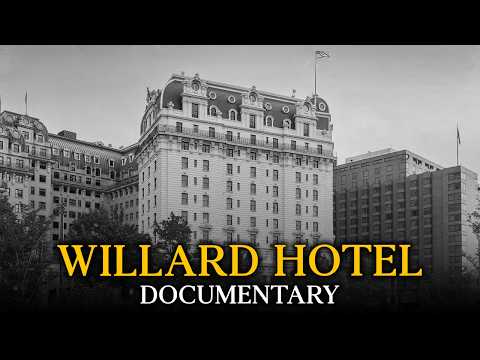
In 1850, a hotel rose beside the White House with marble floors and a dangerous promise of unlimited access. The location seemed perfect. Pennsylvania Avenue stretched before it like a throne room. The White House sat two blocks away. The Capitol Dome rose visible through morning fog. Between them, the Willard Hotel claimed the most valuable real estate in American democracy—a six-story palace with French windows and a lobby designed to accommodate ambition.
Henry Willard understood what proximity meant. He had worked in hotels since childhood, watching travelers pay premiums for convenience, for prestige, for the illusion of belonging. When he secured the lease on this property, he saw something beyond hospitality. He saw a stage where power would perform itself daily.
The building’s architecture reflected that vision. Marble imported from quarries in Vermont lined the entrance hall. Chandeliers hung from fourteen-foot ceilings. Guest rooms featured walnut furniture and Brussels carpets. The dining room seated three hundred beneath gilded mirrors. Every detail announced permanence, luxury, authority.
But the true innovation was philosophical. Willard positioned his hotel not as a business but as an institution. He courted senators before they took office. He extended credit to cabinet members. He treated political access as collateral, assuming that men who shaped the nation would honor their debts as a matter of principle.
The assumption proved catastrophic.
Within five years, the Willard became the unofficial headquarters of American government. Congressmen held meetings in its parlors. Foreign diplomats negotiated in its suites. Journalists gathered intelligence at its bar. The hotel lobby earned a name that would outlast the building itself: the center of American power.
Henry Willard watched his vision succeed beyond measure. Occupancy rates climbed above ninety percent. The guest register read like a government directory. Newspapers described his establishment as indispensable to democracy itself.
The ledgers told a different story.
Bills accumulated faster than payments arrived. Credit extended indefinitely. The men who made the Willard famous treated payment as optional—an administrative detail beneath their attention. By 1857, the hotel owed creditors $40,000. Revenue covered operations, but not debt. The Willard survived on the promise that proximity to power guaranteed permanence. That promise was already rotting from within.
Henry Willard died in 1861, convinced he had built something immortal. He left behind a hotel synonymous with American democracy and account books that revealed the cost of hosting it. His successors inherited fame and insolvency in equal measure. The question facing the new owners was simple but unsolvable: How do you collect from men who write the laws?
The moment presidents crossed the Willard’s threshold as regular guests, the balance between hospitality and exploitation quietly collapsed. Abraham Lincoln arrived at the Willard on February 23, 1861. He occupied Suite 6 on the second floor. For ten days before his inauguration, he conducted the business of forming a government from rooms the hotel provided at a rate it called “preferential.” The bill was never fully paid.
Lincoln’s presence transformed the hotel’s relationship with power. Secret Service agents occupied adjacent rooms. Cabinet appointees held meetings in the parlor. Office seekers filled the lobby at dawn, waiting for access to the president-elect. The Willard became the temporary capital of a government preparing for war.
Hotel staff worked double shifts. Kitchens operated eighteen hours daily. Fireplaces burned through twice the usual coal. The costs mounted while the president’s entourage treated services as entitlements. When Lincoln finally moved to the White House, his bill showed partial payment. The remainder carried forward indefinitely—an accounting fiction that allowed both parties to avoid confrontation. The hotel could claim it hosted the president. The president could claim he patronized a loyal establishment. The missing money simply vanished into the gap between public myth and private arithmetic.
The pattern repeated with every administration. Ulysses Grant lived at the Willard for months after the Civil War. He held court in the lobby, smoking cigars and listening to petitioners. The term “lobbyist” was born there, describing men who waited in the lobby for access to Grant. They bought him drinks. The hotel paid for the glasses. Grant’s bar tab alone exceeded $2,000 by the time he became president. Payment arrived in installments over three years, minus the items his staff disputed as overcharged.
Calvin Coolidge honeymooned at the Willard. His suite overlooked Pennsylvania Avenue. The hotel charged a symbolic rate. Coolidge wrote a thank-you note instead of a check. When he later became president, his staff contacted the hotel to arrange visits. They mentioned the courtesy shown during his honeymoon. They expected reciprocal generosity.
Each presidential interaction reinforced the same dynamic. The hotel provided luxury. Power provided prestige. Money became the awkward subject nobody mentioned. Behind the scenes, management struggled with an impossible calculus. Refusing a president meant political isolation. Demanding payment meant public humiliation. Accepting non-payment meant slow financial strangulation.
The hotel chose prestige over solvency every time.
By the early twentieth century, the Willard’s business model depended entirely on ordinary guests subsidizing extraordinary ones. Traveling salesmen paid full price for modest rooms. Senators paid half price for suites. Presidents paid whatever they felt appropriate. The mathematics could not sustain themselves. Every presidential visit deepened the structural deficit. Fame grew while foundations weakened.
The staff noticed first. Wages fell behind schedule. Suppliers demanded cash on delivery. Maintenance budgets shrank. The hotel that hosted the most powerful men in America could barely afford lamp oil. Yet the guest register continued filling with illustrious names. Appearances mattered more than accounting.
The Willard survived on the collective delusion that proximity to greatness guaranteed prosperity. Nobody wanted to admit the truth: the hotel was subsidizing the government’s social calendar, and the government had no intention of reimbursement.
That delusion held for decades because the alternative was unthinkable. To demand payment from a senator was to insult the Senate. To dun a cabinet secretary was to invite retaliation. The Willard’s managers understood that a single public confrontation could end the hotel’s usefulness to power, and a hotel without power was just another building on Pennsylvania Avenue with too many rooms and too few paying guests.
So the ledgers kept their secrets. Clerks in the basement recorded each unpaid balance in careful copperplate, knowing the numbers would never reach the men who owed them. The accounts became a kind of civic archive—a private record of what American government cost the institutions that served it.
Then came the war between the states, and the Willard learned that proximity to power could extract a different price entirely. Troops bivouacked in the streets. The hotel’s parlors filled with officers, contractors, and speculators. Business boomed, but the boom was feverish and temporary, and the men who profited most were the ones least likely to settle their bills.
By the 1870s, the pattern had hardened into tradition. Every new administration arrived expecting the Willard’s hospitality as a matter of course. Every departing administration left behind a trail of disputed charges and quiet write-offs. The hotel’s reputation grew grander even as its balance sheets grew bleaker—two curves moving in opposite directions, destined to cross at the point of collapse.
What nobody predicted was how long the building could survive that crossing. It survived on borrowed time, borrowed money, and the borrowed prestige of men who never paid for what they borrowed.
The lobby itself became the engine of that borrowed prestige. Its floors were marble, its ceilings frescoed, its chairs arranged to encourage the kind of lingering conversation that shaped legislation. Men came to be seen, and being seen was free. The Willard charged for rooms but never for relevance.
Julia Ward Howe sat in one of those chairs in November 1861 and finished the lyrics to a song soldiers had been singing. She wrote The Battle Hymn of the Republic on Willard stationery, and the hotel kept the pen in a display case. It never charged her for the room. The gesture cost almost nothing and purchased a century of mythology.
Martin Luther King Jr. paced Suite 2001 in August 1963, testing phrases aloud before the March on Washington. The hotel later framed the canceled check from the organization that paid his bill—proof that someone, eventually, settled the account. Between these famous moments, ten thousand smaller transactions unfolded: senators trading committee assignments, diplomats brokering treaties, journalists extracting quotes. The lobby facilitated American governance more efficiently than many government buildings, and it did so largely on credit.
Stenographers worked the lobby, offering transcription by the page. Stationery sat free at writing desks. Telegram boys waited near the entrance. The Willard provided the infrastructure of power, charging nothing for access and hoping proximity would yield profit through secondary spending. It rarely did. Men conducting government business treated the lobby as an extension of federal property. They occupied chairs for hours without ordering drinks. They borrowed stationery by the ream. The hotel absorbed these costs as the price of relevance.
Actual revenue came from the rooms upstairs, but even there the economics twisted strangely. A cattle rancher from Texas paid $120 a week for a standard room. A senator from Massachusetts paid $60 for a suite twice the size. The rancher subsidized the senator. The system required it.
By the early 1900s, historians would later estimate that decisions made in the Willard lobby had affected more lives than many Supreme Court rulings. Newspapers called the hotel indispensable. Presidents praised its patriotic service. None of that praise translated into financial stability. The lobby’s fame created a perverse incentive: the more important the hotel became to American governance, the more politicians felt entitled to use it without full compensation.
Prestige replaced payment. Legacy excused debt. Management could not protest without seeming petty. Imagine the headlines: Willard Hotel Demands President Pay Bar Tab. The public relations catastrophe would exceed any recovered revenue. So the bills accumulated, some line items dating back decades, collection impossible without sacrificing the very reputation that made the hotel valuable.
Behind the velvet drapes, three clerks worked in a windowless basement office, recording charges and sending invoices that rarely generated responses. Their ledgers revealed a shadow economy. Standard guests paid in full, usually within thirty days. Government officials paid partially, eventually, sometimes. Presidential associates paid symbolically or not at all.
One entry from March 1892 showed a senator’s bar tab of $87 accumulated over six weeks. The invoice went out in April. A partial payment of $20 arrived in July. The remainder carried forward indefinitely, joined by new charges from subsequent visits. Another entry documented a cabinet member’s eleven-night suite rental at $12 a night—$132 total. He paid $60 and disputed the rest, claiming he had been promised a government rate. No such rate existed in the hotel’s official pricing. His staff insisted. The hotel waived the balance to avoid confrontation.
By 1900, the Willard’s receivables exceeded $48,000. Nearly seventy percent came from government-associated guests. The average outstanding balance per political figure was $237. Some individual accounts exceeded $1,000. The hotel could not write off these debts without destroying its capital base. It could not aggressively collect without alienating the source of its prestige. The money simply hung there—real enough to damage the balance sheet, too politically sensitive to pursue.
Suppliers noticed. Vendors who had extended credit for decades began demanding cash. The linen service required payment on delivery. The coal merchant refused new shipments until arrears were settled. The Willard’s own unpaid bills totaled $19,000 by 1903. Cash flow became a crisis managed daily. Room revenue covered wages and utilities but left nothing for repairs or debt service. The hotel deferred maintenance on heating systems, delayed replacing worn carpets, reduced staff during slow seasons, and prayed for high-occupancy summers.
Meanwhile, presidents kept visiting. Theodore Roosevelt held meetings in the lobby, his entourage of aides and security occupying eight rooms for a week. The bill approached $600. Payment arrived four months later, covering room charges but not food, beverages, or services. The difference was never reconciled. William Howard Taft celebrated his election victory at the Willard in November 1908, filling the ballroom with four hundred guests. Champagne flowed. The orchestra played until midnight. The hotel catered the evening at cost, hoping publicity would attract future business. The publicity came. The business did not.
What arrived instead were more requests for preferential treatment, more expectations of courtesy rates, more assumptions that the hotel existed to serve power rather than profit. The clerks in the basement recorded every shortfall in ruled columns and careful handwriting, their ledgers becoming an archive of extraction—documentation of how democracy consumed the spaces it inhabited.
By 1912, the Willard faced a choice: continue operating at a loss sustained by hope and denial, or confront the financial reality that fame had created. The owners chose denial. They borrowed against the property to cover operating deficits. They refinanced existing debt at higher interest rates. They sold off furniture and artwork to generate cash. The hotel survived another decade through financial engineering increasingly desperate and unsustainable. The building itself became collateral against its own reputation.
Guests walking through the lobby in 1920 saw unchanged opulence. They did not see the deferred maintenance, the reduced staff, the canceled supply orders, the mounting liens. The performance of permanence continued even as the structure hollowed out. The accountants knew the truth. Their ledgers proved what nobody wanted to admit: the Willard was bankrupt in everything but name, destroyed by the very proximity to power that made it famous.
The bills nobody wanted had finally come due.
The first bankruptcy came in March 1921. Debts totaled $137,000 against assets of $98,000. A judge ordered reorganization, but the hotel’s defense—that its losses were democracy’s gain—fell on deaf ears. Creditors received thirty cents on the dollar and promises nobody believed.
The Willard emerged unchanged. It kept extending credit, kept deferring maintenance, kept confusing fame with viability. A second bankruptcy followed in 1936, a third in 1946—each one a periodic reset that shed debt while preserving the dysfunction that created it.
By 1960 the hotel operated at thirty-eight percent of capacity. Entire wings sat dark. A chunk of lobby plaster fell in 1964, nearly striking a guest; workers patched the hole with painted plywood and hoped nobody looked up. Twice demolition was scheduled—June 1976, then March 1985—and twice it was stayed by weeks.
Salvation arrived as spreadsheets, not sentiment. Developer Oliver Carr’s $134 million restoration reopened the Willard in 1981 with one radical rule: everyone pays. No courtesy rates. No presidential tabs.
The chandeliers still hang. The marble still shines. The building endures—not because power loved it, but because it finally learned to charge power the going rate.
So here is the question worth your comment: when prestige and solvency collide, which would you have chosen—and who should pay for history?
Report this article
Select a reason for reporting:






