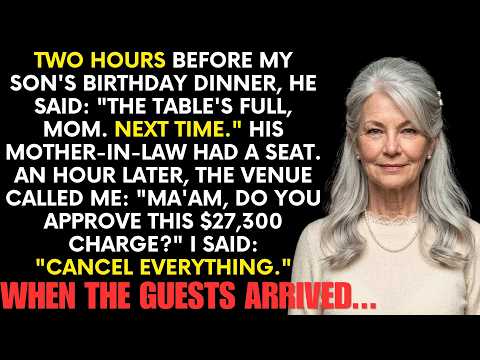
My name is Billy Hwitt. I’m 71 years old. I was sitting on my bed in a brand-new green dress when my son called. It was 5:02 on a Saturday evening. His 40th birthday dinner started at 7. “The table’s full, Mom. Next time.”
His mother-in-law had a seat. So did her boyfriend. So did an aunt I had met twice. I had paid the deposit. I had booked the room. I had given them my husband’s recipe. And I was not invited.
An hour later, my phone rang again. It was the venue. “Ma’am, do you approve this $27,300 charge?” I looked at the dress. I looked at the clock. Then I said two words. “Cancel everything.”
Just before 7, the first of 72 guests started pulling into that gravel parking lot. What happened at that door? My family still doesn’t talk about it.
Let me tell you who I am so you know who you’re listening to. I started washing dishes at the Ashb Grand Hotel when I was 17. That was 1971. Ashb Falls, Ohio had one good hotel, and I was down in its basement with my arms in hot water up to the elbow. I stayed 49 years. I moved from dishes to prep, from prep to the banquet floor, and from the banquet floor to a desk with my name on the door. For 26 of those years, I was director of catering—weddings, proms, retirement dinners, and funerals with ham sandwiches and sweet tea. I have plated dinner for 1,000 people in a single night. I know when a kitchen is lying to me, and I know when a room is about to go wrong before the room knows it.
I retired in 2020. The spring the ballroom went dark. Everybody else got a party. I got an email.
My husband Leon died in 2016. He was a high school shop teacher with big hands and a soft voice. He made the best braised short rib in the county, and he’d tell you so himself. Now I live in a two-bedroom condo on Sycamore Street. I have a balcony, two tomato plants, and a neighbor named Opel who knows everything before the newspaper does.
That Saturday, a dress hung on my closet door. Emerald green, a wrap dress soft as a good dinner napkin, with the price tag still dangling from the sleeve on a little plastic thread. $148 from Marlo’s downtown. I hadn’t cut the tag. I’ll tell you why later.
But that phone call didn’t start on that Saturday. It started five months earlier, on a Monday in May.
Back then, I was the one who booked the table. Larks Hall sits on the river at the edge of town. It used to be a grain mill, and the old water wheel still turns outside the dining room windows, slow and patient, like it has nowhere better to be.
Leon took us there for Toby’s 10th birthday. It was a Wednesday night in October 1995. Toby wore a clip-on tie and ate two helpings of short rib. And then Leon stood up at the table and said two words: “Our boy.” That was his whole speech.
So on Monday, May 12th, I drove out to Larks with my checkbook and my reading glasses. The general manager met me in the stone lobby. Dominic Asher, 48 years old, gray at the temples, suit pressed like a hotel sheet. In 1996, he was a 19-year-old busboy on my banquet floor who dropped a whole tray of champagne flutes at a bank dinner. I didn’t fire him. I taught him to carry a tray from the shoulder.
“Mrs. Huitt,” he said, “You still check the corners of a tablecloth. I saw you do it. Somebody has to.”
We booked the Mill Room for Saturday, October 18th, 7:00. 24 guests with a food and beverage minimum of $6,000. I put a $2,500 deposit on my Visa to hold the date. Then I gave him an index card. It was a copy of Leon’s short rib recipe. The original lives in my kitchen drawer with a grease spot in the right corner and his handwriting across the bottom: Low and slow, Bill. Don’t rush it.
“Give this to your chef,” I said. “Tell him not to improve it.”
Dominic printed the contract. At the top, it said, Client of record: Billy Hwitt. I signed it without a second look, the way I’d signed 10,000 of them. It was going to be a surprise. Toby had no idea.
But a surprise needs a guest list, and for that, I needed help from one person. I picked the wrong one.
I should tell you something about me and my son. For most of Toby’s childhood, I worked Saturdays. Every Saturday, somebody’s wedding, somebody’s reunion, somebody’s daughter’s sweet 16 in the Crystal Room. Leon took Toby to Little League and the hardware store and the lake, and I came home at midnight smelling like fryer oil and roses. I told myself I was building something for us. I was. The hotel paid for Toby’s braces, his college, his first car. But a boy doesn’t count paychecks. He counts empty seats in the bleachers.
When Leon died, Toby was 30 and still single. Two years later, he married Paige Lamb. And little by little, my son drifted into her family’s weather. Their Christmas Eve. Their Fourth of July at the club pool. Their Sunday brunches at the country club. I didn’t fight it because I told myself a grown man gets to choose his own table.
That’s my weakness, if you want it plain. I have said no to brides, to caterers, to hotel owners. I have never once said no to my son. After Leon, I was afraid that if I pulled on that rope, it would snap. So I didn’t ask to be chosen. I waited to be.
On Sunday, July 6th, I asked Paige to meet me for coffee. Paige is 37, pretty, organized, always holding her phone like it’s about to ring. I told her about Larks and the Mill Room and the short rib. 24 people, all of them Toby’s oldest friends.
“I need your guest list help,” I said. “And your silence.”
Her eyes went wide. She pressed her hand to her chest. “Oh my gosh,” she said. “My mom is going to love this.”
I heard it. Her mom, not Toby. I should have taken my coffee and gone home.
Paige’s mother is Sherry Lamb. If you live in Ashb Falls, you’ve seen her. 66 years old, blonde bob, cream cardigan, and a laugh you can hear from the far end of the parking lot. For 24 years, she was married to Ron Lamb of Lamb Chevrolet. You’ve seen the billboards: Drive home a Lamb. They divorced in 2011. Ron kept the dealership and married his bookkeeper. Sherry kept the house on Ridge View Drive and the membership at Cedar Ridge Country Club. Since then, the club has been her whole kingdom. She sits on the social committee, hosts the spring luncheon, and knows who got a new kitchen and whose son got arrested. She’s always, always the hostess.
Three days after that coffee, my phone rang.
“Billy! Paige told me everything. A surprise party at Larks! Oh, you have to let me help. I know everybody who matters in this town.”
“It’s 24 people,” I said. “His old friends, his Little League coach.”
“For now,” she said, and laughed. I didn’t laugh. I’ve heard that laugh before. The mothers of brides use it right before they add 40 people to a headcount that’s already gone to the kitchen.
“I’ve got it handled,” I said. “But thank you.”
“Of course you do. You always do.” She said it sweetly. She’s very good at sweetly.
I hung up and stood in my kitchen for a long time, because I knew that tone. I had known it for seven years.
Sherry Lamb has never forgiven me for one Saturday in June of 2018. I didn’t do anything wrong that day. That’s the part she can’t forgive.
Toby and Paige got married on Saturday, June 16th, 2018, at Cedar Ridge. Sherry planned every inch of it. She fired the club’s kitchen because she said it was too ordinary, and she hired a caterer out of Columbus with a French name and a website full of edible flowers. At 5:40 p.m., the cocktail hour ended. 180 guests sat down in the ballroom. The salad plates were empty, the water glasses were full, and the kitchen was completely dark. The caterer’s van had broken down on Interstate 71, and nobody had called anybody. Sherry was out on the terrace posing for photos with the bridal party.
I was the mother of the groom in lavender chiffon and heels I hated. I walked into that empty kitchen and made one phone call. The Ashb Grand was 11 minutes away, and its walk-in cooler was full of chicken, potatoes, and green beans for a Sunday brunch of 300. My chef could fire a banquet faster than anyone in Ohio, and he owed me about nine favors. In 70 minutes, we had 180 plates of roast chicken on those tables. Green beans, mashed potatoes, rolls still warm. My staff carried them in from the loading dock in black vests like it was any other Saturday night.
At the toasts, Paige’s uncle stood up and raised his glass toward me. “To the woman who saved dinner.” Everybody turned. Everybody clapped. Sherry’s face went the color of the tablecloth.
That night, by the coat check, she caught my arm. “You made my daughter’s wedding about you.”
“I made sure your guests ate,” I said.
She never said thank you, not once in seven years. And I understood something then. Sherry would never let me save anything again. Not a dinner, not a birthday, and not her son-in-law. Especially not her son-in-law.
On Sunday, August 3rd, Paige came by my condo. She brought a lemon loaf from the grocery store and set it on my counter like a peace offering.
“Billy, I’ve been thinking,” she said. “It’s simpler if we handle the party. We—me and Mom. You’ve done so much already. You should just enjoy it.” And Toby, she winced, “he kind of knows. Mom mentioned it at brunch. It slipped out.”
So the surprise was gone. Four weeks after I told Paige, my son already knew.
“Here’s the thing,” Paige said. “Just leave your deposit on it so we don’t lose the date. We’ll square up with you after.”
I looked at her for a moment. I’ve sat across from a lot of people who say after—after the wedding, after the season, after the check clears. But she was my son’s wife, and he knew now. And if I made a fuss, I’d be the woman who made his birthday about herself.
“All right,” I said. “Take it.”
She hugged me. She smelled like vanilla and hurry. That night, after she left, I sat down at my kitchen table with my laptop and wrote one email to Larks Hall. It went to Tessa Marrow, the event coordinator who had handled my booking. It was four sentences long. I read it twice and pressed send at 9:14 p.m. Then I cut a slice of that grocery store lemon loaf, and it was dry, and I ate it anyway.
I’m not going to tell you what those four sentences said. Not yet. I’ll tell you when it matters. And believe me, it’s going to matter.
For the next two months, I stood on the outside of my own idea and watched two women redecorate it. On August 4th, Paige added me to a group chat called Toby Turns 40. There were 11 people in it. Paige, Sherry, three women from Cedar Ridge, two of Paige’s cousins, me, and a few names I didn’t know. The first message was from Sherry. A photo of a tablescape with gold chargers, white hydrangeas, and candles in tall glass towers.
“Thinking bigger,” she wrote. “Our boy deserves it.”
Our boy. That was Leon’s phrase. She didn’t know that, and it still sat wrong in my stomach all afternoon. I wrote one message: “The Mill Room seats 40 at most, just so you know.” Nobody answered.
Two days later, someone posted a link to Larks’ Grand Hall, which seats 120. On August 19th, I opened my phone and saw one gray line: Paige removed you.
That same week, Puit’s Bakery called. Back in June, I’d ordered Toby’s favorite cake from when he was little—two layers of lemon with buttercream—and I’d paid a $96 deposit.
“Mrs. Hwitt,” the girl said, “a Mrs. Lamb called to cancel your order. She said the family has a cake designer. We need your okay since it’s your order.”
I stood in my kitchen with the phone against my ear. The bakery needed my okay because it was my order. I remember thinking that was a nice old-fashioned policy, and I didn’t think anything else about it. Not then.
“Let her,” I said.
I called Toby that night and kept my voice light. “Sherry canceled my cake.”
“Mom,” he sighed. “Just let Sherry have this. She needs it.”
“Needs what, honey? Something to be in charge of? She’s had a rough year.”
I didn’t ask what I needed. Nobody else did either.
On Sunday, August 24th, I went downtown to Marlo’s and bought the dress. I tried on six. The green one was the last—emerald with a wrap waist and sleeves to the elbow. I looked in the mirror and saw a woman who had not been to a party as a guest in a very long time. $148. I paid cash.
That evening, Toby and Paige dropped off my granddaughter for Sunday dinner. Nora is six. She has Leon’s ears and my stubbornness. I showed her the dress on its hanger, and she gasped and made me hold it up against myself. Then she spun in a circle in my living room with her arms out like the dress was spinning her.
“You’ll be the prettiest at Daddy’s party,” she said.
“I’ll be the oldest,” I said. “That’s close enough.”
The next Sunday, August 31st, Nora came again. She climbed onto my kitchen stool and looked at me very seriously. “Grandma Sherry says your dress is for church, not parties.”
Toby was in the doorway holding his car keys. He gave a small laugh, the kind men give when they wish they were already in the car. I set down the potato peeler.
“Toby,” I said, “Am I coming to your party?”
He looked surprised that I’d asked, as if I’d said something a little bit rude. “Of course you’re coming, Mom. Paige is doing seating. All right, don’t worry about it. It’s handled.”
He kissed my cheek. Nora waved from the back seat, and I stood on my balcony and watched the taillights turn onto Sycamore. Paige was doing seating. I should have heard the word doing. In my business, seating is never something you do. It’s something you decide.
On Saturday, September 13th, Ashb Falls Elementary held its fall picnic. Nora had asked me to come and help with the lemonade table, so I came. It was one of those warm September afternoons when the parents pretend the kids are the reason they showed up. Folding tables, paper cups, a bounce house shaped like a school bus, groaning every time a first grader landed on it.
Sherry arrived at 2:00 in white linen pants and oversized sunglasses. She didn’t help with anything. She stood near the hot dog grill with four other mothers and grandmothers, and her voice carried the way it always does.
“We’re doing Toby’s 40th at Larks,” she said. “The Grand Hall. My gift to him.”
The women made the sounds women make. Oh, how generous. Oh, Larks, how lovely.
“Well, he’s family,” Sherry said. “And somebody has to do these things right.”
I was eight feet away, pouring lemonade into a paper cup for a boy with a skinned knee. I kept pouring. Sherry turned and saw me, and her smile didn’t miss a beat. “Billy, look at you working the booth.” She pushed her sunglasses up into her hair. “You’ll come to the party if there’s room.”
“Of course. If there’s room,” I said.
“It’s filling up so fast. You know how people are about Larks.”
“I do know,” I said. “I’ve been going there since 1995.”
She laughed like I’d made a little joke about the weather. Then she turned back to her audience, and I heard her say the word caterer, and two of the women glanced over at me.
A few minutes later, a woman I knew from the PTA years drifted over to my table. She asked very softly whether it was true that I had once taken over Paige’s wedding. I told her I’d fed 180 hungry people. She said, “Well, that’s not how Sherry tells it.”
Nora tugged my sleeve and asked for a refill. I gave her the fullest cup on the table. Then I went home and made a phone call I should have made weeks earlier.
It was Monday morning, September 15th, before I got through, because Larks’ office doesn’t pick up on weekends, and I wasn’t going to leave a message about my son’s birthday on a machine. A young woman answered. Not Tessa.
“Tessa Marrow left us at the end of August,” she said. “I’m Kayla Brandt. I’ve been here two weeks. How can I help you?”
She sounded like a girl who had just been handed a very full binder and told to smile.
“This is Billy Hwitt,” I said. “I booked the October 18th event for my son, Tobias.”
Papers rustled. A keyboard clicked. “Oh yes, the Hwitt 40th. Mrs. Lamb is the family contact on that one now. We’re in the 60s on the headcount.”
The 60s.
“Yes, ma’am. It’s moved to the Grand Hall, and the payment arrangements—Mrs. Lamb said the family’s covering it.”
I let out a breath. I hadn’t noticed I was holding the family. Sherry’s family. If Sherry wanted to pay for 60 people and a grand hall, that was between Sherry and her bank.
“Your deposit is still on file,” Kayla added. “And there’s a note on your account.”
“Good,” I said. “Please keep it there.”
“Yes, ma’am.”
I hung up and told myself the matter was closed. My deposit held the date, my note sat in the file, and Sherry was paying for her own party. All I had to do was show up in a green dress and hug my son. That’s what I believed, sitting on my balcony with a cup of coffee going cold, watching the Sycamore Street traffic go by like any other Monday.
If you’ve ever handed someone your plans and watched them sign their name at the bottom, tell me in the comments. I read everyone. And stay with me, because that note on my account is about to matter more than anything I ever said out loud.
On Saturday, September 20th, I took Toby to lunch at the Lucky Penny Diner, where he’s ordered the same patty melt since he was 15. He looked tired. 40 looks different on your own child. I could see Leon in the lines around his eyes, and I could see a man who hadn’t slept a full night since spring.
He talked about work. He’s a sales manager at Ohio Valley Supply, and there’s a regional director job opening up in January. He’d been passed over once already in 2023 for a man who played golf with the right people, and it still stung.
“Victor Olsen’s coming to the party,” he said. “My boss. Sherry invited him. Sherry knows your boss?”
“His wife plays tennis at Cedar Ridge. Mom, those people matter. Sherry’s friends are good for my career.”
I nodded and passed him the ketchup. Then I asked the question I had come to ask.
“Where am I sitting, honey?”
He put down his sandwich. His jaw moved. “Why is it always about where you’re sitting?”
“I’ve asked one time.”
“You know what, Mom?” His voice went low and hard. “You were always at someone else’s party. Every Saturday of my whole life, somebody else’s wedding, somebody else’s kids’ graduation.”
The waitress set down our check and walked away very fast. I didn’t argue. I couldn’t. Half of what he said was true, and the other half was a little boy who had waited in the bleachers for a mother who was plating salmon for strangers across town.
“I was paying for your braces,” I said quietly.
“I know.” He rubbed his face with both hands. “I know. I just want one night. That’s easy.”
I picked up the check, $31.40. I left a 10 for the waitress who had earned every penny of it. In the parking lot, he hugged me, but he was already looking at his phone over my shoulder.
Paige came to pick up Nora on Sunday, September 28th. She stood in my doorway with her keys in her hand and didn’t take off her jacket. I’ve known Paige since she was 28. She grew up in that house on Ridge View Drive, where love came with a scorecard. Good grades earned a smile. A pageant ribbon earned a dinner out. A B+ earned a week of silence. Sherry once told me, laughing, that she’d made Paige redo her own sixth birthday party because the photos came out crooked. A girl raised like that learns to keep her mother happy because that’s how she stays warm.
“Billy, can I be honest?” Paige said. “Please. Mom’s had a hard year. Her friend group has changed, and Lloyd might propose at Christmas.” Lloyd Ambrose is Sherry’s boyfriend, a retired orthodontist with very white teeth. “This party is really important to her. It’s Toby’s party—you know what I mean. Just let her be the one, Billy. One night.”
“I haven’t stopped her from anything.”
Paige sighed and looked up at the ceiling. “Honestly, you make her feel small.”
“I’ve never said one unkind word to your mother.”
“That’s what makes her feel small.”
Nora came running down the hall with her backpack on upside down, and Paige fixed it with quick, practiced fingers. At the door, Paige turned back. “Oh, and Toby thinks the party was Mom’s idea from the start. It’s easier that way. Let’s keep it simple.”
Then she was gone, and Nora’s little voice floated back up the stairwell asking why Grandma Billy looked sad. I stood in my hallway for a long time. My son thought Sherry had dreamed up his birthday. He didn’t know about May, and he didn’t know about Leon’s recipe card sitting in a chef’s binder out at Larks Hall. He didn’t know his mother had booked his table first.
On Saturday morning, October 4th, Opel Kimell knocked on my door. Opel is 74 and lives across the hall. She was a school librarian for 35 years, and she still reads everything, including other people’s mail if you leave it on the table long enough. She’s also in Sherry’s book club, which meets once a month at Cedar Ridge and hasn’t finished a book since 2019. She was holding an envelope—cream colored, heavy stock, with gold foil on the flap.
“Billy,” she said, “I think you need to see this.”
I put on my reading glasses and took out the card. The lettering was gold and raised, and I could feel it under my thumb. Sherry Lamb invites you to an evening in honor of her son-in-law Tobias Hwitt on his 40th birthday. Larks Hall, Saturday, October 18th, 7:00. Braised short rib. Dinner, dancing, and a toast from your hostess.
I read it twice. Braised short rib. My menu. Leon’s recipe. The dish my husband made every Christmas Eve for 35 years. Printed in gold under Sherry Lamb’s name. A toast from your hostess.
“It came in yesterday’s mail,” Opel said. “The whole book club got one. Half of Cedar Ridge got one. My mail carrier got one. And I’m not kidding. That’s nice, Billy.” She took off her own glasses. “Why isn’t your name on this?”
I didn’t have an answer. I looked at my mailbox key on its hook by the door. I had checked my mail every day that week, the way I have checked it every day of my adult life. No cream envelope, no gold foil. Opel was invited to my son’s 40th birthday. My mail carrier was invited to my son’s 40th birthday. I was not.
After Opel left, I did something I don’t usually do. I opened my kitchen drawer and took out Leon’s original recipe card. The grease spot, the pencil smudge where he’d changed 2 hours to 3. The line across the bottom: Low and slow, Bill. Don’t rush it. I set it on the counter next to Sherry’s invitation. The old card and the new one, side by side.
Then I picked up my phone and typed a message to my son, and I kept it light. “Opel got a lovely invitation to your party. Did mine get lost in the mail?”
His answer came four minutes later. “Paige is handling it. You’re family, Mom. You don’t need a card.”
You don’t need a card. I read that line several times. I made a decision at that counter. I wasn’t going to call Sherry or Paige. I had spent 40 years waiting in hallways to see whether I’d be let into the room, and I was too old to start knocking now. I would wait. I would see whether my son chose me. I’ve never begged a bride for a signature, and I wasn’t going to beg my son for a chair I had already paid to hold. I put Leon’s card back in the drawer and left the invitation on the counter.
Five days later, Sherry Lamb knocked on my door for the first time ever. It was Thursday, October 9th, just after lunch. She stood in my hallway in a camel coat, looking around my condo the way people look at a hotel room they didn’t pick.
“Cute,” she said. “Very efficient.”
I offered her coffee. She declined and sat on the edge of my sofa like it might stain her slacks.
“I’m putting together a slideshow for the party,” she said. “Toby growing up. I need photos—baby pictures, Little League, all of it. Paige says you have the albums.”
“I do.”
“Wonderful. I’ll need them by Monday.” She smiled. “Oh, and the chef at Larks says he has a copy of some old recipe card. I’d love the original for a little display by the buffet.”
I looked at her for a long moment. She wanted my son’s baby pictures for her slideshow, and she wanted my husband’s handwriting for her buffet.
“The chef has what he needs,” I said. “And the albums stay here.”
Her smile went thin. “You always have to be the one, don’t you, Billy? The one who saves the day. The one everybody claps for.”
“I’m sitting in my own living room, Sherry.”
She stood and buttoned her coat. At my door, she turned back with a little wave, as if we’d just had a lovely visit. “And don’t worry about the bill,” she said. “It’s handled. Nobody’s asking you for a dime.”
The door clicked shut behind her. I stood very still in my hallway. Nobody had mentioned the bill. I hadn’t asked about the bill. In my experience, people who are paying for something don’t stop by your home to tell you not to worry about it. I thought about my note sitting quietly in a file out at Larks. And for the first time, I wondered who was actually holding that bill.
Nora slept over on Saturday, October 11th. We made grilled cheese and watched a movie about a dog who becomes mayor. At bedtime, she lay in the guest room with her stuffed rabbit tucked under one arm while I folded her clothes on the chair.
“Grandma Sherry practiced her toast,” she said.
“Did she?”
“In the kitchen with a real microphone that plugs into the TV.” Nora made her voice high and fancy. “I’ve been planning this night for five months.”
I stopped folding. Five months. From the middle of May to the middle of October. I counted it on my fingers in the dark like a girl doing arithmetic in church. May, June, July, August, September. Five months ago, Sherry Lamb didn’t know there was going to be a party. Five months ago, I was standing in Dominic’s office with my checkbook and Leon’s recipe card. She hadn’t only taken over my plans—she had taken my calendar and written her own name across the top of it.
“And Grandma Sherry says you’d only cry anyway,” Nora added, yawning. “At parties. Because of Grandpa Leon.”
I sat down on the edge of her bed. “Would you like to hear about your daddy’s 10th birthday?” I asked. She nodded against the pillow. So I told her. The water wheel outside the window, the clip-on tie, how her daddy ate two helpings of short rib and fell asleep in the car with gravy on his shirt. How Grandpa Leon stood up at the table, raised his glass of iced tea, and said just two words.
“Our boy,” Nora whispered.
“That’s right.”
She was asleep before I turned off the lamp, and I sat there in the dark a while longer, listening to her breathe.
On Tuesday, October 14th, Toby called me at 8:15 in the evening while I was watering my tomato plants on the balcony.
“Hey, Mom. Quick one. The final count goes to Larks tomorrow.”
In my business, we call that the guaranteed count. 72 hours before the event, you tell the kitchen exactly how many people will eat, and you pay for that many, whether they show up or not.
“How many?” I asked.
“72. It’s tight. Paige has been up till midnight with the seating chart.”
“Am I on it, honey?”
A pause. I could hear the television in his house, a football game, somebody cheering.
“Paige is working it out.”
“Toby, am I on the list?”
“Mom, it’s a lot of moving parts. Sherry’s got her club people. Victor’s coming with his wife. And Paige’s aunt Colette is flying in from Tampa. You’re family. It’ll be fine. All right, I’ve got to go. Nora needs a bath.”
He hung up. I stood on my balcony with the watering can dripping onto my slippers. 72 people. My mail carrier. Opel. An aunt from Tampa. A boss’s wife from the tennis courts. I went inside and opened my closet. The green dress was still on the door, and the tag still hung from the sleeve on its little plastic thread. Marlo’s gives you 30 days to change your mind, and my 30 days had run out on September 23rd without my noticing. I couldn’t take it back now if I wanted to. I left the tag on anyway. A tag is a promise you haven’t made yet. I wasn’t ready to make mine until my son made his.
On Friday night, October 17th, I sat at my kitchen table and wrote my son a birthday card. I’d bought it in July, before any of this—a plain card with a sailboat on the front, because Toby loved boats as a boy. Leon built him one out of plywood, and it sank on its first afternoon. I wrote slowly. My handwriting isn’t what it was.
40 years ago tomorrow at 6:12 in the morning, you came into this world yelling. Your father cried harder than you did. I missed a lot of your Saturdays, and I’m sorry for every one, but I never once missed loving you. Happy birthday, my boy.
I read it back. It was the truest thing I’d written in years. I thought about that Wednesday night at Larks in 1995. The water wheel turning in the dark, the candle on his cake, and Leon’s big hand on the back of his neck. Our boy. 30 years later, my boy was going to turn 40 in that same building. Sherry would raise a glass. 72 people would clap. And somewhere in the back of the room, if I was lucky, there’d be a chair for me.
I sealed the envelope. I wrote Toby on the front and put it in my good black purse next to my reading glasses and my car keys. I’d hand it to him myself tomorrow night. That was the plan. I set my alarm, laid out my good shoes by the door, and looked at the dress one more time. Then I turned out the light and lay awake until almost 2. Tomorrow, one way or another, I’d find out what my son thought I was worth.
Saturday, October 18th. My son’s 40th birthday. I woke at 6 out of habit and lay there listening to the refrigerator hum. 40 years earlier at that hour, I had been in a delivery room at Ashb Memorial while Leon hunted the hallways for a vending machine that took dollar bills. I didn’t call Toby. I texted instead, early, so it would be the first thing he saw. “Happy birthday, my boy. 40 looks good on you.” He sent back a heart. Just the little red heart, nothing else.
At 1:00, I had my hair done at May’s salon on Front Street. May asked where I was going. When I told her, she said, “Oh, the one Sherry Lamb is throwing.” I said, “Yes, that one.”
At 3:40, I sent Toby another message. “What time should I be there?” The little word appeared under it a minute later. Read 3:41. No answer. I told myself he was busy because a man turning 40 has a lot of hands to shake. I made a cup of tea and didn’t drink it.
At 4:55, I went into my bedroom and took the green dress off the closet door. I found my sewing scissors in the nightstand drawer and held the tag between two fingers for a long moment. Then I cut it. A promise made. I put the dress on, and the wrap tied just right at the waist, and I sat down on the edge of my bed to put on my good shoes.
That’s when my phone rang. It was 5:02. Toby’s name was on the screen.
“Hi, honey. Happy birthday. I’m almost ready.”
“Mom.” He cleared his throat. There was noise behind him, a hair dryer, and Paige’s voice in another room. “Listen, about tonight.”
I sat very still on my bed, one shoe on and one shoe in my hand.
“The table’s full, Mom. Next time.”
I didn’t say anything. I could hear my own clock ticking on the dresser.
“It’s just the numbers.” He went on, faster now. “Paige did the seating chart like 15 times. The family table’s only 10 seats. It’s me and Paige, Sherry and Lloyd, Aunt Colette, Victor and his wife.”
“Sherry has a seat,” I said.
“Well, yeah, she’s hosting. And Lloyd has a seat. Mom, don’t make it a thing. Please, not today.”
“Who has my seat, Toby?”
A pause. Then Paige’s voice, closer. Now, is that her? Tell her we’ll do brunch.
“We’ll do brunch,” Toby said. “Next weekend, just us, I promise. Tonight just got really big, and it’s Sherry’s party.”
And it’s Sherry’s party. I looked down at the green dress, at the little snip of plastic thread still stuck to the sleeve where the tag had been.
“I understand,” I said.
“You’re not mad?”
“I understand.”
“Okay, great. Thanks, Mom. Love you.”
He hung up before I could say it back. I sat there on the bed in my brand-new dress with one shoe on. I didn’t cry, and I want you to know that. I’ve watched a lot of mothers cry at a lot of parties, and I knew it had never once changed a seating chart.
I took off the shoe and set it next to the other one, side by side, the way you line up your shoes at the end of a long banquet shift. Then I went into the kitchen in my green dress and ate six saltine crackers standing over the sink. I didn’t want anything else. I opened the drawer and took out Leon’s recipe card and held it under the kitchen light. The grease spot looked darker than I remembered. Low and slow, Bill. Don’t rush it.
His picture sits on the bookshelf by the window. It’s from our 34th anniversary, the year before he got sick, and he’s in a plaid shirt, squinting at the sun, pretending not to smile.
“Well,” I said to him, “They’re serving your short rib tonight. I’m not invited.”
He didn’t answer. He never does. But I could hear what he’d say. Billy, you’ve been waiting outside the room your whole life. When are you going to stop?
You were always at someone else’s party, Mom.
I sat down at my kitchen table with the card in front of me and watched the clock on the stove. 5:30. 5:45. 6:00. Across town, the candles would be going into their glass towers, and the waiters would be folding napkins into the shape Dominic taught them, the one I once taught him. If your family has ever told you next time, you know exactly how long an hour can be. Tell me in the comments where you’re watching from, and stay close, because at 6:04 my phone rang again. It wasn’t my son. The name on the screen said Larks Hall.
“Mrs. Hwitt, it’s Dominic Asher at Larks Hall.” His voice was careful, hotel careful. “Ma’am, do you approve this $27,300 charge?”
I set Leon’s card down on the table. “Say that again, please.” He explained it the way I would have: the addenda, the Grand Hall, the band and florals, all signed in blue ink by Sherry Lamb as authorized representative. The only card on file was mine.
“There’s also a note from Kayla,” he said. “Dated September 2nd. Mrs. Lamb told her to keep all charges on the client card. Quote, ‘She can eat it.'”
I looked across the kitchen at the gold-foil invitation on my counter. A toast from your hostess. “Dominic,” I said, “I remain the client of record. Nobody charges my card tonight for anything I didn’t sign.”
I heard him typing. “Cancel everything,” I said. “Everything.” Then I called my son twice and nobody answered, so I put on both shoes, picked up my black purse, and drove to the river.
At 6:48 I signed the cancellation. Dominic handed me the folder. “The short rib is portioned into hotel pans. 72 portions. What do you want me to do with it?”
“Call the community shelter. Tell them dinner’s coming. It’s paid for.”
By 7:00, forty guests stood in that stone lobby reading the easel. Then Sherry swept in, gold sequins and open arms, and saw me in my green dress. “Cancelled by who?” she demanded. “I am the host.”
“No, ma’am,” Dominic said evenly. “Mrs. Hwitt is.”
Kayla’s voice shook as she read her own note aloud. She can eat it. Four words went through that lobby like a dropped tray. Joanne Wickham turned to Sherry. “You told the whole committee this dinner was your gift.”
My son stood in the middle of the floor and looked at me like a stranger. “Just pay it,” he said, his voice cracking. “For once in your life, just show up for me.”
I handed him the original event order. Monday, May 12th. Host: Billy Hwitt. Entrée: Leon Huitt’s recipe. I laid Opel’s invitation on top. “I showed up, Toby. In May. In the room where your father stood up and called you our boy.”
He stared at his father’s name. For one second he was ten years old in a clip-on tie. Then he folded the paper in half and said, “You should have told me.”
“I told Paige in July.” He looked at his wife. She looked at the floor.
Victor Olsen shook Toby’s hand like a man at a funeral. “Happy birthday, Toby. Another time.” Lloyd set Sherry’s keys on the desk. “I’ll get a ride.” The lobby emptied quietly, quickly, all at once.
I took the sailboat card from my purse and put it in my son’s hand. “Happy birthday, my boy.” Then I walked out into the cold, past the white van from the shelter backing up to the kitchen door.
It cost me $6,000. I’ve paid more for worse lessons. Sherry got her invoice for $5,350 and stepped down from the committee by Christmas. Lloyd spent the holiday in Sarasota alone. The shelter sent me a photo of folding tables and paper plates and a whole room eating braised short rib. She can eat it, Sherry had said. Somebody did. Seventy-two somebodies.
Two weeks later I cooked Leon’s short rib in my own kitchen for Opel, Dominic, his wife Rosa, and Kayla. I wore the green dress. The sixth chair stayed empty, with a folded napkin on it, for Nora whenever she’s old enough to come on her own. We ate until nine. Nobody’s name was on a place card. Nobody needed one.
Toby came by on October 29th and didn’t apologize. “We’ll do brunch,” he said. “Next time.”
“No, honey,” I said. “I don’t do next time anymore. If you want to see me, pick a day. I’ll be here.”
He hasn’t picked a day yet. My door is still open. That’s the difference between his table and mine. If you’re the one who built the table, you get to decide who pays for it, and you never have to pay for a seat you were denied.
So tell me—if someone handed you their plans and signed their name at the bottom, would you have made that call at 6:04, or would you have let them eat it?
Report this article
Select a reason for reporting:






