At 10:22 on the morning of June 4, 1942, a Douglas SBD Dauntless rolled over at nearly 15,000 feet and pointed its nose at the Japanese aircraft carrier Kaga. Behind it, thirty more Dauntlesses from the USS Enterprise followed. From the southeast, seventeen more from the Yorktown arrived over the same stretch of ocean in the same minute. Nobody had planned that. No radio call had arranged it.
Below them steamed the Kidō Butai—four fleet carriers that had burned Pearl Harbor six months earlier and had not lost a single ship since. Their hangars were crowded with aircraft being fueled and armed. Their fighter cover was down near the waves, chasing American torpedo planes. Lookouts saw the dive bombers only when the first of them were already falling.
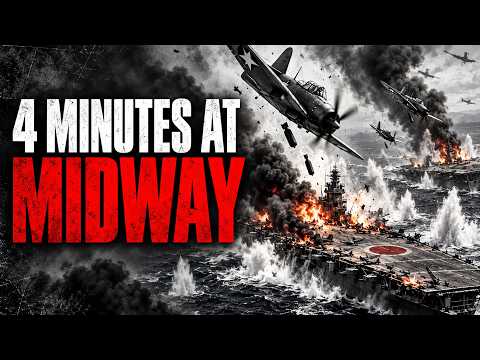
The first bombs struck Kaga within moments. At 10:25, Sōryū was hit. At 10:26, a single thousand-pound bomb punched through the flight deck of Akagi, the flagship, and exploded among armed aircraft in the hangar below. Four minutes. Three carriers, all of them burning out of control. By nightfall, a fourth would join them. The force that had opened the Pacific war would never sail again.
Midway is called the turning point of the Pacific war so often that the phrase has lost its weight. The record gives that weight back. On the morning of June 4, 1942, Japan owned the most powerful carrier striking force on the planet. Six large fleet carriers had attacked Pearl Harbor. Four of them were here. Between them, they carried well over 200 aircraft flown by the most experienced carrier airmen in the world. By the next morning, all four were sunk or sinking.
Japan did not lose the war at 10:22. It lost something that proved just as fatal: the power to choose where the war would be fought. Before that morning, Japan picked the targets—Pearl Harbor, Wake, Rabaul, Darwin, Ceylon. After it, the United States picked them—Guadalcanal, Tarawa, Saipan, Leyte, Okinawa. For the next three years, the initiative in the Pacific never changed hands again.
The weapon that took it away was not a battleship. It was not a new fighter. It was an airplane the United States Navy already considered close to obsolete. The Dauntless topped out at around 250 mph. A Zero could out-climb it, out-turn it, and out-run it. Its replacement was already on order.
Midway is usually told as a miracle. A lucky scout. A lucky heading. Five fateful minutes that happened to go America’s way. That is the version most people know. It is also wrong. What happened in those four minutes had been assembled piece by piece over six years. Some of the pieces were American. The most important of them were Japanese.
But the destruction of the Kidō Butai did not begin in the sky above its carriers. It began six years earlier in an aircraft plant in El Segundo, California, with a decision nobody recorded as important.
In the mid-1930s, the U.S. Navy wanted a new dive bomber. The Navy had believed in dive bombing for more than a decade, and its reasoning was simple arithmetic. A bomb released from 20,000 feet takes more than half a minute to reach the sea. A warship steaming at 30 knots covers several hundred yards in that time and can turn. The dive bomber released its weapon a few thousand feet above the target, pointed almost straight at it. The bomb had very little room to miss.
The idea was not new. Marine Corps pilots had dropped bombs in steep dives against rebel positions in Haiti in 1919 and Nicaragua in 1927. Through the 1930s, Navy squadrons practiced it against towed targets and against their own fleet in exercises. The results were consistent: a diving aircraft hit a moving ship far more often than a formation bombing from high altitude. The Navy built its carrier air groups around that result. Every American fleet carrier would go to war with two full squadrons of dive bombers aboard.
The problem was the dive itself. An aircraft pointed at the ocean keeps accelerating. Past a certain speed, the controls stiffen, the pilot loses his aim, and the airframe can begin to come apart. A dive bomber needed brakes.
At the Northrop plant in El Segundo, a design team under Jack Northrop, including a young engineer named Ed Heinemann, built those brakes into a new aircraft called the BT-1. They used split flaps along the trailing edge of the wing. One half swung up, the other swung down. Together, they held the dive to a steady speed. They also created a new problem. The turbulent air tumbling off the open flaps slammed into the tail. In test dives, the whole aircraft shook. The buffeting was violent enough to make precise aiming close to impossible.
The fix came out of testing. Perforate the flaps. Cut rows of holes through the metal so that part of the airflow passed straight through instead of tearing off the edges. The buffeting disappeared. It was a modest engineering change. Nobody wrote it up as a turning point.
The El Segundo plant became part of Douglas Aircraft, and the design kept evolving. In 1940, it entered service as the Douglas SBD—Scout Bomber Douglas. The crews called it the Dauntless. Those perforated flaps defined everything the aircraft could do. Flaps open, the Dauntless could hold a dive of about 70 degrees at a steady, controllable speed. The pilot had time to line up on a ship, correct for its turn, and correct again. He released at around 2,000 feet. A bomb dropped from that height, already traveling at the speed of the dive, reached its target in a few seconds.
Beneath the fuselage, a hinged crutch swung the bomb down and clear of the propeller at the moment of release. A pilot diving almost vertically could let go of a thousand pounds of explosive without flying into his own weapon. Everything else about the aircraft was ordinary. It was slow. It was lightly armed with two forward machine guns and a gunner facing backward. It was built to be sturdy rather than fast. By early 1942, the Navy was already planning to replace it.
It would take six years to learn what those holes were worth. And the first carriers to find out belonged to the most dangerous naval force ever assembled.
On the other side of the Pacific, the Imperial Japanese Navy was building something no navy had built before. In April 1941, Japan formed the First Air Fleet. For the first time in history, a navy gathered its large aircraft carriers into a single striking force, trained them together, and planned to fight them together. The Japanese called it the Kidō Butai—the mobile force.
The idea had a champion. A young aviation staff officer named Minoru Genda argued that carriers scattered among battleship squadrons wasted their aircraft. Concentrated, their air groups could launch a single strike larger than anything a land base could send. Six carriers working together could put more than 300 aircraft over one target in a single morning. No other navy in the world could do that in 1941. The Japanese could.
Its core was four ships. Akagi and Kaga were giants, each well over 30,000 tons, built on the hulls of a battlecruiser and a battleship that naval treaties had kept from being finished as warships of the line. Sōryū and Hiryū were smaller and newer—purpose-built carriers capable of more than 34 knots. In the autumn of 1941, two more large carriers joined them, Shōkaku and Zuikaku. Six fleet carriers operating as one weapon.
Their aircraft were the best carrier aircraft in the world. The Mitsubishi A6M Zero could fly more than 1,900 miles with a drop tank. It could out-climb and out-turn every Allied fighter it met in 1942. It carried two 20-mm cannon alongside its machine guns. The Nakajima B5N torpedo bomber carried the Type 91 aerial torpedo, a weapon that ran straight and exploded when it struck. The Aichi D3A dive bomber would go on to sink more Allied warships than any other Axis aircraft of the war.
The men who flew them came out of a training system that rejected most of its applicants. Many had been in combat over China since 1937. By December 1941, the airmen of the Kidō Butai were the most experienced carrier aviators on Earth.
On December 7, 1941, the six carriers launched 353 aircraft against Pearl Harbor in two waves. They sank or damaged all eight battleships of the Pacific Fleet present in the harbor. They killed 2,403 Americans. They lost 29 aircraft. Then they kept going. In January, the carriers struck Rabaul. On February 19, 1942, four of them launched 188 aircraft against Darwin in northern Australia. In April, five carriers entered the Indian Ocean and struck Colombo and Trincomalee in Ceylon.
On April 5, their dive bombers caught two British heavy cruisers, Dorsetshire and Cornwall, at sea. Both were on the bottom within about twenty minutes of the first bomb. Four days later, they sank the British carrier Hermes. From Hawaii to Ceylon is more than a third of the way around the planet. The Kidō Butai crossed that distance in four months. It struck wherever it chose. It did not lose a single ship.
Every measure of naval air power favored Japan. More fleet carriers operating together. A fighter that could outfly anything sent against it. A torpedo that worked. Crews with years of combat behind them. Japanese officers would later give the mood of that spring a name. They called it victory disease.
The numbers on the American side read like an inventory of what was missing. After Pearl Harbor, the Pacific Fleet had no battle line. The battleships that survived were damaged or too slow to steam with carriers. The war in the Pacific would be fought by aircraft carriers, and the United States did not have many of them.
On January 11, 1942, a Japanese submarine put a torpedo into the Saratoga. She went to the West Coast for repairs and would miss Midway entirely. On May 8, at the Battle of the Coral Sea, the Lexington was lost. The Yorktown came out of the same battle with a bomb hole driven down through her decks. Enterprise and Hornet had spent April carrying Doolittle’s bombers toward Japan, and they had arrived too late for the Coral Sea. By the end of May, the Pacific Fleet had two undamaged fleet carriers.
Against them, Admiral Isoroku Yamamoto was preparing the largest naval operation in Japanese history. His plan for Midway and the Aleutian Islands committed eight aircraft carriers and eleven battleships, among them the Yamato, the largest battleship ever built.
The aircraft were worse than the numbers. The Navy’s standard carrier fighter, the Grumman F4F Wildcat, was rugged and well-armed, but the Zero could outclimb it, and at the speeds where dogfights were fought, the Zero could turn inside it with ease. Wildcat pilots were taught one rule above all others: never try to turn with a Zero.
The torpedo bomber was the Douglas TBD Devastator. It had first flown in 1935. Its top speed was around 200 miles an hour, and with a torpedo slung beneath it, it cruised far slower. To launch its Mark 13 torpedo, the pilot had to fly straight and level close to the water at little more than 100 knots. Every second of that approach belonged to the enemy’s guns. Even then, the Mark 13 of 1942 was unreliable. It could run erratically, dive too deep, or strike its target and fail to explode.
By June, the Zero had a reputation among American aircrew that no enemy aircraft had earned before. Allied fighters over the Philippines, Java, and Malaya had been shot down in numbers the Allied commands struggled to explain. Reports of its range and climb were first dismissed, then confirmed at high cost. Its weaknesses were real. It carried no armor for the pilot, and its fuel tanks did not seal themselves when hit. But in the spring of 1942, few American pilots had lived long enough in a fight with one to exploit either.
The aircraft on Midway itself were a collection of whatever the Navy, the Marines, and the Army could spare. Brewster F2A Buffalo fighters that the Zero outclassed in every category. Vought SB2U Vindicator dive bombers so worn that their crews called them wind indicators. Army B-17 Flying Fortresses trained to bomb ships from high altitude—the exact method the Navy had rejected a decade earlier for the exact reason it had rejected it.
Midway itself was barely land. Two small islands inside a coral reef, Sand Island and Eastern Island, with a total area of about two and a half square miles. Eastern Island held the airstrip. More than 100 aircraft of every type were crowded onto it. Many flown by crews who had never seen combat. Hornet‘s air group had not yet fought a single battle. Several of the Marine pilots had only recently finished flight training.
On the ground, the Marine garrison had strung barbed wire along the beaches, dug in its anti-aircraft guns, and laid mines in the shallows. They were preparing for an invasion they expected within weeks by a force they knew they could not stop on their own.
Two carriers, one damaged, eleven Japanese battleships against none. Count it the way Yamamoto’s staff counted it: four Japanese fleet carriers against at most two American ones. The Japanese believed the Yorktown had gone down in the Coral Sea. Many doubted any American carriers would be near Midway at all.
There was one thing the Americans had in useful numbers. It had been in their hangars since 1940, and almost nobody expected it to decide anything.
What nobody in Tokyo understood yet was this: the Kidō Butai‘s great strength and its fatal weakness grew out of the same set of design decisions. Japanese fleet carriers were built with enclosed hangars—sealed steel boxes where aircraft were fueled and armed below decks. It protected them from the sea. It also turned every hangar into a bomb waiting for a fuse.
The question that decided the Pacific was not who had the better planes. It was who had built their carriers to survive a single unlucky minute. And on the morning of June 4th, the answer was already six years old, cut into a set of perforated flaps in El Segundo, California.
Report this article
Select a reason for reporting:






