The metallic hammering tore through the fog-shrouded pines like nothing the veteran grenadiers had ever heard. Not the methodical chatter of an MG 42. Not the slower rhythm of a Browning. Something faster—sustained like automatic fire, but coming from individual riflemen scattered across the forest floor.
Obergefreiter Wilhelm Hartmann pressed himself into the frozen earth as wood chips exploded from the tree above his head. Eight rounds impacted in less than five seconds. Then came that distinctive sound—a metallic ping that rang through the forest like a bell—followed immediately by another eight-round volley from the same position.
The American soldier hadn’t moved. Hadn’t paused to reload with fumbling fingers on stripper clips. He simply kept firing with a speed that defied everything Hartmann knew about infantry combat.
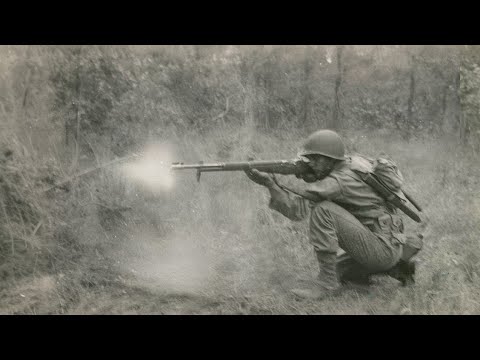
What the German defenders of Hürtgen were experiencing was not a machine gun. It was the M1 Garand semi-automatic rifle, and it was about to revolutionize infantry warfare by doing something no standard-issue rifle had ever done: put the firepower of an entire World War I squad into the hands of a single American soldier.
The Germans called it that damned automatic rifle, and they would learn to fear its distinctive ping more than any other sound on the battlefield. But the terror wasn’t just about the weapon. It was about what it represented.
American industrial genius, unlimited production capacity, and a rifle so reliable that it would fire eight rounds as fast as a soldier could pull the trigger—in any weather, under any conditions, without ever jamming.
General George Patton would call it the greatest battle implement ever devised. German after-action reports would describe facing entire American companies armed with automatic rifles. Neither assessment was exaggeration.
The M1 Garand represented a quantum leap in infantry firepower, and the story of how it came to exist begins not with military vision, but with one brilliant engineer’s decades-long struggle against military bureaucracy, budget constraints, and the institutional inertia of generals who couldn’t imagine anything better than a bolt-action rifle.
The journey toward the M1 began in 1919 when a Canadian-born firearms designer named John Cantius Garand started working at Springfield Armory in Massachusetts. The United States Army had just finished fighting the First World War armed primarily with the Springfield M1903 bolt-action rifle—an excellent weapon by 1918 standards, accurate and reliable, but fundamentally unchanged from designs that dated back to the 1890s.
Every American soldier had watched German machine gun teams pour out sustained fire while American riflemen worked their bolt actions between each shot, ejecting spent cartridges and chambering new rounds in a sequence that seemed glacially slow under combat stress.
Garand understood that the future belonged to self-loading rifles—weapons that used either gas pressure or recoil energy from a fired cartridge to automatically eject the spent case and chamber a fresh round. Several European designers had explored this concept, but none had produced a rifle reliable enough, durable enough, and simple enough for mass production and field use under combat conditions.
The technical challenges were immense. A semi-automatic rifle required a complex mechanism that could harness the violent forces of cartridge ignition, redirect those forces to operate the action, extract and eject a spent case, strip a new round from a magazine, chamber it, and reset the firing mechanism—all in a fraction of a second, all while maintaining accuracy, all while surviving mud, sand, rain, snow, and the thousand other insults that infantry weapons endured in combat.
Garand’s first prototype, submitted in 1920, failed spectacularly. So did his second, third, and fourth designs. The Army was lukewarm about the entire concept of semi-automatic rifles. Bolt actions were proven, understood, and cheap. Semi-automatics were experimental, complex, and expensive. The military budget of the 1920s was microscopic. Congress saw no need to fund expensive weapon development when the nation wasn’t at war.
But Garand persisted, refining his design through the 1920s and early 1930s while working on a shoestring budget at Springfield Armory.
The breakthrough came in 1932 when Garand completed a design using a gas-operated rotating bolt system fed by an eight-round en bloc clip. The cartridge he designed it around was the standard .30-06 Springfield round—the same powerful cartridge used in the M1903 rifle and the Browning automatic rifle. This decision proved crucial. By using existing ammunition, Garand ensured his rifle wouldn’t require a complete overhaul of the Army’s logistics system.
The .30-06 was a powerful round, firing a 150-grain bullet at 2,800 feet per second with enough energy to remain lethal at 800 yards. The en bloc clip system was Garand’s most controversial innovation. Instead of a detachable box magazine like most semi-automatic designs, the M1 used a self-contained eight-round clip that inserted from the top of the receiver. When the last round was fired, the empty clip was automatically ejected with that distinctive metallic ping.
Critics argued that eight rounds weren’t enough, that the ping would alert enemies when a soldier was empty, that the clip system was unnecessarily complex. Garand defended his design by pointing out that the en bloc clip was lighter than a detachable magazine, less prone to damage, impossible to lose because it ejected automatically, and that eight rounds of rapid semi-automatic fire provided more effective firepower than a larger magazine on a slower rifle.
Army testing through the mid-1930s was exhaustive. The M1 prototype fired thousands of rounds in dust chambers, cold rooms, and mud pits. It was frozen, baked, dropped, and deliberately abused to simulate years of field use. Competing designs from other manufacturers failed one test after another. The M1 kept firing.
In January 1936, the United States Army officially adopted the M1 Garand as its standard service rifle, making the American military the first major power to issue semi-automatic rifles to all infantry soldiers, rather than just specialized troops.
Production began slowly. Springfield Armory manufactured the first M1s by hand, using skilled workers to fit individual parts. Early production rates barely exceeded 100 rifles per day. But John Garand and Springfield’s engineers understood that war was coming, and that when it arrived, America would need hundreds of thousands of rifles. They redesigned the M1 for mass production, simplifying manufacturing processes and creating interchangeable parts that could be produced by contractors across the country.
By 1940, production had accelerated to several hundred rifles daily. After Pearl Harbor, it became an avalanche. Winchester Repeating Arms Company geared up M1 production at their New Haven, Connecticut, facility. Springfield Armory expanded dramatically. Harrington and Richardson Arms Company, International Harvester, and other contractors joined the effort.
At peak production in 1943 and 1944, American industry was producing 4,000 M1 Garand rifles every single day.
Each rifle contained 67 precisely machined parts, required 43 separate manufacturing operations, and had to meet tolerances measured in thousandths of an inch. Yet American workers—many of them women who had never seen a rifle before Pearl Harbor—turned out weapons with precision and reliability that exceeded peacetime standards.
The M1 Garand weighed 9 and 1/2 pounds empty, measured 43 and 1/2 inches long, and featured a 24-inch barrel. The gas system used a small port near the muzzle to bleed off propellant gases from each fired round. These gases drove a piston that unlocked and rotated the bolt, extracted the spent cartridge case, cocked the hammer, and chambered the next round from the en bloc clip.
The entire cycle took less than 1/10 of a second. A trained soldier could empty an eight-round clip in about 5 seconds. Faster if he wasn’t concerned about accuracy, slower if he was taking aimed shots—but always dramatically faster than any bolt-action rifle.
The first American soldiers to carry M1s into combat were Marines landing on Guadalcanal in August 1942. The jungle environment immediately tested every claim made about the rifle’s reliability. Humidity corroded metal, sand abraded moving parts, and mud caked every surface. The M1 kept firing.
Japanese soldiers, armed with the Arisaka Type 38 and Type 99 bolt-action rifles, discovered that they were facing an impossible rate of fire from American positions. A Marine squad of 12 men, each armed with an M1, could deliver 96 aimed rounds in under a minute without reloading. A comparable Japanese squad would fire perhaps 30 rounds in the same time, pausing after each shot to work their bolt actions.
First Sergeant John Basilone, fighting on Guadalcanal in October 1942, employed his section’s two Browning M1919 machine guns with devastating effect during a Japanese assault on Henderson Field. But it was the sustained fire from Marines with M1 Garands that held the line between machine gun positions, pouring out semi-automatic fire that broke up Japanese infantry formations before they could close to effective range.
Basilone would receive the Medal of Honor for his actions that night, but the after-action reports noted that the rapid-fire capability of the M1 rifle had been as important as the machine guns in repelling the assault.
By 1943, every branch of the American military was receiving M1s as fast as factories could produce them. Army infantry divisions in North Africa carried them against German and Italian forces. Paratroopers jumped with them into Sicily and Italy. And in June 1944, when American soldiers stormed ashore on the Normandy beaches, virtually every rifleman carried an M1 Garand.
The German army that met the Americans in Normandy was the most experienced military force in the world, battle-hardened by five years of continuous combat across Europe and Russia. But German infantry were armed primarily with the Karabiner 98k—a bolt-action rifle that was essentially an improved version of the Mauser 98 from 1898. It was an excellent weapon by bolt-action standards, accurate, reliable, and well-made. But it required the soldier to manually work the bolt after each shot, a sequence of motions that took even well-trained soldiers at least two seconds, often longer under combat stress.
The tactical implications became apparent within days of the Normandy landings. American squads could put out sustained fire that German units couldn’t match without deploying their belt-fed MG 42 machine guns. In firefights at typical engagement ranges of 100 to 300 yards, the volume of fire from American M1s often forced German soldiers to take cover before they could return effective fire.
The psychological effect was significant. German troops reported facing what they believed were entire squads armed with automatic weapons. Captured German documents from late 1944 revealed the Wehrmacht’s growing concern about American firepower superiority. A tactical assessment from the German 352nd Infantry Division, which had fought Americans since D-Day, noted, “The enemy rifleman is armed with a semi-automatic weapon of considerable effectiveness. Rate of fire appears comparable to submachine guns at close range.”
All infantry attacks must account for sustained fire from enemy rifle positions that cannot be suppressed by small arms fire alone.
The M1’s advantages extended beyond raw firepower. The semi-automatic action significantly reduced fatigue compared to bolt-action rifles. A soldier working a bolt action fifty or sixty times during a firefight would experience tired arms and slowed reactions. An M1 operator simply pulled the trigger, allowing him to maintain faster reactions and better accuracy over extended engagements.
The reduced recoil impulse compared to bolt-action rifles helped as well. The gas-operated system absorbed some of the recoil energy, making follow-up shots faster and more accurate.
But the M1 wasn’t perfect. That distinctive ping when the en bloc clip ejected after the eighth round became legendary, with stories circulating that German soldiers would wait to hear the ping before attacking. In reality, the sound was rarely heard over battlefield noise, and any soldier who assumed an American was empty after eight shots would often meet his end from the soldier’s rapidly reloaded rifle—or from his squadmates who were still firing.
The en bloc clip system did have one genuine limitation. The rifle couldn’t be topped off during a lull in fighting. Once a clip was inserted, it stayed until all eight rounds were fired. Soldiers learned to count their shots and reload during appropriate moments, but this required more attention than simply swapping magazines.
The rifle also required more maintenance than bolt actions. The gas system needed regular cleaning to prevent carbon buildup that could slow the action. The operating rod could bend if the rifle was dropped on its muzzle at the wrong angle. But American logistics and training compensated for these issues. Every soldier received instruction on field stripping and maintaining the M1. Armorers at the company level could replace damaged parts, and the sheer quantity of spare parts flowing through the supply system meant that a damaged rifle could be quickly repaired or replaced.
The Battle of the Bulge in December 1944 provided the ultimate test of the M1’s reliability in extreme cold. Temperatures dropped below zero, snow caked everything, and weapons froze. German forces, betting on winter weather to ground Allied air power and slow their advance, launched a massive counteroffensive through the Ardennes Forest. American units, many of them green replacements rushed to the front, found themselves outnumbered and surrounded in frozen forests.
At Bastogne, the 101st Airborne Division, surrounded and cut off, held against repeated German assaults. The paratroopers, armed primarily with M1 Garands, maintained disciplined fire against attacking German infantry and armor. The semi-automatic fire from hundreds of M1s created defensive firepower that German commanders couldn’t overcome without artillery support.
Captain Charles Coco, commanding Easy Company of the 502nd Parachute Infantry Regiment, reported, “The M1 gave us the firepower to hold positions that would have required twice as many men with bolt-action rifles. Even under sustained assault, our fire never slackened because individual soldiers could maintain effective rates of fire without exhausting themselves working bolt actions.”
The cold weather revealed one M1 vulnerability. The rifle’s gas system could freeze if moisture entered the gas cylinder. But this problem affected all semi-automatic and automatic weapons. German MG 42 machine guns experienced similar freezing issues. The difference was that American soldiers had been trained to prevent this by keeping actions clear of snow and moisture—while German units, less familiar with semi-automatic actions on rifles, had no comparable experience base for their standard infantry weapons.
In the Pacific Theater, the M1 proved equally effective under completely different conditions. The jungle fighting on islands like Peleliu, Iwo Jima, and Okinawa occurred at close ranges where the M1’s rapid-fire capability was decisive. Japanese defensive tactics emphasized close-range ambushes and sudden counterattacks designed to negate American firepower advantages, but Marines and soldiers with M1s could respond instantly with sustained fire that broke up these attacks before they closed to hand-to-hand range.
Gunnery Sergeant John Basilone, who had survived Guadalcanal and received the Medal of Honor there, returned to combat with the 5th Marine Division at Iwo Jima in February 1945. During the initial assault on the black volcanic sand, he led his machine gun section through devastating Japanese fire.
He would be taken down on the first day of the battle, but the Marines advancing with him were armed with M1 Garands that provided the sustained fire needed to suppress Japanese positions while assault teams maneuvered forward.
By early 1945, the American military had fielded over 4 million M1 Garand rifles. German ordnance specialists who evaluated captured M1s concluded the rifle represented a significant advantage in infantry firepower that German forces could not match with current equipment.
One German Unteroffizier captured near the Rhine in March 1945 confessed: “We thought we were facing an entire company. The fire never stopped. Every American seemed to have an automatic rifle. When we finally surrendered, we discovered we had been pinned down by just one platoon.”
Between 1936 and 1957, over 5.5 million M1s were manufactured. Patton called it the greatest battle implement ever devised—and he wasn’t exaggerating.
That metallic ping still echoes in military history: eight rounds of American firepower, followed by a fresh clip and eight more. The Germans called it that damned automatic rifle. American soldiers just called it the M1.
So here’s my question for you: if you had to carry one rifle into combat—the M1 Garand or the German Karabiner 98k—which would you trust with your life, and why?
Report this article
Select a reason for reporting:






