The photograph looked ordinary. Two young men sat side by side in a small Victorian studio, dressed in dark suits, their backs perfectly straight, their expressions carefully composed. One rested his hand on the other’s shoulder. Between them stood a narrow wooden chair, and behind them hung a painted backdrop of a country garden. For over a century, nothing seemed unusual about it. Then someone zoomed in.
At first, researchers thought they were looking at damage—a faded shape behind the two men, partially hidden by the edge of the painted backdrop. But as restoration progressed, the shape sharpened. There was a third person in the photograph. Not standing beside them. Not seated behind them. Someone reflected in a small polished object near the bottom of the frame. And once that reflection was noticed, the entire image began telling a different story.
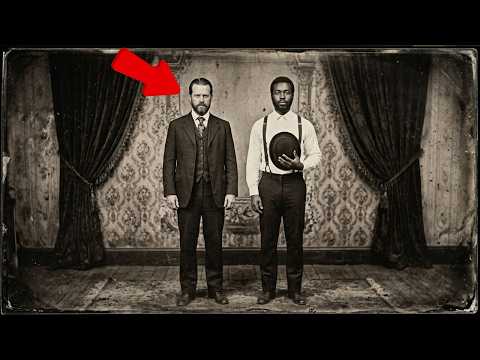
The photograph was found in a box of family papers belonging to a retired schoolteacher in the English town of Whitby. The box held ordinary things—letters, receipts, wedding invitations, pressed flowers, and dozens of faded photographs. Most had names carefully written on the back. This one did not. The only marking was a date: October 1894. The two men appeared to be in their twenties.
The man on the left was slightly taller, with a thin face and dark hair neatly parted down the middle, a small scar above his right eyebrow. The man beside him looked younger. His hair was lighter, his face rounder, his left hand resting loosely on his knee while his right arm disappeared behind his friend. Both wore formal three-piece suits. Neither smiled. That alone was not unusual—nineteenth-century photography required long exposure times, and subjects were often told to remain perfectly still. Serious expressions were common.
What was unusual was the closeness between the two men. Their shoulders touched. Their bodies leaned slightly toward each other. And the taller man had placed his hand on the shorter man’s shoulder with an intimacy that seemed too familiar for a formal studio portrait of the period. Still, there was nothing to prove anything unusual. It might simply have been friendship—which was exactly how the photograph had been described for decades. Two friends, nothing more.
Until a conservator named Eleanor Foss examined the original glass plate negative under a microscope. She noticed something near the bottom right corner. At first, she assumed it was a scratch. The shape was tiny, almost entirely hidden beneath the edge of a piece of studio furniture, but it seemed too symmetrical to be damage. Eleanor scanned the image at very high resolution and adjusted the contrast. The shape became clearer. It was a pocket watch—or at least part of one. Its polished metal casing caught the studio light, and within that small curved surface was a distorted reflection: a face.
Eleanor stopped. The face appeared only as a few pixels in the modern scan, but the location was unmistakable. Someone was standing behind the camera—someone who was not visible anywhere else in the photograph. That raised the first question: Who was the third person?
The answer should have been simple. Photography studios often had assistants. A photographer might have stood behind the camera. Perhaps a studio worker was adjusting equipment. There was nothing mysterious about someone standing out of frame. But Eleanor noticed something else. The reflection did not appear to show the photographer. The person seemed to be standing slightly to the side, and more importantly, they appeared to be holding something—a paper. Perhaps a letter, perhaps no more than a folded cloth. The photograph alone could not prove it.
So Eleanor started with the two men. The back of the photograph contained no names, but the box it was found in included several documents from the same family. One letter, dated 1896, mentioned a young man named Asterix Thomas Bell. Another referred to someone named Asterix Arthur Hale. The two names appeared together only once. That was enough to begin.
Eleanor contacted a local genealogist, Samuel Reed, who specialized in nineteenth-century families from the Yorkshire coast. Samuel searched census records, parish registers, marriage records, and local newspapers. Then he found something. In the 1891 census, a twenty-one-year-old carpenter named Thomas Bell was living with his widowed mother and younger sister. Three streets away lived a nineteen-year-old bookbinding apprentice named Arthur Hall. Their trades were different, their families were different, but there was one connection. Both worked at the same charity reading room. That explained how they met, but it did not explain the photograph.
Then Samuel found a business directory from 1894. The photography studio where the picture was taken belonged to a man named Edwin Mercer. Mercer ran a small studio above a tailor’s shop on Church Street. His surviving advertisements described portraits available in several styles, including special memorial portraits for families. That seemed ordinary. Until the researchers found Mercer’s studio ledger. Only a few pages survived. Most recorded names and prices, but one entry caught their attention. October 17, 1894. Session: Bell and Hall. Paid in cash. No additional description. At first, it seemed like confirmation. Thomas Bell and Arthur Hall had indeed been photographed together.
But Samuel noticed the line directly beneath it. Additional plate paid separately. No explanation. Why would two young men requesting an ordinary portrait need an extra photographic plate? The researchers returned to the image. The reflection in the pocket watch suddenly mattered. Perhaps there was another photograph. Perhaps the second plate captured something that was never meant to remain. But no second image was found. Not yet.
The investigation shifted to Mercer’s personal records. An old newspaper article from 1902 described the photographer’s retirement after his eyesight deteriorated. The article mentioned that crates of his studio equipment had been sold—glass negatives, backdrops, furniture, and personal papers. Most had disappeared. But a surviving inventory list from a local auction included an unusual item: one damaged portrait plate, unidentified, two men. The description was vague—no names, no date. But the dimensions matched the original photograph. That meant the plate might have survived somewhere.
The researchers contacted an archive in York. Nothing. Then a private collector. Nothing. Then a museum that held several nineteenth-century photographic plates from the region. Nothing either. For weeks, the trail seemed to go cold. Then an archivist discovered a handwritten note attached to a box of unrelated negatives. The note read: Session special, please return. There was no name, no date. But there was a number: 17. The same number appeared beside the Bell and Hall entry in Mercer’s ledger.
The researchers now had something more troubling than a mere reflection. They had evidence that the session might have been treated differently from ordinary studio work. The question became: Why?
The obvious explanation was personal. Perhaps one of the men had requested extra copies for someone he loved. Perhaps the photograph was meant as a private gift. But that remained speculation. The documents had to tell them more.
Samuel searched newspaper archives from 1894. At first, nothing. Then, in a small local paper, he found a brief report about an accident at the harbor. A young dock worker had fallen from a loading platform. The man’s name was Thomas Bell. He survived, but the accident left him unable to work for several months. The date was October 11—only six days before the studio portrait.
That changed the timeline. Why would Thomas sit for a portrait immediately after a serious accident? Samuel kept digging. A parish record showed that Thomas’s mother had died earlier that year. His younger sister was preparing to leave Yorkshire for work in Liverpool. Thomas’s life was changing quickly. But Arthur Hall was preparing to leave too. A passenger list later revealed that Arthur Hall sailed for Canada in early 1895.
The two men had been photographed shortly before their lives separated. That gave the image an emotional explanation—two friends documenting a final moment before one of them departed. But the researchers still had not explained the reflection.
Then they found the letter. It was folded inside the same family Bible that held papers belonging to Thomas Bell. The handwriting was difficult to read. The letter was unsigned. But the date was clear: October 16, 1894—the day before the photograph was taken. It was addressed simply to Thomas.
The contents were not dramatic. There was no confession. No secret declaration. No explanation of the photograph. Instead, the writer discussed money, travel, and a promise. But one line near the end changed everything. It referred to a small parcel left with a woman named Margaret Bell, Thomas’s sister. The parcel was not to be opened until after Arthur left England.
The researchers searched Margaret’s later records. She eventually moved to Liverpool. She married in 1898. She died in 1937. Her belongings were never catalogued in detail. So the parcel could not be traced. The mystery seemed impossible to solve—until another photograph surfaced. Not the lost studio plate, but a different image entirely.
It showed a group of workers outside a bookshop. Arthur Hall stood near the edge, Thomas Bell beside him, and on a table between them sat the same pocket watch. It was the first physical link between the reflection and the two men. The watch belonged to Arthur. An engraving inside the cover showed a date: 1891. It must have been a gift from his father.
The researchers examined the portrait again. The watch was not simply lying on the table. It had been placed upright. Its polished lid faced the camera. That was unlikely to be coincidence. Someone had put it there. But why?
The answer came from a small detail hidden in the magnified reflection. The person standing behind the camera was not holding a letter. They were holding a second photograph. And when the researchers reconstructed the shape digitally, it appeared to show the two men together. The reflection had captured an image of the image itself—a second plate, a hidden copy.
The researchers realized that Mercer had likely been experimenting with a simple optical trick, deliberately placing the pocket watch to create a reflective element in the composition. But there was still a problem. Why would a photographer design such an unusual arrangement for two ordinary clients? The surviving studio records finally provided the answer.
Mercer sometimes produced what he called special memorial portraits. These were not unusual in themselves. They were simply photographs commissioned by people who wanted something personal rather than formal—a final image before emigration, or a portrait of a deceased relative. A photograph to be given to someone leaving home. The Bell and Hall portrait most likely fell into that category.
The mystery was beginning to dissolve. But the researchers found one final document. It was not in Mercer’s records. It was in a Canadian archive. A letter written by Arthur Hall in 1895. He had arrived in Nova Scotia, and the letter was addressed to Margaret Bell. In it, Arthur thanked her for sending the photograph. Then he wrote something that made the researchers return to the original image one last time.
He mentioned that he had kept half the photograph, and that Thomas had kept the other half.
The researchers realized what that meant. The original photograph had been physically divided—not digitally or metaphorically, but cut into two halves. Thomas and Arthur each carried a piece of the same image with them. The original in the family collection was never the complete picture. It had been reconstructed from one surviving half.
The odd spacing between the two men suddenly made sense. They weren’t simply posing as friends for a formal portrait. They were creating a single image that could be separated later—one half for each man. The pocket watch sat between them because it belonged to Arthur. When the photograph was split, the watch stayed on his side.
The reflection was not proof of a stranger hiding in the shadows. It was proof of the photographer’s unusual composition. The third person was certainly Edwin Mercer himself, accidentally captured on the polished surface of the watch as he stood behind his camera.
The researchers had spent weeks chasing a mystery that ultimately had a stunningly human explanation. But one question remained. Why was that photograph so important? The answer was found in Arthur’s later life. He stayed in Canada, married, and had children. Thomas remained in England. He eventually became a dock foreman and lived into his seventies. The two men never seemed to live in the same country again, but they continued to correspond. Several letters survived, discussing work, family, weather, money, and ordinary things. And sometimes they mentioned the photograph.
One of Thomas’s letters from 1903 contained a simple sentence: “I still keep my half above the mantelpiece.” That sentence changed the meaning of the portrait. It was never an image meant to preserve a dark secret. It was an image designed to preserve a friendship across distance. The two men knew they were about to separate, and they knew the future was uncertain. So they sat together in a small studio and created something neither of them could carry whole. Each would take half. And each would keep the other half in memory.
More than a century later, the photograph looked different because the researchers knew what they were seeing. The stiff Victorian clothing no longer seemed cold. The serious expressions no longer seemed emotionless. Even the strange space between their bodies began to make sense. It was the line along which the photograph would eventually be divided. And that tiny reflection in the pocket watch—the detail that created the mystery—was perhaps the most fitting part of all. For a fraction of a second, Edwin Mercer was captured in the photograph as he took it. The photographer became part of the memory without ever intending to.
Today, the photograph might look ordinary to someone who doesn’t know its story. Two young men, dark suits, a painted garden, a pocket watch, and a tiny reflection. But photographs are strange things. They preserve what people deliberately place before the camera. And sometimes they preserve things people never intended anyone to notice.
In this case, the smallest detail did not reveal a crime. It did not reveal a conspiracy. It did something quieter. It revealed how much meaning two people placed inside a single image. Thomas and Arthur did not know their lives would eventually move in different directions. They did not realize one would cross an ocean. They did not know their letters would outlive them. And they certainly did not know that more than a hundred years later, someone would magnify a tiny reflection in a pocket watch and start asking questions about them.
But perhaps that is why the photograph survived. Not because it contained a secret, but because it contained a promise. The two friends understood that distance might change their lives. So they made one image, then divided it. One half stayed in England, and the other traveled across the Atlantic. And throughout their lives, each man kept half of the same moment.
When we look at old photographs, we often search for dramatic details—a strange hand, a hidden body, a face in a window, something impossible lurking in plain sight. But sometimes the most affecting discovery is not something frightening at all. Sometimes the smallest detail simply reminds us that the people in these images once stood on the threshold of an unknown future. They had plans, they had fears, and they had people they did not want to forget.
For Thomas Bell and Arthur Hall, that little studio portrait became more than a picture. It became a way for each of them to carry a part of the other with him. Because the smallest detail in an old photograph is not always evidence of a dark secret. Sometimes it is the last trace of a promise made by two people before life carried them in different directions.
If you enjoyed this mystery, what other forgotten stories do you think are hiding inside historical photographs?
Report this article
Select a reason for reporting:






