Corporal James Whitfield of the 101st Airborne Division stood 40 meters from the Australian SAS patrol, a cigarette burning unnoticed between his fingers. The gray pre-dawn light of Phuoc Tuy province, 1967, revealed six men preparing to leave the wire—and in the next eleven minutes, everything he thought he knew about warfare would be dismantled. What he witnessed would haunt him for forty years, sitting in a VA hospital in Knoxville, Tennessee, telling his grandson that those eleven minutes were the most important of his entire Vietnam deployment. More important than any firefight, any briefing, any training the U.S. Army had drilled into him.
Because what those eleven minutes showed him was the difference between men who were going to war and men who were becoming something that war required. The difference between dying and not dying in a jungle that did not care about your training or your firepower or the institutional confidence of the most powerful military in human history. The jungle only cared about whether you understood its rules. And the Australians understood them. Whitfield understood, in those eleven minutes, that he did not.
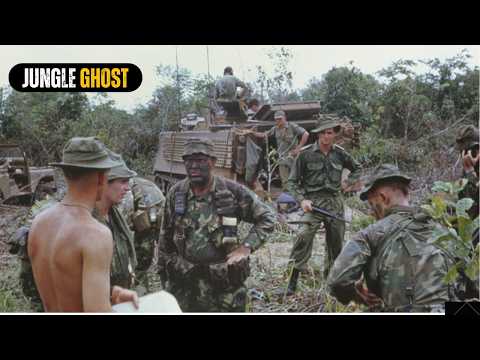
The preparation had begun at 3:47 a.m. Whitfield knew because he had checked his watch when the first Australian moved. The precision struck him as relevant in a way he could not then articulate. The Australians did not begin preparation when the light was sufficient, or when the officer gave the order, or when the base’s rhythm suggested it. They began at the precise moment the mission’s requirements determined—before first light, before the birds began their dawn calling, before the jungle shifted from its night register to its morning register. The insertion window was determined not by human convenience, but by the jungle’s own schedule.
Six men worked in complete silence—not the forced silence of noise discipline, but the natural silence of men for whom speaking had become genuinely unnecessary. They communicated through gestures so compressed and specific that they had ceased to be signals and had become a language. A private language built from years of operating together in environments where sound was the primary currency of survival, and every unnecessary expenditure of it was a debt paid in blood.
Whitfield watched them check each other’s equipment with the thoroughness of people who understood that the thing being checked was not gear, but life. The loose strap, the rattling buckle, the reflective surface catching the wrong light—not equipment deficiencies, but death sentences written in advance.
Then they applied their face paint. Not the geometric green and brown patterns of the Marine Corps field manual that Whitfield had applied hundreds of times without understanding. This was different. This was to make the human brain looking at them fail to register a face at all. To break the facial recognition pattern the nervous system detects in a fraction of a second—the fraction that in a jungle contact was the complete margin between ambush and counter-ambush. Between going home and not going home.
What the Australians had built in Phuoc Tuy province was not a tactical system in the American sense—a set of procedures and protocols that could be trained, tested, and upgraded. It was something older, less replicable, more intimate. Something that sat below procedure and existed in the relationship between specific men and a specific environment. Built through specific time spent on the environment’s terms, not the institution’s.
The Australians had been learning this environment since 1966. They sent five-man patrols into its interior at 20 meters per hour through terrain American units covered at 2 kilometers per day. The difference was not urgency or aggression. It was a difference in what movement itself was understood to be. At 2 kilometers per day, movement was transit—covering ground. At 20 meters per hour, movement was reading. The systematic acquisition of information about a living system constantly generating data: the broken twig, the compressed leaf, the disturbed soil, the specific silence of birds that had stopped calling because something that did not belong was moving through their territory.
The Australians had time to read all of it. The Americans were moving too fast to read any of it. They were generating so much noise and disturbance that they had permanently overwritten the signal with their own interference. They were telling the jungle where they were, how many they were, what direction they were moving, how fast, how heavily loaded, whether they had eaten recently, what products they had used on their skin that morning. A complete operational picture transmitted to every Viet Cong intelligence asset within 500 meters.
And the predictability of patrol routes was itself produced by the speed. At 2 kilometers per day, you had to take the routes that permitted 2 kilometers per day—routes the enemy had already mapped, already registered, already laid his killing grounds along. The Australians at 20 meters per hour could take routes no one had taken before, move through terrain the enemy had assessed as impassable and therefore left unwatched. They could arrive at positions no one was defending because no one believed anyone could reach them.
From those positions, they observed everything the enemy had hidden, believing the noise from American firebases would never find its way this deep into territory this difficult. And what they observed went back to the intelligence cell at Nui Dat each evening in encrypted radio bursts so compressed and brief that enemy signals intelligence could not get a fix before the transmission ended. What the intelligence cell built from those bursts over weeks and months was a picture of Viet Cong operations so detailed that Australian commanders later said it was the closest they had come to knowing what was going to happen before it happened.
Knowing what was going to happen before it happened was not a tactical advantage in the conventional sense. It was the removal of surprise from the equation. And surprise removed meant that the thing the Viet Cong relied on most completely—the thing that had been working against American units with terrible consistency for two years—simply did not work in Phuoc Tuy province. The Viet Cong noticed. They documented it in their internal communications, changed their operating procedures to account for it, and still could not solve it. Because the solution to a problem produced by human observation was not a technological countermeasure or a tactical adjustment, but a different kind of human presence in the terrain.
Sergeant Daniel Firth of the Special Air Service Regiment had been in Phuoc Tuy for seven months when the American liaison officer arrived at Nui Dat in October 1967. In those seven months, Firth had entered the jungle 43 times and come back 43 times. He had not fired his weapon on 38 of those entries. Not because he had not encountered the enemy, but because encountering and engaging were understood within Australian doctrine as two entirely different decisions with two entirely different sets of preconditions. The precondition for engagement was not proximity, but advantage.
On 38 of his 43 entries, those preconditions had not been met. And so he had watched the enemy move through positions his patrol had occupied invisibly. Had listened to conversations in Vietnamese that his signalman translated in whispers during the after-action debrief. Had mapped trails, counted weapons, identified commanders by the behavioral signatures that authority produces in any organization. The way other men deferred. The way the radio operator moved when a specific person spoke. The way a guard straightened when a specific man emerged from a specific doorway.
All of that went back to Nui Dat, fed into the intelligence architecture the SAS squadron had been building since 1966. One patrol at a time. One observation at a time. Until the picture was complete enough and accurate enough that the Australian task force could plan operations against targets it had watched for weeks rather than targets it had stumbled across. Could position blocking forces along withdrawal routes the enemy would use because the intelligence said those were the routes he always used. Could register artillery on coordinates the enemy had not yet moved to but would move to when the registered artillery began falling on the coordinates he was currently occupying.
And could achieve in execution the specific quality that distinguished Australian results from American results throughout the entire Vietnam deployment: the quality of not being surprised. Of having already accounted for every likely enemy response before the first shot was fired. What looked to outside observers like tactical genius was actually the product of patience—the grinding, unglamorous, deeply uncomfortable patience of men who had spent enough time lying in the jungle watching things happen that they understood how things happened. And could therefore predict with sufficient accuracy what was going to happen next to make every engagement a managed event rather than an emergency.
Managed events produced the kill ratios that the Pentagon’s analysis division flagged as statistically anomalous. Managed events produced casualty rates that the same division found impossible to reconcile with the operational tempo the Australians maintained. And managed events produced the specific quality of operational outcome that American units in adjacent sectors could observe but could not replicate. Because replication required the patience, and the patience required the time, and the time required the institutional willingness to measure success by something other than how much ground was covered and how many bodies were counted at the end of each week. And the American military in Vietnam in 1967 was not measuring success by any of those things.
Firth had grown up on a property outside Broken Hill in Western New South Wales, where the land was so large and so indifferent to human presence that learning to read it was not a recreational skill but a survival one. Where you understood from childhood that the country communicated constantly about everything that moved across it. And that the people who listened to what it was communicating lived, and the people who didn’t occasionally didn’t. He had brought this understanding to the army with him, the way people bring the things that formed them without knowing they are bringing anything. Without understanding that what feels like ordinary knowledge is actually a specific and valuable capability that most people do not possess and that cannot be manufactured through training alone.
He had learned in the Australian army how to convert this landscape literacy into military application. How to read a Vietnamese jungle the way he had read the Western New South Wales scrub. What the birds said and what the animals did and what the vegetation communicated about recent disturbance and recent passage. And he had learned the patience in the army that he had already been learning at home without knowing it was patience. The specific quality of a man who can remain motionless in discomfort for a duration that defeats the body’s insistence on movement, because he has spent enough time in country that does not respond to impatience to understand that impatience is not a personality trait but a tactical liability.
He was 24 years old. He had completed 43 patrol entries in seven months. He had built with the four men he operated with a mental map of the area of operations so detailed and so current that the intelligence cell at Nui Dat used it as a primary reference for planning. And he had done this without drawing attention to himself, without seeking recognition, without any of the institutional acknowledgement that the American military used to validate and incentivize performance. Because the Australian SAS culture did not validate performance through acknowledgement. It validated it through the continuation of the mission—the assignment of the next patrol and the next and the next. In the understanding that men who could do this work would be asked to do it, and would do it, and would not need to be told they had done it well because they would know from the doing.
The American liaison officer who arrived at Nui Dat in October 1967 was a captain whose name appears in three separate classified documents under different redaction levels. He had two tours of Vietnam behind him. He had been in firefights and ambushes and the sustained violence of the war as it was being fought by American units in contested provinces. He arrived at Nui Dat with the professional confidence of a man who believed he understood this war. Not perfectly—nobody understood this war perfectly—but adequately. In the way a capable professional understands the environment he is operating in well enough to function effectively within it.
He left Nui Dat 31 days later with no confidence of any kind that he later described as adequate. With a report he would spend two hours per day for the next three weeks writing and rewriting, searching for language precise enough to communicate what he had witnessed without being so far outside the parameters of normal military reporting that the institution would dismiss it as the product of a man who had gone native. And with the specific, permanent, irresolvable professional discomfort of someone who has seen a better version of the thing he does and understands clearly that the better version is not available to him. Because the better version is not a method or a technique or a piece of equipment, but a philosophy. And philosophies cannot be requisitioned or procured or trained into existence in a 12-week course at Fort Bragg. They can only be lived into over years of specific experience in specific terrain with specific people who carry specific knowledge produced by specific histories that the institution cannot replicate because the institution does not have decades to wait for history to produce what it needs.
What he had seen in 31 days at Nui Dat was not a different way of fighting the same war. It was evidence that the war he had been fighting was not the war the jungle was making available, and that the war the jungle was making available was the one the Australians were fighting. The difference between those two wars was not in their geography or their enemy or their strategic objectives, but in the fundamental question of whose terms the fighting happened on. The Australians had answered that question in 1966 when they arrived in Phuoc Tuy province and looked at the jungle and decided to let the jungle tell them what it required, rather than telling the jungle what they had brought. The Americans had answered it in 1965 when they arrived in Vietnam and deployed the most powerful military apparatus in human history and announced through every decision they subsequently made that the apparatus was sufficient and the jungle would have to accommodate it. And the jungle’s response to that announcement was being delivered every day in casualty figures that the body count metrics were designed to make look like a different kind of story than the story they were actually telling.
The thing the captain struggled most to communicate was not the kill ratios. Numbers could be written down, processed, even accepted. What he could not translate was the quality of stillness. Not the coiled stillness of an ambush—waiting as a gap between decision and execution—but the stillness of men for whom observation was itself the mission, and engagement merely something that emerged from it.
It was not suppression. It was the genuine absence of conflict between what the body wanted and what the mission required, achieved through enough repetition that the body had stopped wanting what the mission forbade. That state had taken years—years the American military could not manufacture, procure, or train into existence on the timeline the war allowed.
The Viet Cong had a name for them: Maung. Jungle ghost. Not a metaphor but an operational condition. They documented it in captured materials with a professional respect extended to no other Allied force, and with explicit instructions to subordinate units: avoid them. Do not go where they are. The complete inversion of the tactical relationship they maintained with every other force in theater.
Whitfield stubbed out his cigarette against the rubber tree. The jungle had already closed over them—no sound, no movement, nothing to show six men had walked into the triple canopy. That silence was the whole lesson: not absence, but belonging. You do not master the jungle by bringing enough force to overcome it. You master it by becoming quiet enough that the jungle decides you belong.
The Americans could not learn it—not from cowardice or want of will, but because the learning required becoming something the institution was never designed to become: something invisible, patient, unmeasured. The jungle heard their announcement and answered in the only language it speaks—the men it gives back, and the men it keeps.
Forty years later, in a Knoxville waiting room, Whitfield finally understood what those eleven minutes had taught him. So tell me—have you ever witnessed something that quietly rewrote everything you believed, and did you have the patience to learn its language?
Report this article
Select a reason for reporting:






