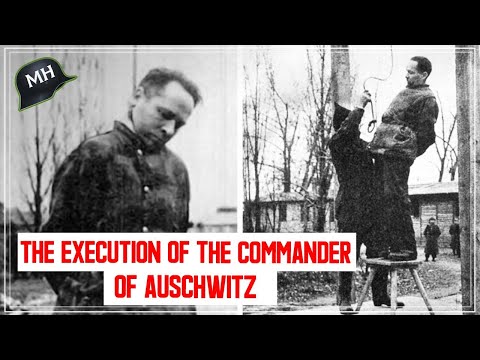
The gallows loomed ahead, a stark silhouette against the gray Polish sky. Rudolf Höss, former commandant of Auschwitz, walked toward it with a deadened stare, his face betraying no remorse. Polish soldiers flanked him, their silence heavier than any shout. They avoided his gaze—not out of fear, but because beneath that ordinary human face lurked one of history’s most monstrous figures.
Just days before, he had worn a tailored uniform designed by Hugo Boss, adorned with the highest insignia Adolf Hitler could bestow. Now, clad in a simple felt jacket and prisoner’s pants, he climbed the steps to meet the noose. The rope would squeeze with the weight of six million innocent souls, erasing the Auschwitz animal from the earth.
Born in 1901 to a devout Catholic family, Rudolf Höss was expected to become a priest. His father, a fervent believer, had dedicated his son to religious life. But young Rudolf’s faith crumbled, replaced by a fascination with military glory. At 16, after his father’s death, he enlisted in the army, beginning a path that would lead to unimaginable atrocities.
In 1923, Höss joined the Freikorps, a paramilitary group tied to the rising Nazi Party. Under orders from Martin Bormann, he and others bludgeoned a teacher to death, believing the man had betrayed their cause. Höss was sentenced to ten years in prison, but served only five after a general amnesty for Hitler’s followers. Upon release, he immersed himself in the Artaman League, a racist organization preaching Saxon blood purity, where he met Heinrich Himmler.
By 1934, with Hitler in power, Höss joined the SS and was assigned to Dachau Concentration Camp. There, he learned the brutal methods of prisoner treatment and rose swiftly through the ranks. Promoted to lieutenant, he became a ruthless head of guards at Sachsenhausen. His efficiency caught the attention of his superiors, and in 1940, he was appointed commander of a new camp: Auschwitz-Birkenau.
Located between railway tracks for easy access, Auschwitz was destined to become the epicenter of the Holocaust. Höss arrived on May 1, 1940, with a handful of guards and thirty criminals—the first inmates. Under his direction, the camp expanded rapidly, becoming a nerve center for the capture of Jews across Europe. But it was in 1941 that Auschwitz transformed from a prison into a killing center.
Höss was a perfectionist in his task. Ordered to annihilate as many Jews as possible, he implemented the deadly gas chambers disguised as showers. Prisoners walked unknowingly to their deaths. For Höss, death by Zyklon B was a humane gesture, avoiding the violence of executions. “Technically it wasn’t that difficult,” he later coldly remarked. “It wouldn’t have been difficult to exterminate even larger numbers. The killing itself took the shortest time. You could dispose of 2,000 heads in half an hour.”
Every day, trains loaded with 2,000 people arrived at Auschwitz. From the entrance, they were divided: those fit for work sent to labor camps, the weak and young sent directly to the gas chambers. Under Höss, Auschwitz became a death factory, with huge furnaces built to burn corpses immediately. In 1944, he carried out Operation Höss, deporting 450,000 Hungarian Jews—half the country’s Jewish population. The gas chambers killed 10,000 people a day, and the ovens burned around the clock, their smoke visible for miles.
As the Allies closed in, Höss fled, disguising himself in a Kriegsmarine uniform. But his wife, Hedwig, under threat, betrayed him, revealing his hideout near Flensburg. Captured on March 11, 1946, Höss initially denied involvement but eventually confessed at Nuremberg. “I commanded Auschwitz from May 1, 1940, to December 1, 1943,” he stated, “and I estimate that at least 2.5 million people were killed and disposed of there by gases and burning. At least half a million more died of starvation and disease, bringing the total to 3 million dead.”
The pride with which he spoke provoked guards to beat him. Sentenced to death in November 1947, Höss was hanged alongside other Nazi officers. The man who orchestrated the calculated death of millions, who fulfilled Hitler’s bloodiest dream, died looking into the faces of survivors he could not kill.
The hangman adjusted the rope, testing its tension with practiced hands. Höss stood motionless, his wrists bound behind his back, his eyes fixed on some distant point beyond the gallows. The survivors who had come to witness this moment stood in a silent row, their faces carved from years of suffering. They did not cheer. They did not weep. They simply watched, as if waiting for a debt to finally be paid.
A priest stepped forward—a Polish Catholic who had himself been imprisoned at Auschwitz. He offered Höss the last rites. “I have already confessed,” Höss replied in a flat voice, refusing the gesture. The priest bowed his head and stepped back. The crowd shifted uneasily. Some whispered that even in death, the commandant remained defiant, unwilling to acknowledge the magnitude of his sins.
The prosecutor who had argued the case against Höss stood among the witnesses, a folder of documents clutched to his chest. He had spent months gathering testimony from survivors, piecing together the machinery of death that Höss had so meticulously designed. Now, as the executioner placed the noose around the condemned man’s neck, the prosecutor felt no triumph—only a hollow exhaustion. Justice, he knew, could never be proportionate to the crime.
Höss was asked if he had any final words. For a long moment, he said nothing. Then, in a voice barely above a whisper, he spoke: “I have led a life of error. I ask forgiveness from the Polish people and from all those who suffered.” The words hung in the cold air, thin and insufficient. Some in the crowd shook their heads. Others turned away. Forgiveness was not theirs to grant, and the dead could not answer.
The executioner pulled the lever. The trapdoor swung open with a heavy clang, and the body dropped. The rope creaked once, then fell silent. Rudolf Höss, the architect of Auschwitz, hung lifeless above the ground, his shadow stretching across the dirt like a stain that would never fully wash away.
The witnesses dispersed slowly, their footsteps crunching on the frost-hardened earth. One survivor, an elderly woman who had lost her entire family in the gas chambers, paused at the edge of the gallows. She looked up at the swinging body and spoke softly, as if to herself: “Now you know what it feels like to suffocate.” She turned and walked away, her back straight, her head held high.
But the story of Rudolf Höss did not end with his death. In the weeks that followed, the world would learn the full extent of his crimes through the testimony he had left behind—pages of cold, clinical descriptions of mass murder, written in his own hand. His memoirs, composed while awaiting trial, revealed a man who had never truly repented, only regretted that he had been caught. And as the survivors rebuilt their shattered lives, the name Auschwitz would forever remain etched into the conscience of humanity, a warning of what ordinary men could do when evil was given a uniform and a license to kill.
The memoirs became a sensation when excerpts leaked to the press. Journalists pored over the pages, searching for some flicker of humanity, some crack in the facade. They found none. “I was not a sadist,” Höss had written. “I was a soldier following orders, a cog in the machinery of the Reich.” The phrase echoed in the minds of readers across Europe—a chilling reminder of how easily ordinary men could become instruments of genocide.
In Warsaw, a young historian named Ewa gathered the memoirs for a university archive. She had lost her grandparents at Auschwitz, and the words before her felt like a second death. She traced the careful handwriting, the neat paragraphs, the almost bureaucratic tone. “He describes murder the way a clerk describes inventory,” she told her colleague, her voice trembling. “How can a man write like this and still call himself human?”
Her colleague, a quiet man named Marek, had no answer. Together, they began cataloging the testimony, knowing that future generations would need these documents to understand the depth of the horror. But the work came with a price. Each page seemed to drag them deeper into a darkness that refused to release its grip.
Meanwhile, in the United States, a psychologist named Dr. Leonard Weiss read the memoirs with clinical detachment. He had spent years studying the minds of war criminals, trying to identify the psychological mechanisms that allowed men to commit atrocities. Höss became his central case study—a man who had loved his children, played with them in the garden of his villa near the camp, and then walked to the gas chambers to oversee the murder of thousands.
Weiss interviewed survivors who had worked in Höss’s household. They described a man who was polite, even gentle, at home—a stark contrast to the monster who ruled the camp. “He never raised his voice at us,” one survivor recalled. “But we knew what he did at the camp. We could smell it on his clothes.” The duality haunted Weiss. He concluded that Höss had fractured his psyche, walling off the horror behind a mental partition that allowed him to function.
The psychologist published his findings in a controversial paper, arguing that Höss was not a unique monster but a product of a system that rewarded cruelty and dehumanization. The paper sparked outrage in some circles, with critics accusing Weiss of excusing the crimes. But Weiss stood by his conclusion: “If we cannot understand how a man becomes Höss, we cannot prevent the next one.”
Back in Poland, Ewa discovered a letter among Höss’s papers—one he had written to his wife, Hedwig, just before his execution. She had betrayed him to the authorities, yet he wrote with tenderness: “I forgive you, my love. You did what you thought was right. Our children must never know the truth of my life.” Ewa stared at the letter, her hands shaking. Even here, in this private moment, Höss had shown no remorse for his victims—only concern for his own legacy.
She translated the letter for an exhibition at the Auschwitz-Birkenau Museum. Visitors would read it alongside survivor testimonies, the contrast as sharp as a blade. “He wanted to be remembered as a good father,” Ewa wrote in the exhibit notes. “But history remembers him as the man who built the gas chambers. That is the truth, and no letter can erase it.”
The exhibition opened on a cold January morning, the anniversary of the camp’s liberation. Survivors walked through the halls, their eyes lingering on photographs, documents, and the letter. One elderly man, a former inmate who had worked in the crematoria, stopped before Höss’s words. He read them slowly, then turned to Ewa. “He forgave his wife,” the man said, his voice steady. “But he never forgave us. He never asked for our forgiveness. That tells you everything you need to know.”
Ewa nodded, unable to speak. The man walked on, his back straight, his steps measured. The exhibition continued, a silent testament to the millions who had died and the few who had survived. And in the archives, the memoirs remained—a dark mirror reflecting the soul of a man who had believed himself righteous to the very end.
Years later, scholars would debate whether Höss’s memoirs revealed a man who truly believed his own lies or one who had simply stopped caring about the difference. “He built a wall between his conscience and his actions,” Dr. Weiss wrote in his final book, “and then he lived inside that wall until the end.”
But the survivors who had faced Höss across the courtroom never needed a psychologist to explain him. They had seen the truth in his eyes—the flat, unrepentant gaze of a man who had traded his humanity for efficiency and never once looked back.
The gallows are gone now, dismantled and carted away. Yet the question Höss never answered still hangs in the air above Auschwitz, heavy as smoke from the crematoria: How many ordinary men are waiting for a uniform and an order to become monsters?
What do you think—can evil ever be truly ordinary, or does it always require a choice?
Report this article
Select a reason for reporting:






