November 20th, 1943. Dawn breaks over Terawa atoll like a blood-red wound across the Pacific sky. Steam rises from the jungle canopy where concrete bunkers and steel gun emplacements have transformed this coral paradise into a fortress of death. Rear Admiral Keiji Shibasaki stands in his reinforced command bunker fifty feet underground, peering through a German-made periscope at the empty horizon. At fifty years old, this veteran of countless naval battles has spent two years turning Terawa into what he calls an impregnable fortress.
The humid air inside the bunker carries the smell of oil, concrete, and the nervous sweat of 4,800 Japanese defenders who believe they’re about to witness American military suicide. Shibasaki adjusts his white naval uniform and turns to his staff officers. His voice carries the confidence of a man who has studied every American amphibious operation since the Marines landed in Nicaragua. “The Americans could not take Tarawa with a million men in a hundred years,” he declares, his words echoing off the concrete walls.
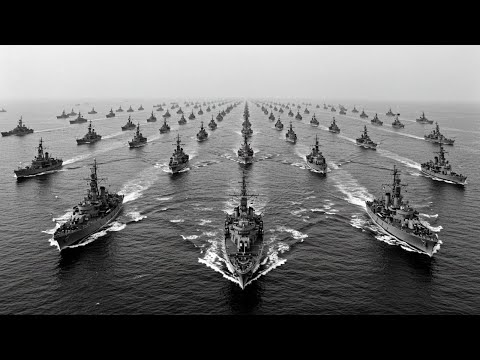
But something on the horizon doesn’t match the intelligence reports. Through his periscope, Shibasaki watches dots appear on the water’s edge. Not the scattered, uncoordinated transport ships his intelligence predicted. These vessels move in perfect formation. Their spacing too precise, their timing too synchronized.
The morning light reveals silhouettes that make his breath catch in his throat.
535 ships.
His staff officers crowd around radio sets, their faces growing pale as reports flood in from observation posts across the atoll. “Sir, the enemy fleet extends beyond visual range. Admiral, our scouts count fifteen aircraft carriers. The formation is unlike anything in our tactical manuals.”
Shibasaki has prepared for American overconfidence. He has planned for their typical pattern of rushed, poorly coordinated beach assaults. His October 1942 battle dispositions directive is clear: wait until the enemy assembles for landing, then destroy their crowded transports with concentrated fire. But these ships aren’t crowding together like sitting ducks. They’re positioning themselves with mathematical precision, creating overlapping fields of fire that turn the lagoon into a coordinated killing zone with Japanese positions as the target.
The sound begins as a whisper, a low rumble that vibrates through the coral bedrock beneath Shibasaki’s feet. Then it grows. The whisper becomes a roar that shakes dust from the bunker ceiling and rattles the radio equipment. Through his periscope, he watches muzzle flashes bloom like deadly flowers across the American fleet.
But here’s what freezes his blood. The bombardment isn’t random. Each ship fires in sequence, creating a rolling wave of destruction that moves across Japanese positions with clockwork precision.
What Shibasaki witnesses in the next 76 hours will haunt military commanders for generations and force an entire nation to abandon everything they believed about warfare. The question that will destroy his worldview and reshape the Pacific War: How is this level of coordination even possible?
To grasp why Shibasaki’s hands begin to tremble, you have to understand what he’s seeing through that periscope. For two decades, he has studied amphibious warfare. As a young lieutenant, he analyzed the failed British assault at Gallipoli—nine months of chaos because British forces couldn’t coordinate their navy and army operations. As a commander, he witnessed Japanese victories across the Pacific, where individual courage and superior fighting spirit overwhelmed poorly coordinated Allied defenders.
The Japanese military doctrine that built his career is rooted in centuries of samurai tradition. The decisive battle concept where concentrated force and warrior spirit crush the enemy through superior will and tactical surprise. At Pearl Harbor, Japanese coordination shocked the Americans. In the Philippines, at Singapore, across the Dutch East Indies, Japanese forces succeeded because they hit hard, fast, and coordinated better than their enemies expected.
Shibasaki has spent months preparing Terawa based on this proven formula. His 4,800 defenders occupy interlocking bunkers designed to create crossfire zones that will slaughter Americans as they stumble ashore in typical western confusion. The concrete walls around him are three feet thick. The steel doors can withstand direct hits from battleship guns. His artillery pieces are pre-registered on every possible landing beach.
But as morning light illuminates the American fleet, something doesn’t match the pattern.
“Sir,” his communications officer calls out, voice tight with confusion. “We’re receiving reports from Guadalcanal that don’t align with our tactical assessments.”
Shibasaki turns from his periscope. “What reports?”
“Intelligence indicates the Americans achieved unprecedented coordination during their August offensive. Our planners reported being stunned by coordination capabilities that exceeded all previous assessments.”
The words hang in the humid bunker air like a death sentence. Shibasaki has dismissed these reports as exaggeration from defeated commanders making excuses. But through his periscope, he watches American ships maintain perfect spacing while maneuvering in waters that should create chaos. Supply vessels move between warships without confusion. Aircraft carriers launch fighter planes in coordinated waves that suggest radio communication between pilots, ships, and ground controllers.
This isn’t how amphibious operations work. Shibasaki has studied American military history. Their Civil War generals struggled to coordinate telegraph communications. Their World War I forces required months of planning for simple trench assaults. Even their successful operations against Japanese positions earlier in this war showed typical Western confusion—individual units fighting separate battles with minimal integration.
But what he observes defies everything he understands about military logistics. Through radio intercepts, his intelligence officers have been tracking American preparations. The scale is staggering. Operations coordinated across 3,500 miles of ocean with supply lines stretching back to Pearl Harbor and the continental United States. Shibasaki had calculated this was logistically impossible with existing communication technology and command structures.
Yet here they are.
“Admiral,” his artillery commander reports, “American naval gunfire is adjusting based on spotter aircraft reports. They’re correcting their aim in real time.”
Real-time coordination between ships and aircraft. Shibasaki has never seen anything like this level of integration. Japanese forces coordinate through careful pre-planning and rigid command structures. But Americans appear to be adapting their coordination as battle conditions change.
The implications hit him like a physical blow. If Americans can coordinate supply operations across thousands of miles of ocean, traditional Japanese defensive strategy becomes obsolete. If they can integrate naval gunfire with air support and ground operations in real time, Japanese bunkers become death traps rather than defensive advantages.
Through his periscope, Shibasaki watches landing craft approach the reef in perfect waves—not the scattered independent assault he prepared for. These boats maintain precise intervals while naval gunfire lifts and shifts to support their advance. Fighter aircraft strafe Japanese positions in coordinated patterns that suggest every pilot knows exactly where every other unit is located.
His stomach knots as the mathematical precision becomes undeniable.
“Sir,” his communications officer’s voice cracks. “Forward observers report American forces have radio communication between individual landing craft, supporting warships, and overhead aircraft. They’re coordinating at the squad level.”
Squad-level coordination with naval and air support. Shibasaki has never encountered anything like this in two decades of military service. But the most terrifying realization is just beginning to dawn on him. The bunker walls that represent two years of construction, the interlocking fields of fire that took months to calculate, the artillery positions registered with mathematical precision—all of it was designed to defeat the uncoordinated American assault he expected. Instead, he faces an enemy that coordinates better than his own forces.
The sound of American bombardment grows louder, but it’s the systematic nature of that bombardment that makes his blood run cold. Each explosion follows the last in a pattern that suggests every shell, every bomb, every machine gun burst is part of a unified plan being executed with mechanical precision. Through the concrete walls, he can hear his own men shouting in confusion and growing panic. They trained to fight American individuals. They prepared to defeat American courage and superior equipment. They never prepared to fight American coordination.
What happens next will shatter not just Shibasaki’s defensive plans, but the entire Japanese understanding of what modern warfare can become when systematic integration replaces individual heroism. The bombardment stops for thirty seconds. An eerie silence settles over Terawa. At his periscope, Shibasaki watches landing craft form perfect assault waves in the lagoon. Then the systematic destruction begins.
What unfolds over the next 76 hours doesn’t just break Japanese defensive lines. It shatters the fundamental assumptions of warfare itself.
“Naval gunfire resuming, sir,” his communications officer shouts over the renewed bombardment. But this isn’t the random pounding Shibasaki expected. American warships fire in sequence, creating a rolling barrage that moves across Japanese positions like a deadly wave. When the shells lift from one defensive sector, landing craft immediately advance toward that same area. Perfect timing, perfect coordination.
Shibasaki grips his periscope handles until his knuckles turn white. Through the eyepiece, he watches American Marines hit the beach not as scattered individuals, but as coordinated units with predetermined objectives. Radio antennas on their landing craft bend and sway as operators maintain constant communication with ships, aircraft, and other Marine units.
“Sir, Bunker 7 reports direct hits from naval gunfire directed by spotter aircraft,” his artillery commander calls out. “The Americans are adjusting their fire based on real-time observation.”
Real-time fire adjustment during an amphibious assault. Shibasaki has never seen anything like this level of integration between sea, air, and land forces. But what makes his chest tighten with genuine fear is the systematic nature of American coordination. This isn’t superior firepower overwhelming Japanese positions. It’s systematic integration that renders Japanese defensive tactics obsolete.
Through radio intercepts, his communications officers track American coordination in real time. Fighter pilots report Japanese positions to naval gunfire controllers. Ground spotters call in air strikes on specific bunkers. Artillery fire lifts precisely as Marine units advance, then resumes the moment those units move to cover.
“Admiral,” his intelligence officer’s voice trembles. “We’re intercepting American radio traffic that suggests coordination down to individual squad level. They know where every unit is located at all times.”
Individual squad coordination with air and naval support. The implications make Shibasaki’s engineering training rebel against the impossibility of what he’s witnessing, but the evidence keeps mounting. American casualties remain surprisingly light despite fierce Japanese resistance—not because Japanese defenders aren’t fighting courageously, Shibasaki can hear the desperate battle cries of his own men through the bunker walls, but because American coordination minimizes their exposure to defensive fire while maximizing the effectiveness of their own attacks.
When Japanese forces concentrate to repel one landing area, American spotters immediately call in air strikes on the exposed defenders. When Japanese artillery opens fire, American counterbattery fire silences those guns within minutes through coordinated naval gunfire. Every Japanese tactical response meets an immediate coordinated American counter-response.
Shibasaki realizes with growing horror that his men are fighting individual battles while Americans fight one unified battle.
“Sir, urgent report from our Saipan intelligence network,” his communications officer announces, reading from a decoded message. “Sergeant Teo Yamuchi reports American coordination at that location left him too petrified to move under systematic bombardment.”
The words hit Shibasaki like a physical blow. Yamuchi is a decorated veteran, a man whose courage has been proven in battles across the Pacific. If systematic American coordination can paralyze a soldier like Yamuchi, what does that mean for traditional Japanese fighting spirit?
Through his periscope, Shibasaki watches the impossible become routine. American landing craft navigate coral reefs with precision that suggests detailed hydrographic surveys. Supply boats arrive exactly when advancing Marines need ammunition and medical supplies. Medical evacuation helicopters coordinate with ground units to remove wounded personnel without disrupting tactical operations. Every element of American operations functions as part of a unified system.
“Admiral, direct communication from Lieutenant General Kuribayashi at Iwo Jima,” his communications officer reports, holding a radio handset. “He requests immediate strategic consultation.”
Shibasaki takes the handset with trembling fingers. Kuribayashi’s voice crackles through static, but his words are clear. “Shibasaki, what we’re witnessing defies all tactical doctrine. The violence of the enemy’s bombardments is far beyond description. The power of the US warships and aircraft makes every landing operation possible on whatever beachhead they like.”
The admission from one of Japan’s most respected generals confirms Shibasaki’s worst fears. This isn’t isolated to Terawa. American coordination capabilities represent a systematic revolution in warfare that affects every Pacific battlefield.
But the psychological impact on Japanese defenders goes deeper than tactical defeat.
“Sir, our forward observers report American forces using smoke screens with tactical precision,” his artillery commander announces. “They’re coordinating smoke deployment with advancing units to provide cover exactly when and where needed.”
Coordinated smoke tactics. Shibasaki has studied military history for decades. He has never encountered systematic integration at this level of detail. The bunker shakes as American naval gunfire walks closer to his command post. Through the concrete walls, he can hear the screams of his men, the explosions of ammunition stores, the grinding sound of American bulldozers clearing beach obstacles under covering fire. But it’s not the sound of random destruction. It’s the sound of systematic coordination destroying Japanese defenses piece by piece according to a unified plan.
“Admiral, casualty reports coming in from all sectors,” his intelligence officer announces, his voice barely audible above the bombardment. “American casualties approximately 20 percent. Our casualties…” He pauses, checking his figures. “Sir, we’re approaching 99 percent casualties in forward positions.”
20 percent American casualties versus 99 percent Japanese casualties. The mathematics of coordination versus individual courage.
Through his periscope, Shibasaki watches American engineers construct supply dumps under fire while Marines advance past destroyed Japanese positions. Radio operators maintain communication between units despite the chaos of amphibious warfare. Every American operates as part of a coordinated system that functions despite individual casualties, equipment failures, and tactical setbacks.
Japanese defenders fight with legendary courage. But courage cannot overcome systematic coordination. Individual heroism cannot defeat integrated planning. Traditional warrior spirit cannot triumph over modern systematic warfare.
As the 76th hour approaches, Shibasaki makes his final radio transmission to Tokyo. “American coordination capabilities exceed all previous military experience. Traditional defensive doctrine rendered obsolete. Recommend immediate strategic review of all Pacific operations.”
The transmission cuts off as American forces overrun his command bunker. But Shibasaki’s death represents more than the fall of Terawa. It marks the moment when traditional warfare dies and modern coordinated operations are born.
What American forces demonstrate at Tarawa isn’t just tactical superiority. It’s a glimpse of warfare’s future where integration and coordination triumph over individual courage and traditional tactics. The ripple effects will transform not just the Pacific War, but military doctrine for generations to come.
So here’s the question that lingers long after the guns fall silent: When systematic coordination makes individual heroism strategically irrelevant, what becomes of the warrior spirit that once defined entire cultures?
Report this article
Select a reason for reporting:






