When we think of World War II, we remember the heroic resistance and the epic battles. But history also holds a darker, often overlooked chapter: the story of those who, in the face of Nazi occupation, chose to betray their own nations. They were the collaborators, the traitors who sold their souls for power and ideology, only to face the ultimate reckoning.
Their names are etched in infamy. John Amery, the British aristocrat who founded the British Free Corps; Joseph Darnand, the Frenchman who led the Milice and hunted his own countrymen; Vidkun Quisling, the Norwegian whose name became synonymous with treason; and the Hungarian brothers, László Endre and László Baky, who orchestrated the deportation of hundreds of thousands of Jews. Each of them believed in a twisted cause, and each met the same fate: capture, trial, and execution.
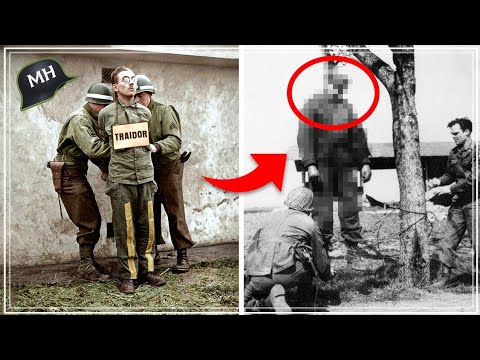
But how did these men, born into different worlds, come to embrace the ideology of their country’s enemy? And what drove them to commit such heinous acts? In this video, we will explore the lives of these traitors, their rise to power under the Nazi shadow, and their dramatic downfalls. From the streets of London to the killing fields of Hungary, their stories are a chilling reminder of the cost of betrayal.
Let us begin with John Amery, the son of a distinguished British politician. Born into privilege, Amery’s path to treason was paved with rebellion and radicalization. His anti-communist fervor led him to fascism, and after several failed business ventures, he fled to France. There, he became a vocal advocate for collaboration with the Nazis, eventually convincing Heinrich Himmler to authorize the creation of a British unit to fight alongside the Germans.
In 1944, Amery gave a rare interview to Norwegian television, defending his actions: “Only history will be able to judge that. My view is that it is these people Churchill, Roosevelt and his friends who are the real traitors.” His words were defiant, but his fate was sealed. As the Allied forces advanced, Amery fled to Italy, where he was captured by partisans and handed over to the British authorities. His trial for high treason was swift, and on December 19, 1945, he was hanged by the infamous executioner Albert Pierrepoint.
Amery’s story is just one of many. In France, Joseph Darnand’s journey from a decorated World War I hero to the head of the Milice, a paramilitary force that brutalized the French Resistance, is equally shocking. Darnand’s radicalization began in the 1930s with far-right groups, and he quickly aligned himself with the Vichy regime. As the supreme leader of the police, he oversaw the arrest and deportation of Jews and resistance fighters, earning him the hatred of his countrymen.
When Paris was liberated, Darnand fled to Germany, but he was eventually captured by the Americans and handed over to the French government. His trial was a sensation, and on October 10, 1945, he faced a firing squad, ending a career that had begun with honor and ended in disgrace.
In Norway, Vidkun Quisling’s name became a byword for treachery. A former pastor’s son, Quisling founded the fascist party Nasjonal Samling and, after the German invasion in 1940, seized power with Nazi support. As prime minister, he actively assisted the Holocaust, handing over Jews and political opponents to the Germans. His trial in 1945 was filmed, and despite his claims of innocence, he was executed by firing squad on October 24. His last words: “I was unjustly convicted and I die innocent.”
Finally, in Hungary, the László brothers, Endre and Baky, were instrumental in the deportation of over 400,000 Jews to Auschwitz. Their zeal for the Final Solution was unmatched, and they worked closely with Adolf Eichmann. As the Red Army approached, they fled but were captured and tried. On March 29, 1946, they were hanged, their executions filmed for the world to see.
These men all shared a common delusion: that their collaboration would bring them power and glory. Instead, they brought only shame and death. Their stories serve as a stark warning about the dangers of extremism and the price of treason. But their downfalls also raise questions about justice, retribution, and the thin line between loyalty and betrayal.
As we delve deeper into each of these cases, we will uncover the personal motivations, the political machinations, and the brutal consequences that defined their lives. From the corridors of power to the executioner’s block, the fate of these traitors is a gripping tale of ambition, ideology, and ultimate reckoning.
But the story of collaboration does not end with these infamous names. Beyond the headlines and the history books, there were thousands of ordinary people who, for reasons ranging from fear to opportunism, chose to serve the occupiers. Their stories are less dramatic but equally revealing about the human capacity for self-preservation at the expense of others.
In France, the Milice grew from a small band of ideologues into a force of nearly 30,000 men, many of whom were drawn not by fascist fervor but by the promise of steady pay and protection for their families. They became the eyes and ears of the Gestapo, tracking down resistance fighters and rounding up Jews with chilling efficiency. Their work was so effective that the German authorities often preferred to use them rather than their own troops for the dirtiest tasks.
Yet the same men who terrorized their countrymen were often the first to flee when the tide turned. As the Allies advanced, Milice units dissolved, their members tearing off their uniforms and melting back into the civilian population. Some were caught, others vanished. But the stain of their betrayal lingered, and post-war France exacted a brutal justice of its own, often outside the courtroom.
In Norway, Quisling’s Nasjonal Samling party had swelled to over 50,000 members during the occupation, a significant number in a country of just three million. Many joined not out of ideological commitment but because it was the path to a job, a ration card, or a favor from the authorities. After the war, these ordinary collaborators faced a reckoning that ranged from fines and social ostracism to prison sentences. The Norwegian government, determined to heal the nation, conducted over 40,000 trials for treason.
One of the most poignant cases was that of Hanna Kvanmo, a young woman who joined the party at nineteen and later became a guard in a German prison camp. She was sentenced to eight months in prison, but her real punishment was a lifetime of shame. Decades later, she became a prominent politician, and her past was dredged up again and again. She never denied her actions, but she insisted she had been a naïve girl who had been seduced by propaganda.
Her story raises uncomfortable questions: How do we judge those who were not monsters but simply weak? Where is the line between collaboration and survival? These are questions that each generation must answer for itself, and the answers are never simple.
The case of Hungary offers perhaps the most chilling example of how ordinary people can be swept up in evil. The Arrow Cross Party, a fascist movement led by Ferenc Szálasi, took power in October 1944 after Horthy’s attempt to surrender to the Soviets. In just a few months, Arrow Cross militias murdered thousands of Jews in the streets of Budapest, often with the enthusiastic participation of neighbors and colleagues.
One of the most notorious was a man named László Ferenczy, a gendarmerie officer who coordinated the deportation of Hungarian Jews. He was not a fanatic like Endre or Baky, but a careerist who followed orders and saw an opportunity for advancement. After the war, he was captured, tried, and hanged. His defense—that he was only following orders—echoed the same excuse used by countless others.
But the question of guilt is not just legal; it is moral. The Hungarian writer Imre Kertész, a Holocaust survivor, wrote that the most terrifying thing about the camps was not the guards but the fact that the prisoners themselves could be complicit in the system. “The Holocaust was not the work of a few madmen,” he wrote. “It was the work of a society that had learned to look the other way.”
This is the uncomfortable truth that lies at the heart of any study of collaboration. The traitors we remember—Amery, Darnand, Quisling, the László brothers—were not aberrations. They were the visible tip of a much larger iceberg, a reminder that under the right conditions, ordinary people can be capable of extraordinary evil.
Yet the story of these traitors is not just about their individual crimes, but about the systems that enabled them. The Nazi occupation of Europe created a moral vacuum in which opportunists and ideologues alike could thrive. For every Amery or Quisling, there were hundreds of lesser-known collaborators who greased the wheels of the Holocaust. They were the clerks who typed deportation lists, the policemen who rounded up Jews, the railway workers who drove the trains to Auschwitz.
After the war, the reckoning was uneven. Some faced the gallows, others prison, and many more simply faded into obscurity. In France, the épuration sauvage—the wild purge—saw thousands executed without trial, while the official courts handed down sentences that were often surprisingly lenient. Justice, it seemed, was as much about politics as it was about morality.
The legacy of these collaborators is a cautionary tale. They remind us that betrayal is rarely dramatic; it often comes in small, incremental steps. A job accepted, a favor granted, a silence maintained. And when the moment of reckoning arrives, the excuses—”I was following orders,” “I was afraid,” “I didn’t know”—ring hollow against the enormity of the crimes.
As we look back on this dark chapter, we must ask ourselves: What would we have done? Would we have had the courage to resist, or would we have found reasons to collaborate? The answer is never easy, but it is essential to confront. For in understanding the traitors, we better understand ourselves.
So, dear viewers, we leave you with this question: In a world of pressure and fear, where is the line between survival and complicity? Share your thoughts in the comments below.
Report this article
Select a reason for reporting:






