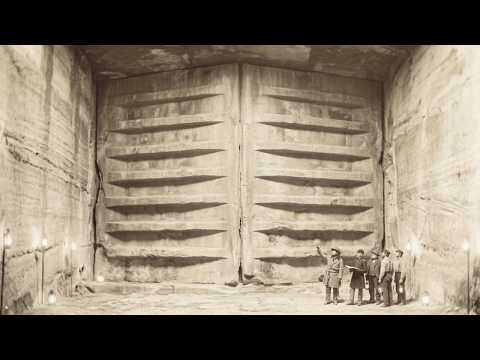
On July 9, 1873, a dynamite blast in the lock pit at Sault Ste. Marie, Michigan, tore open the red sandstone and revealed a passage that should not have existed. At its end stood a stone gate sixty-six feet high, its two leaves meeting in a seam so tight a knife blade could not start. The Ojibwe had a name for that place and said the gate was ancient, long before their grandparents came to fish the rapids. They also had a warning: do not knock on it, do not build against it, do not quiet the rapids.
The army built against it within the week. Before fifty years had passed, other men had quieted the rapids. And the gate, they said, was shut from the inside.
Anders Strand, a hammer man from Norway, was the first to sense something wrong. On July 7, swinging his hammer at the south end of the face, he stopped and told the powderman that the stone answered differently. “Like a bell,” he said, “with a cloth over it.” Two days later, the face was loaded with seven holes of black powder and fired at 10:40 in the morning. The blast threw the usual cloud of smoke—but instead of rising, the cloud was shoved back toward the crew by a wind coming out of the broken rock. It ran low along the ground, cold enough to raise hair on a man’s arms in July.
Owen Trevail, the Cornish powderman, kept everyone back for twenty minutes. When he judged it safe, he and Captain Josiah Abbott went in, with Strand behind them holding the lanterns and a hemp line paid out from a steel driven into the rubble. At the mouth, Abbott struck a candle. The flame bent over and pointed back the way they had come, toward the water. There was no smell of gas. Further in, the stone floor was clean—no dust, no droppings, no bones, no water, no growth of any kind. Nothing on the floor to take a footprint, so they left none.
Then came the silence Strand would remember all his life. About thirty feet from the mouth, the roar of the rapids simply ended, as if a door had been shut behind them. Abbott stood still for a minute by his watch and listened to nothing at all, and then wrote one word and gave it a line to itself: Quiet. In the whole journal, no other entry describes a sound.
A cave was the natural first thought. Water does work its way through sandstone and hollow it out, but a water cave meanders, swells and pinches, and its floor slopes the way the water ran. This was a box. The walls went straight up, flat as a dressed wall in a cellar, and they paid no attention to the stone. The red and pale layers of the sandstone crossed them and stopped at the surface as if sawn. Water does not cut like that. Abbott laid his tape across the passage at the mouth: forty-six feet. Then at one hundred twenty feet in, and at two hundred fourteen where the passage ended: forty-six each time, never off by more than half an inch. He leveled the floor in stations as if it were a canal bottom and found that over its whole length it neither rose nor fell. To a man raised on a canal, that was the plainest fact of all. A floor without fall carries no water. It was made flat because someone wanted it flat.
His compass put the passage a little west of due south, aimed in under the rising ground behind the town. At the end of it was the gate. From that point on the page the handwriting changes. The ink is the same, but the letters grow larger and three times the nib tore the paper. The first word below the line is gate, standing alone. Then figures. And at the very bottom of the page, the one question mark Abbott ever put in that book. No post, no beam, no ring worked from the far side.
One other book noticed the day. Silas Whitlock, the civilian superintendent, kept the time book for the day labor. On the 10th of July he paid the station five crew a full day. Abbott’s journal shows no blasting at station five on the 10th. Whitlock wrote no reason. In the margin there are only his initials: S.W.
Abbott had put his question to the page. Four days later, a man who had never set foot in the passage would put almost the same question to him.
The man was Kejik, an old Ojibwe from the North Shore, and he came down the rapids in a birchbark canoe with his son Joseph steering in the stern. Abbott gave them one line in his journal: Old man from the North Shore, Nolin calls him Kejik, Ojibway, his son with him. The old man came no nearer than the lip of the cut, a hundred yards from Station Five, and sat on one of the dressed stones stacked for the lock walls. He kept his eyes away from the breach the whole time. When he needed to refer to it, he did not raise a finger. He tipped his chin in its direction, Abbott wrote, as one does toward a person who might overhear.
He spoke in Ojibwe and Baptist Nolin turned it into English. First he had questions, three of them, and Abbott wrote the answers beside them. Do the doors lean toward the white water? They do. On your side, is there anything to pull on? There is not. The bottom one, toward where the sun comes up, is it different from the rest? Here the journal shows a blot where the pen rested on the page too long. Then none of the answers seemed to surprise him. Abbott compared his nodding to that of a man who asks the hour only to hear what he already knows.
Then the old man made four statements and Abbott numbered them in the margin as Nolin gave them. One, it does not belong to us. Two, it was not us who closed it. Three, when the one water became two, they went in through it and closed it after them. Four, it will open when the rapids go quiet. Beside the fourth, Abbott wrote, not understood. Through Nolin, he asked what quiet rapids could mean. The old man looked over at the white water, loud as ever a few hundred yards off, and would say nothing more on that point.
What he would say was the warning in three parts. Do not knock on it. Do not build against it. Do not quiet the rapids. Abbott added a small note beneath, almost an apology: Travail knocked the ninth.
That evening, Nolin told the captain what he understood of it, and Abbott set down a paragraph. The old people along this shore, Nolin said, spoke of a time before the rapids when the big lake and the lakes below it were all one water, and a canoe could pass from one to the next without a portage. When the water dropped and the lakes were parted, the river broke white at the Sault and Bawating began. Neither man could have known that geologists would one day map exactly such a time and name it Lake Nipissing. Collectors later printed versions of that teaching. None of them has a gate in it.
The son was called Joseph. He was a whitefish man like his father, with a wife and children of his own on the Canadian shore. He dip-netted in the rapids as long as the fishery lasted, and in later years he worked the decks of ore boats that rose and fell in the very locks his father had warned against. Most of his life he lived at Garden River, a few miles downriver on the Canadian shore.
In the summer of 1922, a University of Michigan graduate student, Ruth Ellingson, twenty-six, was collecting Ojibwe place names along the St. Mary’s for the university’s new museum, writing them into brown cloth notebooks. On the 17th of August, she spent an afternoon at Garden River with Joseph Kejik, then about eighty-four, the two of them on a bench by his door. He used English for most of it and Ojibwe where English failed. He said he had been the man in the stern of the canoe. He went through his father’s three questions and four statements in order, and then he showed her with his hands how the old man had explained the gate on the paddle home. He pressed his palms together, standing upright, fingertip against fingertip. He held them there. Then, very slowly, he parted them until a hand’s breadth of air lay between, and he left them that way.
He told her the name of the place. Ellingson spelled it as best she could, and it will not be attempted here. Next to it, she wrote what he said it meant: where they closed themselves in. Then he recited what had been handed to him, and she took it down line by line. Every line began the same way. They said the doors were there before the people came to the rapids. They said the keepers of the doors lived under the high ground to the south. They said the keepers came out only when the water was quiet. They said the water was quiet then because the big lake and the lower lakes were one. They said when the water fell and the rapids started talking, the keepers went in through the doors and closed them, and the people on the north shore heard the closing. They said the doors are cold to a hand because a hand is on the wrong side of them. They said not to fish under the south ledge after dark. They said not to point at the place. Last of all, he spoke his father’s fourth statement exactly, and Ellingson recorded it with no idea it had been written down once before in an army captain’s book. It will open when the rapids go quiet.
She asked the obvious thing, waiting for what? What is behind it? Her notes mark a long pause. Then he told her that this part was for the Ojibwe and was not going into her notebook. At the foot of the page, she wrote a single line: Remainder withheld at the speaker’s request. She honored that, and this record honors it too.
In the margin of the same page, dated that day, is a short note of her own: JK says the gates at the head of the Rapids were almost closed this week. Fish poor.
By 1922, the Rapids were no longer the Rapids of 1873. Joseph Kejik had held the place name, the three questions, the four statements, and the movement of the hands for forty-nine years. A government box can lose a page. A man who carries a sentence for half a century does not lose it.
Nobody ever meant for these two records to meet. Put them next to each other anyway. One is a captain’s journal kept with a transit, a level, a compass, and a thermometer by a man who stood at the foot of the gate and laid his instruments against it. The other is a student’s notebook from forty-nine years later about a place she had never heard of, taken from a fisherman who steered a canoe that day and never went into the passage. His father stayed a hundred yards from it. The journal describes two leaves closing on one seam. The fisherman pressed two palms together. The journal says the prow of the gate faced the river, built to keep the water out. The fisherman said the doors were closed at the moment the water fell and the Rapids began to talk. The journal says there was nothing on the near side to open it with and underlines that it was shut from within. The father asked whether there was anything on that side to pull and said the keepers went in and closed it after them. The journal sends the passage south under the high ground. The fisherman put the keepers under the high ground to the south. The journal records stone colder than the air. The fisherman said a hand on it is cold because it is on the wrong side. The journal records the lowest lip of the east leaf missing and a flat band in its place. The father asked about the bottom one on the sunrise side before anyone had told him what the gate looked like.
Some of this may be chance, and that should be said. All lock gates have two leaves and all of them point at the water they hold. Nolin had been in the cut on the ninth and might have repeated what the crew said. Each of these can stand alone as an explanation. The sunrise question cannot. It came from a man who would not look at the hole, and it came back in the same order, forty-nine years later, from his son to a stranger who had never seen the journal.
There is one last visit in the journal before the passage was closed. On the 19th of July, Abbott took Trevail and Strand back in for a final round of measurements. When the tape was rolled up, Strand went to the seam, tugged off one glove, and pressed his bare hand to the stone at the level of his eyes. He left it there. Without intending to, Abbott found himself counting the seconds. A minute went by with nobody speaking. Trevail had his hat in his hand. So, Abbott realized, did he, though he could not remember removing it. When Strand stepped back, he said one thing, and Abbott wrote it inside quotation marks: “There is someone on the other side listening.” Abbott then laid his own palm on the seam and described the feeling the only way he knew how, as an engineer: cold, even, like the push of standing water against a gate. But there is no water.
A little lower, he copied out the old man’s fourth statement a second time in quotation marks, as though copying it might unlock it. It will open when the rapids go quiet. Under it, a short line in his own voice: The rapids here never go quiet.
By afternoon, the masons were at work. Forty feet in from the breach, they built a wall of cut stone across the passage and bedded it in cement from the sixteen barrels. Low in the wall, they set the iron frame, two feet square, hung a plate in it, and snapped the padlock through the hasp. The key went into Silas Whitlock’s pocket. Rubble was shoveled back into the breach, and the new lock wall rose over the top. On the drawing for station five, a draftsman shaded a little rectangle behind the wall and lettered it: rock pocket filled.
The next morning, the journal moves on to station six. For station five, it has one closing line: Pocket filled, work resumed. Sixty-nine years would pass before anyone opened that hatch.
Raymond Kessler opened it in April 1942, expecting a pocket of bad rock. He found the gate instead—and the seam had opened three and three-quarter inches. He taped it, sent a telegram to Detroit, and received the answer by morning: “Structure outside scope of lock construction. Seal and proceed. Schedule governs.”
So it was sealed. The hatch was welded shut and concrete poured behind the old masonry. On the new drawings, a draftsman hatched a small rectangle and wrote: old void, sealed, not explored.
Leo Paquin, Kessler’s rodman, was asked decades later what he believed he had seen down there. He answered with one sentence: “We closed it because we were told to, not because it was done.”
The MacArthur lock still lifts ships at the Soo. Every winter the chambers are pumped dry for repair. A maintenance note from February 2019 records one thing in passing: along the south wall, a strip of floor about forty-six feet wide did not take ice, though the air stood below zero for nine days. Cause not determined.
The rapids still run, but not as they did. The sixteen gates at their head, finished in 1921, decide how much of Lake Superior goes over the ledge. The great whitefish fishery of Bawating is gone. Where the water once ran white from bank to bank, much of the ledge now lies bare.
Anders Strand’s daughter told Kessler her father had said one thing about the gate all his life: “It shut when I put my hand on it.” The Ojibwe name for the place does not say cave, and it does not say rock. It says what happened there: where they closed themselves in.
Abbott wrote that the rapids here do not stop. They have been nearly silent for a hundred years.
If a letter, a time book, or a photograph like that has come down to you—what do you think waits on the other side of that seam?
Report this article
Select a reason for reporting:






