The American officer’s parting words were not a warning—they were a promise. “You won’t need to find Charlie. They’ll come looking for you.” Less than twelve hours later, a battalion of the North Vietnamese Army emerged from the darkness and slammed into the Australian position at Firebase Coral. The base was unfinished, the wire not yet laid, the weapon pits half-dug and filling with rain. By every rule of war, it should have fallen before dawn. It didn’t.
This is the story of Coral—and of Balmoral, a smaller base four and a half kilometers north. It was the largest unit-level action Australians fought in Vietnam, the first time they met regular NVA troops in regimental-strength conventional battle. For decades, the men who fought there barely spoke of it. Few people asked.
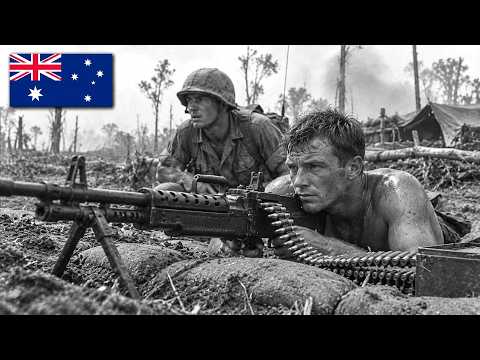
On the afternoon of 12 May 1968, an American company commander was pulling his men out of a landing zone in Binh Duong province, about 45 kilometers north of Saigon. The Australians were flying in as the Americans flew out. The insertion went wrong almost from the first helicopter. The landing zone was shifted 1,000 meters southwest. Units arrived in pieces, some hours late. Captain David Brookke was left alone in an open area for more than an hour. Major Peter Phillips later remembered a confused afternoon with nobody quite certain where they were supposed to be.
That afternoon, troops found around 100 freshly dug enemy weapon pits close to the base site. Freshly dug. Someone had been there very recently—and had meant to come back.
Among the men arriving late that day were four who matter to this story. Lieutenant Anthony “Tony” Jensen, second in command of the mortar platoon of the 1st Battalion, Royal Australian Regiment. Lance Corporal Alan “Jack” Parr, the platoon signaller responsible for two radio sets. Bombardier Andy Forsteike, commanding a team of seven men on an M60 machine gun. And above them all, Lieutenant Colonel Philip Bennett, commanding officer of the 1st Battalion—a Duntroon graduate who had already been to war once and been wounded in Korea.
Bennett knew what a bad position looked like. The mortar platoon reached Coral after 4 p.m., more than four hours behind schedule. Eighteen men. They set up between the number five and number six guns of 102 Field Battery, 50 to 70 meters in front of the gun line. They carried roughly 75 rounds per tube. At 6 p.m., the rain began. It did not stop. The weapon pits filled with water. Some gunners had scraped holes only 15 centimeters deep when the order came to stand to. The wire had not arrived. The claymores were not out. The machine guns had been placed without test firing, their arcs not tied into one another.
The guns of 102 Battery faced north and east—toward where the enemy was expected. The enemy was not where it was expected.
At 9 minutes past 6 that evening, 3rd Battalion reported movement. Multiple enemy crossing its front. Then nothing. Rain on helmets. Rain on ponchos. Men in shallow holes listening.
What the Australians could not see was the march happening in the dark. A battalion of the North Vietnamese 141st Regiment, reinforced by the 275th and 269th Infiltration Groups. The 275th had come off the Ho Chi Minh Trail only 48 hours earlier. Under cover of night and rain, they force-marched toward Coral. They dug in 250 meters from the perimeter. Nobody heard them.
Half past 3 in the morning, 13 May 1968. The sky opened. Rockets and mortars fell on the base. The heaviest weight landed on 102 Field Battery and on Jensen’s mortar platoon. Gunner Neil McNeel watched eight rocket-propelled grenades lift into the night, their trails arcing over the position. Five minutes of barrage, then silence. Ten minutes of it. Long enough to raise a head. Long enough to wonder.
Then the flares—signal flares—climbed over the trees. And under them, the attack came in from the north. Long straight lines, 150 to 200 men each, aimed at the flank the guns were not facing.
Forsteike’s machine gun team was the first to understand how close the enemy already was. He wrote it down afterwards: “VC got up from all around us. They had crawled up to within four feet of the M60 and we did not even know they were there.” Four feet. About one meter and twenty centimeters. Men holding their rifles above their heads, firing as they rose.
Forsteike’s team fired back into the dark. Between them and the mortar line, the ground was full of enemy soldiers. They could hear Australian voices from the mortars shouting that they had been overrun. They could not get to them—and they could not be certain, firing into that mass, that every round missed their own.
On the mortar line, Jensen’s eighteen men were fighting from holes they had not had time to finish. The attackers fired into anything standing, any shelter, any shape. In one account, they seemed not to have realized at first that the tubes were there. Then they did. The mortar position was overrun.
Jack Parr was in a shallow shell scrape with his radios. John O’Brien died in that scrape beside him. Bob Hickey fell five meters away. Errol Bailey about ten. A man the men called Tiny Watson about ten. Parr kept talking into the handset. He called the mortars of 3rd Battalion. He called a light fire team of two helicopter gunships. He called Spooky, the gunship that circles and pours fire down from the dark. He was calling fire onto his own position.
Jensen saw what the radio could not fix. His men were dying around him. Two were killed trying to leave their pits. In one account, the enemy were trying to turn the captured Australian mortars back against Coral itself. He had one weapon left that could clear the ground above his men’s heads: the 90-millimeter recoilless rifles of the battalion’s anti-tank platoon, carrying a round called Splintex. Each one held more than 7,000 steel darts. Jensen asked for it on himself. He shouted to his men, “Stay down! Splintex coming in!”
The darts swept the mortar line. Everything above ground was hit. The guns of 102 Field Battery joined in. One account timed it at 25 minutes past 4 in the morning. Five Splintex rounds fired over the mortar position. Lieutenant Ian Ahern, the battery’s gun position officer, later said that after the firing, everything went sort of quiet. Parr, lying in the scrape, saw the darts afterwards. They were lodged everywhere—in equipment, in weapons. Hold on to that image of steel buried in everything. It explains how close the line between saving men and killing them ran that night.
Meanwhile, the fight had reached the guns. Gunner David Thomas of 102 Battery was carrying Splintex rounds past the number four gun when he stumbled in the dark. Under a poncho near the gun bay lay Bombardier Bluey Sautell, shot in the head. Thomas later said simply, “I covered him up and kept going.”
At the number six gun, the North Vietnamese broke in. Sergeant Max Franklin commanded that gun. Before he pulled back out of the pit, he did one small thing with his hands. It took seconds. Nobody watching would have noticed. What it was and what it meant comes later.
For the first time since the Second World War, Australian gunners were fighting at close quarters to defend their own guns. One of those guns was now in enemy hands. Captain Brookke—the man left alone on the landing zone the afternoon before—and Lieutenant Ahern went forward with grenades. They assaulted the overrun gunpit. They took it back.
Half past 4 in the morning. The main North Vietnamese attack began to falter. It did not end. It thinned. Men who had come over the open ground were now lying on it. Others were still in the pits, in the scrub, in the dark between positions.
Ten past 6. First light. At the number six gun emplacement, the last enemy soldier inside the position was found. He was killed there. By half past 6, the attack had been beaten off and the captured positions retaken. Then the counting began.
The mortar platoon had gone into the night with eighteen men. Five were dead. Eight were wounded. Five men of eighteen walked out whole. Across the base, the Australian War Memorial’s main accounts record 11 Australians killed and 28 wounded. One of the memorial’s own collection records gives nine dead for the attack. The sources do not settle the difference. The dead had an average age of 22. Six were regular soldiers. Five were national servicemen. In front of the base lay 52 North Vietnamese and Viet Cong dead. One prisoner was taken. One howitzer and two mortars were damaged. Artillery history would later call it the most sustained ground attack on an Australian field gun position since the Pacific War.
Bennett sent his message up the chain: “I now believe an enemy battalion has been severely mauled and our losses have more than been accounted for.” No cheering is recorded. Men dug. Wire arrived. Mines went out. Pits went down another meter. The enemy had watched them land. Now the Australians knew it.
The next day, 14 May, patrols clashed in the scrub around the base. Three more Australians were killed. On 15 or 16 May, Tony Jensen bent down and picked up a piece of metal from the ground at Coral. The tail fin of an enemy 60-millimeter mortar bomb. Eight stabilizing fins, twisted, some broken. He kept it.
Half past 2 in the morning, 16 May. The second attack. This time it was not a reinforced battalion. Accounts describe three North Vietnamese battalions. A regimental assault preceded by a heavy barrage. The base was ready this time—or readier. It was still penetrated. The engineers of 1 Field Squadron Group held almost a third of the fighting perimeter, and they held it now, rifle in hand. The fight went on for about four hours. When the light came up, the count was five Australians killed. The wounded were recorded as 19 in some accounts and 21 in others. Two Americans with the force were wounded. Thirty-four enemy bodies were recovered. The memorial’s account of the wider battle adds one more piece of evidence: blood trails and drag marks leading away from the wire. The enemy had carried away many more dead than it left behind. That is the North Vietnamese Army’s own testimony about Coral. It was written on the ground in drag marks.
On 17 May, according to the Department of Veterans Affairs history, General William Westmoreland, the American commander in Vietnam, flew into Coral and congratulated the task force on its defense. The man commanding half a million American troops came to look at the base himself. Then the Australians did something the enemy had not planned for. They sent for the tanks.
On 23 May, Centurion tanks of C Squadron, 1st Armoured Regiment, arrived at Coral from Nui Dat. Fifty tons each, a 20-pounder main gun, and canister rounds that fired a spread of steel balls like a shotgun the size of a car. The next day, 3rd Battalion moved four and a half kilometers north and began building Balmoral. A troop of four Centurions ground up the track to join them—reaching the base only hours before the enemy did.
At 4 a.m. on 26 May, rockets and mortars fell on Balmoral. Then a two-battalion assault from the North Vietnamese 165th Regiment. Most of it fell on Delta Company, commanded by Major Peter Phillips. “Their mortar fire was terribly accurate,” Phillips later said. The NVA had sent scouts in with pieces of string to get exact distances—crawling up to Australian positions in the dark, measuring. An enemy does that only when it takes the target very seriously. The tanks and infantry together broke the assault. Two Australians were killed.
At 2:30 a.m. on 28 May, Balmoral was hit again—heavy mortaring, then probes, then the main assault with Bangalore torpedoes and a 12.7mm anti-aircraft gun dug into an old bomb crater. Lieutenant Mick Butler, commanding the tank troop, put it in one line: “We were firing everything at them—machine guns, high explosive, armour-piercing, and of course canister.” Sergeant Lin Allen’s tank caught an entire assaulting platoon in the open with canister. Three ranks of men. The attack broke. Forty-two enemy dead were counted. Seven prisoners taken.
Afterward, the battalion doctor, Dick Lippett, went out to treat the enemy wounded. One of those wounded soldiers threw a grenade. Lippett was hit in the thighs, right hand, and groin, and had to be evacuated. Even the men they were trying to save were still fighting.
Now back to the number six gun at Coral, the morning of 13 May. When Sergeant Max Franklin pulled out of that pit with the enemy coming over the sandbags, he took the firing pin out of the gun. That was the small thing his hands did. The North Vietnamese captured an Australian 105mm howitzer that night—and they could not fire it. The overrun gunpit, the weapon in enemy hands, the grenades used to retake it: every one of those facts sits beside one quiet decision by a sergeant who understood, in the worst minute of his war, exactly what the enemy would want next. The guns of Coral were not lost. One was taken for a few hours and was useless to the men who took it.
On 6 June 1968, the 1st Australian Task Force handed the area to American and South Vietnamese forces and returned to Nui Dat. Twenty-six days. Twenty-six Australians killed in the official memorial count. More than 100 wounded. On the other side, Australian records claim between 267 and more than 300 enemy killed. Those are counts of bodies found. The real number cannot be settled. What can be stated is what the enemy did not do: the North Vietnamese and Viet Cong units that came through Surfers were forced to put off further attacks on Saigon.
And there is one more verdict in the memorial’s own pages that does not flatter anyone. Its historians wrote that the Australians’ survival at Coral owed as much to luck and bravery as to professional planning and command. The chaotic fly-in. The intelligence on enemy divisions and regiments that battalion commanders complained never reached them. The base that was never finished. Luck and bravery covered for all of it.
Lieutenant Tony Jensen finished his tour on 28 January 1969. The twisted tail fin he picked up at Coral went into the collection of the Australian War Memorial, catalogued as a battlefield relic. His own recognition took longer than the steel. In 2011—43 years after the night he called Splintex down on his own platoon—he received the Medal for Gallantry.
Jack Parr carried the names of the men in his shell scrape for the rest of his life. Years later, he asked, “Just what more could I have done to save them?” He also made a promise: “I pledge that I will do everything possible to ensure their sacrifice is remembered.” And he said this about the dead of the mortar line: “I still see their faces. I still hear their voices.”
Bombardier Andy Forsteike lived to put the night into words. The sentence about the four feet is his, preserved by the memorial. Philip Bennett was awarded the Distinguished Service Order for his service in Vietnam. He rose to Chief of the General Staff, then Chief of the Defence Force from 1984 to 1987, then Governor of Tasmania from 1987 to 1995. He died on 1 August 2023, aged 94.
102 Field Battery was given the honour title Coral. The battle honour Coral–Balmoral went to the 1st and 3rd Battalions of the Royal Australian Regiment, the 1st Armoured Regiment, and the 3rd Cavalry Regiment. Thirty-four decorations were awarded to individual soldiers.
And yet the country those men came home to had little room for them. One veteran quoted at the memorial in 2018 described the homecoming this way: “When we came back, World War II veterans didn’t want to know us. They turned their backs.” Robin Corbens of the 3rd Battalion, who flew into Balmoral on his 23rd birthday, said, “It’s been a long journey with PTSD. I spent 30 years trying to forget.” When he finally told his wife why he was the way he was, the reason fit in five words: “Because I’m a Vietnam vet.”
A soldier named Thomas Lridge of the 1st Battalion wrote to his brother on 21 May 1968 describing the first night. He added one instruction: “Don’t let anyone else read this.” That was how Coral was kept for a generation—in letters not to be shown, in medals put away, in men who stopped talking. The people who kept the record were the veterans themselves, their associations, the regimental histories, and the archivists of the war memorial who catalogued a broken mortar fin and a gunner’s sentence about four feet of darkness.
On 13 May 2018—50 years to the day after the first attack—the Governor-General’s approval of the Unit Citation for Gallantry was announced for the 1st Australian Task Force (Forward) and its associated units for the battles of Coral and Balmoral. Fifty years. Bob Wilson, who had joined the army at 17 in 1963, said, “It feels like a great weight has been lifted off my shoulders.” At the memorial, its director, Brendan Nelson, spoke to the veterans about the way they had been treated on their return: “In this, we failed you.”
So the puzzle from the start. How does a base that was never finished survive a battalion that had all night to prepare? The archive’s answer is plain. It did not survive because it was well planned. It survived because a lieutenant asked for steel darts on his own head. Because a signaller kept talking into a radio while his friends died beside him. Because two officers went into a gunpit with grenades. And because a sergeant pocketed a firing pin on his way out.
And why did the country take 50 years to say so? Because for most of those years, the men who knew did not want to speak—and too few people wanted to listen.
On the afternoon of 12 May 1968, an American officer told the Australians the enemy would come looking for them. He was right. The North Vietnamese came looking at Coral twice. They came looking at Balmoral twice more. They measured the ground with string. What they found is written in their own drag marks, in the prisoners’ file, and in a general who flew in to see the base for himself.
For 50 years, Australia did not go looking for these men. The enemy had come looking within 12 hours. A twisted mortar fin sits in a museum drawer in Canberra. A firing pin left a captured gun silent. Neither one is any use to a country that does not know they exist.
So here is the question worth asking: if a nation can forget a battle for half a century, what else is sitting in the archive—waiting for someone to finally come looking?
Report this article
Select a reason for reporting:






