The rain had been falling since midnight, and by 3 a.m. on November 4, 1938, 125th Street looked like the bottom of a river. The asphalt caught the street light and threw it back in broken pieces. Puddles spread across the sidewalk like oil slicks, slow and black and going nowhere. Harlem was quiet—but not the kind of quiet that meant peace. It was the kind of quiet that meant something was listening.
Six men stepped out of a black Packard on the corner of Lennox Avenue and 126th Street. Long coats. Hands in pockets. They didn’t look around like tourists. They looked around like men counting exits. Their names didn’t matter yet. What mattered was who sent them: Vincent Mangano, the Brooklyn waterfront boss who ran the docks like a private kingdom. He had spent six months watching Harlem the way a landlord watches a tenant who stopped paying rent. Now it was time to knock on the door.
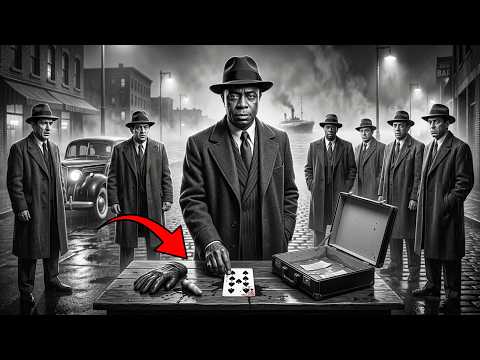
The leader was a heavy-set man named Sal—a man who didn’t negotiate, he calculated. His calculation was simple: Harlem was disorganized, Bumpy Johnson was distracted, and $40,000 in weekly protection revenue was sitting uncollected above 110th Street like fruit nobody had bothered to pick.
Sal’s first stop was a numbers parlor on 131st Street, run by a man named Curtis Webb. The parlor was behind a false wall in a laundromat that smelled of cigarette smoke and old coffee. Curtis had been running numbers there for 11 years. He had paid Bumpy Johnson every Friday without fail. He had never been robbed, never been raided, never been touched. That changed at 3:17 in the morning.
“Starting this week, you pay 30% of your weekly take to a new account,” Sal said. “You’ll get a collection number. You use that number every Friday. You don’t ask questions about where the money goes.” Curtis didn’t move. “I already have an arrangement.” “That arrangement is under review.” Sal placed a single playing card on the desk—the nine of spades—then turned and walked out.
Curtis Webb sat alone for a long time. The photograph of his mother stared down at him from the wall. The nine of spades sat on the desk like a stone. Then he picked up the telephone. The call reached Bumpy Johnson at 3:44 a.m.
Bumpy was not asleep. He was sitting in a leather chair above a restaurant on 133rd Street, reading Marcus Aurelius. He had read the book three times. He kept coming back to one line: The impediment to action advances action. What stands in the way becomes the way. He listened to Curtis without interrupting. When Curtis finished, Bumpy said two words. “How many?” “Six men. One car. Black Packard. Brooklyn plates.” Bumpy said nothing for a moment. Then: “You give them anything?” “No.” “Good. Don’t. Go home. Lock your door. Don’t call anyone else tonight.”
His lieutenant, Juny Bird, stood in the doorway. Juny had been with Bumpy for nine years—not a large man, but with a stillness that made people uncomfortable in enclosed spaces. “Mangano,” Juny said. It wasn’t a question. “Who else?” Bumpy said. “You want me to put people on the street?” Bumpy closed his book and set it on the table, spine up, the way a man marks a page he intends to return to. “No. I want you to watch every spot they touch tonight. I want to know exactly what they said, exactly how they said it, and exactly how much they asked for.” Juny waited. “They’re not here to take money yet,” Bumpy said. “They’re here to see if we flinch.”
He stood and walked to the window. Below, Harlem was still wet and still dark. Somewhere out there, six men in long coats were moving through his streets like they owned them. He watched the rain hit the glass and run down in long, crooked lines. “Let them walk,” he said. “Feed them something small—enough to make them feel like they won tonight.” Juny said, “And tomorrow?” Bumpy didn’t answer right away. A cat crossed under the street light and disappeared into an alley. “Tomorrow they’ll come back hungrier.” He said it the way a man says something he’s known for a long time—not like a threat, like a fact, like the weather.
The old men on 133rd Street who were still alive decades later would tell you that nobody who knew Bumpy Johnson ever remembered him raising his voice. Not once, not even that night. In that world, power rarely opens with gunfire. It opens with the question of who dares to collect the first dollar.
By the third night, Sal’s crew had visited eleven locations. A bar on 128th Street, two numbers parlors, a rooming house on 7th Avenue where the ground floor doubled as an after-hours club, a laundry on 131st that everyone on the block knew wasn’t just washing clothes, a barber shop that closed at 6 but had lights on until 2. Five more stops that don’t appear in any city record from that period because the men who ran them had very specific reasons for staying invisible to anyone with a badge or a subpoena.
At each location, the routine was the same. Two men at the door, Sal in the middle, the thin man with the scar standing close enough to be noticed. A short conversation, a number, a playing card left on a counter or a table or a bar top—always the nine of spades.
By the fourth night, word had moved through Harlem the way weather moves. You didn’t need a newspaper. You needed to stand on the right corner and listen. The owners talked to each other, not openly. They talked in the way people talk when they’re afraid of being overheard: short sentences, low voices, eyes that kept checking the door. The question they kept circling was the same question, and nobody wanted to be the first one to say it out loud.
They were already paying Bumpy Johnson. Every week, on time, in cash, in the agreed amounts. That arrangement had kept them open. It had kept the police from asking too many questions. It had kept other crews from getting ideas. Bumpy’s protection wasn’t charity. It was infrastructure. It was the reason their doors were still on the hinges.
Now someone was asking them to pay twice. A bar owner named Roosevelt Hines put it plainest. He was sitting in his own bar after closing, a glass of bourbon in front of him that he hadn’t touched. “I got one body,” he said to the man across from him. “I can’t work two jobs at the same time.” The man across from him was a numbers runner named Deshawn, twenty-three years old, who had never been to Brooklyn in his life. “So which one you going to pay?” Deshawn said. Roosevelt looked at his glass. “That’s the wrong question.” “What’s the right question?” “Which one’s going to be here next month?”
Bumpy Johnson heard versions of that conversation from four different people within forty-eight hours. He didn’t react. He didn’t call a meeting. He didn’t send anyone to deliver a message. He simply continued to collect his own payments on schedule at the agreed amounts from every location that still owed him. What he did not do was offer any of them relief.
This confused people. Some of the owners had expected him to say, Don’t worry. I’ll handle it. Your rate goes down while this gets sorted. That’s what a man running on fear would have said. That’s what a man who needed his people to feel safe would have said. Bumpy said nothing.
Juny Bird asked him about it directly one afternoon. They were in a car on 7th Avenue, idling at a red light. “The owners are scared,” Juny said. “Some of them are thinking about paying Sal’s crew just to make the pressure stop.” “Let them think about it,” Bumpy said. “If they pay Sal, they’ll find out what it costs to have two landlords. That’s a lesson they need to learn themselves. I can’t teach it to them. They have to pay the tuition.” The light changed. He didn’t say anything else for two blocks. Then: “How many of them are actually going to pay?” Juny thought about it. “Maybe three. The ones with the least margin. The ones who can’t afford to gamble.” “Good,” Bumpy said. “Those three will teach the other eight everything they need to know.”
Red Carbone, Mangano’s field commander for the Harlem operation, was not a subtle man. He was forty-four years old, built like a fire hydrant, and had spent twenty years on the Brooklyn docks convincing people to make correct financial decisions. His method was straightforward: he showed up, he stated the number, and he made it very clear what happened to people who chose the wrong answer. It had worked on the docks for two decades. The docks were a closed system. There were a finite number of jobs, a finite number of piers, and a finite number of people who needed to keep working. When you controlled access to all three, you controlled everything.
Harlem was not a closed system. Harlem was a neighborhood of 300,000 people, 200 blocks, a thousand informal economies, and a social architecture that had been built over forty years by people who had come north from places where they learned very early that survival required knowing things that never got written down. The stories passed down through those blocks carried more operational truth than any police report ever filed at the 28th Precinct.
Red Carbone did not understand this. He understood leverage. He understood physical presence. He understood the specific mathematics of fear. What he did not understand was that in Harlem, the currency of fear was managed differently. It ran on relationships, on history, on the knowledge of who owed what to whom going back ten, fifteen, twenty years.
On the fifth night, one of Sal’s men went to collect from a numbers spot on 132nd Street and found it closed. Not just locked—closed. The furniture was gone. The phone was disconnected. The man who ran it had moved his entire operation to a location that didn’t exist on any list Sal’s crew had been given. He had been tipped off four hours earlier by someone Sal had never heard of. Paid to make one phone call. The call cost seven dollars.
When a street must pay two kings, it will soon decide which one is unnecessary.
On the seventh day, Bumpy Johnson told a lie. It was a small lie on the surface—a rumor, really, the kind of thing that gets passed between people the way rumors always travel: third hand, slightly changed with each retelling, arriving at its destination with just enough detail to sound like it came from someone who knew.
The rumor was this: a major numbers shipment was coming through Harlem on Friday night. Cash proceeds from a week’s worth of consolidated collection across five operations. The number attached to the rumor was $80,000. The location was a warehouse on 134th Street near the river. The time was midnight.
None of it was true. The warehouse existed. The street was real. The number $80,000 was chosen because it was large enough to be credible and large enough to make a man’s hands sweat when he thought about it. The rest was architecture—a stage set built out of words passed through the right mouths at the right volume.
Juny Bird had spent nine years learning which mouths those were. He knew the bartender at a particular establishment on 129th Street who had a habit of talking too much after his shift ended. He knew a parking attendant who worked a garage two blocks from where Sal’s crew had been staying. He knew a woman who cleaned rooms at a boarding house and whose cousin had recently started working for one of Mangano’s peripheral operations. Three people, three separate conversations, three versions of the same story, each slightly different, each arriving at the same destination through a different route.
By Wednesday evening, the rumor had reached Red Carbone. Bumpy knew this because he had a fourth person watching Carbone’s rooming house on 127th Street. Not an enforcer, not anyone who appeared in any organizational chart anyone ever drew—just a retired postal worker named George who sat on his stoop every evening from six to ten and had, for the past three years, received an envelope containing forty dollars on the first of every month. George didn’t ask questions. He just remembered faces the way some men remember baseball scores: completely, permanently, without trying.
On Wednesday at 8 p.m., George reported that three of Sal’s men had left in a hurry, heading south toward a pay phone two blocks away. On Thursday morning, Juny confirmed that a crew of eight had been dispatched to scout the 134th Street warehouse.
While they were scouting, Bumpy’s people were working—not with guns, not with threats, with logistics. The actual money that week, the real collection from the real operations, moved on Thursday night instead of Friday. Different routes, different carriers, different drop points. Every location that Sal’s crew had been monitoring shifted its schedule by twenty-four hours. Four collection points that had been operating on predictable rhythms for years suddenly went dark on Friday and reopened Saturday morning as if nothing had happened.
Two of the local precinct officers who had a standing arrangement with Bumpy’s organization were informed quietly that there might be some activity near 134th Street on Friday night that could warrant a patrol car in the area. They were not told why. They didn’t need to be. They knew what a standing arrangement meant, and they had known it long enough that the knowing had become its own kind of muscle memory.
Red Carbone’s crew arrived at the 134th Street warehouse at 11:45 p.m. on Friday. They found an empty building, two confused cats, and a padlock that had been changed that afternoon. They waited until 1:30 in the morning before one of Sal’s men said what everyone was already thinking: there was no shipment.
Carbone drove back with eight men who had spent a Friday night crouched behind shipping crates waiting for money that didn’t exist. He did not speak. He sat in the passenger seat and watched Harlem go past—the bars still open, the men on corners, the lights four floors up—and understood he had been moved. Not beaten, not confronted. Moved like a piece on a board that someone else was reading three steps ahead.
He never learned who fed the rumor, who changed the padlock, who parked the cruiser where it sat. He only knew that someone had spent a week watching him think, then used that knowledge to point him at a wall.
Bumpy Johnson didn’t stop those men. He just made sure they ran the wrong direction while the real work got done somewhere else.
So here is the question that still hangs over that rain-wet street: when everything you’ve built is on the line, do you move first—or make them walk into your silence?
Report this article
Select a reason for reporting:






