You’re not just looking at a person—you’re looking at an engineering marvel. In the hushed parlors of Victorian England, death was not an end but a performance, and the camera was its stage. In countless post-mortem portraits, the deceased couldn’t sit upright alone, so they were supported carefully, quietly. A stand behind the back, a brace at the neck, sometimes a strap beneath the clothing, sometimes a relative positioned just close enough to stabilize the weight. The living held their breath, not just in grief, but in concentration—every muscle tensed to keep the illusion intact.
But here’s the part they never wanted you to see: they tried to hide it because the illusion mattered. The photograph wasn’t supposed to show mechanics. It was supposed to show presence—a final, frozen moment of dignity before the body surrendered to the earth. And so, the chair was chosen strategically: high-backed, solid, framing the body naturally. Hands were arranged to conceal tension. Fabric was adjusted to cover restraints. To modern eyes, something feels rigid, too balanced, too centered. That’s not coincidence. It’s structure.
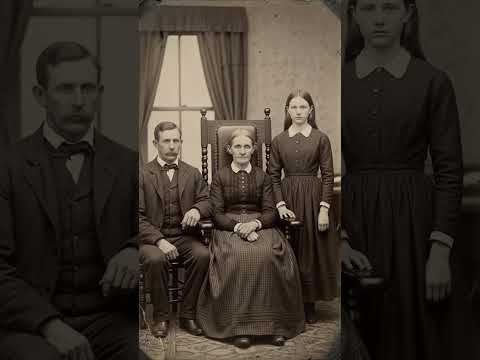
Because in these images, what looks like dignity is often a carefully constructed lie. A lie born of love, perhaps, or of societal expectation—but a lie nonetheless. The Victorians were masters of mourning, and their post-mortem portraits were their masterpiece. Every detail, from the tilt of the head to the fold of the hands, was choreographed to cheat death of its grotesque reality.
Yet, behind the velvet curtains and the silver nitrate, a quiet revolution was brewing. Photographers, often struggling artists themselves, found themselves thrust into the role of engineers, rigging invisible supports and whispering instructions to the dead. “Just a little more to the left,” they might murmur, as if the corpse could hear. And in a way, it could—through the lens, the body spoke a language of stillness that the living could only interpret.
But the secrets didn’t always stay buried. Sometimes, a stray strap would slip, a brace would creak, and the illusion would shatter. In one notorious case, a photographer’s assistant was caught on camera—literally—when a hidden support collapsed mid-exposure, sending the deceased tumbling forward. The resulting image, a blur of fabric and limbs, was hastily destroyed. But rumors spread, and the public began to wonder: how many of these serene portraits were actually macabre puppetry?
The answer, of course, was most of them. And yet, the demand for such portraits only grew. Families clamored for one last image, one last chance to hold onto their loved ones. They didn’t want the truth; they wanted the comfort. And so the photographers obliged, perfecting their craft, hiding the supports deeper, making the lies more beautiful.
But as the century waned and a new era dawned, the practice began to fade. The living moved on, and the dead were left to rest—unsupported, finally, by anything but memory. Yet the images remain, silent witnesses to a time when the line between life and death was blurred by a lens and a lie.
And somewhere, in a dusty archive, a photograph waits—one where the support was not quite hidden. A strap, a shadow, a hand too steady. It’s a reminder that even in death, we are never truly alone. But what happens when the illusion is exposed? That’s a story for another time.
The archive itself was a place of quiet decay. Dust motes swirled in the thin light that filtered through grimy windows, and the air smelled of old paper and forgotten chemicals. Among the thousands of glass plates and faded prints, one image stood apart—not because of its beauty, but because of its imperfection.
It was a portrait of a young woman, no older than twenty, dressed in a high-collared gown of black crepe. Her hands were folded in her lap, her head tilted slightly to the right. At first glance, she seemed peaceful, almost serene. But a closer look revealed something amiss. Beneath the lace at her throat, a thin, dark line was visible—a strap, cutting into the flesh.
The photographer had tried to hide it, of course. The collar was high, the lighting soft. But the strap had slipped, just a fraction, and the camera had caught it. It was a small thing, easily overlooked. Yet for those who knew what to look for, it was a revelation.
Word of the photograph spread quickly among the small circle of collectors and historians who cared about such things. Some dismissed it as a fake, a clever forgery designed to shock. Others argued that it was genuine—a rare glimpse behind the curtain of Victorian mourning. But one man, a quiet scholar named Edmund Hale, became obsessed.
Hale had spent years studying post-mortem photography, not out of morbid curiosity, but out of a deep fascination with the ways people cope with loss. He had seen hundreds of images, catalogued every known technique for posing the dead. But this one was different. The strap was not just a mistake; it was a message.
“They wanted us to see,” he whispered to himself, holding the print under a magnifying glass. “Not the strap—but the struggle. The effort it took to make death look like sleep.”
He began to dig deeper, tracing the photographer’s mark on the back of the card. It led him to a studio in a narrow London alley, long since demolished. But the records survived—ledgers, letters, even a few unfinished plates. And in those records, Hale found something unexpected.
The photographer, a woman named Eleanor Whitmore, had kept a journal. In it, she wrote not of art or commerce, but of guilt. “I have posed the dead as if they were alive,” she wrote, “and in doing so, I have lied to the living.” She described the supports she built, the straps she hid, the relatives she coached. And she admitted that sometimes, late at night, she heard the braces creak in her sleep.
But one entry stood out. It was dated October 1887, and it described a portrait she had taken of a young woman—the same woman in the photograph. “Her name was Alice,” Eleanor wrote. “She died of a fever, and her mother begged me to make her look peaceful. But when I placed the strap, I saw something in her face—a resistance, a refusal. I took the picture anyway.”
Hale set the journal down, his hands trembling. He had found the story behind the image, but it only raised more questions. Why had Eleanor kept the plate? Why had she not destroyed it like the others? And what had she meant by “a refusal”?
He returned to the archive the next morning, before the sun had fully risen. The curator, a thin woman with ink-stained fingers, gave him a key and a warning: the basement plates hadn’t been catalogued in decades. Hale descended the stairs anyway, his lantern throwing long shadows across rows of wooden shelves.
It took him three hours to find the box. It was tucked behind a stack of unmarked negatives, its label faded to near-illegibility: Whitmore, E. — Unfinished. Inside, wrapped in oilcloth, were a dozen glass plates. Eleven were landscapes and ordinary portraits. The twelfth was Alice.
But it was not the same image. This plate had never been printed. In it, Alice’s head had fallen forward, the strap clearly visible, her hands slipped from their careful arrangement. The illusion had collapsed—and Eleanor had captured the moment of its failure.
Hale held the plate to the light, and something cold moved through him. This was not an accident. The composition was too deliberate, the focus too sharp. Eleanor had not simply failed to hide the strap; she had chosen to document its presence. “She photographed the truth,” he murmured, “and then she hid it.”
He searched the journal again, this time reading the entries after October 1887. They grew shorter, more fragmented. Eleanor wrote of sleepless nights, of clients who complained that their loved ones looked “too stiff.” She began to question the work itself. “What comfort is a lie that costs so much?” she asked. “I build scaffolds for the dead and call it peace.”
Then, in a final entry dated only “Winter,” she wrote: “I have made a second plate. The mother will never see it. But someday, someone will.”
Hale realized he was holding that second plate. Eleanor had deliberately preserved the failed exposure—not as evidence of her skill, but as a confession. She had wanted someone, someday, to understand what the serene portraits truly cost.
He sat back on his heels, the plate cradled in his lap. The archive was silent except for the drip of a leaking pipe. And then, from somewhere above, he heard a floorboard creak—slow, deliberate, like footsteps trying not to be heard.
Hale looked up. The curator had said she was the only one with a key.
Hale’s breath caught. He slipped the plate into his coat and climbed the stairs two at a time, but the upper floor was empty—only the curator, bent over a ledger, who looked up with mild surprise. “You found something,” she said, and it was not a question.
He showed her the plate. She studied it for a long moment, then unlocked a drawer and drew out a letter, yellowed and sealed. “It came with the collection,” she said. “Instructions to give it only to someone who asked the right question.”
The letter was from Eleanor Whitmore, written in a shaking hand. She confessed that Alice’s mother had seen the failed plate by accident—and had wept, not with horror, but with relief. “She said it was the first honest thing she had seen since the funeral,” Eleanor wrote. “That the lie had been suffocating her.”
Eleanor never took another post-mortem portrait. She burned her braces and stands, and spent her last years photographing the living—laughing, blinking, imperfect. “I learned,” she wrote, “that comfort built on silence is no comfort at all.”
Hale published the plate and the letter together, and the response was not scandal but something quieter: letters from strangers admitting they, too, had kept secrets to spare the living. The photograph became a small, strange kind of comfort—proof that even the Victorians, with all their velvet and starch, had doubted.
He returned the plate to its box, but left the lid open. Some truths, he decided, should not be buried twice.
And you—what would you have done, holding the strap in your hands and a grieving mother at your shoulder? Would you have hidden the truth, or let the illusion fall? Tell us in the comments.
Report this article
Select a reason for reporting:






