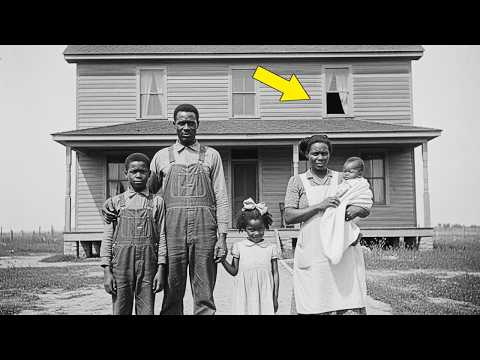
James Brennan wiped the dust from his hands as he surveyed the cluttered storage room of the Lincoln Community Archive. At 63, retirement had proven too quiet, so volunteering to catalog donated materials gave him purpose. The cardboard box in front of him had arrived three weeks earlier from a Chicago storage facility—someone’s entire history packed away and forgotten.
He lifted items carefully: letters tied with faded ribbon, military medals, a cracked leather Bible. Beneath it all, wrapped in brittle tissue paper, lay a collection of photographs spanning decades. James spread them across his worktable, organizing by clothing styles and techniques. Wedding portraits from the 1920s. Children in Sunday best. Families gathered for holidays. Each image told a story, though most were lost to time.
Then his fingers touched a photograph that made him pause. Professional composition, careful lighting—a dignity that transcended the obvious poverty of its subjects. A black family of five stood before a modest two-story wooden house. On the back, in careful pencil: Johnson family, Oklahoma, summer 1930.
James studied the father, tall and dignified in worn work clothes; the mother, hand resting protectively on a young girl’s shoulder; three children, all barefoot, all gazing directly at the camera with resilience. The house behind them showed peeling paint, a sagging porch, a weathered barn. Rural Oklahoma during the Great Depression, the dust bowl era.
He had cataloged hundreds of such photographs. But something about this one felt different—a weight, a sense that the image contained more than what was visible. He set it aside in a special folder.
Three days passed before James returned to it. He brought the photograph to the archive’s new high-resolution scanner, purchased with a grant for preserving historical images. With cotton gloves, he placed it on the scanner bed. The machine hummed, its light bar moving slowly, capturing every detail with remarkable precision.
When the scan completed, James opened the file on his computer. He zoomed in slowly, examining each face, the texture of clothing, the grain of the wooden house. Then he noticed something unusual.
In the second-floor window, behind a white lace curtain, there was a subtle shadow—a shape that didn’t match the interior darkness. James increased the magnification, his heart rate quickening. He adjusted contrast, enhanced shadows, sharpened focus.
What emerged made him lean back, blinking in disbelief.
Behind the curtain, partially obscured but unmistakably present, was the figure of a small child. But this child was distinctly different from the family members. The skin tone was pale. The hair appeared light colored, possibly blonde. The features, though hidden by translucent fabric, were clearly Caucasian.
A white child hidden in the window of a black family’s home in Oklahoma in 1930.
James’ mind raced. This was the era of rigid Jim Crow segregation, when racial boundaries were enforced with brutal violence. Interracial adoption wasn’t just socially unacceptable—it was dangerous, potentially deadly.
He zoomed in further. The child appeared to be a girl, approximately seven or eight years old. She stood slightly to the side, as if watching the photograph being taken while trying to remain unseen. One small hand pressed against the window glass, fingers barely visible through the curtain.
This wasn’t an accidental appearance. The child was deliberately positioned out of view, hidden from whoever was taking the photograph, hidden from the world.
James saved multiple versions of the enhanced image. He needed to show this to someone, to confirm he wasn’t seeing things. But more than that, he needed to understand what this photograph truly represented.
Who was this child? Why was she hidden? And what had compelled the Johnson family to take such an extraordinary and dangerous risk?
He spent the weekend researching Oklahoma history during the 1930s—the Great Depression, the social structures, the racial tensions. The more he learned, the more extraordinary the Johnson family’s actions appeared.
On Monday morning, he arrived at the archive before it opened, carrying a folder of notes. His first step was to search the National Archives database for census records from 1930. The search for Johnson families in Oklahoma returned hundreds of results. He narrowed the parameters: black families, rural locations, children matching the approximate ages.
After two hours, he had a list of 23 possibilities. But census records only showed names, ages, relationships—they didn’t capture the full story of people’s lives, their struggles, their secrets, or their extraordinary acts of courage.
The Johnson family in the photograph existed in the official record as five people. But James now knew that six people had been present in that house when the photograph was taken.
He turned his attention to the photograph itself. The professional quality suggested a traveling photographer, not a casual snapshot. During the Depression, professional photography was expensive—a luxury struggling families rarely afforded unless there was a special reason.
James contacted the Oklahoma Historical Society, composing a careful email with the enhanced image. “I’m researching a family from your region,” he wrote. “The Johnson family, photographed in the summer of 1930 in a rural area, possibly northwest of Guthrie. Any information about families by this name or about traveling photographers documenting families during this period would be greatly appreciated.”
While waiting for responses, he examined the physical photograph more closely under magnification. The paper quality suggested professional development. The composition was deliberate, the family positioned carefully, the lighting even and flattering despite the harsh Oklahoma sun.
His phone rang just after lunch. It was Patricia Reynolds from the archives genealogy department, a woman in her 70s who had volunteered even longer than James.
“I heard you’re researching a Depression-era family photograph,” Patricia said. “There’s something you should know.”
In 1930, there was a documentary photography project called Faces of the Dust Bowl. Photographers traveled through Oklahoma, Kansas, and parts of Texas, documenting families affected by the drought and economic crisis. The project was privately funded and never completed, but some photographs survived.
James felt a surge of hope. “Do you know where those photographs are now?”
“The University of Oklahoma has a collection. The photographer’s name was William Hutchinson. He died in 1932, but his widow donated his work to the university’s archive. If your photograph matches the style and time frame, it might be part of that collection—or at least connected to it.”
James immediately began drafting an email to the university. This was the break he needed—a potential connection to documentation, to names, to the story behind the image that had captivated him completely.
The reply from the University of Oklahoma arrived within 48 hours. Dr. Helen Martinez, the head archivist, invited James to examine the William Hutchinson collection in person, noting that his enhanced image matched Hutchinson’s style. One week later, James walked through the temperature-controlled archives in Norman.
“Hutchinson understood that people suffering through this depression had stories that deserved to be documented with dignity,” Dr. Martinez explained, placing several archival boxes on the table. “He was meticulous. Every photograph has a corresponding entry.”
James opened the leather-bound journal with trembling hands. He searched entries from the summer of 1930 until he found it: Johnson family, August 12th, 1930. Thomas, 42. Ruth, 37. Children: Samuel, 16, Clara, 11, Joseph, 7. Payment: three dozen eggs and a jar of preserves.
Five names. Five people documented. But James knew six had been present that day. The little girl in the window wasn’t mentioned. She wasn’t recorded. Officially, she simply wasn’t there.
“I found what was written down,” James said slowly. “But the real story is what was deliberately left out. This family was protecting someone—someone whose very presence could have gotten them killed.”
What secrets do you think families still keep hidden today—and would you risk everything to protect a stranger?
Report this article
Select a reason for reporting:






