In the shadow of Mount Victoria, on a steep little street in Wellington, 1955, a group of Greek immigrants gathers every Sunday for prayer. Their church is not made of marble or brick. It is a surplus U.S. Army medical barracks, bought from the New Zealand government, shipped from Trentham, and hauled into the city. Inside, men who were fishermen in Ithaca, shopkeepers from Kefalonia, and refugees who arrived just four years earlier on a Norwegian ship after being expelled from communist Romania stand together. Many of these refugees had never lived in Greece. Yet here, at the far edge of the world, they called themselves Greek—and they meant it.
How did Greeks end up in a country so distant from the Aegean that they described it as the edge of the world? Why did a nation that favored British settlers open its doors to them at all? And why, when so many Australian families can trace a Greek ancestor, has this chapter of New Zealand’s history been almost entirely forgotten?
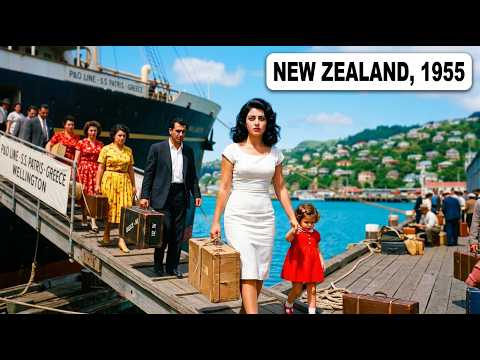
To understand this community in that barracks, we must go back more than a century, to the first Greek sailors who set foot on these shores. The first Greek in New Zealand is believed to have been a merchant navy officer from Sparta, known as Konstas, who reportedly arrived as early as 1798. Records are sparse. What is certain is that Greeks came first as seamen. Sailors jumped ship in New Zealand ports. Some worked the coast as fishermen. Others followed the call of gold. The first official trace appears in the 1874 census. It counted Greeks in the colony: forty men and one woman. That single number says almost everything about the early years. It was a community of lone men, far from their villages, far from their church, and far from any Greek bride.
Te Ara, the encyclopedia of New Zealand, records that these early arrivals mostly headed for the goldfields. Many saved what they could and returned home. Those who stayed had to find another way to live. They had often been farmers in Greece, but land in New Zealand was expensive and they had no capital. So they turned to trades that required only hard work and long hours. Between 1890 and 1914, Greeks established themselves as fishermen, hawkers, confectioners, and restaurant owners in Auckland, Wellington, and Dunedin. A man from the island of Ithaca, known as Nicholas Fernandos, is considered the first known Greek immigrant to settle permanently. Others from the same islands followed. It was chain migration in its purest form. One man found work. He wrote home. A brother came, then a cousin, then a neighbor from the same village. The poorest islands of the Ionian Sea sent their sons around the world. Ithaca and Kefalonia, above all. Later, men came from Achaea on the mainland and from Lesbos in the east.
The journey itself was an ordeal. There was no direct route from the Ionian Sea to the South Pacific. A young man left his village with a small bag, took a steamer to a larger port, then spent weeks at sea, often changing ships along the way. Many never saw their mothers again for decades. Some never saw them at all. They sent money home. They sent letters. And slowly, the villages of Ithaca and Kefalonia learned the names of towns they would never visit.
Those first decades laid the foundation. The next generations would try to build a community around it. In the interwar years, Greek New Zealanders faced a problem that hard work could not solve. They had no church of their own. Since 1924, New Zealand had been under the care of the Greek Orthodox Archdiocese of Australia and New Zealand, administered from Sydney. But there was no Greek priest living in New Zealand. For a people whose life revolves around the sacraments, this was a deep wound. Marriage required a priest. Baptism required a priest. According to Te Ara, until the 1940s, these rites were performed only when a priest visited from Australia. Couples waited. Infants waited. Families measured their lives by the arrival of a clergyman across the Tasman Sea.
Yet chain migration continued. By 1936, there were 82 Greek-born people living in Wellington. The capital became the heart of the community. But Greeks also spread across both islands. Families from Ithaca and Kefalonia settled in New Plymouth, Fielding, Palmerston North, Dannevirke, Napier, and Hastings. In the South Island, they went to Ashburton, Timuka, Timaru, Waimate, and Oamaru. In many of those towns, a Greek family ran the fish shop or the restaurant on the main street. They relied on family labor. Wives served customers. Children peeled potatoes after school. They also faced suspicion. Te Ara notes plainly that Greeks once encountered prejudice in New Zealand. They were foreigners. They were Orthodox. They did not speak English at home.
Then came the war, and with it a bond that would change everything. In April 1941, New Zealand soldiers fought alongside Greek forces as the Germans swept through Greece. The withdrawal ended on the island of Crete. On May 20, 1941, German paratroopers descended from the sky over Crete. The battle lasted barely a week. New Zealand lost 671 men killed. Another 967 were wounded. 2,180 were taken prisoner. But many New Zealanders fled to the mountains. Cretan villagers sheltered them, fed them, and guided them at great risk to their own families. Te Ara records: “Greeks helped New Zealand forces during the withdrawal and the Crete campaign, creating lasting bonds.” For a generation of New Zealand men, Crete was no longer just a name on a map. War made the Greeks allies. Peace would make many of them immigrants.
When the war ended, Greece found no peace. Occupation had left the country starving and devastated. Then from 1946 to 1949, a brutal civil war tore Greece apart. Te Ara describes the dire economic and political conditions that followed, and a surge in chain migration to New Zealand. In Wellington, the community was ready to receive them. American forces had been stationed in the city from 1942 to 1944, and milk bars and cafes had sprung up along Willis Street and Lambton Quay to serve them. It was a trade Greek families understood well. The church followed. From 1945, a priest named Chrysostomos Vogiatzoglou began holding services in Wellington. Then in 1947, the community achieved something it had wanted for decades. It bought a prefabricated U.S. Army medical barracks from the New Zealand government. The building was moved from Trentham to Lloyd Street in Mount Victoria. There, the Greeks of Wellington finally had their own church.
In 1949, a new priest arrived. Father Eleftherios Economou served the community until 1960, the longest tenure of those early years. At last, weddings and baptisms no longer had to wait for a visitor from Sydney. Some of the new arrivals were women who came as brides for soldiers. But most were men following the old chain from the islands, and soon the government itself would send a ship full of Greeks that no one had expected.
After the war, millions of Europeans were stranded far from home. They were called displaced persons. Many could not return because their countries had fallen behind the Iron Curtain. The International Refugee Organization sought to resettle them, and New Zealand agreed to take a quota. Between 1949 and 1953, New Zealand received displaced persons from across Eastern Europe. Poles, Latvians, Yugoslavs, Czechs, Hungarians. 847 came from Poland, 545 from Latvia, 504 from Yugoslavia. But the largest single group came from Romania, 918 people, and most of them were not Romanian at all. They were ethnic Greeks. Greek communities had lived in Romania for generations, many as traders around the Black Sea ports. After the communists seized power, they became undesirable. Now they were leaving with almost nothing.
On May 1, 1951, the ship Goya sailed into Wellington harbor. She came from Piraeus. The Goya had a history of her own. Launched in Germany in 1938 as the Cameroun, she was handed to Norway after the war as reparations and renamed. In 1950, she had already carried refugees from Italy to Australia under contract with the International Refugee Organization. Now she had crossed half the world to reach Wellington. On board were more than 900 refugees. Most were ethnic Greeks from Romania, along with Estonians, Yugoslavs, and others from Eastern Europe. More groups of Greek refugees followed later that year. In total, New Zealand accepted over 1,000 Greek refugees in 1951.
The reception was organized and strict. The newcomers were first taken to a former prisoner-of-war camp at Pahiatua in the Wairarapa. They spent about three months there learning English and some of the laws and customs of New Zealand. Families who had fled a police state now lived behind a camp fence again in a strange country, with a strange language. Then they were sent to work. Te Ara records that the men worked in hydroelectric dam construction and heavy industry where there was a labor shortage. New Zealand was building dams and power stations to light its growing cities. The Greek refugees helped build them. Jobs were found for most arrivals in Wellington, but others were sent around the country where work was available.
For the old Greek families in Wellington, these arrivals were a surprise. They spoke Greek. They crossed themselves in the Orthodox way. But they had been raised in a different world. Within a few years, the two groups would worship side by side in that barracks church. And by the mid-1950s, the community was changing faster than ever.
By 1955, the Greeks of Wellington were no longer just a scattered collection of islanders. They had become a real community. To be fair, there was no single large ship carrying Greeks in 1955. Organized migration had begun in 1951, and the largest program would not start until 1962. 1955 sits exactly in the middle. It is a frozen moment in the middle of the wave, when the men had arrived and the families had not yet followed. What did that community look like? It looked like the fish and chip shop on the corner. It looked like the dairy on the main street. Te Ara lists the businesses Greeks relied on: restaurants, fish and chip shops, fish wholesale outlets, dairies, grocery stores, and shoe stores. Each was run with family effort, everyone opening early and closing late.
Greeks clustered together. Mount Victoria, close to the church and the city center, became the center. Later, Miramar took its place. Houses were bought next to relatives’ houses. Children grew up speaking Greek at home and English in the playground. Young men found their own ways to belong. In 1953, Greek immigrants in Wellington formed a football club. They called it Apollon. The founding is credited to the sons of Father Eleftherios Economou’s parish. In 1959, it became known as Christian Youth. And in 1983, it took the name it is known by today, Wellington Olympic. To this day, the club is commonly known as “the Greeks.”
Women built their own institutions too. The women of the Wellington church had never had a separate congregation. By the 1950s, they had established the Philoptochos Society for Greek Ladies, a charitable women’s association under the Orthodox Church. By the late 1950s, they had formed a separate women’s auxiliary. They raised funds, cared for the poor and newcomers, and held the parish together.
But the community faced a problem rooted in the 1874 census. There were still far more Greek men than women. Many of the men who came in the island chain were single. They worked long hours in shops and on construction sites. And in a small country at the end of the world, it was very difficult to find a Greek bride. The answer, when it came, arrived from the island of Crete.
Across the Tasman, the contrast was stark. In 1952, Australia began offering assisted passage to Greek migrants, and tens of thousands came. By 1961, 77,333 people of Greek origin lived in Australia. New Zealand never opened its doors that way. Its government strongly favored British migrants, and Te Ara notes that only 200 to 350 people arrived from each of several European countries, Greece among them. The Greek community in New Zealand was always counted in the thousands, not hundreds of thousands. That smallness shaped everything.
It also shaped the most remarkable plan of all. Between 1962 and 1964, the New Zealand government brought 267 young Greek women to the country. Most came from Crete, and most from the Chania region. It was that island where Cretans had once risked everything to hide New Zealand soldiers. The plan had two aims. Officially, it was designed to provide domestic labor for hotels and hospitals, where New Zealand was short of workers. Unofficially, as researchers with the Connecting Homelands project recorded, it was also meant to provide potential brides for the many single Greek men who had arrived earlier.
Most of the women were between 16 and 24. Before leaving Greece, they attended special training centers where they learned basic English and domestic skills. Then they crossed the world. Work contracts were signed for two years. Imagine the scale of that decision. Girls from mountain villages in Crete, some barely finished with school, never having seen a large city, sailing or flying to a country on the other side of the planet. They arrived in groups but were distributed upon arrival to different workplaces around the country. Friends who had traveled together were separated within days.
Work began almost immediately. A photograph preserved by Te Ara shows five of these young Greek women working in the Wellington Hospital laundry just one day after their arrival. There was no time to recover from the journey. There were sheets to wash and floors to clean. They worked hard, and many did exactly what the government had quietly hoped. They married. When their contracts ended, many settled in the established Greek communities of Wellington and Auckland. Some married men who had come in the 1950s. Some moved to Australia, where the Greek community was far larger. And some returned home to Crete. Those who stayed changed the community forever. They brought children, and with children came Greek schools, baptisms, name days, and wedding feasts that filled the parish hall.
By the mid-1960s, the Greek community in New Zealand reached its peak. Estimates put it at 5,000 to 6,000 people, including those born in New Zealand. Both Te Ara and NZHistory point to Wellington as the undisputed center. By 1966, Greeks were the most concentrated ethnic group in the Wellington urban area. In Mount Victoria that year, about 60% of Greek households lived in neighboring houses. It was a village within a city. About 65% of Greek New Zealanders came to live in Wellington. Auckland had a smaller community that had its own Greek cafes by the 1970s. Men used to gather there to play cards and argue about politics in Athens. Women, according to old village customs, were not invited to join them.
Then came the church’s great year. In January 1970, the Ecumenical Patriarchate in Constantinople established an independent Greek Orthodox Metropolis in New Zealand. For nearly half a century, the Greeks of New Zealand had been under the rule of Sydney. Now they had their own diocese and their own metropolitan. Metropolitan Dionysios led that diocese from 1970 until 2003. In that same year, the old barracks was demolished. On its site, the community built the Cathedral of the Annunciation, known to Greeks as Evangelismos. A community center was built next to it later. The street itself was eventually renamed. Lloyd Street became Chania Street, after the old capital of Crete. The Greek community had built its cathedral. The next generation would have to decide how much of its Greek identity to keep.
After the peak of migration, the flow of newcomers began to slow. In 1974, Turkey invaded Cyprus and a new wave of Greek Cypriots arrived in New Zealand. In 1981, 50 Cretan families were invited to settle in New Zealand, a gesture rooted in the memory of war. Since 1984, Wellington has had a sister-city relationship with Chania. In 1995, a Greek-New Zealand memorial was unveiled on Cambridge Terrace in Wellington. Every May, near the anniversary of May 20, 1941, the Battle of Crete is commemorated. Meanwhile, Greece itself changed. As conditions at home improved, the need for Greeks to leave diminished. The sons of fish shop families went to university. Te Ara records that later generations moved into the professions and property development. The scales and the fryers gave way to law offices, clinics, and construction companies.
But success had a price. Te Ara says it plainly: “Time, distance, and intermarriage have eroded the language.” About half of Greek marriages in New Zealand are now to New Zealanders of other backgrounds. Grandchildren with Greek surnames often do not speak Greek. In the 2018 census, 2,475 New Zealanders declared Greek ancestry. Estimates suggest far more, perhaps 10,000 people, have some Greek heritage. Their largest concentration has moved from Mount Victoria to Miramar. Yet the Orthodox Church remains, in Te Ara’s words, the unifying force of the community.
So why do so few know about all this? The answer lies in scale. The Greek population in New Zealand never exceeded a few thousand. There was no single dramatic ship immortalized by newspapers, no massive scheme as in Australia, just one refugee ship in 1951, 267 young women from Crete, and a steady trickle of men from the islands, one by one. Across the Tasman, Melbourne was becoming one of the largest Greek cities in the world. Next to that, the Greeks of Wellington simply disappeared from view.
And yet they did not disappear. They are still there. Imagine Wellington in 1955, that steep street in Mount Victoria, an old U.S. Army barracks packed every Sunday morning with fishermen from Ithaca, refugees from Romania, and single men waiting for brides who had not yet arrived. They had no cathedral. They had no diocese. They had very little money and a great deal of faith. Today, on the same land, on a street that now bears the name Chania, stands a cathedral. The fish shops have become family businesses. The football club still plays. The sons of Cretan hospital workers have become grandparents themselves. A few thousand Greeks at the edge of the world built a church from an army hut and then built a community around it.
What do you think: should the story of New Zealand’s Greeks be taught in schools, or is it better kept as a quiet chapter known only to those who lived it?
Report this article
Select a reason for reporting:






