At 1:00 a.m. on March 28, 1942, a battered British destroyer, packed with over three tons of explosives, hurtled through a hail of German fire and rammed into the dock gates of Saint-Nazaire. Within moments, elite commandos stormed ashore, their mission: to destroy the only dry dock capable of servicing the mighty battleship Tirpitz. The fate of the Atlantic convoys—and perhaps the war itself—hung in the balance.
This was Operation Chariot, a raid so audacious that even the Germans, filming the aftermath for propaganda, had no idea that the greatest explosion was yet to come.
In early 1942, the Allies were on the ropes. Germany dominated Europe, Japan had swept through Southeast Asia, and Britain stood alone against the Nazi war machine. With U-boats strangling the Atlantic and the RAF unable to mount a major bombing offensive, Churchill’s only option was to strike back with lightning raids. Enter Combined Operations, led by the controversial Lord Louis Mountbatten—a force of commandos and specialists whose daring would become legendary.
Their target: Saint-Nazaire, a heavily defended port on the French coast. Its massive Normandy Dock was the only facility on the Atlantic that could repair the Tirpitz, a 42,000-ton battleship that threatened to annihilate Allied convoys. If the dock was destroyed, the Tirpitz would be useless. The plan was simple: ram an explosive-laden destroyer into the dock gates and send commandos to wreck the port.
But nothing about this raid was simple.
The destroyer chosen was HMS Campbeltown, an outdated World War I relic. Disguised as a German ship and commanded by Lieutenant-Commander Stephen Beattie, she would lead a flotilla of 19 vessels carrying 621 sailors and commandos. Their journey began on the evening of March 27, 1942, from Falmouth, England, under the cover of fog. For two hours, they slipped through the darkness, guided by the submarine HMS Sturgeon. As they passed the submarine, a voice called out: “Goodbye and good luck.”
By 1:22 a.m., the element of surprise vanished. A German searchlight pierced the fog, illuminating the Campbeltown. Moments later, all hell broke loose. Tracer bullets crisscrossed the sky like fireworks, and shells rained down from every direction. The wooden-hulled motor launches were torn apart, bursting into flames as petrol tanks exploded. Men burned alive in the water, their screams drowned by the roar of guns.
Onboard the Campbeltown, Beattie ordered full speed ahead. Shells ripped through the ship, wounding three-quarters of the men on deck. “My left leg was wet and sticky, and my right arm was spurting blood,” recalled Stewart Chant. “But by some twist of fate, there was no pain. Just discomfort.”
At 19 knots, the Campbeltown slammed into the dock gate, burying her bow 36 feet into the target. The commandos leaped ashore, racing to destroy the pump house and gun emplacements. Meanwhile, at the old mole, the extraction point, the situation was catastrophic. Motor launches were burning wrecks, blocking the jetty. “Bodies floated in a watery bed of fire,” remembered Ralph Battison. “I saw men burn alive in the petrol that covered the surface.”
With no way home, the commandos fought on. They stormed the bridge into Saint-Nazaire, fighting through streets and houses until, out of ammunition, they were captured. But the Campbeltown had one last surprise. At 11:45 a.m., five hours later than planned, she exploded with a force that shattered the dock and sent debris flying across the port. The Germans, who had been inspecting the ship, were caught in the blast.
The raid cost 169 lives, with 382 casualties out of 621 men. Yet the Normandy Dock was destroyed for the rest of the war, and the Tirpitz never sailed. Five Victoria Crosses were awarded, including one to Sergeant Tom Durant, who fought to the last bullet.
But the true legacy of Operation Chariot lies not in the damage inflicted, but in the message it sent: that as long as Europe remained under Nazi control, there were men willing to fight and die for its liberty.
As the smoke drifted across the shattered dockyard, the men of Saint-Nazaire began the grim work of counting the cost. German engineers, their faces pale beneath their helmets, swarmed over the ruined caisson. The great iron gate that had once held back the Atlantic now lay twisted and torn, its rollers flung into the mud like broken toys. For the rest of the war, no capital ship would ever pass through that basin.
But for the commandos still on the loose, the morning brought no relief. Scattered across the old town, small groups of raiders fought on in isolated pockets, their ammunition running low, their escape cut off. One such group, led by Lieutenant Colonel Charles Newman, barricaded itself inside a cellar on the Rue de la Paix. Through the night they held out, exchanging fire with German patrols that probed the alleyways.
Newman, a wiry, soft-spoken officer who had spent years training the commandos, knew the odds were hopeless. Yet he refused to surrender while a single round remained. “We came here to do a job,” he told his men, “and by God, we’ve done it. Now we fight until we can’t.”
Dawn broke grey and cold over the Loire, revealing a scene of utter devastation. The Avant Port was littered with smoldering wrecks, their hulls blackened and rent. Fuel oil spread in iridescent sheets across the water, and the stench of cordite and burning wood hung in the air. German soldiers moved cautiously among the debris, rifles raised, kicking aside empty shell casings and discarded helmets.
It was then that the first reports of the Campbeltown’s destruction reached the German command. The news struck like a thunderbolt. General Karl von Praun, the port commander, had personally inspected the grounded destroyer that morning and declared it harmless. Now, staring at the gaping crater where the dock gate had stood, he realized the full extent of the deception. His report to Berlin would make uncomfortable reading.
Out in the estuary, the surviving motor launches limped toward the open sea. ML 306, riddled with holes and listing badly, had somehow survived the inferno at the old mole. Her crew, many of them wounded, worked frantically to keep her afloat as she crept past the burning port. Then, out of the morning mist, loomed the German corvette Jaguar.
The Jaguar’s captain, Korvettenkapitän Friedrich Paul, ordered the tiny launch to surrender. The reply came in the form of a burst of Bren gun fire from ML 306’s deck. Paul, a veteran of the Great War, was astonished by the defiance. He ordered his gunners to return fire, and within minutes the launch was a slaughterhouse.
Yet even as his men fell around him, Sergeant Tom Durant refused to quit. Having emptied his Bren, he scrambled to the twin Lewis gun and kept firing until a burst of autocannon shells tore through his chest. When the Germans finally boarded the shattered launch, Paul stood over Durant’s body and shook his head in disbelief. “A man like that,” he later said, “deserves the highest honor his country can bestow.”
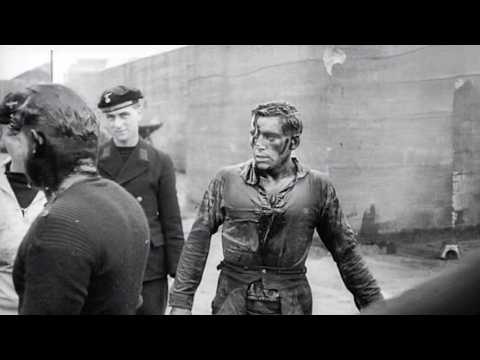
It was on Paul’s testimony that Durant was awarded the Victoria Cross—one of five handed out for the raid, a remarkable tally for a single operation. But the decorations could not mask the human cost. Back in Saint-Nazaire, the wounded were being gathered up and marched through the streets, their faces bloodied, their uniforms torn. German cameramen filmed them for the newsreels, eager to show the Reich’s triumph over British audacity.
Among the prisoners was Newman, captured after his ammunition finally ran out. He was brought before von Praun, who demanded to know why the British had sacrificed so many men for a single dock. Newman, exhausted and wounded, met his gaze without flinching. “Because we had to show you,” he said quietly, “that we can strike anywhere. Even here.”
The words hung in the air between them. Von Praun said nothing, but his expression darkened. He understood, perhaps better than his superiors in Berlin, that the raid was not merely a tactical blow. It was a warning—and a promise.
That evening, as the sun set over the ruined port, a lone German staff car pulled up beside the wreck of the Campbeltown. Two officers stepped out and walked slowly around the shattered bow, now resting at a drunken angle in the dry dock. One of them, a naval engineer, knelt to examine the twisted steel and shook his head. “This was no accident,” he murmured. “They planned every inch of this.”
His companion, a young lieutenant from the propaganda ministry, was already scribbling notes for the next day’s broadcast. The story would be spun as a great German victory—enemy losses heavy, the port soon repaired. But even as he wrote, the lieutenant could not shake the image of those British commandos, fighting to the last round in a town that was never meant to be held.
He glanced at the ruined dock gate one last time, then climbed back into the car. The engine coughed to life, and the staff car rolled away into the gathering dusk. Behind it, the shattered port of Saint-Nazaire lay silent beneath the first stars—a graveyard of ships, and a monument to a raid that would echo through the war.
The weeks that followed brought the reckoning. In Berlin, Hitler flew into one of his celebrated rages, demanding that every British prisoner taken at Saint-Nazaire be shot out of hand. His generals talked him down, but the fury revealed the truth: the raid had cut deeper than any single dry dock. The Tirpitz sat impotent in her Norwegian fjord, and the Atlantic convoys sailed with one less shadow over them.
In London, the newspapers trumpeted the raid as a triumph. Beattie, Ryder, and Newman were paraded before cameras, their VC ribbons bright against their uniforms. But the men who had been there knew the arithmetic better than any headline. Two out of every three who left Falmouth did not come home whole—or did not come home at all.
At Escoublac-La-Baule, a few miles from the port, the dead were laid to rest in a quiet cemetery beneath the pines. German soldiers, under orders, dug the graves and marked them with care. Among the headstones stands one for Sergeant Tom Durant, the man who fought until his last bullet—honored on the word of an enemy.
Years later, veterans would return to Saint-Nazaire and walk the old mole, now silent. They would stand at the edge of the Normandy Dock, where the rusted caisson still bore the scars of that morning, and remember the fire on the water and the friends who never left it.
The raid did not win the war. But it told the world—and the men who would follow—that the fight was far from over. That, in the end, was the real cargo the Campbeltown carried into that dock gate.
What do you think—was Operation Chariot a strategic success, or a costly gamble that history has been too kind to? Tell us in the comments below.
Report this article
Select a reason for reporting:






