London, spring 1879. In the crowded, soot-stained streets of Bloomsbury, a woman’s disappearance went unnoticed for eighteen months. No search parties. No police reports. No frantic relatives. She had erased herself so thoroughly that when her body was finally discovered—strangled, hidden beneath a pile of coal and rubbish in a cellar—the first question wasn’t who killed her? It was who was she?
Her name was Matilda Hacker. And the story of how she came to die in a rented room, known only as “Miss Ewish,” is a tale of wealth turned to paranoia, of a life spent fleeing the very obligations that should have anchored her. It is a case that would grip Victorian England, spark a sensational trial, and then fade into silence—just as she had.
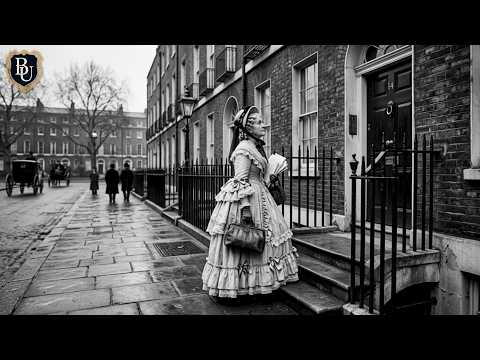
Matilda was born in Canterbury around 1811, into a family of respected builders and property owners. She never married. After inheriting estates in Kent, she lived off her rents—a single woman of independent means, accountable to no one but herself. But her eccentricities were legendary. Neighbors whispered about her extreme stinginess, her girl’s clothing worn well into old age, her dog-eared dream dictionary. She corresponded fiercely with lawyers and tax collectors, determined to avoid them at all costs.
And so she fled. Not from poverty, but from paperwork. From demands. From the suffocating weight of her own property. In the autumn of 1877, she arrived at 4 Euston Square—a narrow, multi-story house packed with lodgers—and took a room under the name “Miss Ewish.” She paid her rent weekly in advance, kept to herself, and vanished.
No one reported her missing. No one asked where she had gone. The household continued its ordinary bustle: meals cooked, rooms let and re-let, coal hauled daily from the cellar beneath the front steps. For eighteen months, the woman who had lived among them as a stranger became a ghost—unnoticed, unmissed.
Then, on May 9, 1879, a servant clearing the coal cellar moved a pile of refuse and ash—and uncovered human remains. A rope was coiled around a woman’s neck. The body had been there all along, hidden beneath the daily traffic of the house.
The identification was painstaking. The press would call it the “Euston Square Mystery.” Police traced her property—a watch pawned by a young servant, Hannah Dobbs, who also possessed Matilda’s dream dictionary and had given the dead woman’s empty cash box to the children as a toy. Dobbs’s story of an inheritance from a nonexistent uncle collapsed. She was arrested and charged with murder.
The trial that followed was built entirely on circumstantial evidence. No one had seen the killing. The date of death could not be fixed. A washed bloodstain on the carpet, the pawned goods, the lie—these were the threads. The defense argued that a young woman of ordinary strength could not have strangled an adult and dragged her to the cellar alone. They pointed to the chaos of the household, the unreliability of its witnesses. And they reminded the jury that a life hung in the balance.
When the jury returned, the verdict was acquittal. Hannah Dobbs walked free. No one else was ever charged.
But the story didn’t end there. Dobbs sold her version of events to a publisher, accusing the landlord, Severin Bastendorff, of the murder and claiming an affair. He sued for libel—and in denying the affair under oath, he committed perjury. In December 1859 (a date that seems to be a transcription error; records suggest 1879), he was sentenced to twelve months’ hard labor. Not for murder. For lying about a love affair.
The house at 4 Euston Square was destroyed by scandal. The Bastendorff furniture business collapsed. The family scattered. And Matilda Hacker? Her grave is unknown. Her personal history was erased by her own design. All that remains is the case file, the newspaper clippings, the trial papers—the public record of a private woman who wished above all to never be found.
Yet the central question lingers, as unanswered now as it was when the coal was cleared away: Who killed Matilda Hacker?
To understand why the question lingers, one must first understand the peculiar mechanics of Victorian justice—how a case could be built, tried, and closed without ever touching the truth. The Euston Square Mystery was not solved. It was processed. And the machinery that processed it was designed less to discover guilt than to produce a verdict.
Consider the evidence as the prosecution presented it. A watch, pawned. A dream dictionary, carried away. A cash box, emptied and handed to children as a plaything. Each item was a small betrayal of the dead woman’s privacy, and together they formed a chain—but a chain of possession, not of violence. The law could prove that Hannah Dobbs had taken Matilda Hacker’s things. It could not prove that she had taken her life.
The defense understood this asymmetry instinctively. In an age when forensic science was still in its infancy—when bloodstains could be washed but not dated, when a body left for eighteen months could tell no reliable story—circumstantial evidence was a house built on sand. The prosecution needed the jury to leap from she had the property to she did the deed. The defense simply refused to let them leap.
But there was something else at work in that courtroom, something the records only hint at. The Bastendorff household was a tangle of lodgers, servants, and children, all moving through the same narrow stairwells, all with access to the cellar. If Hannah Dobbs could have killed Matilda Hacker, so could any of them. The prosecution’s case required the jury to believe that opportunity and possession pointed to one person—but opportunity was the one thing the house had in abundance.
And then there was the matter of time. The body had lain hidden for a year and a half. The medical men could not say when death had occurred, only that it had. In that fog, the defense found its most powerful argument: you cannot convict a woman of a murder you cannot even place in time. The judge, bound by the era’s strict rules of evidence, could offer the jury little guidance. The law demanded certainty. The facts offered only suspicion.
When the acquittal came, the crowd outside the Old Bailey was divided. Some cheered for a young woman spared the gallows. Others muttered that justice had been mocked—that a rich old woman lay in an unmarked grave while her killer walked free. The newspapers, ever hungry, printed both reactions and sold more copies for it.
Yet the acquittal did not silence the case. It inflamed it. Within weeks, Hannah Dobbs had become a minor celebrity—a servant girl who had stared down the gallows and then sold her story to the highest bidder. The pamphlet she produced, The Euston Square Mystery: A Remarkable Statement, was a strange document: part confession, part accusation, part commercial venture. In it, she painted herself as a victim of Severin Bastendorff’s advances, claimed she had discovered the body in his workshop, and implied—without quite saying—that the landlord was the killer.
It was a masterstroke of self-preservation. And it was almost certainly a lie.
Bastendorff, already ruined by scandal, sued for libel. The trial that followed was, in its own way, more revealing than the murder trial had been. Forced to testify under oath about his relationship with Dobbs, he denied everything. The court found his denial false. He was convicted of perjury and sentenced to twelve months’ hard labor—not for murder, but for lying about an affair.
The irony was bitter and complete. The man who may or may not have killed Matilda Hacker was imprisoned for the one thing the court could actually prove: that he had lied about a servant girl. And Hannah Dobbs, the woman who had pawned the dead woman’s watch and spun a tale of a nonexistent uncle, walked away twice—once from the murder charge, once from the libel case—with her freedom and a few pounds from her pamphlet.
But the house at 4 Euston Square did not walk away. It could not. The scandal clung to its brickwork like damp. The furniture business collapsed. The family scattered. And the cellar—that dark, low space beneath the front steps where the coal was kept and the body was found—became a kind of monument, though no plaque ever marked it.
The years that followed did what the courts could not: they buried the case. By the time the Whitechapel murders seized the public imagination in 1888, the name Matilda Hacker had already begun to dissolve from memory. The newspapers that had once sold thousands of copies on the strength of her hidden corpse now sold them on the strength of a different horror entirely. The Euston Square Mystery became a footnote to a footnote—a curiosity for antiquarians of crime, not a wound in the national conscience.
And yet the case left behind a strange residue. In the decades after the acquittal, the house at 4 Euston Square passed through a succession of landlords and tenants, each of whom inherited its reputation whether they wanted it or not. Lodgers complained of drafts in the cellar. A charwoman refused to descend the front steps after dark. These were not ghosts, of course—only the ordinary creakings of an old building—but stories attach themselves to places, and this place had a story it could not shed.
The street itself changed. What had been a narrow row of tall, soot-blackened houses was renumbered, renamed, absorbed into the widening arteries of the growing city. By the twentieth century, the address that had once been 4 Euston Square no longer existed on any map. A visitor searching for it would find only a stretch of pavement, a modern facade, a row of shops—nothing to mark the spot where a woman had been strangled and hidden beneath the coal.
It was not until the late twentieth century that the case was rediscovered. The historian Adrian Holden, working through the Old Bailey archives, came across the trial transcript and recognized in it something more than a Victorian sensation. Here was a case that had been tried twice—once for murder, once for libel—and had failed both times to establish the truth. Holden’s study, published to modest acclaim, argued that the acquittal of Hannah Dobbs was legally correct but morally unsatisfying. The evidence, he wrote, had never been sufficient to convict anyone. But neither had it ever been sufficient to exonerate the household.
A genealogist named David R. Lewis, working independently, took a different approach. He traced the Hacker family of Canterbury through parish records, wills, and tax rolls, reconstructing the life of a woman who had done everything in her power to leave no trace. What he found was a portrait of a person, not a victim—a woman of sharp intelligence and sharper temper, who had quarreled with her own lawyers, evaded her own tenants, and died alone in a rented room because she had chosen to.
These two strands of inquiry—the legal and the personal—never quite met. Holden could explain why the case had failed. Lewis could explain who Matilda Hacker had been. Neither could answer the question that had hung over the cellar since 1879.
Perhaps that is the nature of such cases. They are not puzzles to be solved but mirrors to be looked into. In the trial of Hannah Dobbs, Victorian England saw what it wanted to see: a servant girl, a dead woman, a house full of strangers. The jury chose mercy over certainty. The press chose sensation over truth. The law chose procedure over resolution.
And Matilda Hacker, who had spent her final years fleeing the demands of her own life, achieved in death what she had never achieved in life: she became unknowable. Her grave is unmarked. Her fortune scattered. Her name survives only in the yellowing pages of a trial transcript and the brittle columns of old newspapers.
Yet the case has one more lesson to teach, and it is a lesson about the limits of justice itself. The machinery of the law is designed to answer a narrow question: did this person, on this evidence, commit this crime? It is not designed to answer the larger question: what happened here? The two are not the same. The acquittal of Hannah Dobbs did not mean that no crime had been committed. It meant only that the prosecution had failed to prove its case.
And so the Euston Square Mystery remains what it always was: a story without an ending, a body without an answer, a woman without a grave.
The house is gone. The street is changed. The witnesses are dust. But somewhere in the archives, in the careful handwriting of a Victorian clerk, the case file still exists—closed, but never resolved. It waits, as all unsolved things wait, for someone to ask the question one more time.
But perhaps the question itself is the wrong one. Matilda Hacker did not want to be found. She spent her final years perfecting the art of disappearance—the aliases, the weekly rent, the severed ties. In death, she achieved it absolutely. No grave. No mourners. No verdict.
What remains is not a mystery to be solved but a life to be reckoned with: a wealthy woman who chose erasure over obligation, and a city that let her vanish without a second glance. The law processed her death. It never touched her life.
So the file stays closed. The cellar is paved over. The name fades. And still, from the archives, the question echoes—unanswered, perhaps unanswerable.
Was Matilda Hacker murdered by a stranger, a servant, or her own meticulous plan for oblivion? What do you think really happened in that coal cellar?
Report this article
Select a reason for reporting:






