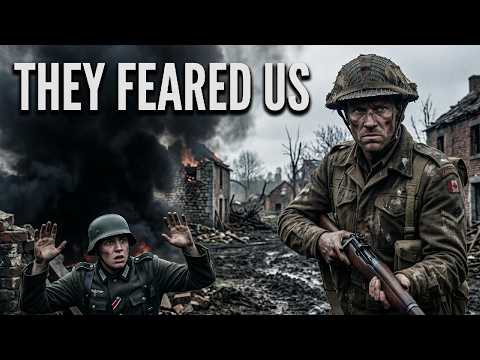
In the popular imagination, Canada is a nation of polite apologies, gentle diplomacy, and an almost pathological commitment to peace. But during the two deadliest conflicts of the twentieth century, the sight of a maple leaf on a soldier’s shoulder sent a very different shiver down the spine—one of pure, primal fear. German soldiers who faced the Canadians in the trenches of World War I and the hedgerows of Normandy did not see peacekeepers. They saw something far more terrifying: an enemy that fought with a ferocity that defied all military convention.
What did the Germans whisper about the Canadians when they thought no one was listening? The answer, preserved in declassified interrogation transcripts and captured letters, reveals a reputation so fearsome that it altered the course of battles.
The transformation began in the blood-soaked spring of 1915, during the Second Battle of Ypres. When a green cloud of chlorine gas rolled into the French lines, panic ripped through the colonial troops. But the Canadians—farmers, loggers, and factory workers turned soldiers—held their ground. They urinated on handkerchiefs, tied them over their faces, and counterattacked through the choking poison. The breach was sealed, and a legend was born.
From that moment, the Canadian Corps was no longer a colonial afterthought. Under the meticulous command of Sir Arthur Currie, they became the shock troops of the British Empire. At Vimy Ridge in 1917, they did what the French and British had failed to do at a cost of over 100,000 casualties—they took the ridge in just four days. The Germans took note: when the Canadians appeared on a sector, an offensive was imminent. Allied commanders even used Canadian troops as decoys, moving small detachments to fool the enemy while the main force struck elsewhere.
But it was the night raid that truly broke the German psyche. Refusing to endure the stalemate of trench warfare, Canadian soldiers blackened their faces, stripped away clanking gear, and crawled into no-man’s-land armed not with rifles but with trench clubs, brass knuckles, and sharpened entrenching tools. They slipped into German trenches like ghosts, silently eliminating sentries, tossing explosives into bunkers, and vanishing before an alarm could sound. The psychological toll was devastating. German front-line units opposite the Canadians suffered from chronic sleep deprivation and paranoia. One captured letter from 1918 read: “We have no rest from these Canadians. They do not fight like regular soldiers. They creep like ghosts in the mud and slaughter us in our sleep.”
That reputation followed the Canadians into the next war. When the 3rd Canadian Infantry Division stormed Juno Beach on D-Day, they pushed further inland than any other Allied force on the first day. Then they ran headlong into the fanatical 12th SS Panzer Division Hitlerjugend—and the fighting turned savage. After SS troops executed Canadian prisoners at Ardenne Abbey, the Canadians responded with a merciless fury that shocked even veteran commanders. Through the hedgerows of Normandy, they hunted SS positions with bayonet charges and relentless tank assaults, shattering the enemy’s elite units.
In the interrogation camps after the Falaise Pocket, German POWs spoke with eerie consistency. “The Americans are predictable,” one major said. “The British are methodical. But the Canadians are completely fanatical. They do not stop when they take casualties.” Another sergeant admitted: “We were told the Canadians take no prisoners. When we saw the maple leaf, we knew we had to fight until our ammunition was gone.”
The irony is stark. The nation that today embodies quiet diplomacy once produced soldiers whose very name made the German High Command shudder. But how did this transformation happen? And what did the Canadians themselves believe they were fighting for?
To understand the answer, you have to look at who these men were before they put on a uniform. The Canadian Expeditionary Force of 1917 was not a caste of professional warriors. It was a cross-section of a young, rugged, and sparsely populated country—miners from Nova Scotia, lumberjacks from British Columbia, prairie farmers who could shoot straight before they could shave. They brought with them a frontier pragmatism that had no patience for the rigid etiquette of European warfare.
British officers initially despaired at their informality. Canadians saluted sloppily, questioned orders, and treated rank with a casualness that scandalized the Old World. But that same irreverence translated into a battlefield advantage: they thought for themselves. When a plan was stupid, they improvised. When a position was hopeless, they found another way. They fought like men who had something to prove—and nothing to lose.
There was also a darker engine driving them. Many of these soldiers were first- or second-generation immigrants from the British Isles, and they carried a fierce, almost tribal loyalty to the mother country. But more than that, they carried the memory of Ypres—of comrades choked to death in the gas, of friends buried alive in the mud. The Canadians did not fight for glory. They fought for the man beside them, and they fought with the cold fury of people who had seen too much.
That fury found its purest expression in the trenches of 1918, during the final Hundred Days offensive. By then, the Canadian Corps had become the spearhead of the Allied advance—a unit so reliable that Field Marshal Haig moved them from one hot spot to the next like a fire brigade. In the last three months of the war, the Canadians advanced farther and captured more prisoners than any other Allied formation. German commanders began to refer to them simply as “the storm troops of the British Empire.”
But the cost was staggering. By the armistice, nearly one in seven Canadian soldiers who served had been killed—a proportion higher than almost any other Allied nation. The country of eight million had poured its sons into the meat grinder, and the survivors came home changed. They had learned something about themselves that peace could not easily erase.
When the Second World War began, that knowledge was not lost. It was passed down. Veterans of the Great War trained the new generation, and the old stories—of gas, of Vimy, of night raids—became the founding myths of a new Canadian army. They entered the fight with a reputation already carved in stone, and they were determined not to tarnish it.
But the war they faced would demand something new. The fanaticism of the SS, the brutality of the Eastern Front veterans, the desperate defense of the Reich—these would test whether the Canadian fighting spirit could adapt and endure. And in the orchards and polders of Northwest Europe, the answer would be written in blood once more.
The first test came in the flooded polders of the Scheldt Estuary, a sprawling, miserable landscape of mud, water, and death that the Germans had turned into a fortress. The task of clearing the approaches to the vital port of Antwerp fell to the First Canadian Army in the autumn of 1944, and the conditions were almost beyond human endurance. Soldiers fought waist-deep in freezing, contaminated water, with no cover, no dry ground, and no chance of retreat. The Germans had flooded the entire region, and every dike, every pillbox, every ruined farmhouse was a killing ground.
The fighting was slow, grinding, and utterly without mercy. Canadian infantry advanced across open mud flats under relentless artillery fire, wading through canals under the guns of fortified positions that had to be reduced one by one. The Germans, who had been ordered to hold the estuary at all costs, later admitted that the Canadians simply refused to be stopped. Where other formations might have paused to regroup, the Canadians kept pressing, accepting horrific casualties rather than giving the enemy a moment to breathe.
One captured German officer from the 64th Infantry Division told his interrogators something that Allied intelligence officers had begun to hear with striking regularity. “We were told to expect the British or the Americans,” he said. “We prepared for them. But when we learned it was the Canadians coming, morale collapsed. My men knew what it meant. It meant there would be no rest and no mercy.”
What made the Canadians so different? Part of the answer lay in their officers—men who led from the front rather than from behind, who shared the same rations and the same risks as their troops. Canadian commanders were expected to be visible, aggressive, and utterly indifferent to their own safety. This bred a culture of initiative that the rigid German command structure could not easily counter. When a Canadian platoon was cut off, it did not wait for orders; it attacked.
But the deeper truth was cultural. These were men from a vast, unforgiving land where self-reliance was not a virtue but a necessity. They had grown up hunting, trapping, and working in isolation, and they brought that same solitary toughness to the battlefield. They did not need to be told to fight; they needed only to be pointed at the enemy.
By the time the Scheldt was finally cleared in early November, the Canadians had suffered nearly thirteen thousand casualties. But they had opened Antwerp, a lifeline that would sustain the Allied advance into Germany. The Germans, once again, had learned the price of standing in their way.
And yet, the most personal testimony of all came not from generals or strategists, but from ordinary German soldiers. In the weeks after the Scheldt, captured letters and diary entries were collected by Allied intelligence. One entry, written by a young German corporal, was translated and filed away with a single line that seemed to capture everything: “If you hear the Canadians are opposite you, dig deeper, pray harder, and do not expect to see the morning.”
That reputation did not fade with the guns. In the decades after 1945, as Canada remade itself into a middle power and peacekeeping champion, the old stories were folded away like uniforms in a trunk. But the men who had been there never forgot. They knew what the maple leaf had meant in the dark, and they carried that knowledge quietly, the way a veteran carries a wound that never fully heals.
Historians would later debate how much of the German fear was myth and how much was cold reality. But the transcripts, the letters, the diaries—they all pointed to the same conclusion. The Canadians had earned their reputation the only way it could be earned: by proving, again and again, that they would not break.
Today, the nation that once sent stormtroopers into the night now sends peacekeepers into the day. But the ancestral soul remains, buried deep beneath the polite exterior. And if the world ever forgets what that soul is capable of, it need only look to the old battlefields, where the ghosts of German soldiers still whisper a warning across the years.
So the next time you see a Canadian apologize for bumping into you on the street, remember: somewhere in the blood, there is a night raider with blackened face and a trench club, waiting.
What do you think—does a nation’s history of ferocity leave a permanent mark, or can it truly be buried beneath generations of politeness? Share your thoughts in the comments below.
Report this article
Select a reason for reporting:






