Spring, 1942. On an island off the coast of Georgia—once called the most inaccessible club in the world—a carriage driver named Charlie Hill helps the daughters of the family he serves pack their winter home. But this is the last winter. He has served this island for 51 years, and now its season has ended early. The workers have gone to the armed forces and to the shipyards in Brunswick. As one museum curator who studies its history puts it today, without their services the club could no longer continue. Three days later, German torpedoes struck ships off the coast. A story would spread that a president ordered the millionaires to leave. So who really emptied Jekyll Island, and who had always kept it full?
If stories like these about the ultra-wealthy and the people who ran their world are why you’re here, I hope you’ll subscribe to the channel. There are more doors to open, and I’d like you to be with me.
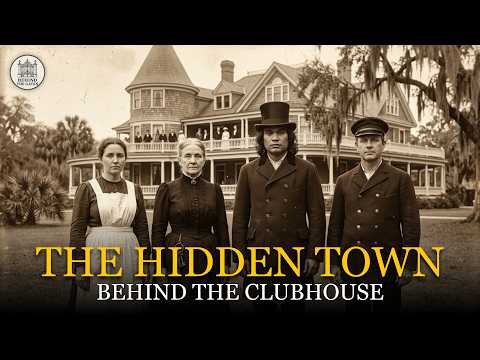
The island was sold with its pigs. Long before it was called a club, Jekyll Island was land that someone else was forced to work. Located off the coast of Georgia, it is a barrier island of about 5,700 acres, bordered by the Atlantic Ocean on one side and a vast salt marsh on the other. Across that marsh lies the port of Brunswick.
Native peoples lived on the island for thousands of years, since about 2,500 BCE. When the Spanish came, they called it Whale Island. In 1733, James Oglethorpe gave the island a new name. He named it after Sir Joseph Jekyll, a financial backer of the new colony of Georgia. From the beginning, the island bore the name of a patron.
Soon a man named William Horton acquired 500 acres there for one pound and one shilling, and by his account, he found the land very rich. He built a house there. In 1742, the Spanish burned that house. A year later, Horton rebuilt, this time using a concrete material called tabby. The ruins of that second house still stand on the island today.
Then came the Dubignon family. Christophe Poulain Dubignon was a French privateer. His family came to the island in the 1790s, and by 1800 the entire island belonged to him. He grew Sea Island cotton. The fields were worked by enslaved people. In 1814, 28 of them left with the British as free people. They represented nearly half the enslaved workforce on the plantations. Dubignon later complained, saying his house was plundered four different times by the said British.
The island was, even then, a place where work was done by people whose names were rarely recorded. Its darkest period came in late November 1858. A yacht called the Wanderer, converted for the slave trade, arrived with 487 African captives on board. 78 of them died on the way. 409 were landed on Jekyll Island. Henry Dubignon, the son, had arranged the landing—he owned the island and was part of the scheme from the beginning. In 1860, a federal jury in Savannah acquitted the defendants. The Wanderer shipment was one of the last shipments to enter the country at all.
The island was used again, and the people who paid the price for its use were not asked. Today, a path on the island marks the landing site. It is called the Wanderer Memory Trail, and it has been listed by UNESCO’s Slave Route Project as a site of memory.
In 1863, the island was divided among the Dubignon heirs. John Eugene Dubignon, a descendant of the privateer, inherited no claim because his father had died before the division. He wanted to reclaim it anyway. Between 1879 and 1885, John Eugene Dubignon bought the island piece by piece, all four parts, until it was whole again in the hands of one man. He built himself a cottage there in 1884, but he was planning something bigger than just a house.
His sister Josephine had married a man named Newton Finney, a man from Wisconsin who worked for the U.S. Coast Survey. Together they saw what the island could become: a winter retreat for the richest men of New York, and a fortune for whoever sold it to them. They were not the only ones circling it. According to one account in the club’s own history, a man named John Claflin almost bought the island for himself. When Dubignon explained it was intended for a club, Claflin was said to have released him from completing the sale.
The island had become too valuable to be owned by one man any longer. It was meant to belong to an association. The math was stunning. Dubignon bought the last parcels of the island for less than $8,000. On February 17, 1886, Finney, on behalf of a new club, agreed to pay $125,000 for the entire island. The price included everything that walked or flew on the island. The agreement included 400 head of cattle, 100 horses, 600 pigs, and all manner of birds and game.
Put the numbers side by side, and the shape of the deal becomes clear. Less than $8,000 had been enough to gather the last pieces. $125,000 bought the whole island. The land came with 400 cattle, 100 horses, 600 pigs, just like furniture left in a house for sale. And behind that price was a plan to finance it. 100 shares at a par value of $600 per share. Two shares per man, for 50 men who were able to spend their winters wherever they wished.
Dubignon kept a foothold for himself. He joined the club himself, and its historians call him the only original member from the South. His cottage remained on the island, though not where he built it. In 1896, the need for his land for a new building, San Souci, arose, and mules moved the old owner’s house out of the way.
The owners of the island had changed before. Now it was sold whole, including the animals, to men from New York. They would come only in winter and for a few months, and they expected to find everything ready. An island where enslaved people had worked, then where cattle and pigs had grazed, was about to be asked for something new. It was to be asked to look comfortable and unpretentious.
That meant they needed more than just an island. They needed a clubhouse grand enough to receive them, and walls of water wide enough to keep others out. A club building built to keep strangers outside.
Newton Finney had not seen cold weather in 11 years, and when he finally went north again, he thought he would freeze. He said so himself. He said: “I thought I would freeze, for I had not seen cold weather in 11 years. You know, I have always been in the South during the winter while working on the Coast Survey.”
Finney was from Fond du Lac, Wisconsin. He had sought an appointment to West Point. He worked for the U.S. Coast Survey from 1857 to 1860. He came out of the war years with a fortune estimated at over $200,000. Later, he entered into a business partnership with a man named Oliver King. Finney realized what a rich man might desire in a northern winter. So Finney and King went looking for them where these men gathered, at the Union Club in New York.
Their offer was simple. The club’s historians described the new members as men longing to escape the New York winter. One of them was Henry Hyde of the Equitable Life Assurance Society. When the invitation reached him, he replied with one bright sentence. “It sounds like a fairy tale. I will be happy to join.”
The fairy tale filled quickly. 53 men signed as original members. Their petition for a charter made clear what the club intended to do. Cattle, birds, and game would be raised. Its members would hunt and fish and sail. It would maintain a race track and build a private clubhouse.
In May 1886, a committee went to inspect the purchase and reported that the island was very satisfactory and full of game. A month before that, on April 4th, the public was informed of the establishment of an association of wealthy gentlemen. The club chose Lloyd Aspinwall as its first president, but he died a few months later. Henry Howland took his place and led the club through its first decade until he stepped down in May 1897. The men who founded the island were already learning that its fate depended on loyal leaders, and that those leaders could be lost suddenly.
Then construction began. In mid-August 1886, workers laid the cornerstone for the house that would stand at the heart of everything. The architect was Charles Alexander of Chicago. The landscape designer was Horace Cleveland, who divided the land into 50 lots, one for each pair of original shares. Members could lease a lot and build on it, but first there had to be a house for everyone.
Alexander drew the plans in the Queen Anne style. A turret rose at one corner. A veranda wrapped around the walls. The design was deliberately uneven, a house that refused to be symmetrical. His drawing appeared in the January 1887 issue of American Architect and Building News, and by the end of that year the building was complete. Alexander did not live long to enjoy it. He died the following May in his hotel in Chicago.
This is the house as its first members found it. It was built at a cost of $45,000. 93 fireplaces were installed in its walls. Its ceilings rose to 12 feet in some rooms and 15 in others. Ionic columns stood in the dining room. The walls were paneled in oak, and the windows were fitted with leaded stained glass. Outside, 50 lots awaited the cottages that would be built later. Inside, the house needed fuel and linens, cooks and waiters before its first member could sit in it.
Someone had to make the island ready to receive them. For the opening season, the club appointed one of its members, Richard Ogden, as manager. According to one account from the club’s history, his list of tasks reads like the taming of a wild place. He had to dispose of wild stallions and large numbers of wild pigs. He had to grade roads and drain ponds. He had to stock the woods with quail and pheasant, erect buildings, and plant crops. The island the members bought came with its animals. Now, those animals had to be sorted into what would be eaten, what would be hunted, and what would be disposed of.
On January 21, 1888, the club officially opened. The first signature in the register was Henry Howland’s. The island was still spelled “Jekyll” with one L in those days, and it remained so until 1929. That first season ran from late January to mid-April. By March, more than 200 members and guests had arrived with their maids, valets, and children.
They arrived in style. According to one account drawn from the club’s history, the Rockefellers arrived on March 2nd. On March 31st, the Vanderbilts’ yacht Alva arrived. The club building, which no one had occupied before, was now alive with the sound of trunks on the stairs and orders in the halls. The island tasted for the first time what it would become: a place that slept most of the year and woke suddenly for the rich.
They loved what they found there. One manager, Thomas Clark, described the atmosphere as homey and the food as that of a private home. That was the effect the club wanted. It was a hotel in size and a private home in style. The man who ran the place expressed it clearly. Ernest Grob wrote that the club was run on the system of a large country house more than a hotel. A country house consists of a family and a staff. The family sees the fires lit and the table set upstairs. The staff sees the hours it took downstairs. Jekyll had both, and from its first winter it was built so that one rarely saw the other.
But a country house also needs a gate. A private island needs something more precise than a gate, because the sea is open to anyone with a boat. It needs rules, and the rules the Jekyll Island Club began writing defined for more than half a century exactly who was allowed to step onto its dock.
The richest club had rules for everyone. A letter arrived for the manager from Murfreesboro, Tennessee, and Ernest Grob’s reply was polite and firm. The writer hoped to visit. Grob explained that Jekyll was a resort for recreation and rest, and that only members and their guests were permitted to dock.
Ernest Grob had come to the club as an employee and rose to become manager. His salary rose to $200 a month, and by 1898 it reached $250. For nearly four decades, he stood between the members and the island, enforcing their rules, answering their complaints, and overseeing the arrangements that ensured their comfort. Little is known of his origins. All that remains are his letters, and in them he appears as a man who understood that preserving the traditions of the place depended on his ability to say no.
The rules began at the gate of membership itself. Money alone was not enough to open it. The club’s historians write that one could not simply buy one’s way into the Jekyll Island Club. A sponsor was necessary. The candidate was voted on by the board, and two blackballs were enough to exclude him.
Guests had their own rules too. The club called them “strangers,” and a stranger’s stay was limited to two weeks. By 1900, guests were barred from the club after February 20th except by special invitation of the executive committee. The club’s 1911 booklet described membership as limited to 100 members, and the clubhouse accommodated 100 guests. The number of people allowed to enjoy the island was kept deliberately small.
Membership required paying money each year, in addition to the initial cost. Annual dues were $100 at first. Under the 1901 constitution, they rose to $300 and later to $500. That constitution allowed women to become members, a provision the club saw as necessary since there were already female members. Not every officer approved of women in the bar. The treasurer, Frederick Baker, objected to allowing women to stand and drink at the bar, calling it against club rules and improper.
Even the animals had rules. Members were not allowed to keep their dogs inside the club building. They were housed with the gamekeeper. Any bird or deer a member shot had to be turned over to the club. Dinner had its own system too. Members had reserved tables and wore evening dress. According to one historian’s account, women wore a different dress for dinner every night. Men wore evening suits. After dinner came cards and billiards.
Meanwhile, the empty land began to fill. By the end of 1892, six private cottages appeared on the tax records. One was Hollybourne, built for a civil engineer named Charles Stewart Maurice, and it was ready by December 1890. The Maurice family was perhaps one of the few families that kept its membership throughout the club’s existence. Another cottage, Indian Mound, was built by Gordon McKay and later bought by William Rockefeller. The colony continued to grow for years.
Moss Cottage was built in 1896. Its veranda was decorated with seashells, and it was later owned by Everett Macy. In 1900, Henry Kirke Porter of Pittsburgh built Mistletoe, designed by architect Charles Allen Gifford, the same man who designed the club annex. Dr. George Shrady, a surgeon once consulted in the care of Ulysses S. Grant, acquired a cottage called Cherokee in 1905, with 22 rooms and eight baths. Frank Goodyear commissioned Carrère and Hastings, and his cottage was completed around 1906. Each one contributed to the town works that guests never saw.
In 1896, Henry Hyde organized something new. Six members united to build San Souci, a building with six private apartments under one roof. It was called one of the first condominiums in the country. In its attic were 12 servants’ rooms. The owners guarded the tranquility of the place very carefully. When prospective buyers with small children applied, they were rejected. Taylor Davis of the Jekyll Island Authority today explains: “They didn’t want to see children running in the halls.”
The partners were careful about adult men too. They rejected Marshall Field because they said he would not be a cheerful social person. The last of the six partners was banker John Pierpont Morgan. Legend later credited him with building the entire building. The club’s historian states clearly that, contrary to myth, he was not responsible for its construction.
When one puts a cost to this life, the numbers began to rise steadily. Annual dues rose from $100 to $300, then to $500. Hollybourne cost $19,100 to build. In 1904, James J. Hill bought a furnished apartment in San Souci for $13,000. In 1901, the club added an annex to the clubhouse with eight apartments and 20 additional bedrooms, and its cost exceeded the initial estimate of $60,000.
The men at the top cared for the place with something close to devotion. Henry Hyde, who had called the invitation a fairy tale, later wrote: “If I had any doubts about Jekyll Island, they have vanished. This is the place for me.” When Charles Lanier hesitated to take the presidency, Hyde pressed him hard. He wrote: “If Mr. Lanier declines for the second time, I will think he has treated me very badly.” Lanier was elected unopposed in May 1897 and led the club until 1914, its golden years.
What were they buying? The historian John Hall McCash, who wrote the club’s history, offers an answer. She says: “They looked at Jekyll as a place where they could shed formality and relax. They still wore the finest clothes, but they truly believed they were living their simple life there.”
A simple life with dresses changed every night, and a manager who turned away strangers with a letter. The club’s fame grew to match its wealth. It was said, and is still said on the island, that its members together owned one-sixth of the world’s wealth. No one ever documented that figure, and the club’s own historians record a more modest claim of one-seventh of the nation’s wealth. It was the kind of number that sticks to a place like this, and it would one day become part of the story of the club’s end.
But in 1904, the end seemed impossibly far away. That year, Munsey’s Magazine looked at the small island off the Georgia coast and described the Jekyll Island Club as the richest, most exclusive, and most difficult club in the world to reach. Every rule the members made was designed to keep people out. Yet there was one group they could not keep away, because without them the island could not function for a single morning. They were never members. Most were never guests. And every winter, before the first private train car reached Brunswick, they were already on their way.
Two kinds of servants crossed the water. Each year, according to one account, in late December or early January, the island’s other residents arrived first. That account, drawn from the club’s history, describes their flow through the coastal town of Brunswick and their boarding of the club’s steamer for the crossing. It adds that shortly after the servants arrived, the industrial magnates and their families followed. The order mattered. A house occupied by its owners only three or four months a year cannot simply open its doors on the morning of their arrival. The island had to wake before its masters opened their eyes upon it.
Some of the servants came by sea along the coast. A plaque on the island indicates that steamers of the Mallory line carried club staff and various personal belongings, including carriages, horses, and hunting dogs. Imagine what that meant. Carriages, horses, and hunting dogs traveled by ship along the coast, so that families would feel that a few winter weeks on a Georgia island were exactly like home.
The workforce that gathered there was of two kinds. The Island Magazine explains that at first, two types of servants worked on the island. The first type traveled south with the wealthy families. It says they were personal assistants, mostly of European origin, usually Irish or German, who met many specialized needs, from valets to hairdressers. According to the island’s museum curator, one family was said to have brought with them a person whose only described duty was “jewelry carrier.” The second type came from much closer. The magazine adds that the rest of the island’s workers came from the nearby mainland, mostly from the Brunswick area. The vast majority of them were African American. By the 1930s, more than 77% of the club’s staff were Black. They worked for the club as sailors and janitors, gardeners and gamekeepers. And they worked for the families as cooks and servants, stable hands and valets. In total, the workforce was estimated in the hundreds—men, women, and children. Jobs ranged from servant and cook to driver, personal attendant, nurse, carpenter, and laborer.
Getting one of these jobs was not simply a matter of showing up. Andrea Marroquin, the curator, expresses it this way. It was not only members who needed a suitable bank account, relatives, and acquaintances to enter the island. The same applied to the staff. The gate worked in both directions. It kept out strangers with money and screened the people who came to work.
The members’ own journey was easier. Most traveled south in a private train car, according to one account, arriving at the busy port of Brunswick in their own cars on the rails. From the Brunswick waterfront, the club’s boats took over. The steamer Howland, dating from about 1887, carried passengers across the water. So did the steamer Jekyll Island, which the island’s records describe as 84 feet long, while an old plaque gives it as 100 feet. Accounts differ. There were smaller launches too. One, the Kitty, was named for Kitty Lawrence, the niece of Charles Lanier. Another, registered as Sybil or Sylvia, was 45 feet long according to one plaque, and named for Sybil Brewster. When not needed, a rotary crane pulled them out of the water.
The crossing itself expressed everything in the island’s design. There was no bridge in those years. Every person, trunk, and horse that reached Jekyll came over the water, on the club’s boats or on a yacht the club allowed to dock. The club’s rule that only members and their guests could land was enforced by the simplest wall in the world: a stretch of salt water, and the question of who owned the boats.
After the passengers came everything else. Barges carried luggage, supplies, and livestock across the marsh. In 1900, the first automobile reached the island the same way. Carried on a barge like a crate of oranges. Some members did not need the club’s boats at all. They arrived on their own yachts. The largest of them could not approach the dock. They anchored in the channel, and smaller boats ferried the owners ashore. John Pierpont Morgan’s yacht, the second Corsair of that name, was 304 feet long, too large ever to dock at the island.
Count the people the island needed, and the scale of this enterprise becomes clear. Hundreds of workers came and went each winter—men, women, and children. In the 1930s, 77 out of every 100 club employees were Black. In that first March of 1888, more than 200 members, guests, maids, valets, and children had arrived. By 1911, the clubhouse alone accommodated 100 guests, and one boat captain served the club for over 40 years. His name was James Clark. An old historical plaque describes him as “boat captain and summer manager of the Jekyll Island Club for over 40 years.” In summer, when the members left for the north, he stayed to manage what remained. Over time, the club built a house for him and his wife directly behind the clubhouse.
One of the men who stayed the longest arrived early in the club’s life. In 1891, the Maurice family of Hollybourne hired a man named Charlie Hill to drive their carriage and guard their property. He worked on the island for 51 years. Over time, his entire family became part of the island’s service. His wife, Angie, worked as a laundress for the Maurice family. His brother tended the grounds. His nephew, Earl, worked as a golf caddie. One island tradition holds that Charlie Hill was the one who drove the first group of millionaires to inspect the island before its purchase. That was years before the Maurice family hired him, and it is best treated as a handed-down tradition. But what is certain is that he was the Maurice family’s driver, and that he stayed for half a century.
Food arrived with the same care as people. The Island Magazine notes that the best chefs were brought from New York restaurants for the winter, and some members were served by personal waiters. Butter came from as far away as Tennessee. Members seated at their reserved tables in evening dress ate meals planned, transported, and cooked by people who came from hundreds of miles away to make the meal look effortless.
In those weeks, the island came alive from bottom to top. First the steamers and barges, then the cooks and servants and valets and hairdressers, then the carriages and horses and dogs. And only then did the private rail cars arrive in Brunswick, the owners step toward the dock, and the clubhouse prepare as if it had been waiting for them all year. In truth, it had been waiting for the people who would light it up. And once those people reached the shore, they did something the guests barely noticed. They disappeared. They took paths that were not meant for guests’ carriages, heading to a part of the island that was a small town of their own.
They disappeared into a town the guests never saw: about 120 buildings along Feeding Road, a general store, a school, and the ten red-roofed houses of Red Row. At noon, the work supervisor rang a bell, and the island’s other world came to eat.
But by 1942, the bell rang for fewer and fewer hands. The workers had gone to the shipyards and the armed forces. Without them, the richest club in the world could not open for a single morning. The season ended early, three days before German torpedoes struck the coast.
The millionaires left expecting to return after the war. They never did. In 1947, Georgia took the island by condemnation for $675,000 and opened it to the public. Charlie Hill, who had served 51 years, lived until 1974, long enough to see the gates finally open.
So the club was not emptied by a president’s order or a submarine’s torpedo. It was emptied by the people who lit its fires, cooked its meals, and rang its bell.
If you could ask one person who kept Jekyll Island running just one question, what would it be?
Report this article
Select a reason for reporting:






