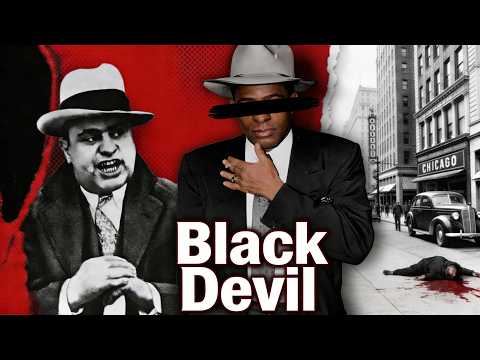
Al Capone ruled Chicago with an iron fist, his name striking fear into the hearts of even the most hardened criminals. But there was one man he refused to cross—a black gangster on the Southside whose reputation for ruthless violence and unwavering loyalty made even Capone think twice. This is the story of Teddy Roe, the only man Al Capone was afraid of.
In the 1930s, Chicago was a city divided by race and power. The Southside, known as Bronzeville, was a thriving black community with its own underground economy fueled by the policy game—a street lottery that generated millions. While Capone controlled bootlegging, gambling, and unions, he steered clear of the Southside. Why? Because Teddy Roe, a sharecropper’s son with a sixth-grade education, had built an empire from nickels and dimes and wasn’t about to let anyone take it.
Roe was a man of contradictions: he could sew a custom suit by hand and shoot a man between the eyes without flinching. He paid hospital bills for the poor and beat cheaters unconscious. He carried a loaded revolver every day of his adult life and had a temper that exploded without warning. His crew included off-duty police officers, and his reputation was so fierce that Capone’s scouts returned with a simple message: the Southside was not worth the blood.
But Capone’s restraint didn’t last forever. After his downfall, a new generation of mobsters saw the Southside’s $25 million-a-year policy racket as ripe for the taking. They kidnapped Roe’s boss, demanded a street tax, and watched as one by one, the policy kings fled or surrendered. Everyone except Teddy Roe. He didn’t just refuse—he expanded, absorbing abandoned territories and daring the mob to come for him.
What followed was a six-year war that shocked the underworld. Roe survived bombings, shootouts, and a kidnapping attempt, killing a made man in self-defense and beating the murder charge. The mob offered him $250,000 to walk away; he said he’d die first. And when cancer finally claimed him, he sent his bodyguards home, dressed in a three-piece suit, and walked out his front door—where hitmen were waiting.
Teddy Roe died in a hail of gunfire, but his legend only grew. Twenty years later, the mob boss who ordered his murder was caught on wiretap saying, “I’ll say this, black or no black, that bastard went out like a man. He had balls.” It was the only time in mafia history a boss admitted a black man was tougher than his entire organization.
But the story doesn’t end with a funeral procession or a wiretap confession. It ends with something far more dangerous to the outfit’s legacy: a paper trail. Because in the years after Roe’s death, as the Italian mob consolidated its grip on the Southside, something unexpected surfaced in the archives of the Chicago Police Department’s vice squad.
A detective named Frank Callahan had spent the summer of 1951 keeping a private file. Not on Roe—on the outfit’s men. Callahan was one of the rare cops who hadn’t been bought, and he had watched the war between Roe and the mob with a mixture of horror and fascination. He documented everything: the license plates of the cars that followed Roe’s sedan, the names of the men who rented the apartment across from 5239 South Michigan, the shell casings recovered from the street after the kidnapping attempt that ended with a made man dead.
Callahan’s file sat in a drawer for two decades. Then, in 1972, a young reporter for the Chicago Defender named Alice Whitfield got a tip. A retired detective wanted to talk. Callahan met her in a diner on 47th Street, slid a manila envelope across the table, and said five words that would change how the city remembered Teddy Roe: “They didn’t just kill him. They erased him.”
Inside the envelope were surveillance photographs. Grainy, black-and-white, but unmistakable. Three men sitting in a parked car outside Roe’s mansion on the evening of August 4, 1952. Callahan had identified all three. One was a low-level outfit driver who had flipped on his bosses years later. The second was a police sergeant who had been on the mob’s payroll since the Capone days. And the third—the man in the passenger seat, holding what looked like a shotgun barrel against the window—was the brother of the made man Roe had killed in the street.
Whitfield published the story in a three-part series. The reaction was immediate. The outfit’s lawyers threatened the paper. The police department denied the file existed. But the photographs were real, and the city knew it. For the first time, the murder of Teddy Roe had a face—three faces, in fact, staring out from a grainy photograph taken by a cop who had refused to look away.
What Whitfield uncovered next was worse. The outfit hadn’t just taken over the policy game after Roe’s death. They had systematically dismantled the community institutions that Roe had built. The funeral homes he had funded were bought out. The churches that had received his donations were pressured to stop mentioning his name. The hospital wing he had paid for was quietly renamed. Within a decade, a generation of Southside children had grown up not knowing who Teddy Roe was—only that the numbers game belonged to men who didn’t live in their neighborhood.
But the money told a different story. In 1975, a federal audit of the outfit’s operations revealed something staggering. The policy racket that Roe had once controlled—the nickels and dimes from Bronzeville’s poorest residents—was now generating $150 million a year. And not one cent of it was staying in the community. The banks that had once cashed policy winnings were gone. The black-owned businesses that had thrived on Roe’s protection had been replaced by storefronts with Italian surnames on the leases.
Whitfield’s final article ended with a quote from an elderly woman who had known Roe personally. She was ninety-three years old, living in a cramped apartment on South Prairie Avenue, and she still played the numbers every week. “Teddy used to say the Southside was ours,” she told Whitfield. “He meant it. He meant every word. And when they killed him, they killed more than a man. They killed the idea that we could keep anything for ourselves.”
The reporter never won a Pulitzer. The story was too uncomfortable, the truth too close to the surface of a city that preferred to forget. But the file that Frank Callahan had kept in his drawer didn’t disappear. It was donated to the Chicago History Museum in 1989, catalogued under a bland title—”Vice Squad Records, 1950-1955″—and largely ignored for another thirty years.
Then, in 2019, a graduate student named Marcus Bell was researching the history of black-owned businesses in Bronzeville when he pulled the file. He found the photographs. He found Callahan’s notes. And he found something else—a single sheet of paper, handwritten, dated August 5, 1952, the morning after Roe’s murder. It was a list of names. The names of every policy operator who had fled Chicago when the outfit came for them. Beside each name, Callahan had written a single word: “Alive.”
At the bottom of the page, in different ink, Callahan had added a final line. “Roe stayed. Roe died. The rest of them lived. That’s the difference between a businessman and a king.”
Marcus Bell sat in the museum’s reading room for three hours, staring at that single sheet of paper. He had come looking for storefront ledgers and tax records. He had found a ghost.
He photographed the file, page by page, and drove back to his apartment on the North Side with the windows down, the city sliding past him in the dark. He kept telling himself it was just history. A dead gangster. A dead war. But the names on Callahan’s list kept surfacing in his mind—men who had run, men who had lived, men whose grandchildren probably still walked the same blocks.
The next morning, he called his advisor and asked a question that had nothing to do with his thesis. “What happens to a neighborhood when you take away the money it built itself on?”
His advisor, a historian named Dr. Evelyn Cross, was silent for a long moment. Then she said something Bell would remember for the rest of his career. “You’re not asking about economics, Marcus. You’re asking about a wound. And wounds like that don’t heal—they scar over. The scar stays.”
He spent the next six months tracking down the descendants of the men on Callahan’s list. Most of them had never heard the name Teddy Roe. Some had heard it whispered, a half-remembered story passed down at funerals and family reunions. But one name led him somewhere unexpected.
Her name was Dorothy Mae Ellison. She was seventy-eight years old, lived in a brick bungalow on South Vernon Avenue, and when Bell knocked on her door and mentioned the name of her grandfather—a policy operator named Samuel Ellison who had fled to Detroit in 1947—she didn’t look surprised. She looked tired.
“I know who you’re talking about,” she said, before he had finished his sentence. “You’re talking about the man who ran. The one who left Teddy Roe to die alone.”
She invited him in. The living room was small and warm, crowded with framed photographs and a Bible on the coffee table. She poured him a glass of iced tea and sat down across from him, her hands folded in her lap.
“My grandfather never talked about Chicago,” she said. “Not once. He moved us to Detroit, changed our name from Ellison to Ellis, and if anyone asked, he said we were from Ohio. I didn’t find out the truth until I was forty years old and my mother was dying. She told me on her deathbed. She said, ‘Your grandfather was a gambler. He ran numbers for a man named Teddy Roe. And when the Italians came, he ran.'”
Bell asked her what she thought of Roe. She was quiet for a long moment, staring at the window, at the elm tree swaying in the afternoon heat.
“I think he was a fool,” she said finally. “And I think he was the bravest man in Chicago. Both things can be true.”
She told him something else, something that wasn’t in any file or newspaper archive. Her grandfather had received a letter, years after Roe’s death, from a woman who signed her name only as Carrie. Roe’s widow. The letter said that Teddy had never blamed the men who ran. He had understood. “He told me once,” the letter read, “that a man who runs from a fight he can’t win isn’t a coward. He’s a father. He’s a husband. He’s smart. The only thing I ever held against them was that they didn’t come back. Not for me. For the neighborhood. They took their money and they left us with nothing.”
Dorothy Mae kept that letter in a shoebox in her closet. She let Bell read it. He copied it by hand into his notebook, word for word, because she wouldn’t let him photograph it.
When he finished, she asked him a question that stopped him cold. “You’re writing about Teddy Roe. But are you writing about what he built, or just how he died?”
Bell didn’t have an answer. Not yet.
Bell left Dorothy Mae’s bungalow with the letter copied in his notebook and a question burning in his chest. He drove back to the museum and pulled Callahan’s file again—but this time he wasn’t looking for death. He was looking for what came before it.
What he found was a single ledger page in Roe’s own hand, tucked behind the surveillance photos. It listed loans—small amounts, never repaid. A hundred dollars to a barber. Fifty to a widow. Two hundred to a church deacon. Beside each entry, Roe had written one word: “Forgiven.”
Bell published his thesis a year later. The title was simple: The King Who Stayed. In the final chapter, he quoted Dorothy Mae Ellison one last time.
“Teddy Roe didn’t die for the numbers,” she said. “He died because he believed the Southside was worth more than his own life. Tell me—what would you have done?”
Report this article
Select a reason for reporting:






