December 1941. The world holds its breath as Japanese planes darken the skies over Pearl Harbor. But behind the roar of engines and the thunder of explosions, a quieter battle was already being fought—one for the minds and hearts of Japan’s soldiers. What did they truly think of the Americans they were about to fight? The answer lies buried in forgotten documents, propaganda posters, and the whispered fears of men pushed to the brink.
For decades, history has focused on how the West viewed the Japanese. But the reverse—how Japanese soldiers saw their American enemies—remains a shadowy corner of WWII. It’s a story of fear, loathing, and a desperate struggle to maintain honor in a war that would soon consume everything.
In the 1930s, Japan’s militarist government faced a crisis. The islands lacked raw materials—oil, iron, rubber—and the West’s grip on Asia tightened. When the U.S. cut off oil exports in 1941, Japan felt strangled. A military pamphlet from that year warned: “Slowly, bit by bit, like a man strangling his victim with a soft silk cord, America was blockading oil and steel to Japan.” This wasn’t just politics; it was a chokehold on a nation’s future.
Japanese propaganda painted the West as arrogant colonizers. “The English, French, Americans, and Dutch sailed to the Far East as if it were their natural right, terrified the culturally backward natives, and colonized every country in the region,” one booklet declared. Japan, by contrast, was portrayed as Asia’s savior, the only hope against white imperialism.
But fear lurked beneath the bravado. Japanese soldiers were taught that Americans were weak, cowardly, and lacked spiritual motivation. “Our opponents are weaker than the Chinese army,” another manual claimed. “They are extremely effeminate and very cowardly, hating to fight in rain, fog, or at night.” This wasn’t just propaganda; it was a coping mechanism. If the enemy was inferior, the war would be quick, the sacrifices bearable.
Yet the same documents reveal a deep-seated anxiety. “The Americans call themselves brave soldiers, but they have no desire for the glory of their ancestors or descendants,” one booklet sneered. “They, as individuals, only want to be known for bravery and gain fame. They fear death, but being individualists, they don’t think much about what happens after.” Such caricatures betrayed a grudging respect—and a fear that American individualism might be a strength, not a weakness.
As the war dragged on, the demonization intensified. Japanese propaganda depicted Americans as fiends, cannibals, and even madmen. A notorious illustration showed President Roosevelt as a demon. This dehumanization served a purpose: it made killing easier. But it also reflected a growing terror. If the enemy was truly monstrous, what did that make the soldiers who fought them?
The brutality of the Pacific War would soon shatter these illusions. Japanese soldiers discovered that Americans were not the soft, decadent foes of their training manuals. They fought with ferocity and technological might. And as the tide turned, the fear that had simmered beneath the surface erupted into desperation. The propaganda had worked too well—now the Japanese faced an enemy they had been taught to hate, but not to understand.
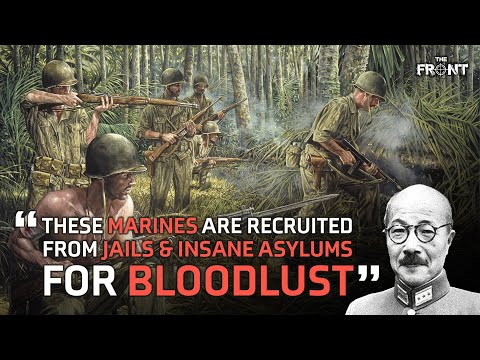
The letters captured on Guadalcanal told a different story. American Marines found diaries and notes on the bodies of dead Japanese soldiers, and what they read revealed a psychology far more complex than the propaganda suggested. One letter, preserved in Jerry Cutter and Jim Proser’s account of Sergeant John Basilone, described the Americans as “not ordinary troops, but Marines, a special force recruited from prisons and madhouses, bloodthirsty.” The writer wasn’t describing soldiers. He was describing monsters.
This wasn’t mere hatred. It was existential dread dressed up as contempt. If the enemy was inhuman, then defeat at their hands meant annihilation—not just of the body, but of the soul. Japanese soldiers had been raised on the bedrock of bushido, the warrior code that made surrender unthinkable. To be captured was to lose all honor, to become less than human. And now they faced an enemy they believed would show them no mercy, because they themselves would have shown none.
The propaganda fed on this fear. Japanese manuals insisted that Westerners were cowardly and effeminate, yet the same manuals betrayed a creeping admiration. “They fear death, but being individualists, they don’t think much about what happens after,” one booklet observed with disdain. But read between the lines, and you find envy. The American soldier fought for himself, for his own survival and glory—not for an emperor, not for ancestors, not for a divine mission. To a Japanese soldier bound by duty, such freedom must have seemed both terrifying and intoxicating.
Colonel Fred Borsch, an American officer who studied Japanese military psychology, noted the contradiction at the heart of this worldview. “Those who surrendered to the Japanese, no matter how bravely or honorably they had fought, deserved only contempt,” he wrote. “They had lost all their honor and were literally worth nothing.” This belief justified atrocities—beheadings, bayonet practice on bound prisoners, drowning—because the victims had already forfeited their right to dignity. But it also planted a seed of doubt. If surrender was the ultimate shame, what would happen when the tide of war turned against Japan?
The answer came slowly, then all at once. As American forces island-hopped across the Pacific, Japanese soldiers began to see the enemy not as decadent colonizers, but as an unstoppable force. The propaganda that had once bolstered morale now became a trap. Soldiers who had been taught to despise Americans as weak and cowardly found themselves facing a military machine of terrifying efficiency. The dissonance was unbearable.
Some responded with even greater ferocity, launching banzai charges into certain death rather than face the shame of surrender. Others, in the privacy of their diaries, began to question everything. One Japanese officer wrote of his confusion after capturing an American pilot: “He did not beg for his life. He did not tremble. He looked at me with calm eyes and asked for a cigarette. Is this the coward my training told me to expect?”
The dehumanization had worked both ways. Japanese soldiers had been taught to see Americans as demons, and Americans had been taught to see Japanese as vermin. But in the mud and blood of places like Guadalcanal and Okinawa, the abstractions crumbled. What remained was the raw, human terror of men who had been told to hate, only to discover that their enemies bled the same red blood.
The propaganda had promised a quick, glorious war. Instead, Japanese soldiers found themselves trapped in a nightmare of attrition, facing an enemy whose industrial might seemed limitless. The same pamphlets that had once mocked American cowardice now rang hollow. “We were told they would not fight at night,” one survivor recalled decades later. “But they came at night, with fire and steel, and they did not stop.”
This cognitive dissonance bred a strange, bitter respect. In diaries recovered from the Philippines and Iwo Jima, Japanese soldiers began to describe Americans not as demons or weaklings, but as something more unsettling: equals. One lieutenant wrote, “The enemy is not what we were taught. He is brave, perhaps too brave. He throws himself at our positions with a recklessness that borders on madness.” The admission, scrawled in a battered notebook, was never meant for anyone else’s eyes.
But the propaganda machine could not afford such honesty. As defeats mounted, the Japanese high command doubled down on dehumanization. Americans were no longer just cowardly—they were subhuman. Leaflets distributed to troops in 1944 depicted American soldiers as hairy, ape-like creatures with fangs and claws. “Do not expect mercy from these beasts,” the text read. “They will torture you, mutilate you, and display your corpse for their amusement.” The irony was staggering. Japanese soldiers had themselves committed such atrocities, projecting their own capacity for cruelty onto the enemy.
Yet even as the lies grew more extreme, the soldiers’ faith eroded. The same men who had been taught to despise American individualism began to envy it. “The American fights for his own life, not for a divine emperor,” one corporal observed in his diary. “And perhaps that is why he fights so well. He has something we have lost—a reason to live that does not require dying.” Such thoughts were dangerous, punishable by death if discovered. But they were written anyway, in tiny characters, buried in the lining of packs or sewn into uniforms.
By the time the war reached Okinawa, the psychological landscape had shifted entirely. Japanese soldiers no longer saw Americans as weak or cowardly. They saw them as relentless, methodical, and terrifyingly indifferent to their own casualties. “They do not stop for their wounded,” a sergeant noted with horror. “They do not weep for their dead. They simply advance.” To men raised on the ethos of mutual sacrifice, such cold efficiency was incomprehensible. It was also deeply demoralizing.
And yet, the old hatreds did not simply vanish. They curdled into something darker—a desperate, nihilistic fury. If the Americans were not the decadent weaklings of propaganda, then Japan’s defeat was not a temporary setback but an existential catastrophe. “We have awakened a sleeping tiger,” one officer wrote in the final months of the war. “And now it will devour us.” The same soldiers who had once mocked American individualism now feared it, because it had produced a war machine they could not match.
The letters and diaries tell a story of shattered illusions. But they also reveal something more uncomfortable: the propaganda had never been entirely believed. Even at the height of Japan’s victories, soldiers had written privately of their doubts. The caricatures of Roosevelt as a demon, the claims of American cowardice—these were not descriptions of reality, but incantations against fear. And when the incantations failed, what remained was a generation of men forced to confront the enemy they had been taught to hate, only to find themselves staring into a mirror.
The war ended, but the questions lingered. In the years after 1945, as Japan rebuilt and the world moved on, the diaries and letters of those soldiers became silent witnesses to a profound transformation. “We were taught to see demons,” one veteran confessed decades later, “but in the end, we saw ourselves.” The propaganda that had once dehumanized the enemy had ultimately dehumanized the soldiers themselves, trapping them in a cycle of fear and hatred that left deep scars.
Historians continue to debate how deeply these views penetrated the ranks. Some argue that most soldiers, especially by the war’s end, had abandoned the caricatures and simply fought for survival. Others insist that the indoctrination was so pervasive that it shaped their perceptions until the very last day. “The enemy was never just the enemy,” wrote one scholar. “He was a mirror reflecting our own darkest fears.”
What remains undeniable is the complexity of human psychology in wartime. The Japanese soldier’s view of the American enemy evolved from contempt to grudging respect to existential dread—a journey that mirrored the shifting tides of the Pacific War itself. And in that journey, we see a universal truth: propaganda can only sustain hatred for so long before reality shatters it.
So, what do you think? Were the Japanese soldiers’ views of Americans primarily shaped by propaganda, or did their experiences in battle reveal a deeper, more nuanced understanding? Share your thoughts in the comments below.
Report this article
Select a reason for reporting:






