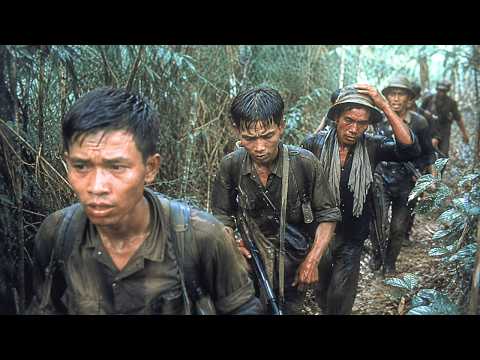
The jungle was alive with the worst kind of life. Heat hung at 35 degrees Celsius, never dropping, even at night. The air was so thick with humidity that breathing felt like drinking water. The ground was a soft, rotting carpet of dead leaves that stank of wet earth and slow decay. Sweat soaked into military uniforms within minutes and never dried.
This was Phuoc Tuy Province, February 1969. And five Australian men were about to enter it—men the jungle would never know were there.
By early 1969, the war in Phuoc Tuy was a stalemate. The 1st Australian Task Force held its base at Nui Dat with 12,000 soldiers behind wire and sandbags. But the jungle outside the wire belonged to the enemy after dark. The Viet Cong’s main force regiments, the 274th and 275th, along with the D445 Provincial Mobile Battalion, moved freely through that darkness. Intelligence estimated 5,000 to 7,000 enemy fighters operating in and around the province.
In neighboring provinces, American forces were launching massive search-and-destroy operations, pushing hundreds and sometimes thousands of men through the jungle at once. Those large sweeps pushed Viet Cong units sideways, and many slipped directly into Australian territory, making an already dangerous situation worse.
The Australians were trying to address this with large patrols. Infantry companies of 200 men or more would push through the jungle looking for the enemy. They rarely found anyone. Viet Cong fighters could hear the Australians coming from a kilometer away—sometimes more—and simply vanished into the deep trees. One SAS soldier later described those conventional operations as resembling a herd of water buffalo moving through the jungle. The enemy would wait, let the noise pass, then return to walking the same trail once it was gone.
The prevailing assumption was that more men meant more power. But the reality was that more men meant a bigger warning to the other side.
The five men about to change that belonged to the 2nd Squadron of the Australian Special Air Service Regiment. Their patrol commander was a sergeant who had already spent time fighting in the jungles of Borneo. He could read the forest floor the way most people read a page of a book. A broken twig at knee height told him a man with a rifle had passed this way. A scuff mark on a mossy trunk told him which direction that man had walked. Disturbed soil still glistening told him the footprint was fresh—no more than two hours old.
His team of four included a signaller, a medic who also served as forward scout, and two assault soldiers. Each had undergone the same brutal training. Every piece of metal on their bodies was covered in tape to prevent noise. Their food was cold rations eaten from plastic bags without lighting any flame. They wore no rank or unit insignia. Their faces were painted with green and dark brown that wouldn’t wash off in rain. Together, the five left less of an imprint on the forest floor than a single conventional infantry platoon.
Intelligence had identified a supply corridor. Signals intercepts and a village informant confirmed that elements of the D445 Battalion were using a specific trail junction deep in the jungle to move rice, ammunition, and fighters. Previous infantry sweeps had found nothing there. The Viet Cong always disappeared before the Australians arrived. But a sweep involving 200 men couldn’t be hidden. A team of five could.
The warning order came through. The mission wasn’t to clear the trail. It wasn’t to hold ground. It was to find the enemy, watch them, and if conditions aligned precisely, deliver a strike so sudden and violent that the enemy wouldn’t be able to explain what had happened to them.
They would be inserted by helicopter at dusk using a fake landing pattern across multiple landing zones so the enemy couldn’t track which one was real. After that, they would move less than 500 meters before full darkness, find the trail, and then do the hardest thing any soldier in war could be asked to do.
They would lie in the dark, stay perfectly still, and wait.
The Australian SAS hadn’t learned jungle fighting in Vietnam. They arrived already knowing something most armies in that war hadn’t grasped. Before Vietnam, they’d spent years in the jungles of Borneo during a conflict called the Confrontation, fighting Indonesian infiltrators alongside British SAS and local Iban trackers who had been reading forest signs since before their grandparents were born.
Those trackers taught the Australians things no military manual had ever written down. How to move through dense vegetation without leaving a trace. How to tell the age of a footprint by pressing your finger gently into the soil beside it. How to freeze so completely that a man standing three meters away might look right at you and see only jungle.
When Australian special forces deployed to Vietnam in 1966, they carried every lesson from those years like a second skin. Everything about their approach ran counter to a conventional soldier’s instincts. In the regular army, aggression was rewarded, speed was valued, and large numbers provided a sense of security. But the Australian SAS abandoned all of that.
While an American infantry unit aimed to cover four to six kilometers a day in the jungle, an SAS patrol might cover one or two—sometimes less. They moved in single file with five meters between each man, each stepping his boot exactly into the footprint of the man ahead. Every 50 to 100 meters, the entire patrol would stop, drop to one knee, and spend five full minutes doing nothing but listening and watching. Movement wasn’t measured in kilometers but in meters per hour. It was painfully slow. It felt wrong. But it was exactly right.
Sound discipline within an SAS patrol was absolute in a way that’s hard to fully comprehend unless you’ve tried to remain completely silent for hours on end in a living forest humming with noise and dripping. There was no talking at all. Communication was through a vocabulary of over 50 hand signals, each rehearsed until it could be understood in near-total darkness. There was no cooking. Rations were cold, dried food softened in plastic bags with water from canteens, eaten silently with plastic spoons that made no sound when they touched the bag. If a man needed to cough, he pressed his face into the crook of his elbow and stifled it until his eyes watered.
Before every patrol, each man would jump up and down in full kit inside the preparation room. If anything rattled or clinked, he’d wrap it in tape or stuff it with padding, then jump again until silence reigned. They carried their own waste out of the jungle in sealed bags. They left nothing behind. No fire ash, no food scraps, no footprints pointing in a clear direction. They passed through the forest like a breath of air.
Teams were kept extremely small—five or six men. The Americans ran reconnaissance patrols of 6 to 12 men and considered that dangerously small. The Australians ran patrols of five and considered six a crowd. Fewer men meant less noise, less imprint on the ground, less consumption of supplies, and a smaller shape slipping between the trees. It also meant every individual had to be exceptional. There was no room for a weak member over 14 days in the field, and that duration wasn’t unusual. SAS patrols stayed in the field for 5 to 14 days straight, sleeping in full kit in a perimeter so tight each man could touch his neighbor’s shoulder.
The American military in Vietnam was built on a simple idea: kill enough enemy fighters and Hanoi would eventually surrender. That meant every unit needed tangible results—body counts, weapons captured, territory secured. The Australian SAS operated on a completely different idea. Their goal wasn’t to kill as many of the enemy as possible. It was to make the enemy feel watched everywhere and at all times. To force them to change their routes, abandon their camps, waste hours on counter-surveillance, and doubt every trail junction they crossed.
An SAS patrol of five men that spent 12 days in the jungle without a contact but mapped three road networks and located an enemy signal site was considered a complete success. In the American system, that same patrol would have been considered a zero.
It was hard to argue with the results of the Australian approach. Over the course of the war, Australian SAS patrols conducted more than 200 operations in Phuoc Tuy Province. Their contact rate was far higher than any comparable unit. For every Australian SAS soldier lost during the entire war, an estimated 50 enemy fighters were killed. The regiment lost fewer than three men in combat throughout their entire commitment to Vietnam. For a unit that never numbered more than 150 men in-country at any one time, those figures were almost unbelievable.
The Viet Cong began to notice. Documents captured from the D445 Battalion showed commanders issuing specific warnings about the small Australian teams. Counter-tracking units were sent into the jungle specifically to find and destroy SAS patrols. Those units would reach a suspected harbor site and find only slightly compressed grass. No food scraps, no cigarette ash, no footprints leading in any identifiable direction. The Australians were already gone.
At Nui Dat, some conventional infantry officers quietly dismissed SAS operations as quiet little games in the jungle. But deep in the forest, the men actually being hunted had already given these five-man teams a name. They called them Maranung—ghosts of the forest. And the fear behind that name was about to be fully earned.
On the night of that February patrol, every lesson was about to be tested against a real enemy column moving through real darkness.
At 17:30, a UH-1 Iroquois lifted from Nui Dat and banked hard toward the fading sky. Inside, the five men sat with weapons on their laps and said nothing. The pilot flew the fake landing pattern exactly as briefed, touching down at four different clearings across ten kilometers of jungle, hovering for exactly ten seconds at each.
At the third stop, the five men slid out silently, dropped into elephant grass, and went flat. The helicopter rose without changing engine pitch and continued to the fourth stop as if nothing had happened. Within seconds, the sounds of the jungle closed back over the place like water over a stone.
The five lay motionless and listened for twenty minutes, weapons ready, heartbeats loud in their ears, certain no one had seen them arrive.
At 17:50, the patrol commander raised a fist, then pointed northeast. The five rose without a sound and began to move. The jungle swallowed them in less than thirty meters.
They covered 400 meters in forty minutes—painfully slow, but exactly the right speed. At 18:30, the forward scout raised a fist and the entire patrol froze. There it was: a trail thirty centimeters wide, packed earth polished by countless feet over many months.
The commander crawled forward and studied the ground in the last gray light. Sandal prints—multiple groups, heading northeast. He pressed a finger into the soil beside the nearest print. Soft, but not wet. Four to eight hours old. This trail was in use. It would be used again tonight.
By 18:45, the ambush was set. Each man chose his position two to three meters off the trail behind natural cover—tree roots here, a fallen log there, a termite mound rising to chest height, solid enough to stop rifle rounds. Two M18A1 Claymores were placed at either end of the kill zone, their curved faces aimed at the trail, their firing wires run back to the commander and invisible on the forest floor. The kill zone itself was twenty-five meters long.
The signaller broke radio silence once on the AN/PRC-77. One click told the operations room at Nui Dat the patrol was in position. The reply came as a single click, then silence, then seven hours of the hardest waiting any soldier could endure.
The jungle at night in Phuoc Tuy is a living pressure. The darkness under the dense canopy isn’t like a room with the lights off. It’s total, absolute—the kind that makes a man wonder if his eyes are even open. Sounds that were background noise in daylight become enormous. A rat moving through fallen leaves sounds like a man. A branch falling from thirty meters up sounds like a rifle shot.
The five lay motionless as the temperature dropped from thirty-two to twenty-four degrees, their sweat-soaked uniforms cooling against their skin. Mosquitoes found every exposed centimeter and the men endured it without moving their hands. Ants crossed their necks and they let them walk. The minutes didn’t pass. They crawled.
At about 0450, the insects on the trail ahead went silent. Not all at once, but in a wave, the silence moving toward the patrol like something tangible. Then the commander heard it. The faintest scuff of a sandal sole on packed earth. Then a sound so soft most men would have missed it entirely—the gentle metallic click of a rifle magazine brushing a canvas belt.
His hand moved one centimeter and found the wrist of the man beside him. The touch passed down the line in both directions. The safety catches on five rifles clicked to automatic. The five men stopped breathing.
The lead scout of the Viet Cong column appeared first as a shape slightly darker than the surrounding darkness. Behind him came others, two meters apart, moving with the quiet confidence of men who owned this trail, who had walked it a hundred times and expected to walk it a hundred more. Heavy bags on their backs—rice, probably, and ammunition.
The commander counted in his head. Five, eight, twelve, fifteen. The column kept coming. This wasn’t a small team. This was a supply force the size of a platoon, maybe twenty-five to thirty men.
He waited until the center of the column was directly in front of the Claymores. Then he squeezed the firing device.
The double blast of the M18A1s was a sound unlike anything else in jungle warfare—a massive, sharp crack that compressed the air inside the chest like a fist. Each mine sent 1,400 steel balls tearing through the kill zone at 1,200 meters per second. In the same instant, five M16A1s opened up, muzzle flashes blinking white and blue among the trees.
The noise was a physical wall. Brass casings flew into the air and pinged off leaves as they fell. The taste of burnt propellant hung in the throat, sharp and chemical, mixed with something heavier underneath.
The whole thing lasted twenty seconds.
Then the commander ordered a ceasefire, and the silence slammed back down, broken only by the ringing in five pairs of ears. The sound of something heavy stopped moving. From somewhere beyond the kill zone, the sound of men running hard into the darkness faded away.
The patrol did not move toward the trail. SAS doctrine was clear. Do not enter the kill zone if you can avoid it. Survivors might form a hasty defense. A larger force might be following close behind.
The signaller was already transmitting in a low, controlled voice. Grid coordinates. Contact. Estimated enemy strength. Casualties inflicted. Requesting extraction at first light.
Three minutes after the last shot, the five men were already moving along their escape route, slipping into the forest one after another, each man covering the man ahead. Within five minutes, the ambush site was empty. The Australians were gone.
Behind them on the trail, the surviving Viet Cong spent the next three hours in a state of paralysis. The men at the rear of the column, those outside the kill zone, had no idea how many Australians had been there. They didn’t know which direction they had gone. Every shadow carried a threat. A platoon commander tried to organize a pursuit and was met with refusal. No one wanted to chase ghosts into the dark.
They recovered their dead and wounded by touch, calling to each other in low voices, stumbling over packs and bodies. By the time they restored some order, dawn was approaching, and the Australians were 500 meters away, lying in a tight, silent perimeter, waiting to hear the sound of rotor blades.
At 06:30, two UH-1 Iroquois from No. 9 Squadron, Royal Australian Air Force, arrived. The patrol popped a smoke grenade and confirmed the color by radio to prevent the enemy from using their own smoke to spoof the aircraft, then were extracted from a small natural clearing.
Total time on the ground: thirteen hours. Total time in contact: twenty seconds. Estimated enemy dead: eight to twelve confirmed, with blood trails leading away from the kill zone indicating many more wounded. Australian casualties: zero.
The entire operation cost the Australians two Claymore mines and about 200 rounds of 5.56mm ammunition. It cost the Viet Cong a resupply mission, a significant portion of a platoon, and something that couldn’t be easily replaced by men or rice. It cost them the feeling that any trail in any part of that forest would ever truly be safe again.
The words came out slowly, the way confessions of fear always do. In Viet Cong documents seized from D445 Battalion operations in Phuoc Tuy, the language was cautious, but the meaning was clear. One report attributed to a political officer warned his men that the enemy had changed. That very small groups were now moving through areas long considered safe. That these groups left no trace, made no sound, and struck without any warning that could be prepared for.
What followed was direct. Avoid trails identified in areas known to be used by Australian special forces. Reinforce flank security at all times. Assume the jungle has eyes everywhere. In the dry language of military documents, that was as close as a Viet Cong officer could come to admitting terror on paper.
The spoken words came later, after the war ended and Vietnamese veterans began talking to historians. Former fighters from D445 and other units operating in Phuoc Tuy described the Australian SAS in terms that made them completely different from any other allied force they had faced. The Americans, they said, were loud and predictable. When a large American unit approached, you felt it before you heard it—a vibration in the ground, a change in the birdsong, a distant sound of a foot snapping a dry branch 500 meters away. You simply moved.
But the small Australian teams were different in a way that was hard to explain. You walked a trail you had walked fifty times, and then the men around you were falling dead, and there was no warning, no sound to react to, nothing at all.
Many veterans used almost identical language in separate interviews, saying that after an SAS ambush, no one wanted to use that trail again. Some said no one wanted to walk any trail at night at all.
The name Maranung had circulated in whispers among Viet Cong units for months. But after nights like the one in February 1969, it stopped being just a warning among fighters and became closer to an admission.
Counter-tracking teams sent specifically to locate and destroy SAS patrols would find the harbor site and discover only slightly compressed grass. No food scraps, no cigarette ash, no footprints leading in any identifiable direction. The Australians were already gone. The counter-tracking teams came back having found evidence of the patrols and evidence of the impossibility of catching them—which was in many ways more frightening than finding nothing at all.
That kill ratio of fifty to one, stunning on its own, became even more significant when placed in the context of the full picture of the war. More than 200 patrols, more than 500 enemy fighters confirmed killed, and fewer than three Australian SAS soldiers lost during the entire commitment in Vietnam. For a unit that never numbered more than 150 men in-country at any one time, those figures fall outside the normal range of what military statistics produce. They are the numbers of a unit that solved a specific problem so completely that the enemy could not find an effective response.
Other Australian units absorbed some of what the SAS demonstrated. Battalions of the Royal Australian Regiment in Phuoc Tuy refined their patrolling skills, reduced the size of their field units, and reinforced sound discipline over successive tours. Long-range reconnaissance patrols and American special forces operating alongside the Australians recognized the value of the approach and carried parts of it into their own training.
But the broader American military machine never changed at the institutional level. It was too large, too committed to its metrics, and too structured around a rotation system that sent individual soldiers home after twelve months regardless of what they had learned. The knowledge an SAS patrol accumulated over weeks in a particular patch of jungle couldn’t survive a system that replaced every man on an annual schedule. The lessons were seen, respected, but never widely adopted.
By 1970, Australia was withdrawing. By 1972, the last Australian combat forces had left. In April 1975, Phuoc Tuy Province fell with the rest of South Vietnam. The jungle swallowed the base at Nui Dat within years. The trails the SAS had watched and ambushed along grew back, were cleared again, and were walked by people who had no reason to know what had happened on them in the dark. Farmers working the fields at the edges of old operational areas found shell casings with their tools—small brass cylinders that told no story to anyone who found them.
The sergeant who led that five-man patrol in February 1969 returned to a country that had largely decided it didn’t want to discuss the war. There were no military parades for Vietnam veterans in Australia. Not for many years. The skills he had spent years perfecting—moving through jungle without leaving a trace, reading the ground like a written text, lying still for seven hours in the dark and then moving with precise, controlled violence in twenty seconds—had no place in civilian life. He carried those memories quietly, the way veterans carry most things.
What the story of the Australian SAS in Vietnam proves, finally and indisputably, is that a small number of well-trained, patient soldiers can dominate a battlefield far beyond what their numbers should allow. Five men made an entire battalion afraid to walk its own trails. Five men produced intelligence, enemy casualties, and long-term psychological damage that outweighed what infantry companies twenty times their size achieved. They proved their idea completely, and the war was lost anyway.
That is the bitter truth at the heart of this story. Tactical brilliance cannot fix a failed strategy. The SAS could make every trail in Phuoc Tuy feel like a death sentence, and it wouldn’t matter if the political decision to withdraw had already been made. They won every fight they chose to pick, and it changed nothing about the outcome.
The jungle doesn’t keep score the way soldiers do. It just keeps growing.
In the years after the war, the methods the Australian SAS developed and refined in the jungles of Phuoc Tuy traveled through time to find new ground. In the mountains of Afghanistan and the cities of Iraq, coalition special operations forces ran small teams on extended operations, moved carefully through hostile terrain, gathered information through patience rather than firepower, and struck precisely when the moment was exactly right. The language used to describe those operations in the decades after Vietnam would have been immediately familiar to a five-man SAS patrol lying in the dark beside a jungle trail in 1969.
The details changed. The essential truth did not. Small, quiet, patient force defeats large, loud, aggressive force. It defeated it then. It defeats it now.
The jungles of Phuoc Tuy stand silent, the heat still there, the humidity, the cicadas screaming from above the canopy in waves. Somewhere under the rotting leaves, the earth still holds the faint, compressed shape of a place where five men lay motionless for seven hours. The trail they watched is gone or changed beyond recognition. Those who walked into that kill zone that night are now old men or dead, carrying their own version of what happened in the dark. And the five men who caused it have mostly faded into the same silence they were always so good at keeping.
What the Viet Cong said after one night against the Australian SAS was that they were afraid. They said it in documents, they said it in interviews, and they gave it as a name to men they could never find. Maranung. Ghosts of the forest. Shadows. The most dangerous thing you could meet in the dark.
That is what five patient men with exceptional training and absolute discipline can become. The tragedy isn’t that it wasn’t enough to win the war. The tragedy is that it was never going to be. Five men cannot carry a strategy that was broken before they ever lay down in the dark and began to wait.
But the jungle remembers. The earth still holds the shape of where they lay. And somewhere, in the whisper of leaves and the hum of insects, the ghosts of Phuoc Tuy still walk—silent, unseen, and utterly unforgotten.
What do you think—can a handful of silent, patient warriors ever truly change the course of a war, or are they doomed to win every battle while losing the peace?
Report this article
Select a reason for reporting:






