February 8th, 1944. The North Atlantic, 200 miles north of Iceland. Chief Petty Officer William Thompson braced himself against the galley counter as HMS Fortitude rolled through another 15-foot swell. Ice cascaded off the destroyer’s superstructure like frozen waterfalls. Through the porthole, he watched a sailor collapse on the forward gun mount—crumpling mid-stride, his body hitting the deck with a thud that Thompson felt through the steel beneath his boots. Two shipmates dragged him toward the hatch, his legs trailing like dead weight. The gunner was the third man to go down that morning. It wasn’t even 0900 hours.
Thompson turned back to his domain: a galley barely eight feet square, wedged between the engine room’s furnace heat and the Arctic’s killing cold. On the counter sat the morning’s breakfast rations—bully beef frozen solid in its tin, hardtack biscuits that could crack teeth, tea that turned to slush before a man finished drinking it. Standard Royal Navy fare. Designed for temperate waters, not this frozen hell where the thermometer hadn’t climbed above minus 20 in eight days.
He watched his crew shuffle through the mess line, hollow-eyed and gaunt. Some couldn’t finish their portions. Their jaws ached from chewing rock-hard bread. They were eating, but they were starving anyway. Malnutrition spread through the ship like a ghost—invisible, but lethal. Men stumbled at their posts. Frostbite claimed fingers and toes. The doctor had pulled him aside yesterday, voice tight with frustration. “They need calories. Real fuel, not this frozen nonsense.” Thompson stared at the dwindling supplies and felt the weight of every man on this ship pressing down on his shoulders.
What the War Office would later dismiss as one cook’s absurd improvisation was about to become the secret that kept 15,000 Arctic convoy sailors alive.
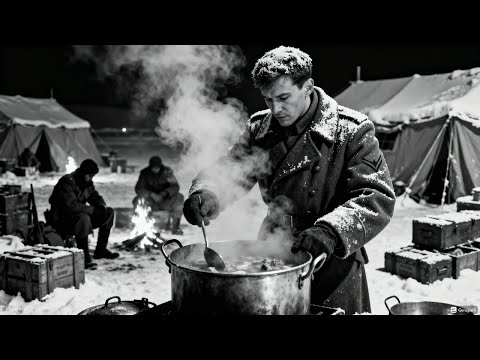
For 18 months, the Arctic convoys had been running a gauntlet that Winston Churchill himself called “the worst journey in the world.” The routes stretched from Iceland to Murmansk—a thousand miles of frozen ocean where the barren sea turned to slush and the sun barely rose above the horizon. These weren’t glamorous missions. No newsreels captured them. No Hollywood films would immortalize them. Just merchant vessels packed with tanks, ammunition, and hope, escorted by destroyers whose crews learned quickly that the cold killed faster than any German torpedo.
The statistics backed up the terror. Convoy PQ17, decimated in July 1942, lost 24 of 35 merchant ships. Over 4 million tons of cargo went to the bottom. But those numbers only told half the story. The other half was written in the medical logs—in the long columns tracking hypothermia, frostbite, and what the doctors euphemistically called “cold exhaustion.” Men didn’t just die from U-boat and Luftwaffe bombs. They died because their bodies simply ran out of fuel.
Operating in temperatures plunging below -30°C, Royal Navy sailors faced conditions that made a mockery of standard rations. The Ministry of Supply had calculated daily caloric requirements based on North Sea operations—moderate weather, reasonable temperatures. They’d allocated 3,200 calories per man per day, packed into tins of bully beef, condensed milk, hardtack biscuits, and tea. It should have been enough. It wasn’t. Not even close.
Arctic operations demanded a different calculation. Men working 18-hour watches in sub-zero cold burned calories like furnaces. Just maintaining core body temperature consumed energy at rates the ministry’s peacetime nutritionists had never considered. A sailor chipping ice off a gun mount for six hours could burn 5,000 calories. A stoker working the engine rooms, shuttling between infernal heat and Arctic wind, could burn 6,000. The gap between intake and expenditure was a death sentence measured in weeks.
What made the situation particularly devastating was how the cold weaponized the food itself. Bully beef, that staple of British military rations since the Boer War, turned to concrete overnight. Men needed knives to chip portions from the tins. Hardtack biscuits, already notorious for their jaw-breaking density, became literally stone-like. Butter solidified into yellow rocks. Even hot tea cooled to ice before a man could finish his mug. Sailors were presented with rations they physically couldn’t consume fast enough to get the calories they desperately needed.
Ship’s doctors documented the progression with clinical precision. First came the exhaustion—men moving slower, thinking slower. Then the tremors—hands shaking so badly they couldn’t grip tools. Then the collapses—bodies simply surrendering to caloric bankruptcy. By week three of a typical convoy run, 20% of crews showed symptoms of malnutrition. By week four, some ships reported men too weak to stand watch. Commander Jeffrey Wilson, captain of HMS Beagle, wrote in his log: “The cold is a more effective enemy than anything Donitz has deployed. My gunners can fight U-boats. They cannot fight starvation disguised as standard rations.”
The Admiralty knew they had a problem. In late 1943, they’d commissioned a study on Arctic nutrition requirements. The report, delivered in January 1944, recommended increasing rations to 4,500 calories per day with emphasis on high-fat, high-protein foods that could be consumed quickly. The recommendations were marked “under review” and filed. Implementation would require logistical restructuring across the entire North Atlantic fleet. It would take months—maybe years. The men on the Arctic run didn’t have months. They had the convoys scheduled for February, March, April. They had the supplies already loaded into ships already at sea. And they had cooks who understood something the Ministry of Supply didn’t: when doctrine fails, improvisation becomes doctrine.
The officers didn’t understand. How could they? They ate in the wardroom, where meals arrived on china plates, where tea stayed hot in silver pots insulated from the cold. First Lieutenant Ashford had actually laughed when Thompson requested additional fat rations. “What exactly do you propose to do with extra lard, Thompson? Grease the deck guns?” The comment had rippled through the officers’ mess as a joke. The cook who wanted butter like it was ammunition. But Ashford hadn’t watched a 19-year-old gunner’s mate try to chew frozen beef with gums that bled from scurvy. He hadn’t seen stokers collapse after six-hour watches, their bodies cannibalizing muscle because they’d burned through every calorie from breakfast before lunch arrived. Ashford commanded from the bridge, where wind chill was measured but not felt—not the way the deck crews felt it, not in the bone-deep way that made men forget their own names.
“You don’t fight the war with soup,” Ashford had said, voice dripping with the particular contempt officers reserved for enlisted men who questioned procedure. “Stick to your pots. Leave strategy to those trained for it.” What they didn’t realize—what Ashford and his War Office superiors couldn’t see from their heated offices and insulated wardrooms—was that logistics is strategy. An army marches on its stomach, Napoleon had said. A navy sailed on the same principle. The finest destroyer in the Royal Navy was just an expensive coffin if her crew was too weak to fight.
Thompson had tried going through proper channels. He’d submitted a requisition for additional condensed milk and beef fat, citing the caloric requirements he’d observed. The form came back stamped DENIED. Rations adequate per ministry standard. He’d tried explaining to the ship’s doctor, who’d agreed completely but had no authority to override supply regulations. He’d even mentioned it to the captain during an inspection, only to be told, “Make do with what you have, Thompson. That’s what we all do.” But making do was killing his crew. So Thompson stopped asking permission. He stopped filing requisitions. And he started doing what cooks throughout history have done when official doctrine fails. He improvised.
It started at 0200 hours with frustration and desperation. Thompson stood alone in his galley, staring at what the mess crew called slop—the leftover scraps that usually went over the side. Congealed oatmeal from breakfast. A half-tin of beef fat skimmed from the weak stew. Condensed milk gone thick and sweet. A precious bag of sugar, rationed like ammunition. Garbage. Scraps. Nothing a sane cook would look at twice.
But Thompson wasn’t thinking like a cook anymore. He was thinking like an engineer. Men were machines. Machines needed fuel. The thin stews and frozen bread weren’t cutting it. What his crew needed was something dense—something that packed maximum calories into minimum volume, something that wouldn’t freeze solid and could be eaten quickly between watches.
He lit the stove and waited for it to heat. Then he made a decision that would either save lives or get him court-martialed. He dumped the beef fat into his largest pot and watched it liquefy, the rendered animal fat turning translucent under the flame. The smell filled the tiny galley—rich and heavy. He added the oatmeal, stirring until it formed a thick paste, then poured in the condensed milk. The mixture bubbled and hissed. He added sugar—more than any recipe would call for—and a heavy pinch of salt. The combination looked like industrial sludge, gray-brown and glistening, more chemistry experiment than food.
Thompson let it cook for twenty minutes, stirring constantly, watching the ingredients merge into something new. Something that might work, or might poison his entire crew. He poured the mixture into a shallow tin pan and carried it to the one cold spot in the galley—where the bulkhead touched the outer hull. Within an hour, it had solidified into something with the consistency of dense cake and the weight of a brick.
He cut a square, two inches by two inches. It felt substantial in his hand. Heavy. He took a bite. The texture was chewy, almost waxy, with a sweetness that fought against the fatty richness. It tasted unlike anything he’d ever made before—not good exactly, not terrible, just different. But it sat in his stomach like ballast, heavy and satisfying in a way the watery soup never had. One small piece filled him up more than a full bowl of regulation stew.
The next morning, Thompson served his experiment alongside regular rations. He placed the squares on plates without explanation, without fanfare. The crew stared at them like he’d served motor oil. “What the hell is this, Cookie?” Able Seaman Richards picked up a square, sniffed it, and made a face. “Smells like someone cooked the engine room.” He took a cautious bite and laughed—but it was a tired laugh, the kind men make when they’re too exhausted for real humor. “Christ, Thompson’s Arctic brick. This is awful, mate.”
But by midday, the jokes had stopped. Richards was still standing watch while other gunners who’d skipped the brick were flagging. He had energy. He was warm. Six hours into his watch, while men around him shivered and stumbled, Richards was solid. By dinner, word had spread through the ship. Half the crew lined up asking for the bricks.
Thompson worked through the night refining his recipe, scaling up production. He scavenged every scrap—leftover porridge from breakfast, beef fat skimmed from lunch stew, condensed milk thinned with water. He hung tins near the engine room steam pipes to thaw frozen ingredients. Nothing was wasted. The bricks evolved. Thompson added cocoa powder, stolen in small quantities from the officers’ stores. He experimented with dried fruit, raisins that rehydrated in the hot mixture. He pressed the mixture thinner so men could carry pieces in their coat pockets. Each batch was a small revolution born from trial and error in a space so cramped he could touch both walls at once.
The transformation was subtle at first, then impossible to ignore. Men who’d been shuffling through shifts with dead eyes started moving faster, standing straighter. The gun crews on deck stopped collapsing after six-hour watches. Morning sick call, which had averaged fifteen men per day, dropped to seven, then five. One morning, Stoker Davies gripped Thompson’s shoulder with a scarred hand. “I don’t know what you’re doing, Cookie. But keep doing it. I’ve got kids back home. I’d like to see them again.” Thompson nodded, throat tight. He couldn’t articulate it—couldn’t explain that he was flying blind, that every batch was part science and part prayer, that he lived in terror the next one might make someone sick. So he just kept cooking.
Then came the afternoon that proved everything. February 16th, 1944. The Luftwaffe found them at 1430 hours. Ju-88 bombers screamed out of low clouds, their shadows racing across the ice-choked sea. Anti-aircraft guns thundered. The air filled with flak and smoke and the shriek of falling bombs.
Thompson grabbed a pot of his bricks and kicked open the galley hatch. The assistant cook shouted after him. “You’re mad!” Thompson ignored him. He stepped onto the deck and into hell.
Wind hit like a fist. Cold was instant. Absolute. Explosions hammered the water around them. He crawled toward the forward gun mount, the pot clutched to his chest, ice forming on his eyebrows before he’d covered ten feet. The gun crew stared like he was a ghost—four men, faces blackened with powder burns, hands raw from handling frozen shells. Thompson shoved bricks into their hands. “Eat now. Keep shooting.”
They ate standing, gulping down the dense cakes between salvos, shoving them into their mouths with numb fingers. Thompson watched them come back to life—watched color return to gray faces, watched hands steady on the firing mechanisms. “Christ, Cookie!” the lead gunner shouted over the chaos. “You trying to get killed?” Thompson grinned through chattering teeth. “Haven’t decided yet.”
He made three more trips—to the aft guns, to the bridge lookouts, to the depth charge racks. Each time the cold tried to kill him. Each time he hauled his pot through the chaos because men couldn’t fight on empty stomachs. When the attack finally ended and the bombers vanished into the northern sky, Thompson collapsed in his galley, hands shaking, blood trickling from his nose where the cold had cracked the skin. The assistant cook whispered, “You’re insane.” Thompson laughed. “Maybe. But they’re still shooting.”
The story spread faster than official orders. During the next supply transfer, a signalman aboard HMS Beagle flashed across the gap: “Heard about your cook’s fuel cakes. Our lads are dropping like flies. Can you share the recipe?” Captain Winters hauled Thompson to the bridge. “They want your recipe, Thompson. Signal them back.”
Thompson dictated ingredients while the lamp blinked across cold water: oatmeal, beef fat, condensed milk, sugar. Mix hot, press flat, cut into squares. The reply came minutes later: “Received. We’ll try. God help us.”
Within a week, the recipe jumped ship to ship like a secret handshake. Cooks swapped lard for beef fat, molasses for sugar. Some batches were better than others. All of them worked. The bricks became the unofficial meal of the Arctic convoys—passed between galleys in grease-stained notes.
By May 1945, Thompson’s improvised fuel cake had kept an estimated 15,000 sailors combat-ready through conditions that should have killed them. He died in 1983 in a small Portsmouth flat, surrounded by letters from men he’d fed. Today, one recipe card sits behind glass at the Imperial War Museum.
What would you have done in Thompson’s boots—follow the manual, or trust your instincts? Tell us in the comments.
Report this article
Select a reason for reporting:






