Dr. James Okafor had seen thousands of old photographs. But the moment Diane placed the cardboard envelope on his desk, something felt different. She held it like it was alive, both arms wrapped around it, as if protecting it from the rain outside. “My grandmother left it to me,” she said. “Nobody knows who these people are. Not their names, not where they came from, nothing.”
James opened the envelope slowly. Inside was an 8×10 cabinet card, the kind that was popular in the 1880s. The image was sharp, the edges browned and warped. A family of seven posed in a photography studio, their expressions serious. The father stood tall in a dark suit. The mother sat in a wooden chair, her hands folded. Five children surrounded them. At the bottom, in faded ink: October 14th, 1882. No name. No location. No studio stamp. Just a date.
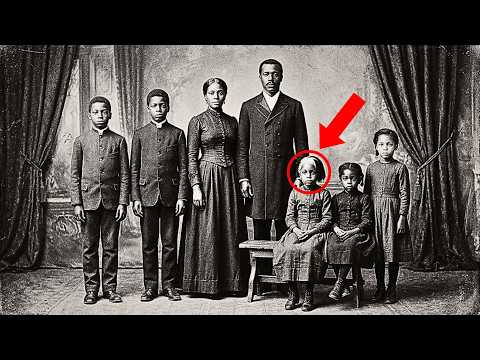
James studied the photograph with a magnifying glass. He noted the clothing, the backdrop, the quality of the paper. All clues pointed to the American South during Reconstruction. But it was the youngest girl, standing apart at the far right, who made him pause. Her face was turned slightly toward the camera. In that turn, both eyes were visible. And they were not the same. One was dark brown. The other was pale, almost gray-blue. Even in sepia, the difference was unmistakable.
James set down the magnifying glass and reached for his digital scanner. He scanned the photograph at high resolution, then enhanced it on his monitor. When he zoomed in on the girl’s face, he leaned back in his chair and went silent. The right eye was blue-gray. Clearly, undeniably blue-gray. A black child in 1882 with one brown eye and one blue-gray eye. He turned to Diane. “Tell me everything you know about this family,” he said. “Everything.”
Diane knew almost nothing. The photograph had been passed down through four generations of women, always with the same vague instruction: Keep this. It matters. No names. No letters. No oral history. “My great-great-grandmother received it from someone she called the old woman,” Diane said. “That’s all I know.”
James nodded slowly, still staring at the screen. He pulled up a medical database. Waardenburg syndrome, type 2A. A genetic condition affecting pigmentation of hair, skin, and eyes. The most distinctive features: heterochromia iridis—irises of two different colors—and a white forelock, a patch of white hair at the front of the scalp. It was caused by mutations in genes like PAX3, MITF, or EDNRB. Autosomal dominant. That meant it only needed to be inherited from one parent. And it meant that in a family line where the mutation existed, it would appear again and again, generation after generation.
James turned back to the enhanced image. The girl’s pale right eye looked back at him across 140 years. “This child has Waardenburg syndrome,” he said carefully. “It’s hereditary, dominant. It doesn’t skip generations.” Diane leaned forward. “What does that mean?” “It means this didn’t start with her.”
James spent the rest of the afternoon scanning every millimeter of the photograph again, this time looking at the other faces. The two older boys showed nothing obvious. The mother’s face was partially turned, her right eye obscured by a shadow. The father’s gaze was direct, his eyes dark and symmetrical. Then James looked at the second girl, seated on the bench, slightly older than the child with the heterochromia. Her eyes were dark, both of them. But at the top of her head, just above her left temple, partially hidden by her hair, there was a patch—perhaps two inches wide—where the hair was strikingly lighter. Not gray. White. Bright, flat white. A white forelock. The hallmark of Waardenburg syndrome, present in a sibling without the heterochromia. That meant the mutation had expressed differently in each child, both inherited from the same parent.
James sat very still. He looked at the father again, then the mother, whose face was partially shadowed. He reached for his phone and called his colleague at the genetics department, Dr. Patricia Ewen. “Patricia, I need you to look at something tomorrow morning. A photograph, 1882.” “What am I looking for?” “Waardenburg markers in two siblings, one with heterochromia, one with a white forelock. And I need you to tell me which parent it came from, because one of those parents has a shadow over their face, and I think that shadow is hiding something.”
There was a silence on the line. “I’ll be there at 8:00,” Patricia said.
Dr. Patricia Ewen arrived with coffee and a hard drive. She was the kind of scientist who prepared before she asked questions, and by the time she sat down across from James, she had already pulled up three medical journals on Waardenburg syndrome type 2A. She studied the enhanced photograph without speaking for several minutes, zooming in on the girl with the heterochromia, then on the older sister with the white forelock, then on the mother’s shadowed face.
She tilted her head slightly, the way she always did when she was thinking. “The shadow isn’t hiding the eyes,” she said finally. “It’s hiding the hair.”
She was right. When James pushed the digital enhancement further, a detail emerged at the mother’s hairline, just above her left temple. At the edge of the shadow, barely visible, was a thin strip of lighter-toned hair—the same position as the white forelock on the older daughter. “She’s the carrier,” Patricia said quietly. “The mutation came through her.”
James leaned back. A black woman in 1882 with Waardenburg syndrome. Two children visibly expressing the trait. A photograph with no name, no location, no studio marking. The next step was clear: the Freedmen’s Bureau records.
After the Civil War, the Bureau of Refugees, Freedmen, and Abandoned Lands had attempted to document the lives of formerly enslaved people across the South. The records were incomplete, often distorted by the prejudices of the agents who created them, but they were the closest thing to a census that existed for black Americans in the years immediately following emancipation. James searched by physical description, looking for any notation of unusual eye pigmentation.
The search took most of the morning. At 11:47, a record appeared on his screen. A labor contract dated 1866 from a district in South Carolina. The contracting party was listed as a woman. Her first name was given as Eliza. Beside her name, in the careful handwriting of the Bureau agent, was a parenthetical notation: “One eye brown, one eye gray blue, distinctive.”
James’s hands went still on the keyboard. Eliza. The name sat on the screen like a stone dropped into still water. He stared at it for a long time before reaching for his notepad. The contract listed her age as approximately thirty-five in 1866, placing her birth around 1831. It listed no surname. No place of origin. Only her name, her approximate age, the district where she was contracting her labor, and that single physical notation that had survived because a Bureau agent, for reasons James would never know, had thought it worth writing down.
He had a name. A rough birth year. A geographical location. And a genetic marker that functioned as a kind of fingerprint—a biological annotation written into her body that no document could erase. But James knew that the Freedmen’s Bureau records were only the beginning. The next archive was harder: slave manifests, the shipping documents used to record the transport of enslaved people along domestic trade routes.
They listed human beings like cargo—name, age, height, physical description, and the name of the person who claimed ownership. They were created not out of concern for the humanity of the people they listed, but because transporting enslaved people across state lines required legal documentation. James searched the digitized collections held by the National Archives and several university libraries, cross-referencing records from South Carolina against the birth window he had for Eliza.
On the second day, he found a manifest from 1849—a coastal shipping record from Charleston. Among the listed individuals was a girl, age approximately eighteen, first name Eliza. Beside her description, the agent had written two words that confirmed everything: “Eyes different.”
James read those two words several times. In the brutal, transactional language of a slave manifest, a human being’s most distinctive feature—the genetic inheritance she carried from her ancestors—had been recorded as a curiosity, a note in a ledger. Two words that had waited 175 years to mean something.
He picked up his phone and called Diane. “I found her,” he said. “Her name was Eliza, and I know where she came from.”
Diane was at his office within the hour. She sat across from him with her coat still on, her hands clasped on the desk, listening without interrupting as James walked her through everything—the Freedmen’s Bureau record, the labor contract, the slave manifest from Charleston. He showed her each document on screen, reading the relevant passages aloud, watching her face as the pieces assembled themselves into something coherent.
When he finished, she was quiet for a moment. “Eliza,” she said, as if testing the weight of it. “That was her name.”
“That’s what the records suggest. The physical description matches. The heterochromia, the notation in the labor contract, the timing. It’s the same woman. With a high degree of confidence, she is the mother in this photograph.”
Diane nodded slowly. Then she said, “Where did she come from before Charleston? Before South Carolina?”
That was the question James had been waiting for. And it was the question he could not answer from documents alone. He had already contacted a genetic genealogy laboratory—one that specialized in ancestral DNA reconstruction using historical family photographs as a starting point. By analyzing visible phenotypic markers in archival photographs alongside genetic databases of known Waardenburg mutations, it was possible to narrow the geographic and ethnic origin of a mutation with meaningful precision.
But there was another avenue. Diane herself. If she was a descendant of the family in the photograph—and the chain of custody through four generations of women made that overwhelmingly likely—then her own DNA carried the answer.
“Have you ever done a genetic ancestry test?” James asked.
“No.” She paused. “Should I?”
“I think you should. But not one of the commercial ones. I want to refer you to Patricia’s lab. They can run a full mitochondrial DNA sequence that traces your maternal line directly—mother to mother to mother—as far back as the data can reach.”
Diane agreed without hesitation. The test took eleven days. When Patricia called James with the preliminary results, her voice had a quality he recognized: the careful, restrained excitement of a scientist who has found something significant and is not yet ready to say how significant.
“The mitochondrial haplogroup,” Patricia said, “is L3. Specifically, a subclade the database associates with a very narrow geographic corridor.” She paused. “West Africa. Sierra Leone. And James—the Waardenburg mutation in this lineage matches a variant documented in exactly one population group in the existing literature.”
The population group was the Mende. James knew the name. Most historians of the Atlantic slave trade did. The Mende people of Sierra Leone had been among the most heavily targeted ethnic groups during the final decades of the legal transatlantic slave trade, a period of intensified raiding and trafficking that preceded the British naval blockade of the West African coast.
Their cultural identity, their language, their social structures had been among the most violently disrupted by the trade. They were also, as Patricia’s database search confirmed, the only documented population in West Africa in which the specific PAX3 gene mutation associated with Eliza’s form of Waardenburg syndrome had been recorded in more than one individual.
James spent two days reading everything he could find about the Mende—their communities, their history of resistance, their presence in the documented records of the transatlantic slave trade. And then, while searching the digitized collection of the Amistad Research Center in New Orleans, he found something he had not been looking for.
A letter.
It was handwritten, dated 1891, and addressed to no one by name. The writer identified herself only as a woman who was once called by another name. James read it twice before he was certain of what he was looking at.
She described a childhood in a village near a river. Being taken at night by men who spoke a language she did not understand. A ship. A new name—Eliza—because the name she was given at birth was considered unpronounceable by the people who now claimed to own her. And near the end, a passage that made James set down his coffee cup: “My mother had eyes that did not match. One dark as river mud, one pale as morning sky. She told me it was a sign that we came from a particular place, and that no matter how far we were taken, that sign would follow us.”
He called Diane and read her the letter over the phone. When he reached the passage about the eyes, she made a sound he could not quite name—not a word, not a cry, something in between. “She wrote it herself,” Diane said finally. “She remembered everything.”
Cross-referencing the letter’s geography against mid-19th-century maps of Sierra Leone, James found the river she described—its width, its proximity to the coast, the trees along its banks—consistent with the Sewa River. The Mende heartland. Patricia’s DNA results, the mutation variant, the letter, the geography: all pointed to the same place, the same people.
A family photographed in South Carolina in 1882, with no name recorded and no history attached, had come from the banks of the Sewa River. Their ancestor had been taken from that valley in the 1830s or 1840s, survived the crossing, survived enslavement, and carried in her irises—in her children’s hair, in the DNA of every descendant—an unbreakable biological record of where she came from.
Diane came to James’s office one last time that October, six weeks after she had first walked in with the photograph pressed against her chest in the rain. He laid everything out in order: the Freedmen’s Bureau record, the labor contract, the DNA analysis, the letter, the maps. She held the printed copy of the letter and read the passage about the mismatched eyes twice.
“She didn’t know,” Diane said quietly. “The little girl. She didn’t know what her eyes meant.”
“No,” James said. “But her great-grandmother knew. She wrote it down.”
Diane looked up. “She wanted someone to know. She wrote it in a language that wasn’t hers, in a country that wasn’t hers, and she left it for someone to find.”
James nodded. “You found it. It just took 140 years.”
Diane picked up the photograph and looked at the little girl at the edge of the frame—the girl who had moved slightly just before the shutter closed, whose pale right eye had caught the studio light in a way no one had noticed for a century and a half. The erasure had never been complete. It could never be complete, because written into the biology of that child was a record no document could destroy.
She tucked the photograph back into its cardboard envelope and held it against her chest, both arms around it, the same way she had carried it into this office six weeks before. “Her name was Eliza,” she said. “But somewhere on the Sewa River she had another name. And now I know where to look for it.”
DNA does not forget. It cannot be confiscated, burned, or renamed. It simply waits. And sometimes, after long enough, someone finally knows how to read it.
If a single photograph could hold 140 years of silenced history, what might the oldest image in your own family be waiting to tell you?
Report this article
Select a reason for reporting:






