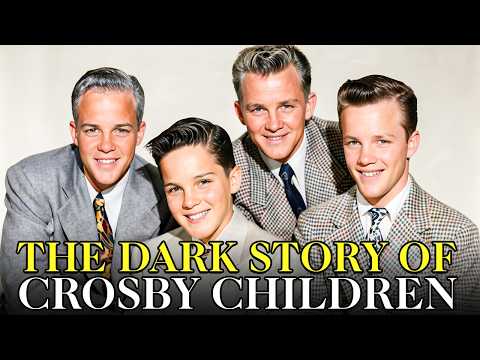
October 14th, 1977. Hillsborough, California. A woman steps onto the patio of a sprawling estate and faces a wall of cameras that assembled faster than grief could. Her husband died hours ago on a golf course outside Madrid—a massive heart attack, no warning. She has not yet had time to sit with what that means. But the press is here. The flashbulbs are already firing.
So Kathryn Crosby stands on the patio of the home she shared with the most beloved voice in America and tells the world that Bing Crosby is gone. The statement is composed. The cameras capture a widow performing steadiness in the middle of devastation. Inside the house, three younger children are absorbing the loss of a father they adored. And 3,000 miles away, four older sons from an earlier marriage are absorbing something harder: the loss of a father they had never been able to reach and now never would.
The world that week mourned Bing Crosby as a national treasure. The voice of White Christmas, the Oscar winner, the man who made warmth sound effortless. The World Series paused for a moment of silence. But inside the Crosby family, there were two households, two sets of children, and two irreconcilable versions of the man being eulogized. The public knew one. The other had been locked away for decades.
This is the story of what Bing Crosby’s sons revealed after he died. A memoir that split the family in half, a childhood that looked nothing like the Christmas specials, and four brothers who carried their father’s name into alcoholism, dependency, and early graves. Two of them ended their own lives. None reached the age their father’s trusts were designed to open.
But to understand how the Crosby name became a fault line—how one family could produce two entirely different versions of the same father, two irreconcilable memories of the same house—you have to go back long before the memoir, before the death in Spain, before the world decided it knew who Bing Crosby was. You have to go back to the version of this family that existed when nobody was watching.
And to do that, you have to understand what the name Crosby actually meant in mid-century America. Because the size of the public image is the only way to measure the weight of the private truth that came after it.
Bing Crosby was not simply a famous entertainer. He was by the middle of the 20th century something closer to a national institution. A man whose voice and whose presence had become shorthand for an entire emotional register of American life. He had won the Academy Award for Best Actor for Going My Way in 1944. He had recorded White Christmas, which became and remains the best-selling single in the history of recorded music. He had dominated radio for years, built a television presence that turned his specials into annual family rituals, and assembled a career so broad and so deeply embedded in American culture that it touched virtually every form of popular entertainment the country produced.
Encyclopedia Britannica describes him as a dominant force across recordings, film, radio, and television. PBS called him an architect of modern entertainment. These are not exaggerations. They are descriptions of a man who would become for millions of Americans the sound of reassurance itself. The voice that told them the world was stable, that warmth was real, that ease and grace were not performances, but the natural state of a life well lived.
That image matters enormously. It matters because this story is not about a minor celebrity whose children aired private grievances after his death. It is about one of the most comforting symbols in American culture—the man who sang America to sleep every Christmas Eve—and what it cost to the people who lived closest to this symbol. The more reassuring the public Bing Crosby, the more destabilizing the private testimony. And the testimony was coming. It just had to wait until after he was gone.
The first household that matters in this story is not the one most Americans knew. It is the one Bing built with a woman named Dixie Lee. Born Wilma Winifred Wyatt, Dixie had been a performer in her own right—an actress and singer who had earned her place in the entertainment world of the late 1920s. She was 19 years old when she married Bing in 1930. He was 27. For a time, the two of them must have looked to the outside world like the most golden version of a young Hollywood couple. Talented, attractive, rising together through the machinery of an industry that rewarded exactly what they appeared to be.
They had four sons in quick succession. Gary was born on June 27th, 1933—the firstborn, the eldest, the one who would later become the family’s most public and most contested witness. The twins, Dennis and Phillip, followed barely a year later on July 13th, 1934. Lindsay arrived on January 5th, 1938—the youngest of the original four, the one who would carry the most complicated and contradictory memories of his father into adulthood.
Four boys in five years, all of them born into a household where the father was ascending toward the very top of American entertainment and the mother was descending—slowly at first, then with gathering speed—into an illness that would become the defining private reality of the first Crosby home.
Dixie Lee drank. That is not a casual biographical footnote. It is one of the central facts of the first Crosby household, and later recollections from virtually every quarter of the family returned to it with the weight of something everyone knew and nobody could repair. Mary Crosby, Bing’s daughter from his second marriage, born decades after Dixie’s death, later described in a PBS interview what she had been told by adults who remembered the first household: Dixie passing out in the house and the boys finding her that way—not once, not as an isolated incident, but as a pattern.
Gary, decades after his mother’s death, spoke about her alcoholism with the unflinching candor of a man who had spent his adult life in Alcoholics Anonymous. And the way he described it suggested that Dixie’s drinking was not merely something that happened inside the home. It was the atmosphere of the home. It was the thing around which the household organized itself—the silences, the adjustments, the unspoken knowledge that shaped every room the boys walked through.
There is a difference between a parent who drinks and a home organized around a parent’s drinking. The first Crosby household appears to have been the latter. And you have to understand what that meant for four boys growing up inside one of the most visible families in the country. Outside, the name Crosby was warmth. It was Christmas carols drifting from every radio speaker in America. It was a father who seemed to move through the world with a calm so natural it looked effortless.
Inside, the boys were living with a mother whose instability was daily and visible, and a father whose response to disorder—by virtually every later account—was not gentleness but control. Not conversation, but correction. Not the easy warmth the public saw, but a rigidity that seemed to intensify in direct proportion to the chaos his wife’s illness introduced.
Gary Crosby was the eldest, and that position would define his life in ways he spent decades trying to escape. He was the first son of a man who demanded order and professionalism—the boy who, by his own later telling, received the earliest and most severe versions of his father’s discipline. But Gary was not simply a victim in the making. He was genuinely talented. He sang with his father, had real commercial success as a young performer, and later built an acting career in film and television. He had his father’s timing, something of his father’s ear, and none of his father’s ability to make ease look natural.
What Gary carried instead was the particular burden of eldest children in difficult homes: the absorption of the household’s tension, the role of the first experiment, the sense of being the prototype on which a father tested his methods before applying them—perhaps more gently—to the ones who came after.
Gary’s wants, as they would later emerge in his memoir and in interviews, were contradictory in a way that makes him a complicated witness rather than a simple accuser. He wanted his father’s approval—wanted it badly enough that he spent years performing inside the Crosby orbit, singing his father’s kind of music, working in his father’s industry, never fully leaving the gravitational pull of a man who made him feel small. He also wanted distance from his father, wanted a life and an identity that were not merely extensions of the Crosby brand. And he wanted most of all to be seen as himself—as Gary, not as Bing Crosby’s boy.
That those three desires pulled against each other constantly was not Gary’s failure. It was the architecture of being Bing Crosby’s firstborn son—the fundamental bind that no amount of success or rebellion or alcohol could untangle.
Dennis, one of the twins, carried a different kind of burden. He was talented enough to perform—all four boys were—but he later admitted something that cuts through the mythology of the show business dynasty more sharply than any accusation of abuse. He said he was painfully self-conscious performing with his brothers. He said the spotlight felt wrong. This is a man whose last name made performance feel not like a choice, but like an obligation. A man who grew up inside the most successful entertainment household in America and found that the thing his family did best was the thing he was least suited to endure.
Dennis later said that Gary had been treated most harshly—that Gary got the first licking, and the others received a second—which positions him as a partial corroborator of Gary’s testimony, but a reluctant one. A man who confirmed the hierarchy of suffering without fully joining the public accusation.
Philip, the other twin, became something unexpected in this family’s narrative: the defender. Years later, after the memoir had detonated, Philip would tell People magazine that the boys had not received punishment they did not deserve, and that he understood Bing better than anyone else in the family. That is a remarkable claim from a man who grew up in the same house, ate at the same table, and submitted to the same paternal authority. But Philip was not a clean defense witness. He struggled with alcoholism himself, which means his insistence that the household was not as dark as Gary painted it comes from inside the same damaged system, not from a position of untouched clarity. Philip is the brother who belongs fully to the injured first family and yet rejects the most damning public interpretation of what that family endured. His testimony does not cancel Gary’s. It complicates it in a way that resists the clean narrative either side might prefer.
And then there was Lindsay, the youngest of the four. Born in 1938, Lindsay would later become the most emotionally haunting voice in the entire Crosby story. He supported Gary’s decision to publish the memoir. He said publicly that the book should exist, that the truth deserved air. But Lindsay also carried memories that no accusation could contain. He remembered specific small moments of paternal tenderness. And the way he described them suggested not a man recalling ordinary affection, but a man recalling water in a desert. He said that hearing his father say “good night, and I love you” felt like heaven.
That single detail is worth sitting with for a long moment, because it holds something that no simple story of abuse or defense can accommodate. A child so deprived of routine warmth that a commonplace expression of parental love—the kind most children hear so often it becomes invisible—registered for Lindsay Crosby as something close to transcendence. His testimony does not contradict Gary’s. It exists beside it. And the coexistence of accusation and longing within the same family—sometimes within the same brother—is what makes the Crosby story impossible to reduce to a verdict.
If you’re finding this story as compelling as I do, take a moment to subscribe. There is so much more to this family that the public never saw. And we’re just getting started.
The world these boys inhabited was old Hollywood at its most insular, its most image-conscious, its most controlled. Money flowed, alcohol flowed more freely. Performance was not just a career, but a way of being. And the boundaries between the family and the brand were deliberately blurred. The Crosby boys were not anonymous rich children growing up behind walls and hedges. They were pulled into the family’s public machinery from childhood—appearing on their father’s radio programs, eventually recording together, learning before they could fully understand the lesson that in the Crosby household, family itself was content.
The outside world saw Christmas specials and studio-lit magazine spreads and a father who accumulated Father of the Year honors. The private reality, in Gary’s telling, was built on intimidation, silence, the fear of an office where punishments were administered, and a pervasive sense that the household existed to serve the image, not the children.
There is a recording that captures both versions of this family in a single artifact, and it is worth describing because it explains why the Crosby story resists every attempt at simplification. In 1950, Bing and Gary recorded Sam’s Song backed with Play a Simple Melody—a father and son single that became a genuine commercial hit. Listen to it and you hear warmth, timing, generational interplay that sounds not just professional but affectionate. A father and son trading lines, enjoying each other’s company, making music together in a way that seems to confirm everything the Crosby image promised.
And Gary himself, decades later, said that the public Bing was real, too—that the relaxed, easy performer the world adored was not a fabrication. The man existed. The warmth was not entirely invented. The problem was that he was not the whole man. The recording was real. The affection it suggested may also have been real. But so was what happened when the microphones were off and the office door closed. And the Crosby household’s central cruelty was that both truths occupied the same rooms, the same years, the same family at the same time.
By the early 1950s, Bing Crosby’s public stature was at something close to its zenith. He was an Oscar winner, a radio institution, the voice of the most beloved Christmas song ever written, and the kind of star whose domestic life was consumed by the American public as proof that fame and decency could coexist. The family appeared in public as a unit—Bing and his four boys, the very image of the American father surrounded by sons who adored him. They performed together on radio, they recorded together, they appeared in photographs that were distributed to magazines and newspapers across the country. Images carefully composed to suggest exactly what the Crosby brand required: ease, stability, wholesome fun. A father who was not just a star, but a dad—and a good one, a natural one. The kind of man who made fatherhood look like the most relaxed thing in the world.
And some of that was real. That is what makes the Crosby story so resistant to simplification. The boys did perform with their father, and there were moments of genuine closeness inside those performances. The music was not entirely manufactured sentiment. But performance in the Crosby household was never simply an activity. It was the family’s organizing principle—the thing that justified the household’s existence in the public eye. And the boys learned early that their value inside the family economy was tied to their willingness and ability to extend the brand. They were not just sons. They were content. And the difference between a father who plays music with his children because he loves it, and a father who puts his children on the air because the image requires it, is invisible from the outside and devastating from within.
Gary later described elements of the household’s private discipline that would not surface publicly for decades: weigh-ins to monitor the boys’ weight, punishments administered in an office behind closed doors, meals eaten in silence under their father’s watch. These details, when they emerged in 1983, would hit the public like a betrayal—not of a minor celebrity’s image, but of a national comfort. But in the early ’50s, none of it was visible. The photographs held. The specials aired. The public never had reason to look behind the image because the image was too good, too warm, too perfectly constructed to invite suspicion.
The marriage between Bing and Dixie, meanwhile, carried the weight of two incompatible relationships with alcohol. Mary Crosby, speaking decades later about what she had been told by people who witnessed that era firsthand, drew a distinction that is useful, even if its precision cannot be independently verified: Bing could function inside old Hollywood’s drinking culture. Dixie could not. He could consume and perform. She consumed and collapsed. Whether that framing is entirely fair to Dixie or slightly too kind to Bing, it points to the dynamic that mattered most inside the first household: the mother’s deterioration was visible enough that stories about it survived for generations, and the boys’ daily environment was shaped by her illness in ways that no studio-produced family portrait could capture or correct.
The brothers were already diverging in their responses to the same pressures, and those divergences would harden into permanent fault lines. Gary bore the most direct exposure to his father’s discipline and his mother’s decline, and he carried the anger that comes with being the one who absorbs the most damage. Dennis performed but hated the spotlight, and the gap between what his name required and what his temperament could tolerate was already widening. Philip internalized the system’s logic and would later defend it. Lindsay, the youngest, held contradictions so deep that they would not resolve in his lifetime. The same house was producing not one memory but several. And that is essential to understanding why the family’s reckoning, when it finally came decades later, would be so bitter and so permanent. This was never a simple case of accusation against denial. It was competing truths shaped by birth order and temperament, and by which version of which parent each son happened to absorb most fully during the years when absorption is involuntary and its consequences are lifelong.
And then, into the middle of all of it, came the loss that divided the first family’s story into before and after.
Dixie Lee died on November 1st, 1952. Ovarian cancer. She was 40 years old. That date should land plainly, because its consequences were not plain at all. Dixie’s death tore the original family unit in half and left in its place a household defined by absence. She had been deteriorating for years—the drinking, the illness, the long collapse that the boys had watched from inside rather than read about in newspapers—and now she was gone. The one figure who, even in her worst moments, even passed out on a floor her children had to step around, had been the emotional center of the first Crosby home. She was not a stable center. She was not a healthy one. But she was the one they had, and her removal left four sons alone with a father whose response to grief and disorder, by the testimony of those who knew him, was not to open, but to close. Not to become softer, but to grip tighter.
Gary was 19. The twins were 18. Lindsay was 14. Old enough to understand exactly what they had lost. Young enough—especially Lindsay—to still need desperately what was no longer available. And the world outside the Crosby house continued as though the loss were manageable. Public sympathy arrived on schedule. Condolences flowed in from every corner of the entertainment industry, and the narrative of a brave widower carrying on for his boys settled over the family like a second skin that looked right from the outside and fit badly underneath.
What Dixie left behind, in practical terms, was a monthly trust for her sons—money that would provide a baseline of support as they grew into adults. Bing’s own wealth, however, was structured differently: a blind trust that would not open fully until the boys turned 65. That is not merely a financial detail. It is a character detail—a fact about the family’s architecture that would shape the first sons’ entire adult lives. Because what it meant in the simplest terms was that the Crosby name would continue to pay the bills, would continue to feed, house, and support the boys while withholding from them the full autonomy that money is supposed to provide. They were not free. They were funded. And the difference between those two things is the difference between independence and a gilded dependency that could last decades.
The cruelest dimension of Dixie’s death was not the grief itself. Grief was something even the Crosby public image could accommodate, could fold into the narrative of a widower’s dignity and resilience. The cruelest dimension was what it set in motion. Because now the first sons were going to have to grow up not just under the weight of their father’s name and their father’s expectations, but under two comparisons that would follow them for the rest of their lives.
The first was their mother. In death, Dixie Lee would become simpler than she had been in life—the beautiful wife taken too soon, the lost maternal presence around which the first family’s grief and damage organized itself. The second comparison was still five years away, but it was coming. In 1957, Bing would marry Kathryn Grant, a younger actress, and together they would build a second family in San Francisco and Hillsborough—a household that operated in a different city, at a different emotional temperature, with a father who, by multiple later accounts, including Gary’s own, appeared to be a different man. Looser, gentler, more present, more willing to say the things his first sons had starved to hear.
That second family would come to represent something almost unbearable for the older boys. Not merely the possibility that their father had changed, but the specific, lacerating possibility that the version of Bing Crosby they had needed as children had existed all along—had simply arrived too late and been given to someone else.
Harry, born in 1958, would later remember a mostly normal childhood in San Francisco. Mary, born in 1959, would remember visibility without cruelty. Nathaniel, born in 1961, would remember a father who tied closeness to golf and presents, not to discipline and silence. The love had been there. It just had not been for the first four.
And that knowledge—if it can even be called knowledge, rather than suspicion or wound—was the thing the older boys would carry into their attempt to build lives of their own. The four Crosby sons were about to enter adulthood carrying a name that opened every door in the entertainment industry and answered none of the questions that actually mattered. They were funded but not free. They were famous but not known. They were sons of the most beloved voice in America, and inside their own memories, that voice had not always said the things they needed to hear.
They would try to become performers inside the same machine that had shaped and damaged them. They would record together, appear on television together, and attempt to convert the family brand into something that belonged to them rather than to their father. And the attempt would expose exactly how little room the Crosby name left for anyone who was not Bing himself.
In 1959, the four Crosby brothers formed a singing group and stepped onto the same stages that had built their father’s empire. It was the obvious play: they had the name, the training, the machinery. What the public saw was continuity. What the boys were attempting was the alchemy of turning Bing Crosby’s sons into artists who existed on their own terms. It did not work.
Every stage belonged in the audience’s mind to their father first. Every note was measured against the voice that had defined American popular music for a generation. They were not building something new. They were auditioning for the right to stand near something that already existed, and the audition never ended.
Gary left the group. Mary Crosby later recalled that the remaining brothers were furious—his exit felt like a betrayal of the family project. Then Bing stepped in and filled Gary’s slot. The father, who had already occupied every room in their professional world, now literally occupied the space his eldest son had vacated.
Whether out of loyalty or a performer’s instinct to never leave a stage empty, the effect was the same. The sons had tried to build a vehicle of their own, and the father had seamlessly taken his place. It was not malice. It was gravity. Even his generosity looked, from the sons’ vantage, like annexation.
That moment captures the entire family dynamic in miniature. The sons build something, one son breaks away, the father fills the hole, and the remaining sons find themselves performing alongside the very man they were trying to distinguish themselves from. They were never going to be the Crosby Boys. They were always going to be Bing Crosby’s sons.
The years that followed scattered the brothers into trajectories that looked, from outside, like ordinary disorder. From inside, they were shaped by forces that had nothing to do with ordinary life. Gary drank hard enough to eventually find Alcoholics Anonymous, where the language of recovery gave him a vocabulary for naming what had happened to him.
Dennis moved further from the spotlight with each passing year, the gap between the life his surname prescribed and the life his temperament could tolerate widening. Philip defended the family system he had internalized. Lindsay orbited the Crosby operation at a distance too close for independence and too far for resolution.
None of it was visible to the millions of Americans who still associated the Crosby name with comfort. The cracks were hidden not by conspiracy, but by the overwhelming weight of the public image. The image held. And as long as Bing was alive, saying what the first sons knew would mean confronting not just a man but an institution. The cost of that confrontation was higher than any of them was prepared to pay. Not yet.
Then on October 14th, 1977, the confrontation became impossible in one direction and inevitable in the other. Bing was in Spain, outside Madrid, at a golf course called La Moraleja. He played 18 holes that afternoon and played them well—an 85, respectable for a 74-year-old on a Spanish course in October. The day was pleasant. The company agreeable. There was nothing to suggest anyone present was witnessing the final afternoon of a life that had defined American entertainment for half a century.
He collapsed on the path between the 18th green and the clubhouse. A massive heart attack. The distance between the last shot and the last breath was measured in steps, not days. By the time help arrived, Bing Crosby was gone.
The news reached America and spread with the velocity reserved for deaths that, in some emotional sense, belong to everyone. Networks broke into programming. Radio stations shifted their playlists. The World Series paused for a moment of silence—a national sporting event, mid-broadcast, stopping to acknowledge the death of a singer. Not a president, not a general. A man whose voice had become so woven into American domestic life that even baseball recognized something foundational had been removed.
In Hillsborough, Kathryn Crosby stepped onto the patio to face the cameras. She was composed. Graceful. Managing the public dimension of a private catastrophe with the control that looked from outside like strength and may have felt from inside like the only available option. The scene is the Crosby family in miniature: a carefully managed public moment concealing an unmanageable private reality.
For the second family, the death was devastating but comprehensible. They had lost a father they had known and loved in a way that was relatively whole. Their grief was real and legible and publicly supported. For the four sons, the death was something far more complicated and far less legible. It was the closing of a door that could never be reopened.
Whatever they still needed from their father—an explanation, an apology, an acknowledgement that the first household had been harder than the public ever knew—was now permanently unavailable. Bing Crosby could no longer answer for the childhood Gary remembered. He could no longer confirm or deny what Dennis had witnessed, or give Lindsay the tenderness that had come so rarely and registered so deeply when it did.
That is the cruelest thing about dying with your mythology intact. The dead do not answer questions. They do not sit across a table and explain themselves. They become untouchable, elevated, simplified, preserved in the version of themselves the public found most comforting. And the living—the ones who carried the complicated version—are left to decide whether to live quietly underneath the legend or to say something and face the consequences.
Gary was 44 when his father died. Dennis and Phillip were 43. Lindsay was 39. They had spent their entire adult lives inside the shadow of a name they could neither escape nor fully claim. They had waited for a reckoning that never came while the principal figure was alive. Now the waiting had become permanent.
What none of them knew yet, as the public stood in the warm glow of the national eulogy, was that six years later one of those sons would take a crowbar to the vault, and the family would never recover from what came out.
For six years, the legend held. The Christmas specials continued to air. The albums continued to sell. If there was a private reckoning happening inside the Crosby family, it was invisible to the public. And then, in 1983, Gary Crosby published a book called Going My Own Way, and the vault broke open.
The title was a deliberate inversion. Going My Way had been the 1944 film that won Bing his Academy Award—the role that cemented his image as America’s ideal father figure. Gary’s memoir took that title and turned it inside out. This was not a celebrity tell-all. It was one man’s attempt, at 49, to force a hidden history into the public record.
Gary described a household built on fear and performance. Weigh-ins where the boys were monitored and punished for gaining weight. An office where discipline was administered behind closed doors. Meals eaten in rigid silence under their father’s surveillance. A pervasive atmosphere of intimidation that bore no resemblance to the easy-going patriarch the public had spent decades adoring. UPI described the memoir as a direct attack on the image of Bing Crosby as a warm, wise family man—a description that understates the seismic quality of what Gary had done.
He had not merely criticized his father. He had told the American public that the man they used to comfort themselves every Christmas—the voice that played in hospitals, in living rooms, in churches, the voice that meant safety—had used his own children as instruments of control.
The timing mattered as much as the content. Gary had waited until after Bing’s death, which gave the memoir the power of the unanswered charge. But it also gave the defense ammunition. Why wait? Why not confront the man while he was alive? The answer is that confronting Bing Crosby while he was alive meant confronting not just a father but a national institution. The cost of that confrontation, for a son financially dependent on the family trust and emotionally unable to sever the connection, may have been genuinely unbearable. The timing was not simply strategic. It was the product of a lifetime of delayed reckoning.
The family’s reaction was immediate, fractured, and irreparable. Lindsay supported Gary. He said publicly that the book should exist, that the truth deserved to be heard. His support was quiet but firm, and it carried the weight of a man who was not seeking the spotlight but who refused to let his brother stand alone in it.
Dennis treated the memoir as Gary’s business, his story to tell. But Dennis also acknowledged that Gary had been treated most severely—that the eldest brother had absorbed the worst of their father’s discipline, and that the rest of them had received what came after. It was not a full endorsement. It was something more nuanced and, in its way, more damning: a confirmation of the hierarchy of suffering without a public denunciation of the man who had imposed it.
Philip rejected the book fiercely and publicly, telling People magazine that Gary had distorted their childhood, that the punishments had been deserved, that their father had been doing his best with four difficult sons in a difficult household. He said he understood Bing better than anyone else in the family. Whether Philip’s defense was the clearest-eyed testimony in the family or the most deeply shaped by the need to preserve the father’s image is a question the family itself never answered.
And then there was Kathryn. In the same year Gary published his memoir, Kathryn Crosby published her own book, My Life with Bing, presenting a portrait of a warm, loving husband and father that directly contradicted Gary’s account. Her book was not just a defense. It was a counter-narrative, a competing version of reality offered by a woman who had known Bing intimately—but who had known him in a different era, in a different household, with different children, under different pressures.
The two books, published in the same year, sat side by side on shelves and in the public imagination, and they created something that would define the Crosby legacy for decades to come. Not a resolution, but a permanent split. Two versions of the same man offered by people who had both loved him and who could not agree on what that love had cost.
The memoir war of 1983 was not, in the end, a war anyone won. It was a family referendum that never reached consensus, and the absence of consensus was itself the only verdict the Crosby story would ever produce. Because what the competing accounts revealed was not that one side was lying and the other was telling the truth. It was that the two Crosby households had produced genuinely different experiences of the same man. The father who had been in the first family a figure of fear and rigid control had become in the second a figure of warmth and quiet presence. And both families were telling the truth as they had lived it.
The public, forced to choose between the Christmas Bing and the memoir Bing, mostly chose discomfort. The revelations did not destroy Bing’s legacy—the music was too deeply embedded, the cultural association too thoroughly woven into American ritual. But they introduced a permanent asterisk, a shadow that attached itself to the name and would follow it wherever it went. Every December, when White Christmas played in department stores and airport terminals and family kitchens, the song still sounded the way it had always sounded. But for anyone who had read Gary’s book, the warmth of the voice now carried an undertone of something more complicated. The sound of comfort had become, for part of the public, the sound of a question that would never be fully answered.
Mary Crosby, years later in a PBS interview, recalled something that added another layer to the already fractured picture. She said Gary had allegedly told her that the story had not happened exactly as he had written it—that publishing pressures had shaped the book, that the narrative had been sharpened for commercial impact. That recollection should be framed for exactly what it is: Mary’s later account of a private conversation, not a confirmed retraction. Gary never publicly recanted the memoir’s core claims. But Mary’s testimony matters because it introduces the possibility that even the accusation was not pure—that it too had been shaped by the forces of image and commerce that had shaped every other Crosby production. In this family, even the rebellion against the brand bore the brand’s fingerprints.
What followed the memoir was not healing. It was not resolution. It was not even the kind of uneasy truce that damaged families sometimes manage after the initial explosion. What followed was a sequence of losses that moved through the first family with a regularity that felt, to anyone watching, less like coincidence than like the accumulated weight of decades finally coming due.
Lindsay Crosby died in 1989. He was 51 years old. His death was reported as a suspected suicide—a gunshot wound at his home in Las Vegas. Lindsay, the youngest of the first four, the brother who had supported Gary’s memoir while still carrying those achingly specific memories of his father’s tenderness, the man who had described hearing “good night, and I love you” as something that felt like heaven—he was gone. The boy who had needed the most from his father and had received the least was the first of the brothers to die.
Two years later, in 1991, Dennis Crosby died. He was 56 years old. The cause was an apparently self-inflicted shotgun wound. The second of Bing Crosby’s first four sons to end his own life in the span of two years. Dennis, the brother who had never wanted the spotlight, who had been painfully self-conscious performing under the family name, who had confirmed that Gary bore the worst of their father’s discipline while keeping much of his own suffering private—he too was gone.
Two brothers, two suicides separated by 24 months. The pattern was not proof of anything as simple as a single cause, but it made visible something the public had been able to ignore when the brothers were alive. The scale of the damage the first Crosby family had absorbed was not metaphorical. It was not a story about difficult feelings or complicated memories. It was a story about men who did not survive the lives they had been given.
Gary Crosby died on August 24th, 1995. Lung cancer. He was 62 years old. The eldest son, the one who had detonated the memoir, the one who had spent his adult life oscillating between the poles of accusation and recovery, the man who had wanted his father’s approval and his own freedom and had never fully achieved either. He outlived two of his brothers, outlived the public firestorm his book had created, and died of a disease that had nothing to do with the Crosby name and everything to do with the body that had carried it for six decades. By the time of his death, the debate his memoir had ignited had not been settled. It had simply been overtaken by grief. There was no winner. There was no vindication. There was only the silence that accumulates when the people who lived through a story are no longer alive to tell it.
Philip Crosby, the defender, was the last of the first four sons. He died in 2004 of natural causes at the age of 69. He had struggled with alcoholism throughout his adult life—the same illness that had consumed his mother Dixie, the same illness that had touched in one form or another every member of the original household. And he had never wavered in his defense of Bing. Not after Gary’s memoir. Not after Lindsay’s death. Not after Dennis’s death. Philip maintained to the end that their father had done his best and that the most extreme characterizations were unfair. His death closed a generation. There were no more direct witnesses from the first Crosby household.
The four boys who had grown up inside that house, who had eaten at that table, who had submitted to that discipline, who had carried four different versions of the same father into adulthood—all of them were gone. What remained were the books they had written and the interviews they had given and the competing testimonies that would never be cross-examined in a room where all the witnesses were present, because no such room had ever existed and now it never could.
The Crosby legacy did not stabilize after the brothers were gone. If anything, the absence of living witnesses made the legacy more contested, not less. Because the people who now spoke about Bing did so from positions of interpretation rather than experience.
In 2014, PBS aired Bing Crosby Rediscovered as part of its American Masters series—the most ambitious attempt yet to reckon with the full scope of Bing’s life, career, and contradictions. The film drew on previously unseen archival material: home movies, private recordings, personal correspondence locked away for decades. It included a never-before-seen 1987 interview with Gary himself, filmed four years after the memoir’s publication, in which the eldest son revisited his claims with a tone reportedly more reflective than the book’s most incendiary passages. The existence of that interview, recorded but unreleased for nearly three decades, was itself a detail worth noting: even within the institutions managing Bing’s legacy, there was an awareness that Gary’s testimony could not simply be ignored. It had to be addressed, absorbed, contextualized, and eventually released on terms the estate could manage.
The film also foregrounded the surviving second family members, who spoke about their father with a nuance the 1983 memoir war had not allowed. They did not simply deny that the first family had suffered. They offered a different portrait—a father who had changed, who had learned, who had become in his second act closer to the man the public had always imagined. And they let the audience sit with the discomfort of knowing that both portraits could be true. The film could not resolve the central dispute. But it reopened the Crosby story in a register that was more documentary than polemic, more investigative than accusatory, and it gave the public a framework for holding the contradictions the family itself had never been able to hold.
Two years later, in 2016, Nathaniel Crosby published 18 Holes with Bing, a memoir structured around the sport that had connected father and youngest son more than any other shared activity. The book was warm, specific, and grounded in the rhythms of golf—the walks between holes, the quiet conversations on fairways, the particular kind of closeness a shared physical activity can create between a parent and child. Nathaniel’s Bing was not the tyrant of Gary’s memoir or the saint of Kathryn’s. He was a man who loved golf, who loved his son’s company on the course, and who expressed affection through presence and shared experience rather than through words. The book was the gentlest entry in the Crosby literary canon, and its gentleness was either evidence that Bing had become a better father or evidence that the second family had been given a version of the man the first family never received. The interpretation depends entirely on which household the reader considers the definitive one—a choice the reader should not be asked to make, because the whole point of the Crosby story is that no single household holds the complete truth.
Today, the first four sons are gone. All of them. Gary, Dennis, Philip, Lindsay. The boys who grew up inside the original Crosby household, who performed under their father’s name, who ate those silent meals and submitted to that discipline, and carried four incompatible versions of the same man into adulthood. None of them survived into old age. None of them reached the 65 that would have fully opened the blind trust their father had established. The money that was supposed to provide for their later years outlasted them. The name that was supposed to be their inheritance became instead the thing they spent their lives trying to survive.
The surviving immediate family comes entirely from the second marriage—the household that knew a different father, in a different city, at a different emotional temperature. Harry Crosby is 67 now, working in business and investment, far from the entertainment world that built and consumed his father’s life, maintaining a privacy that suggests either a healthy distance from the family’s public mythology or a deliberate decision not to enter the arena where his older half-brothers fought and lost. Mary Crosby is 66, best known as Kristin Shepard on Dallas—the woman who shot J.R. Ewing, one of the most famous moments in American television history. She has spoken publicly about her father with a thoughtfulness that acknowledges the complexity without abandoning affection, suggesting a woman who understands that her experience of Bing was not the only valid one. Nathaniel Crosby is 64, his adult life built around golf—winning the U.S. Amateur Championship in 1981 at 19, later working as a golf executive and advocate. His memoir remains one of the most measured accounts of life inside the Crosby name: a book written by a son who loved his father and who knew, without pretending otherwise, that other sons had not been given the same father to love.
Kathryn Crosby died in September of 2024 at the age of 90, closing one of the last major eyewitness accounts of the Crosby marriage and household. With her death, the generation that had known Bing personally—as husband, as father, as the man behind the public image—is almost entirely gone. What remains now is the record: the memoirs, the interviews, the PBS documentary, the music, the films, the Christmas specials that still air every December as though nothing complicated has ever been said about the man whose voice fills them. In practical terms, the Crosby legacy lives in recordings and in ritual. And the people who inherit it going forward will inherit not a settled story but a permanent argument between two families who shared a name and almost nothing else.
The Hillsborough estate—the property where Kathryn once stood on the patio and told the world her husband was gone—entered the real estate market after her death. It is the kind of detail that does not belong at the center of a closing but that sits usefully at its edge. Inheritance turning into property. Memory turning into square footage. A family home becoming a listing with a price tag and an open house. The house where two versions of Bing Crosby coexisted is now available to anyone with the money to buy it. What lived inside it is not for sale and never was.
This story does not close on a verdict, because the Crosby family never reached one. Bing Crosby gave America one of its most durable emotional gifts: the sound of ease, of warmth, of steadiness, of a world where a father’s voice could make everything feel safe. The first family’s testimony does not erase that gift. It sits beside it, painfully and permanently, a counter-melody that will never resolve into harmony.
The real subject of this story was never whether Gary was right or Philip was right or Kathryn was right. It was what happens when children grow up inside a national symbol and spend the rest of their lives deciding whether to protect it, qualify it, or break it open—and discover in the end that the cruelest inheritance was not the money locked in trust until 65, or the name that opened doors they did not want to walk through, or even the memories that would not agree with each other. The cruelest inheritance was authorship: the question of who gets to tell the story of a family, and whether the telling can ever be separated from the damage it describes.
So here is the question that remains, the one no memoir and no documentary can settle: when a beloved voice sings of home, whose home is it—and who pays for the song? Tell me in the comments: should Gary have published the memoir while his father was alive, or was silence the only inheritance he could afford?
Report this article
Select a reason for reporting:






