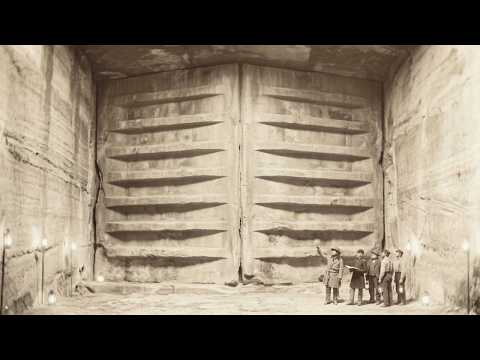
On July 9, 1873, a blast in the lock pit at Sault Ste. Marie, Michigan, tore into the red sandstone and revealed a passage that should not have existed. At its end stood a stone gate sixty-six feet high, its two leaves meeting in a seam so tight that a pocketknife could not start it. The Ojibwe had a name for that place, and they said the gate was ancient—older than their grandparents, older than memory.
Anders Strand, a hammer man from Norway, was the first to sense something wrong. Two days before the blast, he told the powder man that the rock at the south end of the face answered differently. “Like a bell,” he said, “with a cloth over it.” The army drilled and fired anyway. What came back was not smoke and dust but a cold wind out of the broken rock, and then a silence that stopped the roar of the rapids as if a door had been shut.
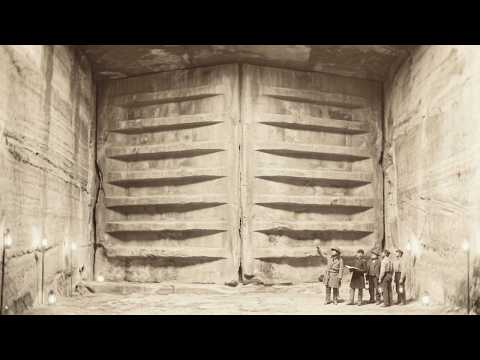
Captain Josiah R. Abbott, a methodical engineer raised on the Erie Canal, kept the blasting journal. He measured the passage at forty-six feet wide, dead level for 214 feet, and the gate at sixty-six feet high. He noted the gate’s prow faced the river—built to keep water out—and that on the near side there was no post, no beam, no ring. “No post, no beam, no ring worked from the far side,” he wrote, and then the only question mark in the entire book.
Four days later, an old Ojibwe man came down the rapids in a canoe and gave the army a warning in three parts: do not knock on it, do not build against it, do not quiet the rapids. He asked three questions of his own—did the doors lean toward the white water, was there anything to pull on, was the bottom one on the sunrise side different—and each answer confirmed what he already knew. Then he told them: the gate did not belong to his people, they did not close it, and “it will open when the rapids go quiet.”
Abbott’s journal records what happened next. They tried steel: three men drilled at the lowest lip for an hour, and the bit came out dull and blued as if it had been hot, though no one felt heat. A cold chisel broke its edge on the first blow. The stone was colder than the air around it—forty-five degrees against the chamber’s forty-nine. Travail swung a sledge against the leaf and the blow died as though it had landed in wet clay. Behind him, Strand spoke under his breath in Norwegian, then repeated it in English for the captain: “At home, they would say, this is a door in the hill. You do not knock on a door in the hill.”
By the end of July, the passage was walled up with cut stone and cement. An iron hatch was set low in the wall, and a padlock snapped through the hasp. On the drawings, a draftsman shaded a rectangle and lettered it: rock pocket filled. The journal’s final line for Station Five read: Pocket filled, work resumed.
But before the masons finished, Strand pressed his bare hand to the seam one last time. He left it there for a full minute while no one spoke. When he stepped back, he said one thing, and Abbott wrote it inside quotation marks: “There is someone on the other side listening.”
Abbott laid his own palm on the seam and described it the only way he knew how—cold, even, like the push of standing water against a gate. But there was no water. A little lower, he copied the old man’s fourth statement a second time, as though copying it might unlock it. It will open when the rapids go quiet. Under it, a short line in his own voice: The rapids here never go quiet.
He was wrong about that. Within fifty years, other men had quieted the rapids. And sixty-nine years later, when engineers opened that hatch again, the seam had moved. The gate was opening—slowly, an inch every twenty years. The men who measured it in 1942 found the gap three and three-quarter inches wide. By afternoon, it was three and seven-eighths.
They sealed it with concrete and wrote on the drawings: old void, sealed, not explored.
But the Ojibwe name for the place was never lost. It did not mean cave, and it did not mean rock. It meant where they closed themselves in.
Raymond Kessler never wrote about Station Five again. But his field book, with its careful pencil entries, outlived him. It passed through the district office, through a records center in Chicago, and finally into the hands of a historian who noticed two numbers a page apart that no one had ever compared. Three and three-quarter inches in the morning. Three and seven-eighths by afternoon. An eighth of an inch in ninety-five minutes.
For more than forty years, those figures lay dormant. Then in 1986, a volunteer for the historical society in Sault Ste. Marie sat down with Leo Paquin, then eighty-four, and asked if he had ever been inside the old lock. The tape recorder captured a long silence before Paquin spoke.
“Soon as we got in there, we taped that gap. Three and three quarters. Before we sealed it up, Mr. Kessler taped it again. Same tape, same spot. Three and seven eighths. We’d been in there an hour and 35 minutes.”
Both numbers were in Kessler’s field book. The first sat in the morning entry. The second was on the following page in the list of closing measurements, with nothing written beside it. Only the first went into his report.
When a reporter later asked Paquin what he believed he had seen down there, the old man answered the way he answered everyone.
“We closed it because we were told to, not because it was done.”
There is a version of all this that settles into comfortable categories, and it deserves its strongest form. The Jacobsville sandstone breaks along flat beds and straight joints. Cold air pours from hollows in it, and an officer raised on lock walls could see a gate in a face of dark layered rock. Magnesium light lasts seconds, and a transit read in seconds can be wrong by several feet. For 1873, there is only one written witness. The old man’s words passed through an interpreter who had been in the cut himself. Joseph Kesick spoke forty-nine years later, and memory gathers what the world adds to it. An eighth of an inch between two tape readings at the end of a long day underground is within the error of a tired hand. A vial can be emptied by a careless clerk.
Each of those points is reasonable, and none needs bad faith. But each one removes a single record and leaves the others standing. The joints explain the walls, not a level floor over 214 feet. The interpreter explains the two doors, not the question about the sunrise side from a man who never looked at the hole. A tired hand explains an eighth of an inch, not three and three-quarter inches in a seam that would not take paper.
And all of it could be settled cheaply with one borehole through the south wall of the MacArthur lock. In more than eighty years, nobody has drilled one.
The MacArthur lock still lifts ships at the Soo beside the Poe lock, and a new lock is being built beside them. Every winter, the locks close, and some chambers are pumped dry for repair. A maintenance note from February 2019 records one thing in passing. Along the south wall of the MacArthur chamber, near its western end, a strip of floor about forty-six feet wide did not take ice, though the air in the chamber stood below zero for nine days. Cause not determined.
The rapids still run, but not as they did. The sixteen gates at their head, finished in 1921, decide how much of Lake Superior goes over the ledge, and in most seasons it is a fraction of the old river. The great whitefish fishery of Bawating is gone. Where the water once ran white from bank to bank, much of the ledge now lies bare.
The Ojibwe are still here on both sides of the river. The Sault Ste. Marie Tribe of Chippewa Indians, the Bay Mills Indian Community, Garden River, and Batchewana. Children at the Soo are learning Anishinaabemowin again, and Ojibwe fishermen still set nets in waters under the treaties. What Joseph Kesick’s family knows about the place where they closed themselves in still belongs to them, and they have not chosen to give it away.
On a calm morning now, a person standing on the lock wall hears ship engines, gulls, and wind. The rapids are a low murmur off to the north. In 1873, the seam took nothing. In 1942, it measured three and three-quarter inches in the morning and three and seven-eighths by afternoon. That was the last time anyone held a tape to it.
The easy explanations are all still on the table. Jointed sandstone, an engineer’s training, an interpreter’s kindness, an old fisherman’s memory. The Ojibwe name for the place uses none of them. It does not say cave, and it does not say rock. It says what happened there: where they closed themselves in.
Families at the Sault kept more than the government did. Letters home, a grandfather’s time book, a photograph of the old wall before the new lock swallowed it. If something like that has come down to you, the record is still open. Abbott wrote that the rapids here do not stop. They have been nearly silent for a hundred years.
And the gate, sealed and forgotten, waits behind the concrete. The seam that would not take paper now stands open by an inch and a half. It will open when the rapids go quiet, the old man said. The rapids have been quiet for a century. The question is not whether the gate will open, but what will come through when it does.
In the decades since Paquin’s tape, the locks have changed hands and names. The MacArthur, built on the bones of Abbott’s pit, still lifts ore boats bound for the steel mills of Indiana and Ohio. Each winter, the chambers drain, and inspectors walk the floors with flashlights and clipboards. None of them carry a steel tape for the old seam.
But the water remembers. In 2019, a maintenance crew found that strip of floor near the south wall that refused to freeze. They noted it, shrugged, and moved on. “Cause not determined,” the report said, the same phrase Kessler’s clerk had typed seventy-seven years before.
The Ojibwe still fish the rapids under treaty rights, their nets set in the dark water below the ledge. Children learn the old stories in classrooms where Anishinaabemowin is spoken again. “Where they closed themselves in,” the elders say, and they do not point at the place.
Abbott’s journal sits in a box in Chicago, still filed under St. Clair Flats. The vial is there too, empty and corked. The photographs Kessler took of the open seam have never surfaced. The gate itself lies sealed behind concrete, its leaves apart by an inch and a half, waiting.
Somewhere under the high ground to the south, the keepers wait too. They closed the doors when the water fell and the rapids began to talk. They will open them when the rapids go quiet. The rapids have been quiet for a hundred years.
What would you do if you found something like this in your family’s papers—a letter, a photograph, a grandfather’s time book? Would you report it, or would you keep it, the way the Ojibwe have kept their part?
Report this article
Select a reason for reporting:






