The morning of June 10, 1944, dawned gray and threatening over the flooded marshlands of Normandy. Along a narrow causeway between Omaha and Utah beaches, Lieutenant Colonel Robert Cole and his paratroopers fixed bayonets. They had one order: take the bridge or die trying.
Just weeks after D-Day, the 101st Airborne Division was bleeding. The Germans had deliberately flooded the countryside, turning every approach into a death trap. The only path to Carentan—the vital junction linking the two American beachheads—was a raised road barely wide enough for men to walk abreast. Today, it is known as Purple Heart Lane.
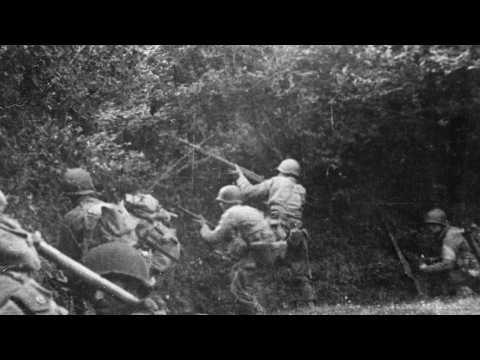
Cole, a 29-year-old Texan, had already seen his battalion decimated. German paratroopers of the 6th Fallschirmjäger Regiment, hardened veterans under Colonel Friedrich von der Heydte, waited behind machine guns and mortars. Every yard of the causeway was zeroed in. “We had no trouble with enemy fire initially,” Cole later recalled. “However, as soon as a man got along the banks here, in any number, the enemy fired quite heavily on the roadway and on the bridge.”
The first bridge was crossed swiftly, but the second had been blown. Engineers worked under fire to lay a footwalk. Men crossed one at a time, a minute apart, while German snipers picked them off. Casualties mounted. By nightfall, I Company had lost 59 of its 86 men.
At 5:15 a.m., Cole made his decision. “I thought the only solution was either to withdraw back to the bridge and take the chance of getting everybody killed withdrawing, or attack this position. So I called for artillery fire, which I received, and then issued orders for a bayonet charge.”
On the whistle, three columns of men rose from the ditches. But confusion and noise meant only about 25 men actually charged with Cole. Fortunately, 40 more who had swum the Madeleine River joined from the right. Under an artillery smoke screen, they stormed the German positions at point-blank range—rifle, pistol, grenade, and bayonet.
Within minutes, the farmhouse at Ingouf was taken. The causeway was finally open. But the fight for Carentan was far from over.
Cole wasted no time. He established his command post inside the captured farmhouse, its walls still scarred by grenade fragments and the smell of cordite hanging in every room. Wounded men from both sides lay in the farmyard, and a brief, informal truce allowed stretcher-bearers to move among them.
But the Germans had no intention of surrendering the town. From the hedgerows beyond the farm, Fallschirmjäger rear guards regrouped and began probing the exhausted paratroopers’ lines. “We expected a counterattack at any moment,” one of Cole’s officers later wrote. “We were down to a handful of men per company, low on ammunition, and running on nothing but adrenaline and coffee.”
The area just beyond the farmyard—a patchwork of fields that the men would soon nickname the cabbage patch—became the next killing ground. German mortar teams zeroed in on the farmhouse, and sniper fire cracked overhead whenever a man dared show himself.
What Cole and his men did not yet know was that their hellish advance had cracked open the German defense of Carentan. Von der Heydte’s regiment, already worn down by days of fighting, could no longer hold the causeway approach. The 6th Fallschirmjäger began a fighting withdrawal into the town itself, determined to sell every street and alley dearly.
For the men of the 502nd, the immediate task was to hold what they had won. Cole moved among his positions, redistributing ammunition and directing fire toward the cabbage patch. “The fighting went on pretty heavily until about 10:00,” Cole remembered, “and then it slackened out.”
That slackening was deceptive. It was the pause before the next storm—the fight for Carentan’s streets, where Easy Company and the 506th would soon write their own chapter. But the road was open, and the junction between Omaha and Utah was within reach.
Even as Cole’s men dug in around the farmhouse, the wider battle was shifting. To the north, the 327th Glider Infantry had clawed a foothold across the Douve, but their advance had stalled against determined resistance. The two American thrusts—Cole’s from the causeway, the glidermen’s from the north—were converging on the same prize, and neither could afford to wait.
Von der Heydte understood his predicament. His regiment had bled white since D-Day, and now the causeway line was gone. He pulled his remaining men back into Carentan’s narrow streets and ordered them to make the Americans pay for every house. “The town itself became a fortress,” one German officer later recalled. “Every window a firing point, every garden a trap.”
But Cole’s battalion was spent. The men who had charged across the open ground at Ingouf Farm were ghosts of the unit that had landed on D-Day. Companies H and G could muster barely a hundred riflemen between them. Ammunition was critically short, and the promise of resupply seemed a cruel joke.
It was during this lull that Cole received orders that would shape the final push. The 506th Parachute Infantry—including Easy Company—would take the lead into Carentan itself. Cole’s men were to hold the causeway and the farm, securing the flank and keeping the supply route open. The hellish lane they had fought across would now become the lifeline for the entire division.
Colonel Cole walked the line that evening, stopping at each foxhole. “He didn’t say much,” a sergeant remembered. “Just asked if we had enough ammo, if the men were holding up. But you could see it in his eyes—he knew what was coming.”
What was coming arrived before dawn on June 12. German artillery, massed beyond the town, opened a barrage that turned the farmyard into a cratered moonscape. The paratroopers pressed themselves into the earth and prayed. Then, as suddenly as it began, the shelling lifted—and through the smoke came the sound of engines.
German infantry, supported by a handful of assault guns, surged toward the farm. Cole’s men met them with rifle fire and grenades, fighting from the same hedgerows they had stormed just days before. The line bent but did not break. “We held,” Cole later said simply. “That’s all there was to it. We held.”
By mid-morning, the counterattack had spent itself. The Germans withdrew, leaving their dead in the fields. And on the horizon, moving up the causeway that Cole’s men had opened at such cost, came the first American tanks—Shermans of the 2nd Armored Division, rolling toward Carentan.
The tanks rumbled past the farmhouse in a cloud of dust and diesel smoke, their commanders waving down at the grimy, hollow-eyed paratroopers. For Cole’s men, it was the first good news in days. The causeway—Purple Heart Lane—was no longer a killing ground. It was a highway.
With armor support, the 506th pushed into Carentan’s outskirts. Street by street, house by house, the Fallschirmjäger rear guard fought with the desperation of men who knew they were buying time. But the momentum had shifted. “By the 13th, the center of town was ours,” Cole recalled. “The Germans pulled back, and we let them go. We were too tired to chase.”
The junction between Omaha and Utah was finally secure. The two American beachheads had been linked, and the liberation of Normandy could truly begin. For the men of the 101st, it was a moment of grim satisfaction—and exhaustion beyond words.
In the weeks that followed, Cole returned to the causeway with newsreel cameras in tow. Standing on the same ground where he had led the bayonet charge, he recounted the fight for history. The footage shows a lean, serious officer, his uniform pressed, his voice steady. “We did what we had to do,” he said into the microphone. “The men did the rest.”
His leadership that day would be recognized with the Medal of Honor. The citation praised his “indomitable courage and aggressive leadership,” noting that he had “personally led the assault which broke the enemy line.” But Cole would never wear the medal.
Just three months later, during Operation Market Garden, the 29-year-old Texan was shot and killed by a German sniper while leading his men near Best, Holland. He died as he had lived—at the front, with his soldiers.
Today, Lieutenant Colonel Robert Cole rests in the Netherlands American Cemetery at Margraten, alongside more than 8,000 of his comrades. His grave is marked by a simple white cross, one among thousands. But for those who know the story of Purple Heart Lane, his name carries a weight that stone cannot measure.
The road between Omaha and Utah is quiet now. The floods are gone, the bridges rebuilt, the farmhouses restored. But if you stand on that causeway at dawn, when the mist rises off the marsh and the light is gray and uncertain, you can almost hear the whistles blowing, the bayonets clicking, and the voice of a young colonel shouting, “Charge!”
What do you think—was Cole’s bayonet charge the turning point of the Normandy campaign, or just one of many desperate stands that history has half-forgotten? Let us know in the comments below.
Report this article
Select a reason for reporting:






