Dr. James Crawford had examined thousands of antebellum photographs, but on that February morning in 2024, one daguerreotype stopped him cold. It was a formal portrait of the Caldwell family of Richmond, Virginia, dated September 1856—wealthy tobacco merchants posed with their two daughters in an opulent parlor. But it was the young enslaved boy standing rigidly to the right, barefoot on the patterned carpet, who caught his eye. His name, according to the case notation, was Benjamin. Seven years old.
James zoomed in on the boy’s hands, enlarged the image until the fingers filled his screen. There, partially concealed between Benjamin’s curved fingers, was a small metal object. A key. The type used for locks on shackles and chains.
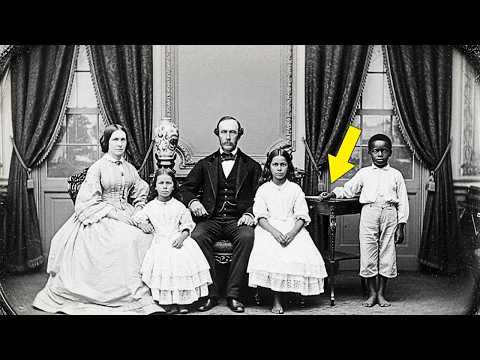
James’s heart pounded. This wasn’t just a family portrait. It was an act of resistance, frozen in silver and glass. What did this key unlock? How had Benjamin obtained it? And what had he planned to do?
He spent the next three days digging through archives. The Caldwell ledgers listed Benjamin as property—age seven, house servant, son of Rachel, cook, and Samuel, field worker, deceased, 1854. A household inventory noted “iron restraints, two sets, chains, locks for security and discipline.” Then a letter from Eleanor Caldwell to her sister, dated August 1856: “We have had troubles with Rachel’s boy… The boy witnessed his father’s punishment and has not been the same since.”
James’s jaw clenched. Samuel’s death hadn’t been from illness. It had been from violence—and Benjamin had seen it happen.
He searched further and found a diary entry from Thomas Caldwell, October 12, 1856—just weeks after the photograph. “Discovered theft of basement key… Rachel’s boy, Benjamin, questioned. Object recovered. Severe measures required… Boy to be sold south immediately.”
James felt sick. Benjamin had been caught. And the consequence was being sold south—separated from his mother, sent to the brutal sugar plantations of Louisiana where enslaved children often didn’t survive a year.
But there had to be more. What had Benjamin actually done with the key before being discovered? James contacted Dr. Monica Price, an expert in tracing the sales of enslaved people. Together they found a bill of sale: November 1856, New Orleans—Benjamin purchased by a Mr. Henri Devereux of St. Charles Parish. A sugar plantation known for its deadly conditions.
Then, a twist. Benjamin’s name appeared again in the records, transferred after only four months—to a free woman of color named Josephine Laurent. She had purchased him for $600 in March 1857. James stared at the screen. Why would a free woman of color pay such a sum for a seven-year-old boy?
The answer lay in Josephine’s papers: a letter dated February 1857. “I have received word through our network that Rachel’s son is here in Louisiana… Rachel has asked if anything can be done. I’m making arrangements to purchase the boy. The sum is considerable, but we cannot leave him to die in that hell.”
James sat back, stunned. Rachel, still enslaved in Virginia, had somehow sent word through a resistance network to save her son. And Josephine Laurent was part of it.
But what had Benjamin done with the key? James found the answer in the memoir of a formerly enslaved woman, Harriet Jacobs, published in 1861. “In Richmond, I met a woman named Rachel… Her young son sold away after he unlocked chains meant for runaways, helping two souls reach freedom before he was discovered.”
There it was. At seven years old, Benjamin had used that key to free two people—before being torn from his mother and sent to almost certain death.
James flew to New Orleans, delving deeper into Josephine Laurent’s records. She had kept Benjamin in her household, educated him, and planned to free him when safe. Letters between Josephine and Rachel, carefully coded, revealed a mother’s desperate gratitude and a son’s remarkable progress. “He learns his letters with remarkable speed… The key he carried in his heart has become a key to knowledge.”
By 1862, Union forces captured New Orleans. Benjamin, age 13, was formally manumitted and immediately sought work with Union forces, establishing schools for formerly enslaved people. He was already following his parents’ legacy.
But what happened to Rachel? James returned to Virginia, searching for her story. He found that she had remained in the Caldwell household, but her resistance had only deepened. Records from the First African Baptist Church showed she provided “sustenance to travelers”—code for helping freedom seekers. A letter from Thomas Caldwell to Richmond authorities in September 1856 reported “suspicious activity” and a missing key. “My cook Rachel has been observed meeting with individuals of questionable character… I request investigation.”
Rachel had been helping people escape. Samuel’s murder in 1854 was likely because the Caldwells discovered his role. And Benjamin, at seven, had stolen a key to continue his parents’ work.
During the Civil War, Rachel became a Union spy. Elizabeth Van Lew’s coded records noted: “Our sister at the Caldwell House continues providing intelligence regarding Confederate supply movements.” Union Army records confirmed her contributions.
After the war, in May 1865, Rachel’s name appeared in Freedmen’s Bureau records: “Rachel, aged 39, formerly enslaved by Caldwell family, seeking information regarding son Benjamin, last known to be in Louisiana.” Her first act of freedom was to find her son.
And she did. A letter from Benjamin to Reverend John Jasper, October 1865, revealed the reunion: “My mother, Rachel, arrived in New Orleans last week… We embraced for the first time in 9 years. We are together now and both free.”
James sat back, overwhelmed. They had survived. But the story still wasn’t complete. What happened to them during Reconstruction? James needed to know.
James returned to the Freedmen’s Bureau archives with renewed urgency, pulling every document that mentioned either name. New Orleans had been a major center for educating formerly enslaved people, and the records were voluminous—but Benjamin’s name surfaced again and again. By 1866, at age seventeen, he was already teaching basic literacy to adults and children in the Tremé neighborhood. By eighteen, he had become head teacher at a Freedmen’s school there.
Rachel’s name appeared in the same ledgers. She taught domestic skills and literacy to formerly enslaved women, helping them navigate the bewildering mechanics of freedom—contracts, wages, the terrifying business of negotiating with white employers who had once owned them.
But James found something else, something that made him lean forward. Both Benjamin and Rachel were listed as members of the Louisiana Equal Rights League, an organization founded by free people of color and formerly enslaved people to fight for voting rights and equal treatment under the law.
In the league’s meeting minutes from 1867, a newspaper account preserved in the New Orleans Tribune reported a speech given by an eighteen-year-old Benjamin Freeman. James read it slowly, twice.
“I stand before you as proof that the chains which bound our people could never bind our spirits. At seven years old, I held a key—a small piece of metal that I used to unlock shackles and help two souls reach freedom. I was punished terribly for that act. I was torn from my mother’s arms and sent to die in the cane fields. But I survived.”
James felt the words settle over him. Benjamin had chosen the surname Freeman himself after emancipation—symbolic, obviously. And here he was, barely a man, declaring to hundreds that freedom meant nothing without equality.
“Every book we open is a key. Every word we teach is a key. Every right we claim is a key that unlocks the chains they tried to bind us with.”
The speech had been met with a standing ovation and reprinted in abolitionist newspapers across the North. James traced Benjamin’s life through the 1870s and 1880s. In 1872, Benjamin married a woman named Katherine. They had four children—Marcus, Sarah, Thomas, and Ruth, named after Benjamin’s mother. He continued teaching, became involved in Republican Party politics during Reconstruction, and fought for Black voting rights and representation.
Rachel lived with Benjamin’s family, helping raise her grandchildren and continuing to teach. She lived to see her son become a respected educator and community leader.
Then James found Rachel’s obituary from 1889 in the New Orleans Tribune. “Mrs. Rachel, age 63, passed peacefully surrounded by family. Born into slavery in Virginia, she was known for her courage during the antebellum years, helping numerous freedom seekers escape bondage at great personal risk. Her husband Samuel was killed for teaching enslaved people to read. Her son Benjamin was sold away at age seven after using stolen keys to help two people escape slavery. Separated for nine years, mother and son reunited after the war.”
She had often said that the key to freedom was education, and she had spent her life proving it.
Benjamin lived until 1914, dying at age sixty-five. His obituary listed extraordinary accomplishments: founder of three schools for Black children in New Orleans, service in the Louisiana State Legislature during Reconstruction, two books on education and civil rights, and hundreds of students who themselves became teachers and leaders.
But one detail struck James most powerfully. “He was known to keep in his desk a small iron key, which he said was a reminder of where he came from and why education mattered. He told his students it was the first key to freedom he ever held.”
Benjamin had kept that key his entire life—the same key visible in the 1856 daguerreotype, the key he had used at age seven to free two people. The obituary mentioned four children. Could any of their descendants still be in New Orleans?
James contacted Dr. Kendra Williams, a genealogist specializing in African American family histories in Louisiana. When he explained what he had discovered, Kendra was immediately interested. Benjamin’s chosen surname, Freeman, made the search both easier and more complicated—a common name, but a distinctive story attached to it.
Kendra searched through census records, birth certificates, marriage licenses, and death certificates, building a family tree that extended from Benjamin and Katherine’s four children down through five more generations. Three weeks later, she called James with news.
“I found them. Benjamin Freeman has living descendants in New Orleans. His great-great-granddaughter is named Denise Freeman Carter. She’s a teacher—actually, she’s a principal at a public elementary school. I reached out to her, told her about your research. She wants to meet you.”
James flew to New Orleans immediately.
Denise Freeman Carter met him in the hallway of her school, where photographs of Black educators lined the walls. She was in her mid-fifties, with warm eyes and a commanding presence. Among the portraits, James recognized one instantly—Benjamin Freeman in his later years, standing with a group of students.
“That’s my great-great-grandfather,” Denise said proudly. “Growing up, we heard stories about him. How he’d been enslaved as a child, separated from his mother, survived somehow, and came back to dedicate his life to education. Education was our family’s legacy, our resistance, our power.”
James showed her the daguerreotype. Denise stared at it for a long time, her hand over her mouth. “That’s him,” she whispered. “My god, look how small he was.”
He zoomed into Benjamin’s hands. When she saw the key, tears filled her eyes. James explained everything—the stolen key, the two people freed, the brutal sale south, Josephine Laurent’s rescue, the nine-year separation, the reunion.
Denise stood abruptly. “Wait here.” She returned ten minutes later carrying a small wooden box, old and carefully preserved. “This has been passed down in our family for generations. It was Benjamin’s. When my grandmother died, she left it to my mother, and my mother gave it to me when I became a teacher. She said it represented who we are.”
She opened the box. Inside, wrapped in aged cloth, was a small iron key.
James stopped breathing. “That’s it. That’s the key from the photograph.”
Denise lifted it carefully. “We always knew this key was important, but the details had gotten fuzzy over generations. We knew Benjamin had been enslaved, that he’d been separated from his mother, that he’d become a teacher. But we didn’t know about this photograph, or exactly what the key had been used for.”
She held it up to the light. “This key unlocked chains. It freed two people. It cost my great-great-great-grandfather his childhood, and he kept it for sixty years as a reminder.”
Six months later, James stood in the Smithsonian’s National Museum of African American History and Culture, watching visitors move through the new special exhibition: The Key to Freedom: Benjamin Freeman’s Story of Resistance and Education. The original daguerreotype hung large on the wall. The centerpiece was a glass case containing the key itself, loaned by Denise Freeman Carter.
But the moment that mattered most came when Denise brought her students—thirty children, ages seven to ten, the same age as Benjamin in the photograph. One little girl raised her hand. “Miss Denise, was Benjamin scared?”
Denise knelt down. “Yes, baby. He was terrified. He knew if he got caught with that key, terrible things would happen. But he did it anyway because two people needed help and he had the power to help them.”
“That’s brave,” the girl said softly.
“It is brave. And you know what? Benjamin was your age. He proved that even children have power, even in the darkest circumstances. Education is still a key—the most powerful key there is. All of you hold that key every time you open a book.”
James thought of that February morning when he’d first zoomed into Benjamin’s hands. How easily it could have been missed. But it hadn’t been. The key had been found. The story had been told. And now Benjamin’s legacy lived on—in classrooms across the country where children learned that they too held keys, that they too had power.
The photograph meant to display the Caldwells’ wealth had instead become a testament to the courage of the child they tried to treat as property. Benjamin’s small hand clutching that forbidden key spoke a truth the Caldwells never intended to preserve: that the people they enslaved were not passive, not defeated, not property. They resisted. They fought. They held keys—both literal and metaphorical—and they unlocked doors that slaveholders tried desperately to keep closed.
The key remained in its case at the Smithsonian. Every day, visitors stood before it, seeing not just a historical artifact, but a reminder. We all hold keys. And the question isn’t whether we have power—it’s what we choose to unlock. So what key are you holding today, and what door will you open?
Report this article
Select a reason for reporting:






