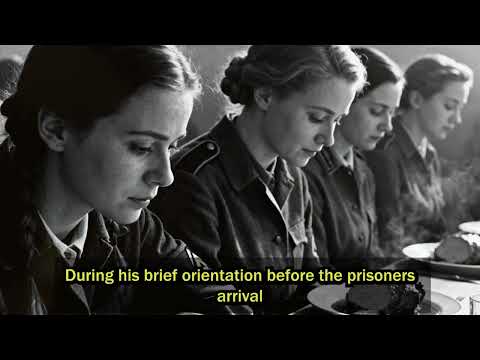
November 18th, 1944. A cold Wednesday evening at a makeshift prisoner of war facility outside Fort Meade, Massachusetts. In a sparse dining hall lit by harsh overhead bulbs, 57 German women sat frozen in their chairs, staring at the metal trays placed before them. The scene would have looked ordinary to any American observer—just another routine dinner service. But to these women, members of the German Women’s Auxiliary Corps captured during the Allied advance through France, what lay on those trays defied everything they understood about war, captivity, and reality itself.
Ilse Neumann, a 23-year-old former teacher from Berlin, gripped the edge of the table so tightly her knuckles turned white. On her tray sat a thick slice of roasted pork, its surface glistening with rich brown gravy. Beside it, a generous portion of mashed potatoes crowned with a pat of real butter that was already beginning to melt into golden pools. Green beans—not the wilted scraps she remembered from home—but vibrant and plentiful. A slice of white bread, soft and fresh, accompanied by another pat of butter. And in a small bowl, apple compote that smelled of cinnamon and sugar.
Next to her, Hannelore Steinberg, a 21-year-old seamstress from Leipzig, whispered in German, “Ilse, is this real? Are we meant to eat all of this?” Her voice carried a tremor of something between hope and fear, as if touching the food might make it vanish like a cruel mirage.
Across the table, Ingeborg Lehmann, a 27-year-old pharmacist assistant from Hamburg, simply stared at her tray with tears streaming down her face. She made no sound, but her shoulders shook with silent sobs she could not control. The youngest among them, 19-year-old Christa Bergmann from Nuremberg, looked around the dining hall with wide, confused eyes. “Is it a holiday?” she asked. “Is it someone’s birthday? Why would they give us this?” Her question hung in the air unanswered because none of them could fathom an explanation that made sense.
In their experience, in the Germany they had left behind, food like this appeared only in memories of peacetime or in propaganda posters promising victory—certainly not on the plates of prisoners of war.
Captain Margaret Sullivan stood near the doorway observing the scene with growing concern. She had anticipated many reactions to the prisoners’ arrival—defiance, fear, anger, perhaps even relief. But this stunned silence, these tears, this visible disbelief at a standard military meal troubled her in ways she had not expected. She exchanged glances with Private Chester Drummond, a farm boy from Iowa assigned to the facility just weeks earlier. His young face reflected his own confusion. “Ma’am,” he whispered, “why aren’t they eating? The food’s getting cold.”
Captain Sullivan shook her head slowly, beginning to understand something profound about the women before her. “Private,” she said quietly, “I don’t think they believe it’s real.”
Forty-eight hours earlier, the 57 German women had stepped off a military transport ship at Boston Harbor. Their first moments on American soil were marked by November wind cutting through their worn auxiliary uniforms. They had spent three weeks crossing the Atlantic in the cargo hold of a converted freighter, sleeping on narrow bunks and surviving on meager rations that barely kept hunger at bay. The crossing had been rough, and many of them spent days too seasick to eat what little was offered. Now, standing on the dock with their few possessions clutched in small bags, they faced an uncertain future in a land they had been taught to view as the enemy.
Ilse Neumann had kept a small notebook hidden in her jacket pocket throughout the journey, though she had nothing to write with anymore. She had been a teacher of literature in Berlin before joining the Women’s Auxiliary Corps in 1943, believing she was serving her country’s defense by working as a communication specialist. Now, at 23, she found herself a prisoner in a nation she knew only through propaganda films and official government statements.
Everything she had been told about America painted it as a place of poverty and moral decay, where citizens struggled for basic necessities while their government waged an unjust war across Europe. The reality confronting her at Boston Harbor contradicted those teachings in subtle but unsettling ways. The American soldiers processing their arrival were efficient but not cruel. The dockworkers going about their business looked well-fed and adequately clothed despite the country being at war. The vehicles that transported them inland appeared functional and maintained, not the desperate patchwork of failing machinery she had expected. These observations created small fissures in the foundation of everything she believed, though she tried to dismiss them as mere surface appearances.
Hannelore Steinberg, the seamstress from Leipzig, noticed different details. Having worked with fabrics her entire life, she could not help but observe the quality of the American uniforms. The weave was tight and even, the material substantial—rather than the increasingly thin and recycled fabrics she had been working with in Germany for the past two years. Even the ordinary workers on the dock wore clothing that showed no signs of the desperate mending and make-do repairs that had become universal back home. It was a small thing, perhaps, but small things often revealed larger truths.
When they arrived at the facility outside Fort Meade after a six-hour drive through the Massachusetts countryside, exhaustion had dulled their capacity for observation. Captain Sullivan met them at the gate, her bearing military but her expression revealing something closer to concern than hostility. She addressed them in English, which Sergeant Daniel Castillo then translated into careful German. They would be housed in barracks, assigned work duties, and treated according to the Geneva Convention. What none of them understood yet was that their treatment would exceed those minimum standards in ways that would challenge everything they thought they knew.
To understand the women’s reaction to that first meal, one must understand the hunger that had become their constant companion long before capture. Hannelore Steinberg’s story was typical of what many of them had experienced in the final years of the war. In Leipzig, where she had worked as a seamstress in a factory producing military uniforms, the ration system had steadily deteriorated throughout 1943 and 1944. What began as modest restrictions evolved into a daily struggle for basic sustenance that consumed every thought and shaped every decision.
Her official ration card entitled her to 250 grams of bread per day, though the bread itself had changed dramatically over the years. Real wheat flour had long since been replaced by a mixture that included sawdust, chestnuts, and whatever other fillers the bakers could incorporate while still producing something that held together enough to be called bread. It was gray, dense, and often caused stomach problems, but it was better than nothing. Her weekly allotment of meat had shrunk to 100 grams, usually in the form of sausage that bore only a distant relationship to actual meat. Fat, butter, and milk existed only in memory for most civilians by 1944.
The ersatz coffee that had become universal throughout Germany was made from roasted acorns, chicory, and occasionally barley. It tasted nothing like real coffee, but it was hot and gave the illusion of a proper breakfast. Hannelore had not tasted real coffee since 1941, and even then it had been mixed with substitutes to stretch the limited supply. Sugar had become so precious that mothers saved their tiny rations for weeks to bake a small cake for a child’s birthday, using even that sparingly and substituting saccharin when possible.
The constant hunger created a psychological state that was difficult for those who had never experienced it to understand. It was not the sharp, immediate hunger of missing a single meal, but a grinding, perpetual emptiness that never completely went away even after eating. Hannelore’s workdays at the uniform factory were punctuated by thoughts of food, memories of meals from before the war, and elaborate fantasies about what she would eat when the promised victory finally arrived and normal life resumed. Her coworkers engaged in the same mental exercises, sometimes spending entire lunch breaks describing in detail the Christmas dinners of their childhood—meals that now seemed impossibly luxurious.
When she joined the Women’s Auxiliary Corps in early 1944, it was partly motivated by the promise of slightly better rations for those in military service. The additional 100 grams of bread per day and the possibility of occasional access to military kitchens made the decision practical, not just patriotic. By the time she was captured in France that October, she had lost nearly 15 kilograms from her already slender frame. The hunger had become so normalized that she no longer consciously registered it most of the time. It was simply the background condition of existence.
The morning after their arrival brought the first true shock to their understanding of American captivity. Christa Bergmann woke before dawn in the barracks, her internal clock still adjusted to the rigid schedule of her previous posting. At 19, she was the youngest among the prisoners, a telegraph operator from Nuremberg who had joined the auxiliary service straight from technical school. She had expected to be roused by harsh commands and marched to whatever labor the Americans had planned for them. Instead, she woke to relative quiet and the unprecedented luxury of being allowed to sleep until a reasonable hour.
When a bell finally rang at 6:30 in the morning, the women rose and prepared themselves with the mechanical efficiency of military routine. They were directed to the same dining hall where they had received dinner the previous evening—though most of them had barely touched that meal, still uncertain whether it was real or some kind of psychological test. This morning, the uncertainty remained, but hunger had begun to override caution. They had not eaten properly in days, and their bodies were making demands their minds could not ignore.
What awaited them at breakfast defied comprehension even more than dinner had. On each tray sat two fried eggs, their yolks golden and intact. Three strips of bacon, crispy and fragrant. Two slices of toast made from genuine white bread, accompanied by small containers of butter and strawberry jam. A portion of fried potatoes and a cup of real coffee—black and strong—with small containers of cream and sugar available on each table. The quantity alone would have been shocking, but the quality made it almost obscene to women who had been surviving on ersatz coffee and bread that was more sawdust than grain.
Ingeborg Lehmann, the pharmacist assistant from Hamburg, picked up her fork with trembling hands. At 27, she was older than many of the others and had clearer memories of life before the war’s privations. She cut into one of the eggs, watching the yolk run across the plate in a rich yellow stream that seemed almost indecent in its abundance. She brought the fork to her mouth and closed her eyes as she tasted real egg for the first time in over three years. The flavor was so intense, so full of life, that she had to set down her fork and simply breathe for a moment to steady herself.
Around her, similar scenes played out. Some women ate slowly, savoring each bite as if it might be their last. Others ate quickly, driven by a hunger so deep that even this generous portion barely seemed adequate. A few still could not bring themselves to eat, convinced that accepting American generosity represented some form of betrayal—or that the food must be conditional on some demand they did not yet understand.
Private Chester Drummond watched the German women eat their breakfast with growing confusion. The 20-year-old farm boy from Iowa had been raised on meals far more substantial than what these prisoners were receiving, and he genuinely could not understand their stunned reactions. To him, eggs and bacon represented a standard morning meal—nothing special or particularly generous. His mother prepared similar breakfasts every day for his family back home, often with even larger portions when his father and brothers needed fuel for a long day of farm work.
During his brief orientation before the prisoners’ arrival, Captain Sullivan had mentioned that the women might be malnourished and should be monitored for signs of illness. But Drummond had interpreted that as a general precaution, not as an indication that these women had been living on the edge of starvation. Now, watching them react to ordinary food with tears and trembling hands, he began to understand that something fundamental separated his experience of the world from theirs. The concept of daily abundance that he took for granted was apparently completely foreign to them.
Sergeant Daniel Castillo, a 32-year-old Mexican-American from Texas, had a different perspective. His family had experienced genuine poverty during his childhood, and he remembered times when meals were sparse and uncertain. But even in those difficult years, his mother had managed to provide something substantial most days—beans, tortillas, whatever vegetables they could grow or afford. The hunger he remembered from childhood was occasional and temporary, not the grinding, constant deprivation that these German women’s faces suggested they had endured for years. He approached Captain Sullivan after breakfast as the prisoners filed out to their barracks. “Ma’am, I don’t think they believe this is normal. They think we’re fattening them up for something or that this is special treatment before interrogation.”
Sullivan nodded slowly, her expression thoughtful. “I’m beginning to realize that, Sergeant. The intelligence reports mentioned food shortages in Germany, but seeing their reaction makes me wonder if we truly understood the scale of their deprivation.”
Dr. Howard Lindstrom, the camp’s medical officer, had conducted preliminary health examinations of all the prisoners upon arrival. His findings troubled him deeply. Nearly every woman showed signs of prolonged malnutrition. Many had vitamin deficiencies visible in their skin and hair. Several had dental problems related to inadequate nutrition. Their average weight was significantly below what would be considered healthy for their heights and ages. These were not women who had experienced a few weeks of reduced rations during transport. These were women whose bodies bore the evidence of years of inadequate food.
He shared his observations with Captain Sullivan that afternoon. “Margaret, if we continue feeding them standard military rations, we need to do it gradually. Their digestive systems may not be able to handle rich foods immediately after prolonged deprivation. We should start with smaller portions and work up to normal servings over a few weeks.” Sullivan agreed, though she realized this created an unusual situation. They would need to deliberately give prisoners less food than regulations required—not as punishment, but as medical necessity.
That night, unable to sleep despite her exhaustion, Hannelore Steinberg lay in her narrow bunk and allowed herself to remember bread. Real bread. The kind she had known as a child in Leipzig before the war transformed everything. Her father had owned a small bakery, and she had grown up surrounded by the smell of yeast and flour, watching him work with an artisan’s pride to create loaves that satisfied both eye and palate. Those memories had sustained her through years of eating the gray, dense substitute that barely deserved the name.
She remembered being seven years old, standing on a stool in her father’s bakery, watching him knead dough with strong, practiced movements. He would let her help sometimes, her small hands pressing into the soft, elastic mass while he guided her movements. “Feel how it comes alive under your hands, Hannelore,” he would say. “Good bread is not just flour and water. It is patience and respect for the process.” The loaves that emerged from his ovens were golden and crusty, with interiors so light and tender that they seemed to melt on the tongue.
By 1939, when she was 16, her father’s recipes had already begun to change. Regulations required bakers to add potato flour to stretch the wheat supplies. The resulting bread was heavier, denser, but still recognizable as proper bread. Her father adapted, learning to work with the mandated mixtures while still producing something he could be proud of. But each year brought new restrictions, new substitutes, new compromises with quality that troubled him deeply.
In 1941, the bakery closed. There was no longer enough flour allocated to small, independent bakers. The government directed all grain to large industrial bakeries that could produce the maximum quantity with the minimum ingredients. Her father found work in one of these facilities, but he came home each evening looking defeated, ashamed of what he was forced to create. The bread they produced was gray-brown, studded with visible chunks of sawdust and wood pulp held together more by desperate chemistry than by any natural process.
Hannelore had eaten that bread for three years before joining the auxiliary service. She had forced it down despite the way it sat heavy in her stomach, despite how it sometimes caused cramps and digestive problems. She had eaten it because the alternative was hunger, and hunger was worse. She had watched her mother slice it thin to make the ration last longer, had seen her younger brother cry because he was still hungry after finishing his portion, had learned to chew each bite thoroughly to extract maximum satisfaction from minimum substance.
The white bread she had been served at breakfast that morning was so far beyond those memories that it seemed to exist in a different reality entirely. Soft, light, with a subtle sweetness that came from actual wheat flour—and perhaps a touch of milk. When she had spread butter on it—real butter, not the rancid fat substitute they had been using in Germany—she had experienced something close to grief for all the years of deprivation, for her father’s lost pride, for the simple pleasure of good bread that had been stolen from an entire nation.
On their third day, Ingeborg and five others were assigned to kitchen duty. When Corporal Whitney opened the storage room, she gripped a shelf to steady herself. “We’re actually running a bit low this week,” he apologized through Castillo’s translation. Running low. She wanted to laugh or cry. He wanted twenty kilograms of potatoes peeled—for one meal—an amount that would have been rationed across families for a week.
That evening, Ilse sat before blank paper, struggling to write home. How could she describe this without sounding delusional? “Dear Mama and Papa, everything we were told was a lie.” The words lived only in her mind, never on the page.
Then came the Sunday pork roast, and something in Ilse broke loose. If the Americans could feed prisoners this well, what did it mean about everything else she had been told? Across the dark barracks, Ingeborg whispered, “What if everything we were told about America was false? What does that mean about everything else?” The question hung unanswered, because no answer existed that did not demand they reconsider who they truly were.
What would you have done, waking to a world where everything you believed had been a lie?
Report this article
Select a reason for reporting:






