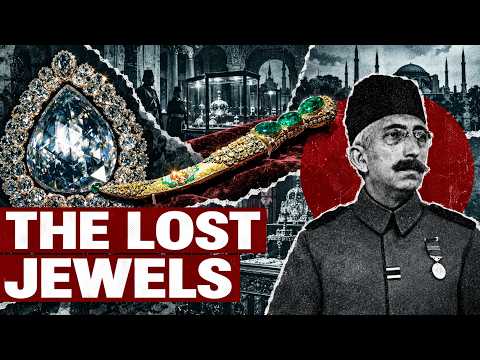
Imagine an empire that lasted over 600 years, stretched across three continents, and accumulated a treasury so vast that even the greatest kingdoms of Europe looked on with envy. Now imagine that empire collapsing in the span of a single generation. What happened to the diamonds, the emeralds, the golden thrones, and the sacred relics that once filled the vaults of the most powerful Islamic dynasty the world had ever seen?
This is a story about treasure, but it is also a story about power, betrayal, revolution, exile, and the cold political arithmetic that decides who gets to keep the spoils when an empire dies. Because when the Ottoman Empire finally fell, its crown jewels did not simply vanish. They were scattered, seized, auctioned off to the highest bidder, smuggled across borders, locked behind museum glass, and in some cases, lost entirely to the fog of history.
Some of those jewels sit right now in the Smithsonian in Washington. Others are still on display in Istanbul. And some, well, nobody really knows where they ended up.
So, let us go back. Let us start at the beginning. Because to understand where the Ottoman crown jewels went, you first need to understand how staggering they were and where they came from.
The Ottoman Empire, at its height, was one of the richest civilizations on the planet. When Sultan Mehmed II conquered Constantinople in 1453, he did not simply capture a city. He captured the capital of the Eastern Roman Empire, a city that had been accumulating wealth for over a thousand years. The gold, the icons, the relics, the art—all of it became Ottoman property overnight. And this was just the beginning.
Over the next several centuries, every military victory, every territorial expansion, every diplomatic gift, and every tribute payment added to the imperial treasury. By the time the empire reached its peak under Suleiman the Magnificent in the 1500s, the collection was almost incomprehensible in its scale.
And the wealth did not come only from conquest. The Ottomans sat at the crossroads of global trade. They controlled the Silk Road. They taxed the flow of spices, textiles, and precious metals between Asia and Europe. They received tribute from vassal states across three continents. And their court workshops employed the finest goldsmiths, jewelers, and lapidaries in the Islamic world—artisans who could transform raw gemstones into objects of breathtaking beauty.
Under Suleiman, the treasury swelled to almost mythological proportions. Ambassadors from European courts who visited Istanbul wrote back to their kings in a state of shock, describing thrones covered in rubies, walls draped in silks, and ceremonial objects studded with diamonds that put the jewels of Christendom to shame. The Venetians, themselves no strangers to wealth, called the Ottoman court the most magnificent spectacle on Earth. And at the heart of all this splendor was the man they called the Magnificent, wearing robes sewn with gold thread and a turban crowned with an aigrette of diamonds and feathers that caught the light with every movement.
The center of this collection was the Topkapi Palace, constructed between 1460 and 1478 by Mehmed II himself. Topkapi was not just a residence. It was the administrative nerve center, the ceremonial heart, and the ultimate vault of the Ottoman state. Deep inside its third courtyard sat the imperial treasury, known in Ottoman Turkish as the Hazîne-i Hümâyun. According to palace law, the sultan himself was the only person permitted to enter the treasury alone. If anyone else needed access, a group of no fewer than 40 men had to enter together—a safeguard designed to prevent theft.
Now, here is something that makes the Ottoman collection different from, say, the British Crown Jewels. The Ottomans did not have a single fixed set of regalia that passed from ruler to ruler. There was no single crown, no single scepter, no single orb. Instead, the treasury was a living, breathing collection, constantly being restocked with new commissions, spoils of war, diplomatic gifts, and masterworks from the empire’s vast network of artisans. Each sultan added to it, and the collection grew with every generation.
And the pieces themselves were extraordinary. Let us talk about a few of them.
The most famous item in the entire Ottoman treasury is probably the Spoonmaker’s Diamond, a massive 86-carat pear-shaped diamond surrounded by 49 smaller old mine cut diamonds arranged in two rows. It is considered the fourth largest diamond of its kind in the world. Its origins are wrapped in legend. One story claims that a poor fisherman found it in a rubbish heap near the old city walls and traded it for three wooden spoons, not realizing what he had. Another account says it was purchased from Napoleon Bonaparte’s mother, Laetitia, after Napoleon was exiled to the island of Elba. She supposedly sold the diamond to save her son, and it eventually made its way through the hands of European royalty until the Ottomans acquired it. The truth is that nobody really knows for certain how the diamond ended up in the Topkapi treasury, but it has been there since at least the 17th century, and it remains there today.
Then there is the Topkapi Dagger, one of the most recognizable artifacts in the world, partly because it inspired the 1964 heist film of the same name. This dagger was crafted in 1746 by Ottoman goldsmiths on the orders of Sultan Mahmud I. It was intended as a gift for Nader Shah, the ruler of Persia. The dagger’s handle is set with three enormous Colombian emeralds of exceptional color and clarity, and hidden beneath one of those emeralds is a small English pocket watch. The sheath is covered in rows of smaller diamonds. It is, by any measure, a masterpiece of the highest artistic traditions of the Ottoman world. But the dagger never reached its intended recipient. While the Ottoman embassy was still en route to the Persian border, word arrived that Nader Shah had been assassinated. The ambassadors turned around and brought the dagger back to Istanbul, where it was placed in the Imperial Treasury. It has never left.
Beyond these showpieces, the Treasury held thousands of other items. Golden thrones encrusted with rubies and turquoise, ceremonial swords set with precious stones, prayer beads carved from single blocks of emerald, jeweled quivers and arrow cases, aigrettes covered in diamonds that were pinned to the Sultan’s turbans, and armor so lavishly decorated that it seemed designed more for ceremony than for war. The collection also included the holy relics of the Prophet Muhammad—sacred items of immense spiritual significance, including the Prophet’s mantle, his sword, a hair from his beard, and his footprint pressed into stone. These relics were kept in a special chamber of the Topkapi and are still there today.
So, the Treasury was vast, layered, and deeply intertwined with the identity of the Ottoman state itself. And that is precisely what made its fate so complicated when the empire began to crumble.
The decline did not happen overnight. It was a slow, agonizing process that unfolded over more than a century. By the 1820s, the Greeks had won their independence. By the 1870s, the Balkans were in revolt. Egypt had already become semi-independent under the dynasty of Muhammad Ali. And European powers—Britain, France, Russia, and Austria-Hungary—were circling the weakened empire like creditors around a debtor, each looking to carve off territory or extract concessions.
By the 19th century, the Ottoman Empire was already being called the sick man of Europe. Its territories were shrinking, its military was falling behind, and its finances were in a state of perpetual crisis. The empire owed enormous debts to European banks, and the pressure to modernize was relentless. In the 1850s, the sultans abandoned the Topkapi Palace as their primary residence and moved to the Dolmabahçe Palace, a lavish new structure built on the shores of the Bosphorus in the European style. But even as the sultans left Topkapi, the treasury remained. The jewels, the relics, and the imperial archives all stayed in the old palace, which continued to host certain state ceremonies and religious observances.
The first major blow to the Ottoman treasury came in 1909, and it was not delivered by a foreign enemy. It was an inside job.
Sultan Abdulhamid II was one of the most complex and controversial rulers in Ottoman history. He came to power in 1876 and ruled for over 30 years, earning a reputation as both a modernizer and a paranoid autocrat. Abdulhamid was deeply suspicious of the people around him. He moved the center of his government from the grand Dolmabahçe Palace to the smaller but more defensible Yıldız Palace, which sat on a hilltop overlooking the Bosphorus and was surrounded by high walls, guardhouses, and a labyrinth of gardens and pavilions. He rarely left the palace grounds, and he built an extensive intelligence network to monitor his enemies, both real and imagined.
But Abdulhamid was also a man of refined tastes. Over the decades, he amassed a personal collection of jewelry and precious objects that was staggering in its scope. Hundreds of items—diamonds, emeralds, sapphires, tiaras, brooches, necklaces, cigarette boxes encrusted with gems, clocks and cups—all accumulated within the walls of Yıldız Palace. This was not the state treasury sitting in Topkapi. This was the sultan’s personal collection, and the distinction would become critically important.
In 1908, the political tide turned against Abdulhamid. A group of reformist military officers, known as the Young Turks, forced him to reinstate the Ottoman constitution that he had suspended decades earlier. Then, in April 1909, after a brief counter-revolution attempt, Abdulhamid was formally deposed. He was stripped of his title and sent into exile—first to Salonica, and later to a closely guarded residence in Istanbul, where he would spend the rest of his life until his death in 1918.
What followed the Sultan’s deposition was nothing short of sanctioned plunder.
The new government, led by the Committee of Union and Progress, swept through Yıldız Palace and confiscated everything of value. They claimed that selling the Sultan’s personal possessions would help fill the depleted state treasury and finance the modernization of the Ottoman military. The empire was deep in debt. Its navy was nearly obsolete. Selling the jewels, they argued, was a matter of national survival.
And so, the jewels were cataloged, packed into crates, and shipped out of Istanbul. Not to the Topkapi Palace, where they might have been preserved alongside the state treasury. Not to the new Sultan Reshad. They were sent to Paris.
In November 1911, the treasures of Sultan Abdulhamid II arrived in the French capital, and the event sent shockwaves through the international art and jewelry world. The auction catalog was published under the title Les bijoux de son majesté le sultan. More than 400 items went under the hammer—necklaces of brilliant-cut diamonds, tiaras adorned with crescent moons, stomacher brooches layered with emeralds, and solitary gemstones of extraordinary size.
One of the most significant pieces was a 75.47-carat Colombian emerald that had once belonged to Abdulhamid, worn mounted into a belt buckle. In 1911, it was sold to Tiffany and Company of New York. Their gem buyer, George Frederick Kunz, had it reset as the centerpiece of a diamond tiara, later a brooch. In 1977, philanthropist Janet Annenberg Hooker donated it to the Smithsonian. Today, the Hooker Emerald Brooch sits in Washington, D.C., valued at approximately $5 million—one of the few pieces whose journey can be documented from the Sultan’s palace to its current home.
But that is just one stone. The rest of the 400-plus items scattered to the winds. Private collectors and jewelry houses snapped them up. Many have never been publicly identified since. Some may still be sitting in bank vaults, their Ottoman provenance unknown even to their current owners.
Then came the real earthquake. The empire staggered through World War I as an ally of Germany, a decision that sealed its fate. By 1918, it was finished. In 1922, Mustafa Kemal Atatürk formally abolished the Sultanate. The last Sultan, Mehmed VI, fled Istanbul aboard a British warship, carrying virtually nothing. The 600-year-old dynasty was over.
On March 3, 1924, the caliphate was abolished, and 155 members of the Ottoman Imperial family were deported from Istanbul. The law that forced them into exile also legalized the seizure of all real estate registered under the sultans’ names, as well as all assets contained within the palaces. They were given one year to sell whatever personal property they had left. Most sold what they could for pennies on the dollar, entrusted valuables to people they hoped they could trust, or simply left everything behind.
The palaces—Topkapi, Dolmabahçe, Yıldız—were all nationalized. On April 3, 1924, just one month after the exile was ordered, Atatürk decreed that Topkapi Palace would be converted into a museum. The ancestral seat of the dynasty was being given back to the people. The Spoonmaker’s Diamond, the Topkapi Dagger, the sacred relics—all of it was now public property. This was not a gradual transition. This was a political statement, a deliberate line drawn between the old world and the new.
But the exiled family’s story is darker. Many fell into poverty almost immediately. Ottoman princes educated in the finest military academies found themselves working manual labor. Princesses who had grown up surrounded by servants were suddenly washing their own clothes in rented apartments in Nice or Beirut. Piece by piece, generation by generation, the remaining Ottoman treasures were liquidated—a diamond brooch sold to pay for food, a string of pearls traded for a few months of rent. This was the quiet dissolution of an empire’s wealth, not in a grand auction, but in the slow, grinding mathematics of poverty.
Today, the largest surviving collection remains in the Topkapi Palace Museum in Istanbul, where the Spoonmaker’s Diamond still draws millions of visitors each year. But scattered across the globe—in the Smithsonian, in private collections in London and Paris, in auction house archives—the rest of the Ottoman treasury tells a more fragmented story. The line between preservation and possession, between cultural heritage and political power, remains as contested today as it was in 1924.
And there is one more irony worth noting. In 1964, a Hollywood film called Topkapi dramatized a fictional heist to steal the dagger from the palace museum. The dagger that was meant as a gift for a Persian Shah who was assassinated before he could receive it, that was locked in a treasury for two centuries, that survived the fall of an empire and the birth of a republic, became famous because Hollywood imagined someone trying to steal it. You could not make this up.
This is the deeper lesson of the Ottoman Crown Jewels. They are not just beautiful objects. They are records of power. And power does not simply disappear when an empire falls. It transforms. It gets redistributed. It flows into new hands, takes new shapes, and serves new purposes. Every transfer of ownership was a statement about who had the right to the past and what that past meant.
Six hundred years of accumulated wealth scattered across the globe in the span of a single generation. Some of it preserved with extraordinary care. Some of it sold for a fraction of its value. Some of it lost entirely. That is what happened to the Ottoman Crown Jewels—and in many ways, the story is still being written.
So here is the question for you: if a single emerald from a sultan’s belt buckle can end up in a Washington museum, how many other pieces of history are sitting silently in private vaults, their stories waiting to be rediscovered? And who should decide what happens to them next?
Report this article
Select a reason for reporting:






