At first glance, there is nothing mysterious about the photograph. A young woman sits in a wedding dress, her veil framing her face. Her clothing is formal, carefully arranged, and unmistakably associated with marriage. The image is black and white, posed, serious, and almost perfectly still. It looks like the kind of photograph families once placed inside albums and passed from one generation to another.
But look closer—not at the dress first, not at the veil, but at the woman herself. Then look at the photograph again. The face is calm, the posture is controlled, nothing appears dramatic. There is no obvious accident, no strange figure standing behind her, no message written across the wall. And yet, when a high-resolution version of an old photograph is enlarged, the image can begin to behave differently. Details that disappear at normal viewing size suddenly become visible. The texture of fabric becomes recognizable. A fold in the veil becomes separate from the background. A piece of jewelry can be distinguished from a shadow. The position of a hand becomes clearer.
And sometimes the most important discovery is not a secret object at all. It is the realization that an apparently ordinary photograph can tell us much more about its own time than we first understood.
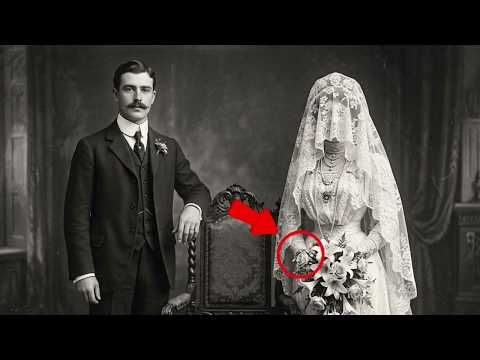
That is the case with one documented bridal photograph from North Carolina. The woman is Sarah Sadie Fisher Money. The photograph is dated September 3, 1904. It belongs to the Kings Mountain Historical Museum and is preserved through the North Carolina Digital Heritage Center. The catalog identifies Sadie as sitting in her wedding dress and veil. The original photograph is approximately 10 by 12 inches, and the museum record identifies it as a black and white wedding photograph.
There is an important warning before we go any further. The popular title of this documentary suggests that historians discovered a dramatic hidden secret simply by enlarging the bride’s image. The surviving museum record does not document such a sensational discovery. There is no reliable evidence that historians enlarged this photograph and suddenly uncovered a hidden crime, secret identity, threatening message, or mysterious object. So we are not going to invent one.
Instead, we are going to do something more difficult. We are going to enlarge the historical meaning of the photograph. Because when the image is examined alongside the records surrounding it, the ordinary portrait becomes something far more interesting. It becomes a doorway into the world of Kings Mountain, North Carolina, in 1904.
And the first clue is the woman herself. Her name was Sadie. Her wedding date was September 3. And the man she married was Doric—or Doris—C. Money. The museum preserves a separate photograph of the groom from the same date. That record identifies him as Doric C. Money, seated in a wooden chair, dressed in formal wear with gloves in his left hand.
That immediately changes how we should look at the bridal photograph. This is not simply an anonymous Edwardian bride. The archive gives us a name. And a name is where a photograph stops being merely visual evidence and starts becoming historical evidence.
Because once a person has a name, researchers can begin asking questions. Who was she? Who was her husband? Where did they live? What kind of community surrounded them? What did marriage mean for a woman in 1904? Why was the photograph made? And perhaps most importantly, what can the photograph actually tell us that the written record cannot?
To answer those questions, we first have to understand what we are looking at. The woman is seated rather than standing. Her clothing dominates the frame. The veil is part of the visual identity of the portrait. Her body has been arranged deliberately for the camera. This was not a casual snapshot. That distinction matters.
Photography in the early 20th century was already much more common than it had been during the 19th century, but formal portraits still required preparation. The camera was not simply pulled from a pocket. A person had to be placed before it. Lighting had to be considered. Clothing had to be arranged. The subject had to remain still long enough for the exposure. And the finished photograph could become an object that represented a person to people who had never met them.
Museums preserve many portraits from roughly this period made using photographic processes involving silver and gelatin, including formal studio portraits mounted on cards. The Smithsonian’s collections contain early 20th century examples of this kind of portrait photography. The Library of Congress also preserves numerous portraits from the same period identified as gelatin silver prints.
That means the photograph of Sadie should not be viewed with modern assumptions about photography. It was not necessarily created to capture an accidental expression. It was created to present her. And that is an important distinction.
A wedding portrait is partly a record of what happened, but it is also a record of how the people involved wanted that event to be remembered. The clothing tells us something. The pose tells us something. The setting tells us something. Even the decision to preserve the photograph tells us something.
And the more we enlarge the image, the more carefully we have to separate what we can see from what we merely want to believe. That is where historical investigation becomes different from storytelling.
For example, a modern viewer might look at the bride’s expression and decide that she appears nervous. Another viewer might say she looks proud. Someone else might describe her as serious. But none of those emotional conclusions can be proven from a photograph alone. The camera captured her face. It did not capture her thoughts.
There is no surviving caption telling us what she felt at that exact second. There is no reliable quotation from Sadie explaining why she looked the way she did. So we have to resist the temptation to turn expression into evidence. Instead, we look at things that can be tested: her clothing, her identity, her wedding date, her husband’s identity, her community, her family, and the historical world around them.
The photograph’s date gives us an unusually narrow window: September 3, 1904. That places the image firmly in the Edwardian period. Queen Victoria had died only three years earlier. The Victorian era had ended, but many of its social expectations remained. Women were still expected to present themselves according to strict standards of respectability. Marriage remained one of the central social transitions in a woman’s life. Clothing reflected status, age, occasion, and social expectations, and wedding clothing could carry a particularly strong symbolic meaning.
A surviving 1904 bridal party photograph from Rhode Island gives us an excellent comparison. The University of Rhode Island’s historic textile and costume collection identifies the photograph as having been taken on June 8, 1904, outside the bride’s home in Usquepaugh. The women wear the fashionable S-shaped silhouette with narrow waists shaped by corsetry. The collection also notes the mono-bosom effect associated with women’s fashion at the time.
That does not mean Sadie’s photograph was taken in Rhode Island. It was not. It means that another independently documented 1904 wedding photograph gives us a contemporary comparison for understanding fashion. And this comparison is important. When we enlarge Sadie’s image, the clothing is not merely decoration. It is historical evidence. The bride is wearing the visual language of her time.
Her dress belongs to a world in which women’s clothing could be highly structured and carefully constructed. Her veil does not simply tell us that she was getting married. It places her inside a long tradition of bridal presentation. White wedding clothing had already become strongly associated with western bridal fashion. The University of Rhode Island collection notes the influence of Queen Victoria’s 1840 wedding on the practice of brides wearing white.
But even here, caution matters. We cannot assume every bride wore a pure white dress. Historical wedding dresses could be cream, ivory, colored, or adapted from ordinary formal clothing. A surviving 1904 wedding dress in Australia, for example, was made from wool crepe because its July wedding took place during winter. A 1904 dress in the Metropolitan Museum of Art’s collection was French and associated with the fashion houses Rouff and Co. and Huet and Chéruit. The Smithsonian also preserves a two-piece dress made in Albuquerque in 1904 and associated with wedding clothing.
These surviving objects remind us of something easy to forget. There was no single 1904 wedding dress. There were many. They reflected geography, money, climate, family background, personal taste, and access to clothing.
And this is where Sadie’s photograph becomes more interesting. Because the photograph is not only about a bride. It is about a particular bride in a particular town. Kings Mountain, North Carolina.
To understand what we are seeing, we need to step outside the frame. Kings Mountain was developing as a textile-centered community. The town’s industrial history was closely connected to cotton manufacturing. The National Register of Historic Places document describes Jacob S. Mauney as one of the organizers of the Kings Mountain Manufacturing Company and notes that the company became part of the foundation of the town’s industrial development.
The Mauney family was deeply connected to that development, and that fact becomes important when we follow Sadie’s life beyond the photograph. Because her wedding did not place her at the edge of Kings Mountain history. It placed her inside one of the families associated with the town’s growth.
The groom, D.C. Money, would later be connected to the Sadie Cotton Mills. But that mill did not exist yet on the day of the wedding. A centennial history of Kings Mountain lists Sadie Cotton Mills as being founded in 1920 by D.C. Money.
That means the photograph contains a fascinating historical contrast. In 1904, the young couple had not yet reached that later chapter. They were at the beginning. The future industrial importance of the family had not yet fully unfolded. The photograph captures them before the later buildings, businesses, and institutions existed.
And that is precisely why enlargement matters. Not because it magically reveals a secret object, but because a close examination forces us to notice how much information is already there: the bride’s clothing, her posture, the formal nature of the portrait, the existence of a matching groom’s photograph, the date, the names, and the community around them. At normal size, we see a bride. At historical scale, we see a moment in the development of a southern textile town.
But there is still a question. Why was Sadie’s photograph preserved? Was it simply a family keepsake? Was it part of a larger wedding set? Was it meant to be displayed? Did the couple exchange photographs with relatives?
We cannot answer every one of those questions. The archive does not give us a diary describing the portrait session. It does not preserve a photographer’s account, and it does not tell us exactly where the camera stood. That uncertainty is important. Because the mystery of the photograph is not that everything is hidden. The mystery is how much can be recovered without inventing what we do not know.
And that investigation begins with the records surrounding the woman in the photograph. The bride has a name. The groom has a name. The date is known. And the town can be traced. The next question is what happened after the shutter closed.
Because the photograph captured one day. History continued for decades. And the evidence suggests that this wedding was not an isolated family event. It was the beginning of a life deeply connected to the changing history of Kings Mountain.
That is where the investigation becomes much larger than the photograph.
So we return to the framed face one last time, not hunting for a hidden crime but reading what the archive already gave us. Sadie Fisher Money lived until 1952; her husband until 1956. She witnessed two world wars, the rise of automobiles, and the slow transformation of her town.
What survives is not a scandal but a chain: bride, marriage, family, cotton mill, public tribute, museum shelf. The photograph waited quietly while history moved forward without it.
That is the real secret enlargement reveals—not something concealed in the veil, but a life that continued long after the shutter clicked.
So when you look at your own old family photographs, what forgotten life might be waiting for you to ask?
Report this article
Select a reason for reporting:






