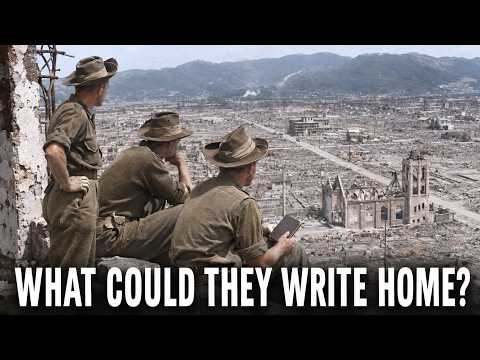
Sergeant Keith Lootas stood atop the shattered Chugoku newspaper building, gazing across a city erased by the atomic bomb. It was March 5, 1946, seven months after the blast, and what he saw made his hand tremble as he wrote: “Truly, it makes one fear to look on.” Below him, Hiroshima was not a wasteland but a living scar—families already rebuilding among the ruins, children picking through rubble, the first fragile signs of life returning to a place synonymous with annihilation.
Lootas was one of thousands of Australian soldiers who occupied western Japan after World War II, tasked with enforcing surrender terms and demilitarizing a defeated nation. But his diary—improvised, personal, and now held at the Australian War Memorial—captures something far more intimate: the raw confrontation of ordinary men with the aftermath of the unthinkable.
Months earlier, Lootas had been stuck on the island of Morotai, waiting. The war was over, but the occupation had yet to begin. “Flares going up, horns and men shouting,” he wrote on New Year’s Day 1946, noting the unusual enthusiasm. These were soldiers impatient to get to Japan, and their impatience boiled over. In mid-January, troops demonstrated at brigade headquarters, demanding deployment. No arrests followed—just a lieutenant colonel receiving their grievances and an order from headquarters ruling out discipline. It wasn’t mutiny; it was frustration.
Then, on February 22, Lootas finally set foot in Japan. His diary entries from those first weeks are a mix of the mundane and the shocking: a haircut for 10 yen, patrols through local villages, new restrictions from General MacArthur against trading with the Japanese. But it’s the small, human details that linger—like the teenage girl taken in by the camp cooks, her family reportedly killed in the bombing. “Two days before Lootas saw the city, the bomb had already reached his camp through the story of one girl.”
When he finally took the train into Hiroshima, Lootas recorded the destruction with a soldier’s eye: flattened for about a mile in every direction. But he also noted the families who had already settled again around the ruins, begun to build. He climbed the newspaper building—hit but still standing—and looked out. The view overwhelmed him. In the right-hand column of the page, he wrote that line about fear, then admitted he could not take in anymore.
Lootas was not the only Australian to come looking. By 1946, a tourist trade was beginning in Hiroshima; locals sold debris to visitors, and some soldiers sifted the rubble for souvenirs. The army’s military history section collected too—Lieutenant Alan Queale took a melted beer bottle from beneath the center of the blast, and a terracotta tile fused with other debris. Both were chosen for their melted state, meant for the national record.
But the story doesn’t end with Lootas. A year later, another Australian would write home from nearby Hiro—a gunner named Daniel Crane, whose letter to his parents in Brisbane offers a different view: the guard rosters, the mail from home, the quiet routine of occupation. Two men, two documents, two ways of witnessing a world forever changed.
Daniel Patrick Crane was born in 1924, and by April 1947 he was a gunner in a field battery attached to the 34th Australian Infantry Brigade—the same brigade that had carried Lootas into Hiroshima a year earlier. His letter, held by the State Library of Queensland, opens with the place: Hiro. Then his number, rank, name, battery, brigade. Then the date, the 3rd of April, 1947. “Dear Mum, Dad and all,” it begins, and the first thing he does is acknowledge their letter of the 29th of March, received that same day, and say he is glad to know they are well.
It is a small thing, this exchange of dates. But it fixes the letter in time: a family in Brisbane writing on a Saturday, a son in Japan answering the following Thursday. Five days across the world, and in between them the ordinary machinery of a soldier’s week.
Crane gives his parents that week in plain figures. They had come back to Hiro the day before, at midday, after what he calls a very quiet trip. Behind the return lay a month of work that had taken him as far as Tokyo. Thirteen guard shifts, twenty-six hours in total. He sets it down without complaint, as a man might list the hours he spent at any job, and the library describes the letter as six sheets of rice paper covering his activities and his New Zealand and American mates.
Only the opening page survives in the digitized view. The rest is described, not shown, and this story will not guess at it. What the readable page holds is quieter than Lootas’s diary and just as real: no ruins, no word of the bomb, only a son telling his family where he is and what he has been doing.
That silence is itself a kind of evidence. By early 1947 the heavy work of disarmament was winding down. The hunt for weapons dumps had given way to guard rosters, and the force as a whole had begun to shrink. Crane’s letter sits exactly where the record says it should: a gunner counting shifts instead of a sergeant cataloging melted bottles and fused tiles.
Lootas, meanwhile, kept writing. A second diary runs from 1946 to 1950 and fills 228 images at the memorial, though only its opening pages were examined for this film. On the 6th of March, the day after Hiroshima, he noted more Japanese civilians in the camp—laundresses, a tailor, women working in the office. On the 13th, the unit moved quarters and took on seamstresses. On the 29th, he had a day’s leave in Kure and found the souvenirs too expensive.
Other Australians went further than looking. Major Jack Lee Bloomfield, an officer in the audit section at Kure headquarters, worked closely with the Hiroshima orphanage. As president of the Forces Tourist Club he helped fund new books and toys and visited regularly, and in 1949 the orphanage’s president, Gishu Yamashita, wrote to thank him. That letter came later, but the visits began while the ruins were still fresh.
Not every soldier responded that way. A Commonwealth intelligence summary for February 1947 reported a lack of feeling for the sufferings of the Japanese public—a line that sits uneasily beside Bloomfield’s toys and Crane’s quiet letter, and belongs in the record all the same. Private documents speak for the men who wrote them and for nobody else.
What survives from these years is uneven, and that is precisely what makes it worth reading. A sergeant rode a train into Hiroshima seven months after the bomb, climbed a damaged newspaper building, and wrote that the view made him afraid. A gunner at Hiro wrote to his parents that their letter had arrived and the trip back had been quiet. The diary is in Canberra. The letter is in Brisbane. Both can be read today in their own handwriting.
There is one more document worth setting beside them, though it reaches us only second hand. On the 22nd of March 2011, after the earthquake and tsunami struck Japan, the Queensland MP Dean Wells rose to speak. He said he had been born on the Australian army base at Hiroshima, and that his father had been posted to Japan in February 1946. The family, he told the chamber, still kept the letters his father wrote home to his own parents.
According to Wells, those letters described the people his father met—some with burns down one side of the body, walking about the community and putting on a brave face. The originals were not available for this film. The father is not named, and no date or wording from the letters can be given here. What Wells offered was a son’s summary, spoken sixty-five years later.
It points the same way as Lootas’s diary, toward a soldier who looked at the people he met and not only at the ruins. But it is a memory of a memory, and it should be weighed as such.
The camera, meanwhile, kept its own record. On the 5th of August 1946, Alan George Cuthbert photographed the rebuilt railway station, and a rebuilding scene was captured from the roof of the Chugoku Shimbun newspaper—the same building, perhaps, that Lootas had climbed five months earlier. Whether it was the same building his diary does not say, and this story will not claim it.
Another photograph from that year, credited to Patrick Flannery, shows Australians of the occupation force playing a rugby match among the ruins. Two children on a makeshift seesaw appear in yet another frame. Life, of a kind, was going on in the middle of the destruction.
From foot patrols to Mustang surveillance flights, the work of the force was one connected job. The Royal Australian Navy patrolled the inland sea to stop smuggling and the illegal immigration of Koreans into Japan. The Air Force helped track suspect vessels, and its squadrons—76, 77 and 82, all flying Mustangs—flew surveillance patrols over each prefecture in the zone to help locate leftover weapons and ordnance.
Ships including Australia, Hobart and Shropshire served with the force, while the landing ships Manoora, Westralia and Kanimbla carried troops. Australians were the ones checking that the destruction or conversion of military gear to civilian use was done, carried out by Japanese civilians under Australian supervision.
April 1946 left a filmed record as well. Between the 8th and 11th of April, Lieutenant Ronald Selby Cartledge filmed election observers in Hiroshima prefecture. On the 12th of April at Kure, a camera recorded a joint Commonwealth flag raising with Northcott present, the 34th Australian Infantry Brigade among the units taking part. These are official films, not private writing, and nobody in them is identified as Lootas. They matter for a simpler reason: they put his brigade on public record, in uniform and on duty, in the same spring that his second diary was following in private.
Stewart Inder’s letters fill in the rest of that year from another angle. In June 1946 he contrasted American abundance with the hunger of people in Osaka. In July he described soldiers reselling canteen goods for yen—the kind of trade the rules Lootas copied down were aimed at, and something that should not be pinned on every Australian. In August and October his letters turned to the Japanese women employed in domestic work around him, and the study reads them as showing both daily closeness and a prejudice that had not gone away.
By the end of 1948 the force was made up entirely of Australians. It ceased to exist on the 28th of April 1952, when the peace treaty with Japan came into effect. Some of its men stayed on to serve in Korea. Members of Number 77 Squadron had their going-home celebrations interrupted by the news that they were being sent there at once.
That abrupt turn—from occupation to a new war—closes the record of the force itself. The men who had guarded Hiroshima’s ruins, counted shifts at Hiro, and watched children rebuild on seesaws were scattered: some home to Brisbane and Canberra, some to the Korean hills. Lootas’s second diary runs to 1950, but this story stops where the documents stop.
What remains is the uneven, human evidence of two soldiers who wrote what they saw—one overwhelmed by a city erased, one quietly noting a letter from home. The diary is in Canberra. The letter is in Brisbane. Both are real, both are in Australian hands, and both can be read today.
If a single sergeant’s fear and a single gunner’s silence can hold so much, what might the thousands of unwritten letters have said?
Report this article
Select a reason for reporting:






