What if you could witness the raw, unflinching reality of World War I—not through staged reels or AI-generated fakes, but through actual footage captured amidst the chaos of battle? In a world where history is often sanitized or sensationalized, a single reel of film stands as a haunting testament to the truth. This is the story of the ‘Barrage Film,’ the only verified German combat footage from the Great War, and the incredible journey that brought it to light.
Military historian Dan Hill has spent years separating fact from fiction in WWI archives. When he stumbled upon this silent, unedited film, he knew he had found something extraordinary—a rare glimpse into the German perspective, captured between 1914 and 1916. But what makes this footage so unique? It’s not just the soldiers marching in pickelhaube helmets or the artillery batteries in action; it’s the unguarded moments of humanity and terror that unfold before the lens.
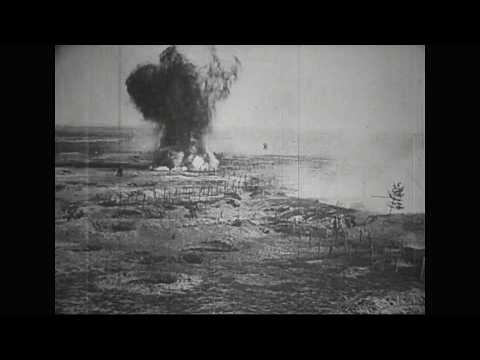
As the film rolls, we see troops moving with purpose, their faces etched with determination and fear. A shell lands between two men, and when the camera restarts, they are gone—almost certainly casualties of the relentless bombardment. “This isn’t somebody just playing up for the cameras,” Hill notes. “This is very likely actual footage of an Allied bombardment of the lines.” The authenticity is undeniable, and the implications are staggering.
But how did such footage survive? The answer lies in a twist of fate. In the aftermath of the war, an American military attaché named Edward Davis was stationed in Berlin. Aware of the German archives at Potsdam, he requested a reel as a souvenir. He was given four, including the one he would later call the Barrage Film. “In my judgment, no part of the Barosch film is faked,” Davis wrote, “except possibly a few feet of an unimportant nature just at the end.” His words, those of a combat veteran and cameraman, lend credence to the film’s authenticity.
The footage itself is a mosaic of war’s many faces. We see German soldiers using a fountain to clean up, a moment of levity with a piano in downtime, and the ever-present railway guns—like the massive Big Bertha—that could hurl shells weighing hundreds of kilos for miles. “You can imagine the damage a 900-kilo shell getting thrown 11 miles can do,” Hill remarks. These guns were so immense they had to be moved on railways, a testament to the scale of destruction.
Yet, amidst the machinery of war, there are poignant reminders of the human cost. Refugees flee with all their worldly possessions in a wheelbarrow, a tragic exodus overtaken by the German advance. The film also captures the aftermath of battle: a destroyed French fort, its grassy banks designed to conceal it from aerial view, and a German field hospital where a French prisoner, identifiable by his Adrian helmet, assists in carrying wounded.
But the heart of the film lies in the barrage sequence. Here, the camera captures a relentless bombardment, shells exploding with terrifying frequency. “If this is staged, that’s a very expensive staging of shots,” Hill points out. The volume of fire and the men running for their lives—not for the cameras—suggest this is the real deal. The cameraman himself is in a protective position, possibly a bunker or wrecked building, risking his life to document the onslaught.
As the reel nears its end, we see cavalry troops carrying lances—a strange juxtaposition of ancient and modern warfare—and the ubiquitous 77mm artillery, the workhorse of the German army. Each frame is a window into a world long gone, but the questions linger. What drove these men? What did they see? And why has this footage remained largely unknown for so long?
The story of the Barrage Film is not just about the past; it’s about how we remember it. In an age of misinformation, this footage stands as a beacon of truth, a reminder of the sacrifices made and the horrors endured. But as we delve deeper, we uncover more than just images—we uncover the secrets of an archive that could change everything we thought we knew about World War I.
Dan Hill pauses the footage on a frame most viewers would skip past—a small, unremarkable detail tucked into the corner of the shot. It is a dugout entrance, angled away from the horizon. “They’re never dug so that the entrance is facing the enemy,” he explains. “Be way too dangerous to have a shell drop directly down into it.” That single detail tells him where the British line must be, and it confirms the camera is pointed in the right direction.
He then turns to the smoke. White puffs, not gray or black. “Germans tend to use a slightly different type of explosive,” Hill notes, “which tends to leave a gray or even black smoke.” British shells, by contrast, throw up that distinctive white. It is a forensic clue hidden in plain sight, and it points to an Allied bombardment hammering the German lines.
There is also the question of gas. Some of those bursts might not be high explosive at all. Hill suggests phosgene or chlorine, delivered by shell with an impact fuse—early war chemistry, before mustard gas ever reached the field. “At this stage of the war, until 1916, this is likely to be phosgene gas, possibly chlorine.” The white smoke could be gas, or smoke mixed in to worsen the conditions for anyone caught above ground.
What strikes him most, though, is the emptiness. The ground is nearly cleared of troops. “These guys are simply not going to be here,” he says. “They’re going to be down in dugouts, down in bunkers, staying out of the way.” That absence is itself evidence—no staged film would bother clearing the field for authenticity.
Then comes the detail that has haunted viewers for a century. Hill rewinds to the top of the frame, where two men stand exposed. A shell pitches directly between them. The camera jolts, the image blurs—and when it restarts, the men are gone. “These are almost certainly casualties of the fight,” he says quietly. It is not spectacle. It is a record of two lives ending in the space between two frames of film.
The cameraman, meanwhile, was no reckless amateur. Hill points to the aperture framing the shot—a bunker slit, a broken wall, something solid between the lens and the shrapnel. That protection is why the footage exists at all. “Clearly there’s something here that’s protecting the cameraman,” he observes. “And it’s where he’s getting his elevation from as well.”
It is believed the sequence was shot on the Somme in 1916. The terrain fits—the chalk scarp, the crisscrossed trench lines, the churned earth. And the date matters, because by 1916 the German army had learned to endure bombardments like this one, burrowing deep and waiting out the storm.
But the film does not end with the barrage. The reel moves on to stranger, quieter images: a railway motorcar fitted to run on tracks, a destroyed French fort with grass banks built to hide it from the air, and Pinon Castle in the French sector. Each frame adds another layer to a document that is far more than battlefield spectacle—it is a portrait of an army at war, in all its ingenuity and exhaustion.
And then, almost without warning, the footage shifts again—to a tented field hospital, where a figure in a French Adrian helmet moves among the stretchers. Hill lingers on him. “This is a French prisoner who’s fairly recently been brought in,” he says, “and has been used to transfer wounded.” The war, in that single frame, becomes something smaller and more human: enemies pressed into service beside one another, bound by the same mud and the same need to survive.
Hill lets the frame rest there a moment before moving on. The hospital tents, the stretcher-bearers, the French prisoner—all of it sits in stark contrast to the barrage we just witnessed. “It gives you an idea of how the war was fought on so many levels at once,” he says. “Artillery, infantry, medicine, captivity—all of it happening within a few hundred yards of each other.”
Then the reel cuts to cavalry. A column of horsemen rides across the screen, lances held upright, steel helmets gleaming. It is an image that seems centuries out of place. “Cavalry is so often considered totally obsolete,” Hill notes, “but the truth is it’s not really the case.” In 1914, horsemen still had a role—screening, reconnaissance, exploiting gaps. And in 1918, when the trench deadlock finally broke, they would ride again.
But the lance is what catches his eye. “Literally an old-fashioned lance that you would have seen with Roman soldiers a couple of thousand years before,” he says, “whilst wearing steel helmets.” It is a strange marriage of ancient and modern, a reminder that armies rarely transform overnight. They carry the past with them, even into the industrial slaughter of the twentieth century.
The final shots are pure German artillery: the 77mm gun, the workhorse of the army. “Very quick firing,” Hill explains. “Distance covers about five miles, eight kilometers, something like that.” When massed in batteries, as they are here, they can put down a curtain of fire that stops an advance cold. The gun is not glamorous like the railway monsters, but it is the weapon that shaped the war more than any other.
As the reel runs out, Hill returns to the question that has shadowed the entire film. How do we know it is real? The answer, he says, is not in any single frame but in the accumulation of small, unglamorous details—the dugout entrance, the color of the smoke, the emptiness of the battlefield, the men running with purpose rather than posing. “If you’ll study the bursts carefully,” Davis wrote a century ago, “you’ll observe that there are bursts of projectiles and not of mines.” The smoke, the debris, the dispersion—all correct.
Davis showed the film to thousands of American officers and enlisted men who had served overseas. He screened it at military schools, including the Signal School. “Such is also the opinion of many experienced soldiers who have seen it,” he noted. Their verdict was unanimous: this was no fabrication. The attitudes of the men, the relationship between the lines of advance and the shell bursts—every minute detail rang true.
Yet for all that verification, the film remains largely unknown today. It was a sensation in the 1920s, screened and debated, then quietly forgotten as the world moved on to other wars and other horrors. “There’s so little of this because it’s so dangerous to obtain,” Hill says. Cameramen in the Great War did not carry lightweight cameras. They hauled heavy equipment into exposed positions and waited for death to fall around them. Many never came back.
That is what makes the Barrage Film more than a historical document. It is a survival—a fragile strip of celluloid that outlasted the men who shot it, the men it recorded, and the empire that produced it. And now, a century later, it offers something rare: a chance to see the war not as it was imagined or recreated, but as it actually looked and sounded and felt.
Hill stops the reel on its final frame: the 77mm gun, its crew frozen mid-load. “So there we are,” he says. “The end of the reel.” He lets the silence hang, the way a historian does when the footage has said more than any narration could.
What survives of that day is not victory or defeat, but proof. A strip of film that outlived the cameraman, the soldiers, and the empire that sent them. “This is very likely actual footage,” Hill repeats—not as a hedge, but as a verdict.
The Barrage Film was a sensation in the 1920s, then forgotten. Now it returns, asking us to look again. Do we see the war clearly, or only what we expect to find? What will you notice that everyone else has missed?
Report this article
Select a reason for reporting:






