The flashbulbs popped like fireworks, but the smiles were real—or were they? In the golden age of Hollywood, a wedding was more than a union; it was a performance, a contract, and sometimes, a carefully crafted illusion. From the 1930s to the 1970s, the biggest stars walked down the aisle under the watchful eyes of studio publicists, their nuptials staged for magazine covers and fan magazines. But behind the glamour, there were secrets, scandals, and heartbreaks that the cameras never captured.
Now, for the first time in decades, a hidden archive of rare wedding photographs has surfaced, offering a glimpse into the most intimate moments of Tinseltown’s royalty. These images, locked away in studio vaults and private collections, reveal the truth behind the headlines—the nervous glances, the forced smiles, and the occasional genuine joy.
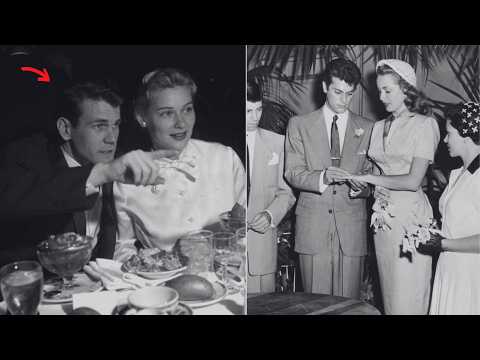
Take, for instance, the 1940 wedding of Clark Gable and Carole Lombard. Their love story was the stuff of legend, but the photos show a rare tenderness—Gable, the ultimate leading man, looking at his bride with an adoration that seemed almost too perfect for the cameras. Yet, just two years later, Lombard would be gone in a tragic plane crash, leaving behind a grief-stricken Gable who never truly recovered.
Then there’s the 1954 union of Marilyn Monroe and Joe DiMaggio. The baseball legend and the blonde bombshell seemed like an unlikely pair, and the photos from their City Hall ceremony show a fleeting happiness. Monroe’s smile is radiant, but her eyes betray a hint of uncertainty. Their marriage would last only nine months, but these images capture the brief moment when two American icons collided.
As we delve deeper into this collection, we uncover the weddings that defined eras—the lavish 1950s ceremonies with their fairy-tale gowns, the rebellious 1960s elopements that defied studio contracts, and the 1970s affairs that mirrored the changing times. Each photograph is a time capsule, preserving not just the faces of legends but the emotions of a bygone era.
But these images also raise questions. Why were some hidden for so long? What stories were the studios desperate to suppress? And what do these rare glimpses reveal about the true nature of celebrity love?
Stay with us as we journey through the golden age of Hollywood weddings, where every kiss was a headline and every vow a potential scandal. The past is waiting to be rediscovered, one photograph at a time.
The archive’s curator, a soft-spoken historian named Eleanor, had spent three years tracking down these negatives—many of them smuggled out of studio lots by assistants who knew they were documenting something the front office wanted erased. “Studios treated marriages like plot points,” she explains, sliding a brittle contact sheet across the table. “If a romance sold tickets, they scripted it. If it threatened the box office, they buried it.”
One envelope, marked only with a date—June 1949—contains a series of shots that were never published. They show a young actress in a simple dress, standing beside a man the studio had forbidden her to marry. Her jaw is set, her hands clenched at her sides. There is no bouquet, no press line, no smiling publicist hovering at the edge of the frame.
Eleanor handles the print like it might dissolve. “This is the wedding they told her to forget. She never did.” The actress, it turns out, kept a copy hidden in a hatbox for the rest of her life, and it only surfaced after her death, tucked inside a diary whose final page reads: They took the pictures, but they couldn’t take the day.
Not every secret was a heartbreak. Some were simply too ordinary for the myth machine to allow. A 1962 contact sheet shows a legendary leading man in rolled-up sleeves, laughing as he tries to cut a cake with a prop sword, his bride doubled over beside him. The studio rejected the whole set—too casual, too human, they said. The public wanted gods, not neighbors.
Yet it’s exactly that humanity that makes these photographs so magnetic now. The gowns have yellowed, the flowers have wilted in the frame, but the nerves and the laughter and the trembling hands remain utterly alive.
And then there is the photograph Eleanor has saved for last—the one she won’t describe until we’re seated, the one she keeps face-down beneath a sheet of archival tissue. “Every collection has its center of gravity,” she says quietly, her fingers resting on the edge. “This one changes how you read all the others.”
She lifts the tissue away slowly, as though the image might flinch. It is not a wedding at all—or not the kind we’ve been chasing. The photograph shows a narrow dressing room, a mirror ringed with dead bulbs, and a woman in a plain slip, her back to the lens. Beside her, a man in a rumpled tuxedo holds a small bouquet of grocery-store carnations. There is no altar. No guests. Only the two of them, and a justice of the peace in a borrowed suit, squinting at a document he clearly cannot read in the dim light.
“Nobody knows this happened,” Eleanor says. “Not the fans. Not the columnists. Not even the studio, for almost a year.” The woman, it turns out, was one of the most photographed faces of the 1940s—a star whose on-screen romances were engineered with military precision. But on this night, she had slipped out a stage door, married a grip she’d met on set, and returned before dawn. The only record was this single frame, taken by a wardrobe girl with a borrowed camera.
Why did she do it? Eleanor shrugs. “Because for one night, she wanted to be a person instead of a product.” When the studio eventually found out, they gave her a choice: annul the marriage or lose her contract. She chose the contract. The grip disappeared from the lot within a week. But she kept the photograph, and years later, when she was old and the studio was gone, she wrote one line on the back: I was brave once.
This is the thread that runs through the whole collection—not scandal, exactly, but the quiet cost of being adored. The 1930s brides in their satin and pearls, the 1950s starlets clutching bouquets that weighed more than their contracts, the 1970s rebels who married in jeans and dared the columnists to care. Each one is a negotiation between the woman and the myth.
Eleanor begins laying the photographs side by side on the long table, and a pattern emerges. In the official portraits, the couples stand apart, chins lifted, eyes fixed on some distant point beyond the lens. In the candid frames—the ones the studios rejected—they lean together, whisper, laugh at private jokes. “The difference between a photo and a photograph,” Eleanor says, “is whether someone was performing or forgetting to.”
She pauses over one image from 1968: a bride in a simple white shift, barefoot on a lawn, her groom’s jacket draped over her shoulders. The marriage lasted fifty-one years. The studio never forgave her for the bare feet. “They called it undignified,” Eleanor says with a thin smile. “She called it the happiest day of her life. Both of them were right.”
There are more envelopes yet—dozens, maybe hundreds—each one a sealed decade waiting to be opened. Eleanor glances at the clock, then back at the table. “The next box is from 1972,” she says. “That’s when the old rules started to crack. And there’s one wedding in there that no one has ever seen. Not a single frame.”
She pulls the box toward her, and the cardboard sighs open. Inside, a single roll of film sits in a dented canister, unlabeled except for a strip of masking tape that reads, in fading pencil, Do not develop. Eleanor laughs softly. “That’s the whole story right there. Someone wanted this forgotten so badly they never even looked at it.”
The negatives, once developed, show a ceremony in a backyard—a folding table, paper lanterns, a dog asleep under the chairs. The bride is a folk singer the studio had spent years trying to turn into a sex symbol. The groom is her high school sweetheart, a carpenter with paint on his cuffs. No press. No contract. No myth.
“They offered her the moon to call it off,” Eleanor says, reading from a memo tucked in the canister. “She wrote back four words: ‘Keep the moon. I’m married.'” The studio shelved her next film and let her contract lapse. She never made another picture. But the photographs show her laughing so hard she had to hold the fence to stay upright.
Eleanor sets the last print down and steps back from the table. The archive stretches before us—decades of brides and grooms, some performing, some forgetting to perform, all of them caught between the myth and the morning after. “That’s why I kept looking,” she says. “Not for the scandals. For the ones who got away with being happy.”
She turns off the desk lamp, and the room goes soft with shadows. The photographs wait in their envelopes, patient as secrets. Somewhere in the dark, that barefoot bride is still laughing, still holding the fence, still married to the carpenter with paint on his cuffs.
Which of these hidden weddings would you have wanted to witness in person—the forbidden elopement, the grocery-store carnations, or the backyard vows the studio tried to erase?
Report this article
Select a reason for reporting:






