The P-47 Thunderbolt pilot peered through the gunsight, his breath fogging the canopy as he lined up the shot. Below, a German Panzer IV rumbled along a dusty road, its crew oblivious to the hunter circling above. He had three weapons at his disposal: eight .50-caliber machine guns, a pair of 500-pound bombs, and a battery of five-inch rockets. But which one would actually kill the tank? The answer, as hundreds of pilots would discover, was not what the manuals initially suggested.
In the skies over Europe, the P-47 had earned a reputation as a rugged ground-attack fighter, its air-cooled engine shrugging off battle damage. Yet tank-busting was a deadly science, and the Thunderbolt’s arsenal each had distinct limitations. Bullets were accurate but lacked punch; bombs were devastating but wildly imprecise. The rocket, a relatively new addition, sat somewhere in between—and it would soon prove to be the war’s most effective anti-tank weapon.
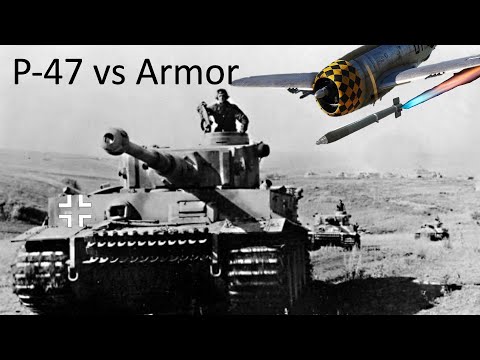
The approach was textbook. A squadron of sixteen P-47s would split into two flights: one to provide top cover, the other to attack. Spotting a target from 12,000 feet kept them clear of light flak, and the dive began. “Open fire at 400 yards, 30-degree dive, 300 mph,” the gunnery manual instructed. But when the .50-caliber rounds struck the Panzer’s side armor, they sparked and ricocheted away. The bullets simply couldn’t penetrate anything thicker than 0.19 inches under those conditions—far less than the 1.25 to 3.25 inches of side armor on German tanks.
So why shoot at all? Because a well-aimed burst into the rear engine vents could set a tank ablaze, and ricochets off the ground occasionally found their way into the Tiger’s belly. But it was a gamble, not a sure kill. Bombs, on the other hand, could crack any tank’s top armor—if they hit. Dive-bombing accuracy was dismal, and the effort rarely justified the results. A direct hit or near miss was required, and those were few and far between.
Then came the HVAR—the five-inch High Velocity Aircraft Rocket, affectionately nicknamed the “Holy Moses.” Weighing 140 pounds with an 8.2-pound warhead, it could punch through 1.75 inches of armor, enough to crack the side of a Panzer IV or the top of a Panther. “When a tank is hit by a rocket, it was destroyed,” one report stated flatly. Accuracy hovered around 50 to 60 percent—far better than bombs—and the trajectory was flat enough that pilots could aim with confidence.
General Elwood “Pete” Quesada, commanding the Ninth Air Force’s fighter-bombers, didn’t need convincing. He ordered every P-47 in his command equipped with HVARs. Ground troops, watching tanks erupt in flames after a single rocket strike, called it the best anti-tank weapon in the arsenal. Even German generals later admitted that Allied air power—and the rockets that came with it—had crippled their armored movements, forcing tanks to hide by day and move only under cover of darkness.
But the story of the P-47’s tank-killing evolution was far from over. The rockets had proven themselves in the skies over France and Belgium, yet the question remained: how had a weapon originally designed for air-to-air combat become the scourge of the Wehrmacht’s panzers? The answer lay in a series of hard-learned lessons, declassified reports, and the courage of pilots who flew straight into the teeth of German flak to prove that sometimes, the simplest solution—a rocket with a well-aimed warhead—was the deadliest of all.
The transformation didn’t happen overnight. In the early months of 1944, P-47 pilots were still experimenting with tactics that often cost more than they delivered. Bombing runs against tanks were frequently wasted effort—a 500-pound bomb, fused for instantaneous detonation, needed a direct hit or a near miss within a few feet to crack a Panzer’s top plate, and dive-bombing accuracy from a 60-degree plunge rarely met that standard. Post-strike reconnaissance photos often showed nothing but craters in empty fields.
Strafing was even more frustrating. The .50-caliber armor-piercing incendiary rounds, when fired from a 30-degree dive at 300 mph, struck at roughly 2,800 feet per second—but the obliquity of the impact and the bullet’s drag dropped their penetration to a mere 0.19 inches. Against the side armor of a Panzer IV, the rounds simply bounced. “The only way to kill a tank with guns was to hit the engine vents from behind,” one gunnery instructor noted, “and that required a pilot to fly straight through his own ricochets.”
Then came the rockets. The HVAR, rushed into production in 1944, changed the calculus. Unlike the earlier bazooka-style launchers, the HVAR was fired from zero-length rails and accelerated to 1,300 feet per second, giving it a flat trajectory and a predictable impact point. Pilots practiced on derelict hulks in England, learning to fire in half-second bursts from a 15-degree dive. “It was like throwing a sledgehammer at the tank,” recalled one Ninth Air Force pilot. “If you hit it, it was over.”
The numbers backed up the anecdotes. A post-war evaluation of the Battle of the Bulge found that fighter-bombers destroyed 751 armored vehicles and damaged another 509 between December 1944 and January 1945. German tank commanders learned to fear the rocket-carrying Thunderbolt more than any other Allied aircraft. One captured Panzer officer admitted that his crews would abandon a tank at the first sound of a P-47’s radial engine—not because the guns were deadly, but because the rockets were.
Yet the rocket’s success also exposed a hard truth about the P-47’s other weapons. Bombs, for all their explosive power, remained too inaccurate for consistent tank-killing. Machine guns, despite their psychological effect, could not defeat armor. The HVAR filled the gap between precision and power—and it did so with a simplicity that frontline pilots appreciated. No complex bombsights, no steep dives into flak, just a steady approach and a well-aimed salvo.
By the spring of 1945, the tactical playbook had crystallized. A flight of four Thunderbolts would approach a tank column at 12,000 feet, split into pairs, and roll in from opposite directions. The first pair fired rockets to break up the formation; the second pair strafed the fleeing vehicles, aiming for engine decks and fuel tanks. “We didn’t need to penetrate the armor,” explained one squadron commander. “We just needed to make the crew bail out.”
That psychological dimension proved as important as the warhead. German tank crews, already hampered by fuel shortages and Allied air superiority, began moving only at night and hiding under trees during the day. A report from the 19th Tactical Air Command noted that “the mere presence of rocket-armed Thunderbolts over a battlefield forced enemy armor to disperse and conceal itself,” often at the cost of tactical cohesion. The tank that hid was a tank that couldn’t fight.
Still, the question of effectiveness lingered. A 1945 Army Air Forces evaluation board concluded that while rockets were the best anti-tank weapon available, the credit for destroying German armor had to be shared with air-directed artillery and ground forces. The P-47 was not a flying tank killer in the way propaganda posters suggested—it was a harasser, a disruptor, and, when the pilot’s aim was true, a precision executioner.
What the rocket did change was the tempo of the war. A single Thunderbolt armed with HVARs could now threaten a column of tanks from beyond the range of light flak, strike, and be gone before the Germans could organize a response. That speed and reach turned the P-47 into a weapon that shaped enemy behavior, not just one that destroyed metal. And as the war ground toward its final months, the pilots who flew those rocket-laden Thunderbolts understood that their greatest contribution wasn’t measured in tank hulks—it was in the fear that kept those tanks hidden.
The lessons learned over France and Belgium would not fade with the peace. The HVAR remained in service for a decade after World War II, and its success cemented the fighter-bomber as a cornerstone of air power. But for the men who flew the P-47 in 1944, the truth was simpler: the rocket was the only weapon that reliably turned a tank into a burning wreck, and that knowledge—hard-won and paid for in flak and fire—was worth more than any manual.
Yet for all the rocket’s promise, the pilots who flew those early missions knew that a weapon is only as good as the eyes and hands that guide it. The HVAR’s flat trajectory made it forgiving, but fifty to sixty percent accuracy still meant that nearly half of every salvo fell wide. Pilots learned to fire in pairs, walking their rockets onto the target while the wingman called corrections over the radio. It was a crude form of teamwork, but it worked—and it kept the Thunderbolts from making the same pass twice through a wall of 20mm flak.
Training reflected that reality. Replacement pilots arriving in England in late 1944 spent hours over the Wash, firing practice rockets at wooden tank silhouettes towed behind boats. Instructors hammered home the same refrain: “Aim for the engine deck, not the turret.” A rocket that struck the rear of a Panzer could brew it up in seconds; one that hit the thick mantlet often just scarred the steel and enraged the crew.
Ground crews, meanwhile, grew intimately familiar with the rocket’s quirks. The zero-length rails under the wings collected mud and ice, and a misaligned rail could throw a shot yards off target. Armorers checked each rocket’s electrical ignition with the same care a surgeon gives a scalpel. “A dud rocket was worse than no rocket,” one crew chief recalled. “It gave the pilot a false sense of a kill.”
Combat reports from the fall of 1944 painted a picture that no training exercise could replicate. Near Metz, a flight of four P-47s caught a column of Panther tanks strung along a sunken road. The lead pilot fired a pair of rockets at the rear tank, which erupted in a column of black smoke. The second pilot’s salvo missed wide, but the explosion of dirt and rock sent the surviving crews scrambling from their vehicles. Not a single tank was destroyed by that second salvo—yet the column stopped dead for six hours.
That pattern repeated itself across the Western Front. Rockets rarely wiped out an entire armored column, but they shattered its cohesion. A tank that survived a rocket pass often found itself alone, its supporting infantry pinned, its radio antenna sheared off by shrapnel. German after-action reports grew bitter and resigned. One Panzer battalion commander wrote that “the Jabos do not need to hit us to stop us.”
The P-47’s own losses told a grimmer story. Low-angle rocket attacks brought the Thunderbolt into the heart of the German light flak envelope, and the rugged radial engine could only absorb so much. Pilots learned to jink hard after firing, to break away at the first sign of tracer, and to never, ever make a second pass over the same ground. Survival, not glory, became the measure of a good tank-buster.
By early 1945, the tactical doctrine had hardened into something approaching an art form. A squadron would send two flights in a coordinated pincer: one to draw the flak with a high-speed strafing run, the other to slide in low and unseen for the rocket kill. The machine guns, once dismissed as useless against armor, found a new role—suppressing the flak crews and the infantry that shielded the tanks. The weapons complemented each other in ways the manuals had never anticipated.
And still, the debate over effectiveness simmered in staff tents and post-war studies. The rocket was a killer, yes—but it was the pilot’s nerve and the ground crew’s diligence that made it so. The P-47 had become a system, not just an airplane, and its deadliest weapon was the one thing no ballistic table could measure: the willingness to dive into the fire one more time.
By the war’s final weeks, the verdict was in. “The 5-inch HVAR was the best anti-tank weapon of the war,” General Myers declared—a sentiment echoed by the tank crews who watched Panzers burn. The Thunderbolt had not been designed to kill tanks, yet it had become the Wehrmacht’s nightmare.
Its legacy outlived the conflict. The rocket stayed in service for a decade, and the fighter-bomber doctrine it forged shaped air power for generations. Sometimes the simplest weapon, aimed by a steady hand, wins the fight.
So here’s the question: if you were a P-47 pilot in 1944, would you trust the rocket, the bomb, or the guns?
Report this article
Select a reason for reporting:






