The November wind cut through the Massachusetts compound like a blade, but the 47 German women climbing out of the transport trucks barely felt it. They were numb—from the weeks of cramped transit across the Atlantic, from the gnawing hunger that had become a constant companion, and from the terror of what awaited them on American soil. Greta Zimmerman, twenty-three years old and hollowed out by retreat and capture, gripped the canvas flap of the truck and peered through the gap. What she saw made no sense. The buildings were sturdy, the soldiers moved without cruelty, and the air—the air carried a scent she had not known in years.
It was chicken. Rich, buttery, herb-laced chicken, roasting somewhere in this enemy prison camp. Greta’s stomach clenched so hard she doubled over. Around her, other women lifted their heads, nostrils flaring, eyes wide with disbelief. They had been promised starvation and brutality. Instead, they were drowning in the aroma of Sunday dinner.
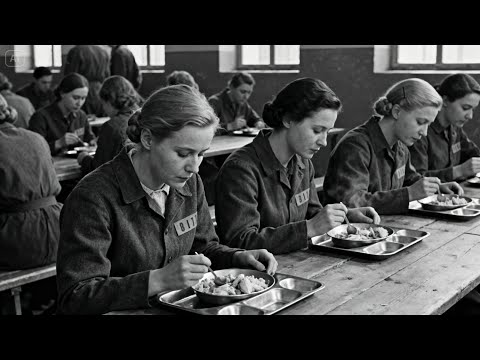
Captain Margaret Sullivan watched the women line up, their gray uniforms torn, their faces masks of defiant pride over raw fear. She had read their files. Most were barely out of their teens—radio operators, clerks, medical assistants plucked from the collapsing Wehrmacht. They had been indoctrinated to believe Americans were savages. Sullivan knew that the smell drifting from the mess hall was about to do more than any propaganda ever could.
**“Someone is roasting chicken,”** Greta whispered to Elsa Hoffman, the twenty-year-old beside her who had spent the voyage composing letters to a mother in Dresden she might never see again. Elsa’s lips trembled. **“It smells like home,”** she said, **“before the war.”**
The journey to this moment had begun three weeks earlier in a muddy field outside Metz, France. Greta had been stationed at a communications post, part of the desperate German retreat. When American soldiers surrounded their position, the male officers had fled during the night, leaving the auxiliary women to face capture alone. Young GIs—farm boys who looked barely old enough to shave—had approached with rifles raised, then lowered them uncertainly when only women emerged with hands up. One soldier had actually apologized as he directed them toward the holding area. That apology had planted the first seed of doubt in Greta’s mind.
During training, instructors had filled their heads with stories of American savagery—torture, degradation, unspeakable fates for female captives. The warnings were meant to ensure loyalty. They had worked perfectly. Greta and her companions had lived in constant fear of capture. But the reality had been disturbingly different. In a displaced persons camp in France, they received medical exams, clean clothing, and regular meals. The food was plain but adequate—far better than the turnip soup and black bread of the final months. American soldiers guarded them with professional distance. There was no cruelty, no abuse.
**The Atlantic crossing had been the worst part.** Confined below decks on a Liberty ship, the women battled seasickness and claustrophobia. But even there, American sailors checked on them, bringing water and crackers. One medic had helped Greta through a fever, administering aspirin and cool compresses without a hint of malice. Elsa had spent the voyage trying to reconcile the propaganda with the farm boy who had apologized. Now, standing in this Massachusetts compound with the impossible smell of roasting chicken filling the air, the cognitive dissonance reached a breaking point.
Captain Sullivan led them through the camp—the barracks, the washroom, the recreation area. Simple wooden structures, hastily built but solid against the coming New England winter. Each woman received a bunk, two wool blankets, and basic toiletries. The efficiency was impersonal but not unkind. Greta claimed a lower bunk near a window, smoothing the thin straw mattress with hands rough from months of hard labor. In the corner, a small pot-bellied stove promised heat. It was Spartan, but far superior to the conditions they had endured during the retreat.
Private Sarah Morrison, one of the guards, stood near the door. She was young, perhaps twenty-five, with kind eyes and a rifle she carried with obvious discomfort. Greta noticed she did not hold it with aggression, but with the awkwardness of someone unaccustomed to treating other women as enemies. As the afternoon wore on, the smell from the mess hall grew stronger. Greta’s stomach cramped with hunger that had become a constant companion. Rationing in Germany had grown severe—meals had shrunk to meager portions of black bread, thin soup, and occasional potatoes. Meat had become a luxury reserved for frontline troops. The aroma drifting through the compound spoke of an abundance that seemed almost obscene.
At 1700 hours, the women were called to the mess hall. They filed in silently, maintaining the military discipline drilled into them. What they saw stopped several in their tracks. Long tables were set with actual plates, not tin mess kits. Cups for drinking. Utensils that matched. But most shocking was what waited on those plates: each woman received a portion of chicken casserole that would have fed a family back home. Tender pieces of roasted chicken mixed with carrots, peas, onions, and potatoes, all bound together in a creamy sauce and topped with a golden crust. Alongside it sat fresh bread with butter, a small serving of canned peaches, and hot coffee with real sugar.
Elsa sat frozen, staring at her plate with tears forming in her eyes. This was more food than she had seen in a single meal since before the war began. Around the mess hall, other women had similar reactions. Some cried openly. Others simply stared in disbelief.
Behind the serving lines stood Dorothy Chen, the head cook. She was a second-generation Chinese American woman from San Francisco, forty-two years old with strong, capable hands that had been preparing food since she was tall enough to reach her mother’s kitchen counter. She watched the German women’s reactions with an expression that mixed satisfaction with deep sadness. This was exactly the response she had anticipated—and the reason she had insisted on preparing this particular dish for their first night.
Dorothy had argued with the camp administration about the menu. Standard procedure called for basic military rations—adequate nutrition, delivered efficiently and without luxury. But Dorothy had fought for something different. **“These are not soldiers who carried rifles into battle,”** she had told the skeptical officers. **“They are young women caught up in circumstances beyond their control. How America treats them in this moment will echo far beyond the walls of this compound.”**
Her assistant, Helen Martinez, a young woman from New Mexico whose husband was fighting in the Pacific, had initially questioned the generosity. **“Why should we feed them better than we feed ourselves?”** she had asked. Dorothy’s response had been simple but profound: **“Because we can afford to—and because showing them American abundance is more powerful than any propaganda poster. Let them taste what freedom provides.”**
The recipe was Dorothy’s own creation, adapted from traditional American comfort food. She had started before dawn, roasting chickens until the skin turned golden and crispy, then shredding the meat by hand. The vegetables came from local farms, still fresh despite the late season. She had made the cream sauce from scratch using real butter and milk, seasoning it with herbs from the small garden behind the mess hall. The entire preparation had taken hours of labor. But as she watched the prisoners’ faces, she knew the effort had achieved its purpose.
Greta lifted her fork with trembling hands and took her first bite. The flavors exploded across her tongue—rich, savory, comforting. It tasted like her grandmother’s Sunday dinners in Hamburg, like celebrations and holidays, like everything the war had taken away. She had to stop herself from eating too quickly, knowing her shrunken stomach would rebel. Around the mess hall, forty-seven German women experienced the same moment of sensory memory and cognitive dissonance. They were prisoners of war, captured enemies of the American state. Yet they were being fed like honored guests at a family gathering. The contradiction was overwhelming. Everything they had been told about American cruelty was being challenged by every bite of this impossibly generous meal.
Dorothy Chen watched from the kitchen doorway, understanding that she was not just feeding hungry women. She was waging a different kind of war—one fought with kindness instead of bullets. The silence in the mess hall was broken only by the soft sounds of forks against plates and occasional quiet sobs.
Greta ate slowly, savoring each bite while her mind struggled to process what was happening. This meal represented more calories than she had consumed in an entire day during the final months before her capture. The chicken was tender and seasoned with herbs she could not quite identify. The vegetables were cooked perfectly—still holding their shape, but soft enough to melt in her mouth. Across the table, Elsa had stopped eating altogether. She sat with her fork suspended halfway to her mouth, tears streaming down her face. Private Morrison approached, and Elsa flinched instinctively, expecting punishment for her emotional display. Instead, Morrison knelt beside her and spoke in gentle tones. **“Are you all right? Do you need anything?”** The kindness in her voice only made Elsa cry harder.
Captain Sullivan moved through the mess hall, observing. She had been briefed on the psychological state of these prisoners—indoctrinated to believe Americans were savage enemies. This meal was designed to shatter that belief, and it was working more effectively than any amount of propaganda could have achieved. The women were experiencing a fundamental crack in their worldview, and Sullivan knew that such moments were when real transformation became possible.
Dorothy emerged from the kitchen carrying additional servings. Several women looked at the extra food with expressions of pure disbelief. In Germany, asking for second helpings had become unthinkable as rations grew scarcer. Here, their captor was offering them more food than they could comfortably eat. Greta accepted another small portion—not because she was still hungry, but because she needed to confirm that this abundance was real and not some cruel illusion.
The meal concluded with the canned peaches, a luxury that seemed almost decadent. Greta had not tasted fruit preserved in sweet syrup since before the war. The sugar alone represented more than a week’s ration back home. She ate the peaches slowly, letting each piece dissolve on her tongue while she tried to understand what this generosity meant. Were the Americans trying to fatten them up for some darker purpose? Was this meal an exception—a single moment of abundance before they faced the starvation she had been promised?
As the women filed out of the mess hall, they moved differently than when they had entered. Their shoulders were less rigid, their expressions softer. The meal had done something that military force could never accomplish: it had made them question everything they thought they knew about their enemies. Greta paused at the door and looked back at Dorothy, who was already beginning to clean the kitchen. Their eyes met for a brief moment, and Greta saw something in the older woman’s face that she had not expected to find in a prison camp. She saw compassion, dignity, and a quiet determination to treat them as human beings rather than defeated enemies.
The next morning, breakfast proved the feast was no fluke: scrambled eggs, toast with butter and jam, hot oatmeal with brown sugar. The women ate in continued amazement. Afterward, Captain Sullivan assigned work details—laundry, cleaning, kitchen assistance. Greta and Elsa volunteered for the kitchen, drawn to the woman who had fed them like honored guests.
Dorothy accepted them with a knowing smile. She started them on simple tasks—peeling potatoes, washing vegetables—correcting their methods with gentle guidance. Elsa, stationed beside her chopping onions, heard Dorothy observe, “You have done this before.” Elsa managed, “My mother,” and Dorothy replied, “My mother, too.” In that moment, the boundaries between captor and captive began to blur.
Weeks passed. The kitchen became a sanctuary where women processed grief through work—chopping, kneading, stirring. When news of the concentration camps reached the camp in January, Greta sat in the library staring at photographs she could not unsee. “What kind of country were we serving?” Elsa whispered. The questions had no easy answers.
On the final Sunday before repatriation, Dorothy prepared a feast incorporating every dish they had shared. The table groaned with abundance—a promise that connections forged through shared meals would endure beyond barbed wire and national boundaries.
Twenty-five years later, Greta stood in her Hamburg restaurant, Dorothy’s Kitchen, serving chicken casserole exactly as she had learned it. The casserole that had once seemed impossibly generous had become a symbol of dignity’s enduring power.
What small kindness will you offer someone today?
Report this article
Select a reason for reporting:






