In November 1897, four hundred feet beneath a hill in New Mexico, a miner’s pick struck something that rang like a bell. Rock does not ring. Copper ore does not ring. But this did—a clear, sustained note that echoed through the tunnel and raised the hair on every man in the stope.
Cresencio Baca called for a lantern. What he saw in the red clay was impossible: a pale, flat face of metal, as wide as a man’s back and as long as a door. By morning, a second face had been uncovered beside it—identical, parallel, two blades of a single tool. The miners had no words for it. But one man did.
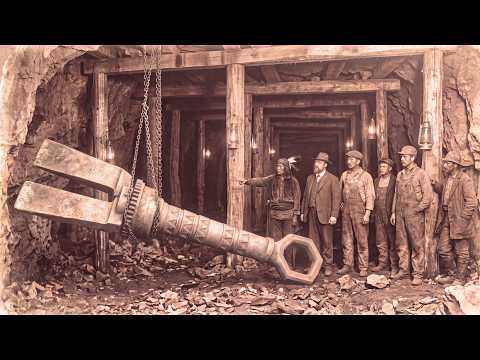
Viejo Tomas was an old Apache teamster who drove ore wagons down to the railroad siding. That evening, he rode the bucket down into the shaft, looked at the two blades, and said nothing. Then he spoke a single sentence in Spanish: “Lo dejaron.” They left it behind. He did not say who. The next morning, he refused to go down again.
Over the next three weeks, the miners uncovered the rest of the tool. Behind the blades, a drum ringed with teeth. Behind the drum, a thick carved shaft. At the end, an eight-sided ring wide enough for a man to walk through. The tool was thirty-two feet nine inches long. It weighed an estimated sixty tons. It could not have fit down any shaft in the mine. No one had lowered it there. The mine had been dug down to it.
Edwin Trask Rowe, the mine manager, kept a detailed ledger. He measured everything: the room was forty-one feet long, fourteen wide, eleven high. The walls were straight, the corners rounded. The clay beneath the tool was packed hard as stone; above it, loose. The blades were flawless—not a single nick, though the quartz sand in that clay dulled a steel pick in a week.
When a hammer struck one blade, the note lasted forty seconds. Two diggers crossed themselves without a word. Rowe wrote: “It resembles nothing that has ever come out of this hill, and it is made of everything that has.” A sample sent to the New Mexico School of Mines returned a startling result: 99.7% pure copper, cast in a single pour—not hammered, not grown in the ground. No known ancient culture in the Southwest had ever cast copper on this scale.
Rowe measured the direction the blades were pointing: south 52° east. He never wrote why. But thirty-seven years later, an old Apache woman at the Mescalero reservation—who had never seen the tool, never read a word about it—described it to an anthropologist. She said it had two mouths, both looking forward, and that it was longer than a house. She said it was held by its ring. And she said: “They left it facing the door so it would be found—but not by us.”
Draw a line from the tool’s location south 52° east, and a mile and a half later it strikes a red cliff—the cliff behind the kneeling nun, the sacred stone the Apache called the door. Rowe never drew that line. The woman never heard his bearing. No one ever set the two side by side.
In 1899, the mine was sold for more than five million dollars. On the new maps, the level was marked closed: “Caved. Not to be reopened.” The pumps were pulled. Water rose. The room filled—or should have. But when engineers finally reached it again in 1938, the room was dry. Bone dry. And on its floor, pressed into the hard clay, was a perfect mold of the tool: two blades, sixty-four teeth, an eight-sided ring. No drag marks. No cut marks. No shavings of copper. Something weighing sixty tons had been removed from a sealed room, and the floor said nothing about how.
Viejo Tomas’s wagon was found empty on the San Jose road not long after. The mules were still in harness, facing east toward the red cliff. He was never seen again.
Rowe’s ledger, bound in green cloth and marked with the number three, was not the only record to vanish into the wrong folder. The two-pound sample sent to Socorro left a carbon copy of the professor’s letter and a catalog card reading “Copper, Santa Rita, Hearst lease, ETR 1897.” The card exists. The specimen does not. The school’s drawers hold hundreds of native copper pieces from Santa Rita, but none carries that number.
For decades, the pieces of the file sat in four separate places: Rowe’s book in Berkeley, Opler’s note at Cornell, Wade’s pit book and empty envelope in Silver City, the card in Socorro. They were never in the same room. Then, in 1988, a young historian named Marisol Archuleta began reading the Silver City papers of 1897 line by line on microfilm. At the bottom of the weekly mining column in the November 23rd issue, she found a two-sentence item: the Hearst lease had struck a peculiar mass of native copper on the 400-ft level. Manager Rowe declined to give particulars.
Archuleta followed Rowe’s name to Socorro, then to the Bancroft Library. The answer came two months later: no ledger in Rowe’s name among the Hearst family’s New Mexico papers. That answer was not wrong. The ledger was not among the New Mexico papers. In the spring of 1990, a librarian going through the California ranch papers for another reader came across a book bound in green cloth, the number three on its cover. Santa Rita, New Mexico on its first page. The librarian moved it to the right folder and sent Archuleta a short note.
Archuleta read the book in the summer of 1990. The December 1st page, the February page, the last three lines. And folded inside the back cover, she found a single sheet: the draft of a letter Rowe wrote to San Francisco in March of 1898. Since it was still in the book, it may never have been sent. The draft makes one request—that the tool not be cut up, that the stope be closed. And there is one sentence struck through, but still legible: “I do not think this thing is out of place here. I think we are.”
Archuleta turned in her thesis in 1991. Its subject was the Mexican lessees. The book appears in a single footnote. But the footnote led her to another name: Ramon Olguin, her great-grandfather, who had shared a contract with Cresencio Baca. In the family, Olguin was remembered for one thing only. He had refused, all his life, to go below the 300-ft level.
The comfortable version of the story resolves everything into neat categories. Nearly the whole record rests on one man’s notebook. The Socorro analysis is a single letter from an unnamed professor. The Mescalero note was written thirty-seven years after the find, and in those years a miner’s tale could cross the mountains. The empty room in 1938? In 1899, sixty-three tons of pure copper was worth more than twenty thousand dollars. It is entirely reasonable that the new company quietly cut the tool up and sent it to the smelter. They would not have needed to tell anyone.
And the historian Robert Spude, writing on Santa Rita, says it plainly: the Chihenne did not mine copper. They camped along the creek and gathered food there, but they did not dig the copper. To the skeptic, that settles it. A people who never worked copper would not carry special knowledge of a copper tool. To the believer, the same sentence says the opposite. They did not dig because they knew they should not.
But this version does not explain everything either. It does not explain how a tool could be cut apart without leaving a single cut mark. It does not explain a dry room on a level that had been drowned for forty years. It does not explain how a woman who came back from exile could say which way a tool she had never seen was pointing.
The mine is real. The Hearst lease is real. The great stope, Opler’s Mescalero, the bells of Pueblo Bonito—all real. The unanswered questions begin only after that point. And what looks like the weakness of this record—the fact that it has no answer—is not a weakness in the record. It is the record.
Today, Santa Rita does not exist. In the 1950s, the mining company found that the ore ran on beneath the town itself. One by one, the houses were moved or torn down. By 1970, the town, its church, its school, part of its cemetery, and the last tower of the three-sided Spanish fort had disappeared into the pit. The 400-ft level of the Hearst shaft, Rowe’s room, Wade’s mold—they are empty air now, somewhere high above the floor of the pit.
In July of 1935, a boy named Harrison Schmitt was born in that town. His father was a mining geologist. Schmitt became a geologist too. In December of 1972, he landed on the moon with Apollo 17 and collected rocks there—the only geologist ever to walk on the moon. By then, the town he was born in was gone from the map.
The pit is now a mile and three-quarters across and 1,350 feet deep. From the overlook beside State Highway 152, above the southeast rim, the Kneeling Nun is still visible. Behind her, the red cliff. Geologists have studied that rock too. The Kneeling Nun is a mass of tuff formed some 35 million years ago when ash from an ancient volcano nine miles away settled, welded, and turned to stone. And it is not standing still. The pillar is a block that broke away from the cliff, and it is creeping very slowly down the slope. The thirty feet of rock that fell in 1885 was part of that movement. Even the cliff described as the door is moving.
The descendants of the Chiricahua are living today. Some at Mescalero, some in Oklahoma as the Fort Sill Apache tribe. The accounts they carry are their own, and they decide which ones to tell and to whom. In 2011, the federal government recognized a small piece of land near Deming, New Mexico as the Fort Sill Apache tribe’s reservation. For the first time in 125 years, ground of their own—an hour’s drive from their ancestors’ mountains.
In November of 1897, four hundred feet down, Cresencio Baca’s pick struck metal and the metal rang. The note lasted forty seconds. According to Rowe, it ended in the air, not in the rock. An old Apache teamster said two words and never went down again. Lo dejaron. They left it behind.
In February, when his wagon was found empty on the San Jose road, Rule noticed that the mules were standing with their heads turned east toward the red cliff. Forty years later, the room was empty. In its floor, the print of two blades, sixty-four teeth, and an eight-sided ring. And the print of the blades was still pointing the same way. They left it facing the door so that it would be found. She did not say by whom.
So the file closes the way it opened: with a question no ledger can hold. The tool is gone, the room is air, the cliff is creeping down the slope—and still the blades point south 52° east, toward a door that is itself slowly moving.
Perhaps that is the answer. Whatever waits behind that door has been waiting a very long time, and it knows how to be patient. The copper was never the point. The pointing was.
If your family worked the Hearst lease, or lived in old Santa Rita, or carries a story of the two-mouthed thing in the hill—tell us. Because a name can be misfiled in a county ledger. It cannot be misfiled in the mouth of a living person.
And consider this: if something was left facing a door, and the door is still there, and the thing is gone—who opened it, and who is still waiting on the other side?
Report this article
Select a reason for reporting:






